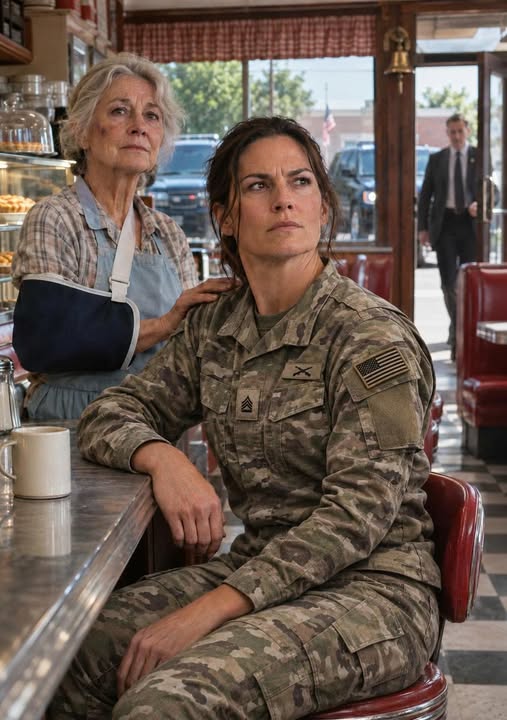
PART 2: THE SHADOW BEHIND THE BADGE
A woman in a charcoal coat entered first.
Her eyes moved across the diner.
Not hurriedly.
Not nervously.
She studied the exits, the customers,
and the man sitting beside the window.
Then she looked directly at me.
Two men followed her inside.
Neither wore a military uniform.
Neither carried himself like a tourist.
The woman approached my table.
“Lieutenant Colonel Turner?”
I stood.
“Special Agent Alicia Moreno,” she said.
“Federal Bureau of Investigation.”
She offered her hand.
Behind her, a broad-shouldered man introduced himself.
“Daniel Mercer. State Bureau of Investigation.”
The third man remained near the entrance.
His name was Thomas Reed.
He was another federal investigator.
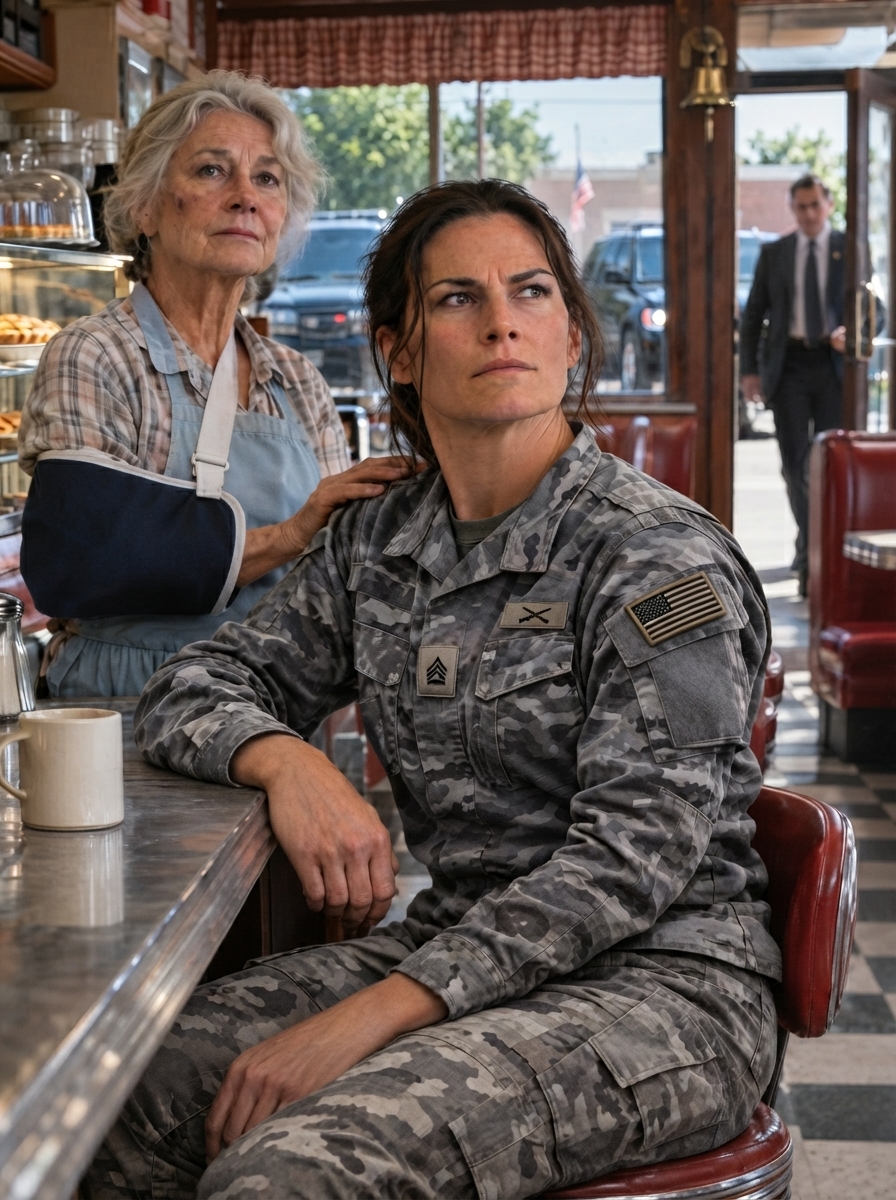
My mother stopped pouring coffee.
For several seconds,
the only sound came from the refrigerator
humming behind the counter.
Then Mom said something I hadn’t expected.
“Oh, Nicole.”
It wasn’t relief.
It was fear.
I walked toward her.
“Mom, they’re here to help.”
She looked at the agents.
Then she looked outside.
Across the street,
a gray pickup sat beside the pharmacy.
Its engine was running.
I had noticed it earlier.
Now I noticed the driver
holding a phone against his ear.
“That’s one of Wade’s men,” Mom whispered.
“He’s been there since yesterday.”
Moreno followed her gaze.
“I see him.”
She said nothing else.
But Agent Reed stepped outside.
The pickup immediately pulled away.
My mother watched it disappear.
“That’s what happens,” she whispered.
“Every time somebody comes asking questions.”
I touched her good shoulder.
“Not this time.”
She gave me a tired look.
“You’ve been gone a long time, sweetheart.”
Those words hurt more than I expected.
Because she was right.
I knew how to assess a threat.
I knew how to lead soldiers.
I knew how to keep calm
when everything around me became uncertain.
But I didn’t know
what six years of fear
had done to the woman
who had raised me.
Moreno placed a small leather folder
on the counter.
“Mrs. Turner, we understand you’ve experienced
a very frightening incident.”
Mom glanced toward the other customers.
“I fell.”
Nobody moved.
Nobody looked up.
Moreno didn’t challenge her.
Instead, she pulled out a chair.
“Would you mind sitting with me?”
My mother hesitated.
Then she slowly lowered herself
into the booth beside the counter.
I remained standing.
Moreno opened the folder.
“We’ve been reviewing several property transactions
in this county,” she explained.
“Transactions involving Cain Realty,
multiple financial institutions,
and several public officials.”
My mother’s expression changed.
“How long?”
“Seven months.”
I felt my jaw tighten.
Seven months.
For seven months,
someone outside this town
had been asking questions
about the same people
who had terrorized my mother.
“Why didn’t anybody come here?” I asked.
Moreno looked at me.
“We did.”
She turned a page.
“Three potential witnesses withdrew their statements.
Two refused further contact.
One moved out of state.”
She paused.
“Another received threats against his grandchildren.”
Mom closed her eyes.
I understood then
why those frightened customers
had stared into their coffee.
This wasn’t simply cowardice.
It was survival.
Moreno continued.
“We had financial irregularities
and suspicious property transfers.
But we needed witnesses
who could connect those transactions
to coercion and official misconduct.”
I looked toward the kitchen.
Kayla was standing just inside the doorway.
She had heard everything.
Her face was pale.
But she didn’t leave.
I raised my hand.
“Kayla.”
She stepped forward.
Moreno turned.
“Are you Kayla Medina?”
Kayla nodded.
“We received your video,” Moreno said.
“Thank you for preserving it.”
Kayla swallowed.
“Is my name going into a report?”
“Your information will be handled carefully.
But I won’t promise absolute secrecy.”
Kayla’s fingers tightened around her apron.
“My little brother is sixteen.”
Moreno waited.
“Travis knows where he goes to school.”
The words hung between us.
My mother reached for Kayla’s hand.
“Baby, you didn’t have to do this.”
Kayla shook her head.
“Yes, I did.”
Her voice trembled.
“I watched him hurt you.”
She looked at me.
“And I watched everyone pretend
it didn’t happen.”
Moreno closed the folder.
“We can discuss protective arrangements
and document any additional threats.”
Then she said something
that changed the atmosphere completely.
“But before we proceed,
there’s something you should understand.
The Cains may already know
that somebody has been talking.”
A bell rang above the entrance.
All four of us turned.
Travis Cain walked inside.
He wore a cream-colored jacket,
expensive boots,
and the same crooked smile
I had watched twelve times
on Carol’s recording.
He stopped when he saw the strangers.
His smile disappeared.
Only briefly.
Then it returned.
“Well,” he said.
“Looks like breakfast got interesting.”
He walked toward the counter.
My mother went rigid.
I saw her good hand
press against the edge
of the booth.
Travis noticed.
And smiled wider.
“Morning, Evelyn.”
She said nothing.
He glanced at her sling.
“Shoulder still bothering you?”
I took one step forward.
Moreno lifted her hand slightly.
Not to command me.
To remind me.
We needed him talking.
Travis looked at me.
“And you must be Nicole.”
I didn’t answer immediately.
He studied my sweatshirt.
“Your mother mentioned you.”
He laughed.
“Something about being in the Army.”
I met his eyes.
“That’s right.”
“Well, thank you for your service.”
The words were polite.
His expression wasn’t.
Then he leaned over the counter.
“Tell your mother
she can avoid more accidents
by signing the papers.”
My mother inhaled sharply.
I heard Kayla whisper my name.
Moreno stood.
“Mr. Cain?”
Travis turned.
“Who’s asking?”
“Special Agent Alicia Moreno. FBI.”
For the first time,
his face genuinely changed.
The confidence didn’t disappear.
But something underneath it shifted.
His eyes moved toward the door.
Then toward the windows.
Finally, he looked at me again.
“You called the feds?”
I said nothing.
Moreno answered.
“We’re conducting an investigation.
I’d like to speak with you.”
Travis laughed once.
“About a waitress falling down?”
“About several matters.”
“Talk to my attorney.”
“That’s certainly your right.”
He stepped backward.
Then pointed toward my mother.
“This place has a lot of problems.”
He looked around the diner.
“Old wiring. Fire violations.
Health concerns.”
His smile returned.
“Wouldn’t surprise me
if somebody shut it down.”
I moved closer.
“You finished?”
He looked directly into my eyes.
“Do you know who my father is?”
“Yes.”
“And you know what he owns?”
“Some buildings.”
His smile hardened.
“Half this town.”
I shook my head.
“People aren’t buildings, Travis.”
A few customers looked up.
He stepped closer.
“You think that uniform makes you important?”
“I’m not wearing a uniform.”
“Maybe you should.”
He leaned forward.
“Then people could see
who they’re supposed to salute.”
I kept my voice quiet.
“You have something backward.”
He frowned.
“What’s that?”
“Authority doesn’t mean
people are supposed to fear you.”
For a moment,
we stood inches apart.
Then Moreno spoke.
“Mr. Cain, I suggest you leave.”
Travis turned toward her.
“Am I under arrest?”
“No.”
“Then this conversation is over.”
He looked at my mother again.
“Tell Wade about the paperwork.”
He smiled at me.
“Enjoy your visit home, soldier.”
Then he walked outside.
The bell rang behind him.
Nobody spoke.
Until Mom whispered,
“He’s going to make us pay.”
I sat beside her.
“Then we make sure
he can’t do it again.”
She shook her head.
“You don’t understand.”
I took her hand.
“Then help me understand.”
She stared at the door.
And began crying.
It was the first time
I’d seen my mother cry
since we buried my father.
Not at the hospital.
Not when her shoulder hurt.
Not even when I arrived home.
But in that booth,
surrounded by the photographs
of happier decades,
she finally broke.
“I’m tired, Nicole.”
I wrapped my arms around her carefully.
“I’m so tired of being afraid.”
I held her.
And I didn’t say
that everything would be fine.
Because I wasn’t certain.
Instead, I promised something
I knew I could keep.
“You won’t face them alone anymore.”
By lunchtime,
half the town knew
federal investigators had visited the diner.
By two o’clock,
someone had posted photographs
of the black SUVs online.
And by three,
Sheriff Don Harper
was standing on my mother’s porch.
He didn’t come alone.
A deputy stood beside his cruiser.
Harper carried a thick manila envelope.
He was sixty-two,
with thinning gray hair,
a heavy stomach,
and a weathered face
that had once looked trustworthy.
When I was fourteen,
he had helped my father
fix a broken fence.
When I was seventeen,
he’d congratulated me
on my military scholarship.
At my father’s funeral,
he carried a corner of the casket.
Now he stood at our doorway
holding papers
that would have destroyed my mother.
“Afternoon, Evelyn.”
Mom stayed behind me.
“What do you want, Don?”
He raised the envelope.
“Just tying up loose ends.”
I didn’t move.
“What kind of loose ends?”
He looked irritated.
“Official business.”
“Then identify the purpose.”
His eyes narrowed.
“Nicole, I’ve known you
since you were knee-high.”
“And you’ve known my mother longer.”
“That’s right.”
“Then you know she was assaulted.”
He sighed.
“Not this again.”
He looked past me.
“Evelyn, I need your signature
on the final incident statement.”
My mother whispered,
“What statement?”
He pulled out a document.
“Confirms there was no criminal conduct.
Just an unfortunate accident.”
I reached for the paper.
He pulled it back.
“This concerns your mother.”
“Then let her read it.”
Harper looked at me.
“You’re making this difficult.”
I held out my hand.
He hesitated.
Then passed it over.
The document was three pages.
My mother was expected to certify
that she had lost her balance,
fallen without assistance,
and suffered injuries
through her own carelessness.
The final paragraph
was far worse.
It stated that
she had no reason to believe
any employee or representative
of Cain Realty
had contributed to her injuries.
I looked at the signature line.
Her name was already typed.
Beside it,
someone had entered yesterday’s date.
I held the paper up.
“Why is this backdated?”
Harper’s face reddened.
“Clerical error.”
“Who prepared it?”
“County office.”
“Which employee?”
“Nicole.”
“Who?”
He lowered his voice.
“I suggest you remember
who runs this county.”
I looked at him steadily.
“That’s an interesting thing
for an elected sheriff to say.”
He stepped closer.
“You’re not on your base now.”
“No,” I replied.
“I’m in my mother’s house.”
He stared at me.
Then turned toward Evelyn.
“Your daughter has no idea
how things work around here.”
Mom’s voice came out thin.
“I know how they work.”
Something moved across Harper’s face.
I recognized it immediately.
Concern.
Not for her.
For himself.
He folded the remaining papers.
“Fine. Have it your way.”
He walked toward his cruiser.
But at the porch steps,
he stopped.
“Nicole.”
I waited.
“Your father was a stubborn man too.”
The air seemed to change.
Harper looked directly at me.
“Stubbornness doesn’t always end well.”
Then he climbed into the cruiser.
I watched him drive away.
My mother remained behind me.
Her breathing had become shallow.
I turned.
“Mom?”
She was staring at the road.
Her lips were trembling.
“That’s what he said to Thomas.”
I felt my stomach tighten.
“When?”
She looked at me.
“Three days before your father died.”
I closed the door.
And for the first time
since coming home,
I knew the assault
wasn’t the beginning of this story.
It was the continuation
of something that had started
six years earlier.
That evening,
I drove to Carol’s house.
Carol Sutton lived two doors down.
She had been my mother’s closest friend
for almost thirty years.
Her little blue house
smelled of cinnamon,
old books,
and fresh coffee.
She invited me inside
without asking why I’d come.
“I figured you’d show up.”
She locked the door.
Then closed the curtains.
I noticed.
“So it’s that bad?”
Carol gave a bitter laugh.
“Sweetheart, it’s worse.”
She brought me into the kitchen.
Three cups sat on the table.
One belonged to her.
The second was mine.
The third belonged
to a man I hadn’t seen
in nearly twenty years.
“Eddie Medina.”
He stood slowly.
His hair had gone almost white.
He wore a faded work jacket.
One hand rested on a cane.
Eddie had once worked
as a deputy under Sheriff Harper.
He was also Kayla’s uncle.
“Hello, Nicole.”
I shook his hand.
“Kayla told you?”
He nodded.
“She showed me what she recorded.”
His eyes dropped.
“I’m proud of that girl.”
Carol pulled out a chair.
“Sit down.”
I did.
Eddie remained standing.
He looked toward the kitchen window.
Then took a folded photograph
from his jacket.
“Do you recognize this?”
He placed it on the table.
The picture showed my father’s truck.
A dark green Chevrolet.
Parked beside the diner.
My father stood near the driver’s door,
wearing his old brown jacket.
He was smiling.
I swallowed.
“That’s Dad.”
Eddie nodded.
“Taken six days before he died.”
I studied it.
Behind my father,
standing beside a black SUV,
were two men.
Wade Cain.
And Sheriff Harper.
Wade was holding a rolled document.
Harper was pointing toward my father.
“What were they arguing about?”
Eddie sat down.
“The county wanted the Turner property.”
“I know.”
“No.”
He shook his head.
“You know what they told Evelyn.”
I leaned forward.
“What’s the difference?”
Eddie exchanged a glance with Carol.
Then he spoke carefully.
“Your father discovered
something about the land transfers.”
“What?”
“Not just the sales.”
He tapped the photograph.
“The way the county
was changing ownership records.”
I thought about the thirty families.
The tax liens.
The failed inspections.
The complaints dismissed by Harper.
“They were forcing people to sell.”
“Yes.”
“But that’s not all.”
Eddie took a breath.
“Some parcels were listed
as environmentally damaged or flood-prone.
Then, after Cain Realty purchased them,
the county changed the classifications.”
I frowned.
“To increase their value?”
“Exactly.”
Carol reached for her coffee.
“The family who owned Miller Farm
was told they couldn’t rebuild
because the land was unsafe.”
Eddie nodded.
“Cains bought it cheap.
Six months later,
the county approved a commercial development.”
I leaned back.
“Who signed the assessment changes?”
“Mayor Brooks approved the planning process.
County offices issued the underlying records.”
“And Harper?”
Eddie stared at the photograph.
“He made sure people cooperated.”
I looked from one face to the other.
“How?”
Carol answered.
“Threats.”
Eddie added,
“Traffic stops. Property inspections.
Missing equipment.
Unexplained damage.”
He looked at me.
“Sometimes people got hurt.”
I remembered the video
of Mom hitting the floor.
“And nobody reported it?”
Eddie’s expression darkened.
“They did.”
“What happened?”
“The reports disappeared.”
He reached into his jacket again.
This time,
he pulled out a smaller envelope.
Inside was a photocopy
of a handwritten incident report.
The date caught my attention.
Six years earlier.
Two days before Dad’s crash.
The complainant was Thomas Turner.
The report described
an attempted forced entry
at the diner after closing.
Two men had threatened him.
One carried a tire iron.
Dad had identified one
as a Cain Realty employee.
My hands grew cold.
“Why wasn’t this investigated?”
Eddie looked away.
“Because Harper told me
to destroy the original.”
I stared at him.
“And you did?”
He nodded.
“I was still a deputy.”
The kitchen became painfully quiet.
Eddie’s face twisted.
“I had two children.
A mortgage.
My wife was sick.”
I didn’t answer.
He swallowed.
“That’s not an excuse.”
“No,” I said.
“It isn’t.”
He lowered his head.
“I made a copy.
I thought that would be enough.”
My voice hardened.
“It wasn’t enough for my father.”
Carol reached toward me.
I pulled my hand away.
Eddie didn’t defend himself.
He simply nodded.
“You’re right.”
I stood.
“Why are you telling me now?”
He looked up.
“Because Kayla showed me that video.”
His voice cracked.
“And all I could think about
was your father.”
I waited.
Eddie wiped his eyes.
“He came into the station
the night before he died.
He asked me to keep a file.”
“What file?”
“A folder of surveys and county records.”
My pulse quickened.
“Where is it?”
Eddie shook his head.
“I never got it.”
“Why?”
“Because Harper walked into the room.”
He looked at Carol.
Then back at me.
“Thomas stopped talking.
He told me he’d come back
when the sheriff wasn’t there.”
Eddie took a breath.
“He never came back.”
I stared at the photograph.
Dad had spent his life
teaching me that courage
wasn’t the absence of fear.
It was deciding
what mattered more than fear.
And six years ago,
he’d walked into that sheriff’s office
knowing something was terribly wrong.
He’d trusted Eddie.
He’d trusted the law.
He’d trusted a town
that had known him for decades.
And all three had failed him.
“There’s something else,” Eddie said.
I looked up.
“What?”
“The night of the crash,
Harper wasn’t where his report says.”
I gripped the chair.
“Explain.”
“His official log shows him
at a domestic disturbance
on the other side of town.”
“And?”
“That call never happened.”
I stared at him.
“How do you know?”
“Because I was on duty.
And Harper had ordered
the dispatcher to mark him unavailable.”
The room seemed suddenly smaller.
“Where was he?”
Eddie looked at me.
“On Route 9.”
I didn’t speak.
Eddie continued.
“I heard him over the radio
before your father’s accident was reported.”
“What did he say?”
Eddie closed his eyes.
“He told somebody
the road needed to stay clear.”
My mouth went dry.
“Stay clear for what?”
“He didn’t say.”
Carol placed her hand
over Eddie’s shaking fingers.
He looked at me.
“But ten minutes later,
we got the crash call.”
For several seconds,
I heard nothing
except the old refrigerator humming.
Then I asked,
“Why didn’t you report this?”
Eddie’s face collapsed.
“I tried.”
“To whom?”
“The state.”
He shook his head.
“I called the regional office.
Two days later,
Harper called me into his office.”
“What happened?”
“He knew every word I’d said.”
Carol spoke softly.
“Eddie was dismissed that afternoon.”
Eddie nodded.
“Misconduct. Failure to follow procedures.”
He held up his cane.
“Two weeks later,
somebody ran me off the highway.”
I stared at his leg.
“That wasn’t a work accident?”
He shook his head.
“No.”
I felt something dangerous rising inside me.
Not panic.
Not confusion.
Anger.
A cold, precise anger
that made every detail
suddenly appear sharper.
I had spent twenty years
learning the difference
between anger and action.
Anger could destroy judgment.
Action required it.
I sat down again.
“Eddie, I need everything you remember.”
He nodded.
“And I need you to tell
the investigators directly.”
His eyes widened.
“Harper still has friends everywhere.”
“I know.”
“My daughter lives here.”
“I know.”
He looked frightened.
I leaned closer.
“But the people investigating this
aren’t under Harper’s command.”
Eddie swallowed.
“Can they protect my family?”
“I’ll ask them
what protection they can actually provide.
I won’t promise what I can’t guarantee.”
He stared at me.
Then slowly nodded.
“All right.”
Carol reached beneath the table.
She brought out an old cardboard box.
“There’s more.”
Inside were newspaper clippings,
photographs,
and handwritten notes.
Carol had been collecting them
for nearly five years.
Every threatened family.
Every suspicious fire.
Every foreclosure.
Every property sold
far below its assessed value.
She had kept track
because she was afraid
someone would eventually destroy the records.
I lifted a photograph.
It showed the Miller family farmhouse.
Its roof had burned.
The newspaper headline called it
an electrical accident.
I looked at Carol.
“Was it?”
She shook her head.
“The fire inspector said so.”
“Who appointed him?”
“Mayor Brooks.”
I placed the photograph down.
And opened the next folder.
There were fourteen more.
By midnight,
I understood something fundamental.
Wade Cain didn’t own the town
because he was wealthy.
He was wealthy
because he had taught the town
that resisting him
was more expensive than surrendering.
And the people entrusted
with protecting those residents
had helped enforce the lesson.
The following morning,
I met with Agent Moreno
and an attorney named Grace Holloway.
Grace practiced two counties away.
She was forty-eight,
with sharp eyes,
a calm voice,
and no interest in impressing powerful men.
She had represented three families
who lost property to Cain Realty.
“Nobody wanted those cases,” she told me.
“Why not?”
“Because fighting the Cains
costs more than most people own.”
We sat in her office.
The desk held organized files,
a chipped coffee mug,
and a small photograph
of two teenage daughters.
I showed her the documents
Harper had brought to Mom’s house.
She read them twice.
Then set them down carefully.
“This statement is dangerous.”
“Because it’s false?”
“Because they tried to create
a signed denial of criminal conduct.”
She pointed to the date.
“And they wanted it to appear
your mother had already agreed.”
Moreno studied the signature line.
“Who prepared it?”
“Harper wouldn’t say.”
Grace looked at her.
“We’ll seek preservation of county records.
I’ll also request the sheriff’s office
produce the document’s drafting history.”
I leaned forward.
“What about the diner?”
Grace took another folder.
“That’s our immediate problem.”
She slid it toward me.
Inside was a notice.
The county inspection office
had scheduled a comprehensive building review.
Electrical.
Fire.
Food safety.
Structural condition.
All four inspections
were scheduled for the same afternoon.
“Can they do that?”
“They can conduct legitimate inspections.”
She paused.
“But this timing raises serious concerns.”
“When?”
“Friday.”
Three days away.
Grace continued.
“They’re also considering
whether the rear parcel
qualifies for compulsory acquisition
under a proposed infrastructure plan.”
I stared at her.
“Through eminent domain?”
“That’s what they’re threatening.”
“For what project?”
She opened another page.
“Riverbend Commercial Access Corridor.”
The name meant nothing to me.
Grace brought out a map.
A thick red line
crossed several parcels of land.
It ran behind the old mill,
through Miller Farm,
past the highway interchange,
and directly through
the narrow strip behind our diner.
I recognized the land.
My father used to walk there
every Sunday afternoon.
He called it
the quietest acre in the county.
“What is the corridor?”
“An access road for a commercial complex.
Warehouses, freight distribution,
and a proposed industrial processing facility.”
“Who owns the development company?”
Grace gave me a grim smile.
“Cain Holdings.”
Of course.
She turned another page.
“The county applied for funding
under a regional infrastructure program.
The application includes federal grant money.”
Moreno leaned closer.
“That’s one of the financial transactions
our team has been examining.”
I looked at the map.
Thirty families.
Thirty pressured sales.
And one remaining property.
Our property.
“Mom’s land is the missing piece.”
Grace nodded.
“Without a lawful access arrangement,
the current plan becomes much harder.”
I looked at Moreno.
“And Wade knows it.”
“Yes.”
“Then he’s running out of time.”
Grace nodded.
“The county planning board
meets next Tuesday.”
I studied the notice.
“If Mom signs,
they get their corridor.”
“Possibly,” Grace said.
“But a signed sale isn’t the only route
they’re preparing.”
She placed another document before me.
It contained a proposed valuation.
Mom’s diner,
the surrounding property,
and the rear strip
had been assigned a total value
far below their legitimate market worth.
“Who calculated this?”
“The county assessor’s office.”
I recognized the name.
The same office
that had called my father uncooperative.
Beneath the valuation,
someone had typed a sentence.
“Owner’s refusal creates public safety concerns.”
I read it twice.
Then I remembered
the handwritten note
from my father’s file.
Escalation recommended.
The same language.
The same pattern.
Only this time,
they were targeting my mother.
Grace looked at me.
“Nicole, before we proceed,
I need you to understand something.”
I nodded.
“Your military career
does not give you authority
over these civilians or officials.”
“I know.”
“And using military resources
for a private dispute
could create serious problems.”
“I haven’t.”
She watched me.
“My leave was approved.
I’ve contacted investigators as a witness.
I haven’t issued orders,
requested military intervention,
or represented this as Army business.”
Moreno nodded.
“That’s important.”
I looked at both women.
“I don’t need a uniform
to protect my mother lawfully.”
Grace gave a small smile.
“Good.”
Then she closed the folder.
“Because we’re going to win this
with evidence,
not intimidation.”
That afternoon,
Mom and I returned to the diner.
She insisted on making coffee herself.
I offered to help.
She refused.
“You never made it strong enough.”
I laughed despite myself.
“Mom, I commanded hundreds of soldiers.”
“And you still made terrible coffee.”
For one brief moment,
the room felt normal.
The bell above the door jingled.
An elderly man entered.
Mr. Walter Price.
He had eaten breakfast
at our diner for thirty years.
He removed his cap.
“Evelyn.”
Mom smiled weakly.
“Morning, Walter.”
He sat at his usual booth.
I brought him coffee.
He looked at me.
“Heard you came home.”
“Yes, sir.”
He nodded.
“Your father would be proud.”
The words caught me unexpectedly.
I set down the cup.
“Thank you.”
Walter studied the room.
Then lowered his voice.
“I was here that morning.”
My chest tightened.
“When Travis assaulted Mom?”
He nodded.
“I saw him.”
I pulled out the opposite chair.
“Would you be willing to say that
to an investigator?”
He looked toward the window.
His fingers trembled.
“I’ve got a granddaughter.”
I waited.
“She runs the flower shop
near the courthouse.”
I knew the place.
He continued.
“The Cains own her building.”
I understood.
“Walter, I’m not going to pressure you.”
His eyes filled.
“Your mother gave me free meals
when my wife was dying.”
He looked toward Mom.
“And I sat there
while that boy hurt her.”
He covered his face.
“I’ve never been so ashamed.”
I reached across the table.
“You can still tell the truth.”
He shook his head.
“If she loses that shop,
she loses everything.”
I sat quietly.
Then an idea came.
“Would you speak with an attorney first?
Privately?
To understand the options?”
He looked at me.
“Would that help?”
“It could.”
He stared into his coffee.
Finally,
he nodded.
“All right.”
It wasn’t a public declaration.
It wasn’t a dramatic victory.
But it was the first time
someone who had witnessed the assault
had voluntarily admitted it to me.
And that mattered.
By evening,
Walter had spoken with Grace.
By the next morning,
two more customers
had contacted her office.
One was a retired schoolteacher.
The other owned a repair shop.
Both had witnessed Travis shove Mom.
Both had initially denied it.
And both were frightened.
Grace didn’t promise them immunity
from the consequences of speaking.
But she explained their legal options
and documented their accounts.
For the first time,
the silence around the diner
began developing cracks.
Wade Cain noticed.
On Thursday morning,
a delivery truck refused
to bring groceries.
The driver looked apologetic.
“Management canceled the account.”
Mom frowned.
“Since when?”
“Last night.”
“Who authorized it?”
He wouldn’t answer.
Twenty minutes later,
our bakery supplier called.
They were suspending deliveries
until an outstanding balance was resolved.
Mom stared at the phone.
“We paid them Monday.”
I checked the account.
She had.
The payment had cleared.
Then the insurance company called.
They needed to review
an anonymous complaint
about the diner’s safety.
Mom lowered herself onto a stool.
“He’s doing it again.”
I pulled out my notebook.
“Three incidents in forty minutes.”
She looked exhausted.
“Nicole, you don’t understand.
They can make this last forever.”
I crouched beside her.
“Then we document every incident.”
She shook her head.
“I just want my diner.”
“I know.”
“My husband built that back porch.
He laid those tiles himself.”
I followed her gaze.
The floor near the pie case
had blue-and-white ceramic squares.
Dad installed them
the summer I turned twelve.
He let me place
one crooked tile near the doorway.
It was still there.
Mom continued.
“He worked every weekend
so we could pay the mortgage.”
Her voice cracked.
“And now somebody thinks
they can take it
because they have more money.”
I took her hand.
“They don’t own your memories.”
She looked at me.
“They can still take the building.”
I wanted to tell her no.
But I had learned
that false certainty
wasn’t courage.
So I told her the truth.
“We’re going to fight for it.
And we’re going to do it properly.”
She stared at me.
Then nodded.
“All right.”
That afternoon,
a young woman named Hannah Greer
called Grace’s office.
Hannah had worked
in the county assessor’s department
for eleven years.
She requested a meeting
outside the county.
Grace invited Moreno
and arranged a neutral location.
I wasn’t initially included.
The investigators wanted
to protect the integrity of her statement.
Two hours later,
Moreno called me.
“Nicole, we need to speak.”
I drove to Grace’s office.
Moreno was waiting
with a document folder.
She looked unusually serious.
“Hannah identified several records
that don’t match the official county files.”
I sat down.
“What kind of records?”
“Assessment changes. Tax penalties.
Property-transfer authorizations.”
She opened a document.
“Some were created
after the dates shown on their faces.”
I stared at the page.
“Backdated?”
“That’s what the metadata suggests.”
She turned another.
“And some were altered
after the property owners had already sold.”
I felt my pulse accelerate.
“Why?”
“To make certain acquisitions
appear financially justified.”
She paused.
“There’s also evidence
of payments to county officials
through consulting companies.”
I looked at her.
“Harper?”
“We’re still tracing the funds.”
She held my gaze.
“But Hannah remembered your father.”
I went still.
“Why?”
“He came to her office
about a month before his death.”
“What did he want?”
“Historical survey records.”
I thought of Eddie’s story.
“The folder.”
Moreno nodded.
“Hannah said he was particularly interested
in a drainage map
and an old easement.”
“What easement?”
“One crossing the land
behind Turner’s Family Diner.”
I stared at her.
“Why would that matter?”
“Because the map used
in the current development application
appears inconsistent with
the original county survey.”
I frowned.
“How?”
Moreno studied her notes.
“The modern map shows
a public access corridor
where the historic records
may establish protected drainage land.”
I leaned forward.
“And if it’s protected?”
“Then certain development claims
could be invalid.”
I thought of my father.
All those Sunday walks.
All those evenings
spent examining documents at the counter.
He hadn’t simply refused an offer.
He had found something.
Something powerful enough
to threaten millions of dollars.
“Did Hannah tell Harper?”
Moreno’s expression tightened.
“She said she warned her supervisor
that your father was requesting records.”
“And?”
“Three days later,
the supervisor instructed staff
not to provide further copies.”
My hands curled.
“Who gave the instruction?”
Moreno slid another page forward.
It carried a typed authorization.
At the bottom
was a familiar signature.
Linda Brooks.
The mayor.
I stared at it.
“Hannah kept a copy?”
“She preserved several records.
The original systems are being examined.”
I breathed slowly.
“Does Hannah know what happened to Dad?”
“She doesn’t claim to.”
Moreno paused.
“But she remembers something else.”
I looked up.
“After your father died,
a man came to the assessor’s office
and demanded his visitor records.”
“Who?”
“Sheriff Harper.”
My stomach tightened.
“Was that standard procedure?”
“No.”
She leaned toward me.
“Nicole, I need you
to let us handle that part.”
“I understand.”
“I know you do.”
She studied my face.
“But I’m asking you as someone
who has watched families unravel
while searching for answers.”
I looked away.
For six years,
I had believed my father
lost control of his truck.
I had accepted
the highway patrol report.
I had folded the funeral flag
and placed it in Mom’s bedroom.
I had returned to duty
because there was nothing left to do.
Now every answer
raised a worse question.
And the hardest question
was one I wasn’t ready to ask.
Had my father died
because he refused to surrender?
Or because someone decided
he knew too much?
That evening,
I returned home
to find Mom sitting
at the kitchen table.
She was holding Dad’s photograph.
A small lamp burned beside her.
There were two cups of tea.
One untouched.
She looked up.
“Carol called.”
I sat down.
“What did she say?”
“That you spoke with Eddie.”
I waited.
Mom looked at the photograph.
“I knew he had something.”
My stomach sank.
“Who?”
“Your father.”
She traced the wooden frame.
“Thomas was worried
during those last few weeks.”
“About the property?”
“About all of it.”
She looked at me.
“He kept saying
the maps didn’t make sense.”
I leaned forward.
“What maps?”
“County maps.
He said somebody was changing
where the water was supposed to go.”
I remembered the protected drainage land.
“Did he explain?”
“He tried.”
She gave a sad smile.
“You know your father.
He could talk about surveying lines
until everybody left the room.”
I almost laughed.
He really could.
Dad had studied surveying
before opening the diner.
For years,
he worked part-time
helping local farmers resolve boundaries.
He believed a measured line
was a promise.
That a property owner
should be able to trust
what the county recorded.
And that nobody’s wealth
gave them the right
to move somebody else’s boundary.
“What happened before the crash?” I asked.
Mom looked toward the window.
“He stopped sleeping.”
I waited.
“He kept checking the locks.
He started carrying his old field recorder.”
I went still.
“Field recorder?”
She nodded.
“The little silver one.
He used it to dictate measurements.”
I remembered it immediately.
A small handheld device,
scratched along one side,
with a red recording button.
Dad carried it everywhere
during his surveying days.
“Where is it?”
Mom’s hand tightened around the frame.
She didn’t answer.
“Mom.”
Her eyes filled.
“Please.”
I leaned closer.
“Where’s the recorder?”
She began shaking.
For a moment,
I thought she’d become ill.
I reached for her.
But she pulled away.
Then she whispered,
“I promised him.”
I stared at her.
“Promised him what?”
She closed her eyes.
“That I wouldn’t bring you into this.”
The kitchen seemed to tilt.
“What are you talking about?”
She pressed her lips together.
“Your father knew
how much danger he was in.”
“Then why didn’t he leave?”
“Because he thought
he could prove what they were doing.”
“Who?”
She shook her head.
I felt my voice rise.
“Mom, who?”
She looked at me.
And the fear in her eyes
was unlike anything I’d ever seen.
“Wade.”
I waited.
“And Don Harper.”
I sat back.
She covered her mouth.
“Thomas said they were stealing
from people who couldn’t fight back.”
A tear slipped down her cheek.
“He said if he stayed quiet,
somebody else would get hurt.”
I looked at Dad’s photograph.
“Did he record them?”
Mom began crying harder.
“Yes.”
I couldn’t speak.
For six years,
I’d carried a question
that sometimes woke me at night.
Why had Dad crashed
on a road he knew so well?
I’d told myself
there was no answer.
Sometimes accidents happened.
Sometimes good men died.
Sometimes the world made no sense.
But my mother was telling me
there had been another possibility
all along.
“Where is it?” I asked quietly.
She looked at the kitchen floor.
Then at the hallway.
Finally,
she stood.
“Come with me.”
I followed her
into my father’s old bedroom.
Nothing had changed.
His brown reading chair.
His books.
The fishing photograph
above the dresser.
The same blue quilt
he’d used for twenty years.
Mom walked to the closet.
She reached for
an old wooden toolbox
on the bottom shelf.
It was heavier than I expected.
I carried it to the bed.
She gave me a small key.
“Under the handle.”
I turned the box.
There was a narrow metal compartment.
Dad had built it himself.
I slipped the key inside.
The panel opened.
Inside lay a silver recorder,
a plastic memory card,
and a folded piece of paper.
My hands began trembling.
I lifted the paper first.
It was written
in my father’s handwriting.
Not elegant.
Not perfectly straight.
Just the familiar uneven letters
I’d seen on birthday cards
and diner receipts.
There were only four lines.
Evelyn,
If anything happens,
don’t let Nicole come after them alone.
Make sure she knows
I never stopped fighting for us.
I read it twice.
Then a third time.
My throat closed.
Mom touched my shoulder.
“He wrote that
the afternoon before the accident.”
I stared at her.
“Why didn’t you tell me?”
She lowered herself onto the bed.
“Because a man came here
the morning after the funeral.”
I felt cold.
“Who?”
She shook her head.
“He didn’t give his name.”
“What did he want?”
“He said Thomas had made enemies.”
I waited.
“He said your military career
could be damaged
if you started asking questions.”
My breath caught.
Mom continued.
“He knew where you were stationed.
He knew your rank.
He knew you were deployed.”
She looked at me.
“He even knew
the name of your commanding officer.”
I crouched in front of her.
“Mom, those details don’t make threats legitimate.”
“I know that now.”
Her voice broke.
“But your father was dead.”
She gripped my hand.
“And I couldn’t lose you too.”
I looked at the recorder.
“Did you listen to it?”
She nodded.
“Once.”
“What did you hear?”
She shook her head.
“I couldn’t finish.”
I looked down.
The recorder was old.
Its screen was scratched.
The battery compartment
had a little piece of tape
holding the cover in place.
I remembered Dad
slapping that cover
whenever it stopped working.
For one terrible second,
I could almost hear him laughing.
I pressed the power button.
Nothing happened.
Mom whispered,
“It hasn’t worked for years.”
I examined the memory card.
Then carefully put it aside.
“This may still hold the files.”
She looked at me.
“Can you get them?”
“I’ll ask Moreno
to have it examined properly.”
I didn’t play with the card.
Didn’t connect it to my laptop.
Didn’t risk altering anything.
Instead, I photographed the compartment,
the recorder,
the handwritten note,
and the position of every item.
I made a record
of when Mom handed them to me.
Then I called Agent Moreno.
She arrived forty minutes later.
This time,
she brought an evidence technician.
They documented the items,
placed them in separate evidence packaging,
and asked my mother
to describe exactly
how she had found them.
Mom answered slowly.
Sometimes she stopped.
Sometimes she cried.
But she kept answering.
When Moreno finished,
she sat beside her.
“Mrs. Turner, you did the right thing
by telling us now.”
Mom stared at her hands.
“I should have told somebody sooner.”
Moreno didn’t offer easy forgiveness.
She simply said,
“You can still help establish the truth.”
And somehow,
that seemed to matter more.
The next morning,
the inspection notices arrived.
Four county vehicles
pulled into the diner’s parking lot.
Two inspectors stepped out.
A fire official followed.
Then a man in a suit.
He introduced himself
as County Administrator Peter Lang.
He looked at the cracked pavement
before addressing my mother.
“Mrs. Turner, we’re conducting
an urgent compliance review.”
Grace Holloway was already waiting.
“Then we’ll need
the legal authority for each inspection.”
Lang blinked.
“And you are?”
“Counsel for Mrs. Turner.”
He gave a forced smile.
“Well, that complicates things.”
Grace didn’t smile back.
“Only if the process was improper.”
The inspectors exchanged looks.
The fire official
opened his clipboard.
“We’ve received several complaints.”
Grace nodded.
“Please identify the relevant regulations
and the areas you need to inspect.”
They spent two hours
examining the diner.
Every refrigerator.
Every outlet.
Every emergency exit.
Every storage shelf.
I watched without interfering.
Mom sat beside the window,
her sling resting against her chest.
Kayla brought her tea.
When an inspector opened
the kitchen storage room,
Mom flinched.
I sat beside her.
“They can look,” I whispered.
“We’ve got nothing to hide.”
She nodded.
But her face remained pale.
At eleven thirty,
the fire official announced
that the kitchen’s rear exit
needed a closer inspection.
Grace approached.
“What specific defect?”
He pointed toward the door.
“Possible obstruction.”
The door was clear.
The path beyond it was clear.
The emergency lighting worked.
Grace photographed everything.
“Please document the obstruction
you’re referring to.”
The official looked at Lang.
Lang said nothing.
The inspector finally closed his clipboard.
“We’ll note that further review is required.”
Grace nodded.
“And we’ll be requesting copies
of every report.”
By noon,
the inspectors left
without closing the diner.
It was a small victory.
But Mom sat perfectly still
for nearly five minutes afterward.
Then she asked,
“Are they really gone?”
I looked outside.
“Yes.”
She exhaled.
Kayla walked toward us.
“I made pie.”
Mom looked at her.
“What kind?”
“Apple.”
Mom smiled faintly.
“Too much cinnamon?”
“Probably.”
For the first time that week,
they both laughed.
I wanted to preserve that moment.
The sound of laughter.
The smell of apple pie.
The late morning sunlight
touching the chrome napkin holders.
For a few minutes,
the diner felt like
the place I remembered.
Then my phone rang.
It was Grace.
“Nicole, are you somewhere private?”
I stepped into the kitchen.
“Yes.”
“We’ve received the preliminary records
for your father’s accident.”
My heart accelerated.
“And?”
“There are inconsistencies.”
“What kind?”
“The original incident timeline
doesn’t match the later report.”
I gripped the counter.
“Explain.”
“The first logged call
about a disabled vehicle
on Route 9
came twenty-six minutes
before the reported crash.”
I stared at the wall.
“Disabled vehicle?”
“Yes.”
“The report said Dad
lost control while driving.”
“I know.”
I closed my eyes.
Grace continued.
“There’s a record
of a road-service request.
It refers to a green pickup
with a possible mechanical problem.”
Dad’s truck.
“Who made the call?”
“We’re trying to establish that.”
I forced myself to breathe.
“Was Harper involved?”
“His unit identifier appears
in a related dispatch entry.”
I looked toward the dining room.
Mom was smiling at Kayla.
I couldn’t bear
to imagine telling her
that the last six years
might have been built
on a deliberate lie.
Grace lowered her voice.
“Nicole, there’s one more thing.”
I waited.
“The crash investigation lists
a witness who supposedly saw
your father’s vehicle leave the road.”
“Who?”
She hesitated.
“Travis Cain.”
I couldn’t move.
“Travis?”
“Yes.”
“How old was he then?”
“Twenty-five.”
I pressed my free hand
against the counter.
“Why was he there?”
“The report doesn’t explain.”
I thought about the man
who’d shoved my mother.
The smile.
The casual cruelty.
The certainty
that nobody could touch him.
And now his name
appeared in the file
that explained my father’s death.
I looked toward the dining room.
Mom was still laughing softly.
I couldn’t tell her yet.
Not until I had something certain.
Not until I understood
what exactly had happened
on Route 9.
That evening,
Agent Moreno called again.
The recorder’s memory card
had been examined.
The original files
were being preserved.
Several recordings remained readable.
She asked Mom and me
to come to the regional field office.
We drove there after sunset.
Neither of us spoke much.
The road passed through farmland,
low hills,
and scattered houses
where porch lights glowed
against the approaching darkness.
Mom held Dad’s note in her lap.
She’d insisted on bringing a copy.
At the field office,
Moreno led us
into a small interview room.
A computer sat on the table.
Beside it stood
an evidence technician named Sarah Chen.
Moreno looked at my mother.
“Mrs. Turner, you can stop at any time.”
Mom nodded.
“I want to hear it.”
Chen explained
that several recordings
contained ordinary surveying notes.
Distances.
Boundary descriptions.
Dates.
Dad’s voice sounded younger
than I remembered.
Hearing him again
hurt in a way
I hadn’t prepared for.
“North boundary marker,
approximately seventeen feet
from the drainage culvert.”
His familiar voice
filled the small room.
I pressed my lips together.
Mom closed her eyes.
Then another file began.
There was wind.
Passing traffic.
And the sound
of my father breathing.
He spoke quietly.
“October seventeenth.
Nine forty-two in the morning.
Meeting with Wade Cain
regarding the Turner parcel.”
A car door slammed.
Then I heard another voice.
Wade Cain.
“Tom, this doesn’t need to be ugly.”
Dad answered calmly.
“Then stop trying to take my property.”
Wade laughed.
“You don’t understand
what’s at stake.”
“I understand perfectly.”
“Millions of dollars.”
“And a creek full of families
who don’t know
what you’ve buried upstream.”
My blood went cold.
Buried?
Moreno glanced at me.
The recording continued.
Wade’s voice sharpened.
“Keep your voice down.”
Dad answered,
“You altered the flood maps.”
“Watch yourself.”
“And those soil reports
don’t match the samples
taken before your company bought the land.”
There was a pause.
Then Wade said,
“You’ve been asking dangerous questions.”
Dad didn’t retreat.
“I’ve been asking honest ones.”
I felt tears gathering.
That was my father.
Stubborn.
Principled.
A man who believed
truth should be enough.
Wade spoke again.
“Sell the land, Tom.”
“No.”
“Take the money.”
“No.”
“You have a daughter.”
My mother gasped.
I reached for her hand.
Wade continued.
“She’s made quite a career
for herself in the military.”
Dad’s voice changed.
“Leave Nicole out of this.”
“Then stop making problems.”
A car door opened.
The recording crackled.
Dad said,
“If anything happens to my family,
I’m taking this to the state.”
Wade laughed softly.
“You still think
the state will save you?”
Then the recording ended.
Mom began crying.
I held her hand.
Across the table,
Moreno looked grim.
“There’s another recording,” she said.
I looked up.
“When?”
“Three weeks later.”
My breath caught.
“That’s the night Dad died.”
Moreno nodded.
The technician glanced at her.
Then selected the file.
A timestamp appeared.
October eighth.
Eight fifty-seven p.m.
The room became utterly quiet.
At first,
all I heard was road noise.
Then the recorder picked up
my father’s voice.
“Route 9.
Pulled over near the old mill.”
A vehicle approached.
Gravel shifted beneath tires.
A door slammed.
My father spoke again.
“Don?”
I gripped Mom’s hand.
Sheriff Harper answered.
“Evening, Tom.”
“What are you doing out here?”
“Checking on a friend.”
Dad’s voice hardened.
“Where’s Wade?”
There was a pause.
Then another voice spoke.
“Right here.”
Wade Cain.
My mother made a broken sound.
I stared at the computer.
Wade continued.
“We gave you every opportunity.”
Dad answered,
“I already sent copies.”
Silence.
Then Harper said,
“To whom?”
Dad didn’t answer.
Harper’s voice rose.
“Thomas, who has those records?”
Dad said,
“Somebody you can’t threaten.”
A scrape sounded.
Then something heavy struck metal.
Mom squeezed my hand so hard
that her fingers hurt.
Wade spoke again.
“You should’ve taken the money.”
Dad answered,
“You should’ve left those families alone.”
Another metallic sound.
A car door slammed.
Then Harper said something
I will remember
for the rest of my life.
“Make sure the steering fails
before the next bend.”
My mother screamed.
Chen stopped the recording.
For several seconds,
nobody moved.
I stared at the silent computer.
My father hadn’t lost control
because he was careless.
He hadn’t simply
driven too fast.
He had been stopped
on a lonely road
by men he knew.
Men who had helped bury him.
Men who had stood beside us
at his funeral.
I felt the room closing in.
Moreno reached toward me.
“Nicole.”
I couldn’t answer.
She spoke gently.
“We need to continue documenting this.
It may be crucial evidence.”
I nodded.
Then Mom whispered,
“Play the rest.”
Moreno looked at her.
“Are you sure?”
Mom wiped her face.
“Please.”
Chen resumed the file.
We heard an engine start.
Then my father’s voice.
Fainter now.
He was breathing hard.
There was another car door.
Someone spoke.
It was Travis.
I recognized his laugh immediately.
“He’s still got that recorder.”
My stomach turned.
Wade answered,
“Find it.”
There was movement.
Footsteps.
The sound of a struggle.
Then Harper spoke.
“Leave it. We don’t have time.”
Travis said,
“What if somebody finds it?”
Wade replied,
“Then they’ll find themselves
in the same position.”
I felt my mother trembling beside me.
The recording crackled again.
And Wade Cain said
the words that explained
why my mother
had spent six years
terrified of telling me the truth.
“If Nicole Turner ever comes home
looking for answers,
we bury the daughter
right beside the father.”