My lawyer, a kind man named Thomas Reed, had been assigned to me through a legal assistance organization.
He was in his early forties, wore inexpensive suits, and had the habit of rubbing his forehead whenever he was thinking.
During our first meeting, he asked me the same question three times.
“Mrs. Keller, are you absolutely certain you never touched Mr. Haller?”
“Absolutely.”
“Not his arm? His shoulder? His clothing?”
“No.”
“Did you threaten him?”
“No.”
“Did you call him a kidnapper?”
“I told him I was concerned because the little girl said he wasn’t her father.”
Thomas closed his notebook.
“Then why is he claiming you assaulted him?”
“Because he wants money.”
Thomas looked at me for a moment.
“That’s what I suspect, too. But suspicion isn’t evidence.”
I nodded.
He leaned forward.
“There’s something else. The store has provided a statement from your former manager. He says you behaved aggressively, blocked the exit, and frightened the child.”
I felt my stomach tighten.
“Mr. Darby saw what happened. He knows I didn’t frighten that little girl.”
“He’s saying you caused a disturbance.”
I looked down at my hands.
Nine years.
Nine years of opening doors, helping elderly customers, finding lost children, and picking up abandoned shopping carts.
Nine years of remembering which little boy liked dinosaur stickers and which little girl always wanted two smiley faces instead of one.
And now, the store had decided I was a liability.
“Does the police report help?” I asked.
Thomas opened another folder.
“It helps. But there’s a problem.”
“What problem?”
“The report confirms that you called 911. It also confirms that officers located the vehicle you photographed. But it doesn’t establish that Mr. Haller committed a crime.”
“Did they find the little girl?”
He hesitated.
“Yes.”
I sat straighter.
“Was she safe?”
“She was placed with child protective services temporarily while authorities investigated.”
I covered my mouth.
“Thank God.”
Thomas continued.
“There’s an investigation involving a woman named Patricia Corliss. Apparently, she was caring for Quinn that afternoon.”
“That’s the woman Quinn mentioned.”
“Yes. The police have been trying to establish exactly what happened.”
I felt a little hope.
“Then surely the lawsuit will go away.”
Thomas didn’t answer immediately.
“I hope so, Mrs. Keller. But I need you to understand something. Even if you were right to be concerned, the court still has to decide whether your actions were reasonable.”
I nodded.
I understood.
I had spent enough years dealing with people to know that doing the right thing didn’t always make you popular.
Sometimes it made you inconvenient.
And sometimes it made you a target.
The months passed.
I sold my old sewing machine.
I stopped going to restaurants.
I canceled the little trip I’d planned to visit my sister in Oklahoma.
My daughter, Elaine, called every Sunday.
“Mom, please stop worrying. We’ll figure this out.”
“With what money, sweetheart?”
“We’ll figure it out.”
She lived three hours away and had two children of her own. I didn’t want her worrying about me.
One evening, she came to visit.
She found me sitting at the kitchen table, sorting through a box of old photographs.
There was one photograph of me wearing my store uniform. I was smiling, holding a little boy who had just received a sticker.
Elaine picked it up.
“You loved that job.”
“I did.”
“Then why do you look so sad?”
I put the photograph down.
“Because I don’t know if being a good person was worth losing everything.”
Elaine sat beside me.
“Mom, you know what you did.”
“Knowing doesn’t pay a lawyer.”
She reached over and held my hand.
“That little girl might be alive today because you paid attention.”
I looked toward the window.
Outside, a neighbor’s child was riding a bicycle.
“I hope she’s all right,” I whispered.
October arrived.
The courthouse smelled of old wood, paper, and floor polish.
I wore my navy-blue dress, the one Elaine had bought me for my retirement party.
My hands shook as I walked into the courtroom.
Wayne Haller was already there.
He wore an expensive gray suit. His hair was neatly combed, and he sat beside a lawyer who looked as though he’d never lost an argument in his life.
Wayne glanced at me.
Then he smiled.
Not a friendly smile.
A smile that said he believed the whole thing was already over.
His attorney stood and approached Thomas.
“Mrs. Keller,” he said politely, “my client would still consider settling this matter.”
I looked at him.
“How much?”
“One hundred thousand dollars. In exchange for a public apology and a confidentiality agreement.”
I almost laughed.
“Your client is suing me for a quarter of a million dollars, and you want me to apologize for something I didn’t do?”
“It’s an opportunity to avoid further embarrassment.”
I looked at Wayne.
He was watching me.
“No,” I said.
The attorney shrugged.
“Then we’ll proceed.”
Thomas touched my elbow.
“Don’t engage with them.”
I sat down.
The judge entered.
Everyone stood.
The clerk announced the case.
Wayne Haller versus Mavis Keller.
The first hour was devoted to procedural matters.
Then Wayne’s lawyer began his opening statement.
He described me as an elderly employee who had allowed her imagination to run wild.
He said I had interfered with a father’s lawful custody of his daughter.
He said I had followed him, photographed him, and publicly humiliated him.
He said I had turned an ordinary family disagreement into a frightening experience for a three-year-old child.
Then he mentioned the $250,000.
“Mr. Haller has suffered anxiety, reputational damage, and emotional distress. He deserves compensation.”
I sat completely still.
When Thomas stood, his opening statement was much shorter.
“My client did not touch Mr. Haller. She did not threaten him. She did not invent the child’s words. She heard a frightened three-year-old repeatedly say that the man carrying her was not her father. She responded by seeking assistance and contacting law enforcement.”
He paused.
“This case is not about whether Mrs. Keller was polite enough. It is about whether she acted reasonably when confronted with a possible emergency.”
Then he sat down.
Wayne’s attorney called his first witness.
Wayne Haller.
He walked to the witness stand confidently.
He raised his right hand and swore to tell the truth.
His lawyer asked him to explain what happened on that Tuesday afternoon.
Wayne spoke slowly.
He said he’d taken Quinn shopping.
He said she had been tired.
He said she’d thrown a tantrum because he wouldn’t buy her a toy.
He said I had approached them aggressively.
“She was screaming,” he said. “And this woman started questioning me as though I were some kind of criminal.”
His attorney asked, “Did you tell her you were the child’s father?”
“Repeatedly.”
“Did she believe you?”
“No. She seemed determined to make a scene.”
“Did she touch you?”
Wayne paused.
“She grabbed my arm when I tried to leave.”
I looked at Thomas.
His pen stopped moving.
“Are you certain?” his lawyer asked.
“Absolutely.”
“Did she threaten you?”
“She said she would make sure I never saw my daughter again.”
I felt my cheeks grow hot.
I’d never said those words.
Not once.
Wayne continued.
“I was frightened. My daughter was frightened. I couldn’t understand why an employee would behave that way.”
His attorney nodded sympathetically.
Then Thomas stood.
“Mr. Haller, you said you took Quinn shopping?”
“Yes.”
“At what time?”
“About three.”
“And you said she was tired?”
“Yes.”
“Did she know you?”
“Of course. She’s my daughter.”
“Then why did she repeatedly say you weren’t her father?”
“Because children say things.”
“She said, ‘He took me.’ Do you remember that?”
“She’s three. She doesn’t understand.”
“She mentioned a woman named Miss Corliss. Do you know that name?”
Wayne shifted in his seat.
“No.”
“Patricia Corliss?”
“I don’t know anyone by that name.”
Thomas lifted a document.
“Did you tell the police that you were Quinn’s legal father?”
“Yes.”
“Did you provide them with proof?”
“I showed them a photograph.”
“A photograph of yourself holding a baby?”
“Yes.”
“Was that a birth certificate?”
“No.”
“Was it a court order?”
“No.”
“Was it a document establishing legal custody?”
Wayne’s jaw tightened.
“No.”
Thomas waited a moment.
“Mr. Haller, you also showed the store manager your driver’s license. Is that correct?”
“Yes.”
“Does your driver’s license identify you as Quinn’s father?”
“No.”
“Then the photograph and your license didn’t establish your legal relationship to the child, did they?”
Wayne’s lawyer objected.
The judge allowed the question to stand.
Wayne looked irritated.
“I had nothing to hide.”
Thomas nodded.
“Then you won’t mind answering another question. Why did you leave the store before the police arrived?”
“I had somewhere to be.”
“Where?”
“Home.”
“With Quinn?”
“Yes.”
“Did you go home?”
Wayne didn’t answer immediately.
“I don’t remember.”
Thomas glanced at his notes.
“Interesting.”
He returned to his seat.
My heart was beating so hard I could hear it.
But the worst was still ahead.
The next witness was my former manager, Mr. Darby.
He walked into the courtroom wearing the same expression he’d worn the morning he fired me.
His testimony was brief.
He said I had been difficult.
He said I had ignored instructions.
He said I had followed a customer outside.
Then Wayne’s attorney asked him whether he believed I had acted appropriately.
Mr. Darby looked toward me.
“No,” he said. “She embarrassed the company.”
I lowered my eyes.
Thomas stood.
“Mr. Darby, did you personally witness Mrs. Keller touch Mr. Haller?”
“No.”
“Did you see her strike him?”
“No.”
“Did you hear her threaten him?”
“No.”
“Did you hear the little girl say the man wasn’t her father?”
Mr. Darby hesitated.
“Yes.”
“Did you hear her say she wanted her mother?”
“Yes.”
“Did you hear her mention Miss Corliss?”
“I think so.”
“Then why did you instruct Mrs. Keller to step aside?”
Mr. Darby looked uncomfortable.
“Because the man showed me identification.”
“A driver’s license?”
“Yes.”
“Did you verify that he was the child’s father?”
“No.”
“Did you contact the police?”
“No.”
“Did you ask the child if she felt safe?”
“No.”
Thomas paused.
“So the only thing you did to determine whether this child was safe was look at an adult man’s driver’s license?”
Wayne’s attorney objected.
The judge sustained the objection.
But the question remained in the room.
Mr. Darby left the witness stand looking smaller than when he’d entered.
I felt no satisfaction.
Only sadness.
I wondered whether he had thought about that afternoon since I’d been fired.
I wondered whether he had ever asked himself what would have happened if I hadn’t made that phone call.
Then Thomas called the next witness.
A police officer.
He explained that officers had received my emergency call and had used the license plate photograph to locate the vehicle.
He said the little girl had been found.
He said the initial investigation had revealed inconsistencies in Mr. Haller’s explanation.
Wayne’s attorney objected repeatedly.
But the officer remained calm.
Then Thomas asked him a question.
“Officer, did you find any evidence that Mrs. Keller had assaulted Mr. Haller?”
“No.”
“Did you find any evidence that she had physically restrained him?”
“No.”
“Did you find any independent witness who saw her grab his arm?”
“No.”
“Thank you.”
The officer stepped down.
I began to breathe a little easier.
Then Wayne’s lawyer stood.
“Your Honor, the plaintiff rests.”
Thomas whispered, “We’re doing all right.”
I nodded.
But then something happened that nobody in that courtroom expected.
The judge was looking through the papers in front of her when the courtroom doors opened.
A young woman entered.
She looked about twenty-five.
She wore jeans, a plain white blouse, and a dark jacket.
Her hair was pulled into a messy ponytail.
She stood near the back of the courtroom, holding a large envelope against her chest.
The judge looked up.
“Can I help you?”
The young woman took a breath.
“My name is Hannah Corliss.”
Thomas stopped writing.
Wayne’s face changed.
It was subtle, but I saw it.
His shoulders stiffened.
His mouth opened slightly.
The young woman looked directly at the judge.
“I’m sorry I’m late. But I think you need to hear what happened to that little girl.”
The courtroom went silent.
And then she said six words that changed everything.
“Quinn is my daughter. Not his.”
PART 3: THE TRUTH ABOUT LITTLE QUINN
Nobody moved.
Not the judge.
Not the lawyers.
Not even the court reporter.
I felt my fingers tighten around the edge of the table.
Wayne suddenly stood.
“This is ridiculous.”
The judge raised her hand.
“Sir, sit down.”
“She has no business being here.”
The young woman flinched at his voice.
But she didn’t leave.
“My daughter is three years old,” she said. “Her name is Quinn Elizabeth Corliss. And I’ve been looking for her for eleven months.”
The judge looked at the clerk.
“Is this witness on the list?”
The clerk checked the paperwork.
“No, Your Honor.”
Wayne’s lawyer stood immediately.
“We object. This woman has no established connection to the present case, and her testimony would be prejudicial.”
The judge looked at Hannah.
“Miss Corliss, do you have identification?”
Hannah approached the clerk and handed over her driver’s license.
Then she opened the envelope.
Inside were several documents.
A birth certificate.
A custody order.
A police report.
And a photograph.
The judge examined the documents.
Her expression changed.
“Counsel, approach the bench.”
The lawyers walked forward.
They spoke quietly for several minutes.
I couldn’t hear every word.
But I heard the judge say:
“Why wasn’t this information disclosed?”
Wayne’s attorney answered something I couldn’t understand.
Then the judge looked toward Wayne.
“Mr. Haller, I want you to remain seated and say nothing until I address you.”
Wayne sat down.
His face had turned pale.
The judge turned back to Hannah.
“Miss Corliss, I’m going to allow you to speak provisionally. You understand that you are under oath if you testify?”
“Yes, Your Honor.”
“Do you have an attorney?”
“No.”
Thomas looked at me.
Then he whispered to the judge.
“Your Honor, if the court permits, I would request a short recess so that we can examine these documents and determine the appropriate procedure.”
The judge agreed.
The courtroom was dismissed for twenty minutes.
During the break, Hannah sat in a chair near the hallway.
She looked exhausted.
I walked over.
“Are you Quinn’s mother?”
She looked up.
When she saw me, her eyes filled with tears.
“You’re Mavis?”
I nodded.
She stood immediately and took my hands.
“Thank you.”
I didn’t know what to say.
She began crying.
“Thank you for not looking away.”
I held her hands.
“Is Quinn all right?”
Hannah nodded.
“She’s safe now.”
I closed my eyes.
For seven months, I’d wondered about that little girl.
I’d imagined her crying in unfamiliar rooms.
I’d imagined her asking for her mother.
I’d imagined the worst.
“Can I see her?” I whispered.
“She’s with my sister. I didn’t want to bring her into the courthouse.”
“That’s probably best.”
Hannah wiped her face.
Then she looked at me.
“I brought something for you.”
She opened the envelope again and pulled out a small drawing.
It was made with crayons.
There was a little girl with curly hair.
Beside her was a woman wearing a blue vest.
Above the drawing, someone had written in uneven letters:
THE STICKER LADY.
I couldn’t stop myself.
I began to cry.
When the court reconvened, Hannah took the witness stand.
Thomas questioned her first.
“Miss Corliss, how do you know Mr. Haller?”
Hannah swallowed.
“Wayne was my mother’s boyfriend.”
“Was he Quinn’s biological father?”
“No.”
“Was he Quinn’s legal guardian?”
“No.”
“Did you give him permission to take Quinn from the person caring for her?”
“Absolutely not.”
“Who was caring for Quinn that afternoon?”
“My aunt, Patricia Corliss. Everyone calls her Aunt Patty.”
I felt my heart jump.
That was the name Quinn had screamed.
“Miss Corliss, can you explain how Quinn came to be with Mr. Haller?”
Hannah took a breath.
“Eleven months ago, my mother became very ill. She was living with Wayne at the time. I was working two jobs, and my aunt Patty offered to help care for Quinn while I arranged a more stable living situation.”
She paused.
“Wayne said he wanted to help. He told me he loved Quinn. I believed him.”
“What happened next?”
“My mother died.”
The courtroom became very quiet.
Hannah continued.
“After the funeral, Wayne began telling me that I wasn’t capable of raising Quinn. He said I was too young. He said I didn’t have enough money. He said Quinn would have a better life with him.”
“Did you agree?”
“No.”
“Did you ever give him legal custody?”
“No.”
“Did you ever sign adoption papers?”
“No.”
“Did you ever tell him he could take Quinn away?”
“Never.”
Hannah looked down at her hands.
“One afternoon, I came home and Quinn was gone. Wayne had taken her. My aunt said he told her he was going to take Quinn for a short visit.”
“Did he return?”
“No.”
“Did you contact law enforcement?”
“Immediately.”
“Did you know where he was?”
“No. He stopped answering his phone.”
Thomas placed a document on the screen.
“Is this the police report you filed?”
“Yes.”
“Did you continue looking for your daughter?”
“Every day.”
Hannah’s voice began to shake.
“I put up photographs. I called hospitals. I called relatives. I went to places he used to visit. I contacted anyone who might know where he was.”
She looked toward Wayne.
“He knew I was looking for her.”
Wayne stared at the table.
Thomas continued.
“How did you learn that Quinn had been found?”
Hannah took a breath.
“My aunt Patty received a call from the police. They had found Quinn after a woman at a store reported a suspicious situation.”
“Did you learn the name of that woman?”
“Yes.”
She turned toward me.
“Mavis Keller.”
I looked down.
Thomas asked, “Did you know Mrs. Keller before that afternoon?”
“No.”
“Had you ever spoken to her?”
“No.”
“Then how did you identify her?”
“From the police report. The officer showed me the photographs she had taken.”
Thomas nodded.
“What happened when you learned Quinn was safe?”
Hannah began crying again.
“I went to the police station. They let me see her.”
She pressed her fingers against her lips.
“She ran into my arms. She wouldn’t let go. She kept asking if I was going to leave her again.”
The courtroom was completely silent.
“Did she tell you anything about the day she was taken?”
“Yes.”
“What did she say?”
Hannah looked toward the judge.
“She said a lady with a smiley-face sticker had tried to help her.”
My throat tightened.
“She said she told the lady that Wayne wasn’t her daddy. She said the lady listened.”
Hannah looked directly at me.
“She remembered you.”
I couldn’t hold back my tears.
Wayne’s attorney stood for cross-examination.
“Miss Corliss, isn’t it true that you had a difficult relationship with Mr. Haller?”
“Yes.”
“Isn’t it true that he helped your family financially?”
“Sometimes.”
“And isn’t it true that you were struggling to care for Quinn?”
Hannah hesitated.
“I was young. I was working. But I was caring for my daughter.”
“Did you ever leave Quinn with him?”
“Yes.”
“So he had cared for her?”
“That doesn’t mean I gave him custody.”
“Did Quinn call him by any affectionate names?”
“She sometimes called him Wayne.”
“Isn’t it possible she became confused?”
“No.”
“Isn’t it possible that you are angry with Mr. Haller and want to punish him?”
Hannah stared at him.
“Do you know what it’s like to wake up every morning and not know where your child is?”
The attorney began to object.
But Hannah continued.
“Do you know what it’s like to keep a night-light on because your little girl used to be afraid of the dark, even though she’s not there anymore? Do you know what it’s like to hear a child crying in a grocery store and turn around because for one second you think it’s yours?”
The judge raised her hand.
“Miss Corliss, please answer only the questions asked.”
Hannah nodded.
The attorney tried again.
“You cannot personally prove what Quinn said to Mrs. Keller, can you?”
“No. I wasn’t there.”
“Then your testimony about what happened inside that store is secondhand.”
Thomas stood.
“Your Honor, the witness is not being offered to establish the precise words spoken in the store. She is explaining the child’s identity, the custody situation, and the circumstances that led to the police investigation.”
The judge agreed.
Wayne’s attorney sat down.
But the most important witness had not yet spoken.
The judge called for a recess.
When she returned, she announced that the court had received additional information from the police investigation and that a separate criminal investigation was ongoing.
She instructed the parties not to treat the civil trial as a substitute for that investigation.
Then she addressed Thomas.
“Counsel, do you have anything further?”
Thomas stood.
“Yes, Your Honor. We would like to introduce the police report, the custody order, and the photographs taken by Mrs. Keller.”
The judge reviewed the documents.
The custody order established that Quinn was legally in Hannah’s care.
The police report documented that Wayne had no authorization to remove the child.
The photographs showed the vehicle, the license plate, and the little girl’s face.
Then Thomas introduced another document.
A written statement from the aunt, Patricia Corliss.
It explained that Wayne had collected Quinn from her home without permission.
It also confirmed that Quinn had repeatedly cried for her mother.
Thomas looked at Wayne.
“Mr. Haller, you testified earlier that you had never heard of Patricia Corliss.”
Wayne said nothing.
“Would you like to explain why her statement identifies you as the man who took Quinn from her home?”
Wayne’s attorney stood.
“My client declines to answer.”
Thomas nodded.
“Then I have no further questions.”
The judge turned toward Wayne.
“Mr. Haller, I need to ask you something.”
Wayne looked up.
“Did you have legal authority to take Quinn from the home of Patricia Corliss?”
His lawyer whispered something.
Wayne swallowed.
“I believed I was doing what was best for her.”
“That was not my question.”
He looked toward his attorney.
The attorney whispered again.
Finally, Wayne answered.
“No.”
A sound moved through the courtroom.
It wasn’t quite a gasp.
It was more like the entire room had exhaled at once.
The judge looked down at her papers.
“Thank you. I will take that into consideration.”
Then she announced another recess.
During the break, Thomas came over to me.
“Mavis, I think the plaintiff’s case is in serious trouble.”
“Does that mean I win?”
“It means their evidence has been significantly undermined. But we still need to finish properly.”
I nodded.
Then I looked toward Hannah.
She was standing alone near the hallway window.
I walked over.
“How is Quinn?”
“She’s doing better.”
“Does she still remember that day?”
Hannah nodded.
“Sometimes. She has nightmares. But we’re getting help.”
I touched her shoulder.
“Tell her I still have stickers.”
Hannah smiled through her tears.
“I will.”
Then she said something that stayed with me.
“Mrs. Keller, I want you to know that before you called 911, my daughter had been missing for almost eleven months. Everyone told me to be patient. Everyone told me the police would find her. Everyone told me there was nothing more I could do.”
She paused.
“But you didn’t tell yourself there was nothing you could do.”
I shook my head.
“I just heard a little girl crying.”
“That’s exactly what I’m talking about.”
When the trial resumed, Wayne’s attorney requested permission to confer privately with his client.
The judge allowed a short recess.
They spoke for several minutes.
Wayne looked angry.
His attorney looked increasingly concerned.
Finally, they returned.
The attorney stood.
“Your Honor, after reviewing the evidence, the plaintiff wishes to withdraw his claims against Mrs. Keller.”
I wasn’t sure I’d heard correctly.
Thomas turned toward me.
Then he smiled.
The judge looked at Wayne.
“Mr. Haller, is that your decision?”
Wayne nodded.
“Yes.”
“Do you understand that withdrawing the claims means you will not receive the compensation you requested?”
“Yes.”
The judge looked at the lawyers.
“Any objection?”
Thomas stood.
“Your Honor, we request that the dismissal be with prejudice, that our client’s costs be addressed as permitted by law, and that the record reflect that no evidence was presented establishing the alleged physical assault.”
The judge reviewed the request.
After a brief discussion, she entered an order dismissing Wayne’s claims with prejudice.
That meant he could not simply bring the same lawsuit against me again.
I sat there, unable to move.
Two hundred and fifty thousand dollars.
Seven months of worry.
Seven months of wondering whether I would lose my home.
And now, suddenly, it was over.
Thomas touched my arm.
“You did it.”
I looked at him.
“I didn’t do anything.”
He smiled.
“Sometimes that’s exactly what people need to do. Tell the truth and stay standing.”
I began to cry.
But this time, they were tears of relief.
Then I looked across the courtroom.
Hannah was smiling.
And beside her, sitting with my daughter Elaine, was a little girl wearing pink rain boots.
Curly hair.
Big eyes.
A small pink jacket.
Quinn.
She was holding something in her hand.
A smiley-face sticker.
She saw me.
And she waved.
PART 4: THE FULL ENDING — THE LITTLE GIRL WHO REMEMBERED
I thought the story would end in that courtroom.
I thought I’d go home, make a cup of tea, and finally sleep through the night.
But life had other plans.
When the judge dismissed the case, Hannah came over with Quinn.
The little girl stood behind her mother’s leg.
She looked smaller than I remembered.
Her curls were tied into two little ponytails, and her pink boots were slightly muddy.
Hannah knelt beside her.
“Quinn, do you remember the nice lady I told you about?”
Quinn looked at me.
For a moment, she didn’t say anything.
Then she stepped forward.
“Sticker lady?”
My knees nearly gave out.
“Hello, sweetheart.”
She looked at my empty hands.
“Where’s my smiley?”
I laughed through my tears.
“I have something better.”
I reached into my handbag.
I’d brought the little roll of stickers from home.
I’d carried it with me that morning without knowing why.
I peeled off one yellow smiley face and placed it gently on the front of her jacket.
“There you go.”
Quinn studied it.
Then she reached into her pocket and pulled out a folded piece of paper.
It was another drawing.
This one showed three people.
A little girl.
A woman with long hair.
And an older woman wearing a blue vest.
There was a yellow circle above all three of them.
“What is this?” I asked.
Quinn pointed.
“That’s Mommy.”
Then she pointed to the older woman.
“That’s you.”
“And who’s this?”
She pointed to herself.
“Me.”
I smiled.
“That’s a beautiful picture.”
She leaned forward and hugged my leg.
I closed my eyes.
For months, I’d wondered whether she was safe.
Now I knew.
And for the first time since that Tuesday afternoon, I felt that my part in the story had ended.
Or so I thought.
A week later, I received a letter.
It came in a plain white envelope.
There was no return address.
Inside was a handwritten note.
It read:
Mrs. Keller,
I know I don’t deserve your forgiveness. I also know that I have no right to ask you for anything.
I wanted you to know that I was wrong.
I was angry that you questioned me. I was angry that someone had the courage to do something I thought nobody would do.
I believed that because I had taken care of Quinn sometimes, I had the right to decide what happened to her.
I didn’t.
I cannot change what happened. I cannot undo the fear I caused her or the pain I caused her mother.
I am facing the consequences of my actions.
I am sorry for putting you through the lawsuit.
Wayne Haller.
I read it twice.
Then I folded it and put it in the kitchen drawer.
I didn’t write back.
Some apologies don’t require an answer.
Some people need to live with what they’ve done.
And some people need to understand that saying sorry doesn’t erase the damage.
The following month, I received another phone call.
This time, it was from the regional manager of the big-box store.
His name was Mr. Collins.
I’d never met him.
“Mrs. Keller, I wanted to speak with you about your employment.”
I almost laughed.
“That’s a little late, isn’t it?”
He cleared his throat.
“I understand that you were dismissed following the incident involving Mr. Haller.”
“That’s correct.”
“We have reviewed the circumstances. There are concerns about how the situation was handled.”
I said nothing.
He continued.
“Your actions in contacting the police were appropriate. We regret that you were placed in that position without adequate support from management.”
I looked out my kitchen window.
“Mr. Collins, I called for help because a little girl was frightened.”
“Yes. We understand that now.”
“Do you?”
He was quiet.
Then he said, “We would like to offer you your position back.”
I leaned against the counter.
For nine years, that store had been my second home.
I’d known the cashiers, the stockroom workers, the maintenance staff, and the children who came in every Saturday.
Part of me wanted to say yes.
But another part remembered the morning Mr. Darby fired me.
I remembered standing in that office while he told me I’d embarrassed the company.
I remembered walking to my car with my purse in one hand and my little roll of stickers in the other.
“No,” I said.
There was a pause.
“No?”
“Thank you. But I don’t think I want to come back.”
“I understand.”
I hung up.
Then I sat quietly for a while.
I wasn’t angry.
I wasn’t even particularly bitter.
I simply understood that some doors close for a reason.
And sometimes the best thing you can do is stop trying to open them again.
A few weeks later, Hannah invited me to visit.
She lived in a modest two-bedroom house on the other side of town.
The front yard had a little swing set.
There were flowers growing along the walkway.
When I arrived, Quinn was sitting on the floor drawing with crayons.
She looked up.
“STICKER LADY!”
She ran toward me.
Hannah laughed.
“She’s been waiting for you all morning.”
I bent down and hugged her.
“Well, I couldn’t keep a young lady waiting.”
Quinn took my hand and pulled me toward the kitchen.
“Come see.”
On the refrigerator was a collection of drawings.
There were pictures of flowers, cats, houses, and people.
And there, in the middle, was the drawing she’d shown me at the courthouse.
Three people.
A little girl.
Her mother.
And an old woman in a blue vest.
Above them was a large yellow sun.
Hannah poured coffee.
“She draws that picture all the time.”
I looked at it.
“Does she?”
“Yes. She says you helped her find Mommy.”
I felt something catch in my throat.
Hannah sat across from me.
“I’ve wanted to tell you something.”
“What’s that?”
“Before that day at the store, I was beginning to lose hope.”
She looked down at her coffee.
“Eleven months is a long time to search for a child. People stop asking how you’re doing. They stop offering help. Eventually, they assume you should move on.”
I nodded.
“I can’t imagine.”
“I had started thinking maybe I’d never see her again.”
She looked toward Quinn.
“Then a stranger noticed her crying.”
Hannah reached across the table.
“I don’t know how to thank you.”
I shook my head.
“You don’t need to.”
“Yes, I do.”
She squeezed my hand.
“You lost your job. You went through a lawsuit. You were frightened and alone. And you still kept telling the truth.”
I smiled.
“I had a good daughter who reminded me what mattered.”
Hannah smiled.
“Then your daughter deserves some thanks, too.”
We laughed.
For a while, we talked about ordinary things.
Quinn’s favorite cartoon.
The little garden Hannah was trying to grow.
The fact that Quinn refused to eat carrots unless they were cut into tiny stars.
It was the kind of afternoon I’d missed.
A quiet afternoon.
A normal afternoon.
The kind that reminds you how precious ordinary life can be.
In December, something unexpected happened.
I received an invitation.
Not from the store.
Not from a lawyer.
From a local community center.
Hannah had contacted them.
She wanted to organize a small event about child safety in public places.
She asked if I would speak.
At first, I refused.
“I’m not a public speaker,” I told her.
“You don’t have to be.”
“I don’t know what I’d say.”
“Just tell them what happened.”
I thought about it.
Then I agreed.
The event was scheduled for a Saturday morning.
About forty people attended.
There were parents, grandparents, teachers, store employees, and several local volunteers.
I sat at a small table at the front.
My hands were trembling.
Hannah stood beside me.
She introduced me.
“This is Mavis Keller. She’s the reason my daughter is home.”
People applauded.
I didn’t know where to look.
Then Hannah handed me the microphone.
I stood.
“Good morning.”
My voice sounded strange through the speakers.
“I want to begin by saying that I’m not a hero.”
The room became quiet.
“I’m an ordinary woman. I’m sixty-seven years old. I spent thirty-one years delivering mail. Then I spent nine years greeting customers at a store.”
A few people smiled.
“I like children. I like old people. I like dogs. I like knowing people’s names.”
Some laughter.
“And I carry smiley-face stickers because I think children deserve to feel welcome wherever they go.”
I paused.
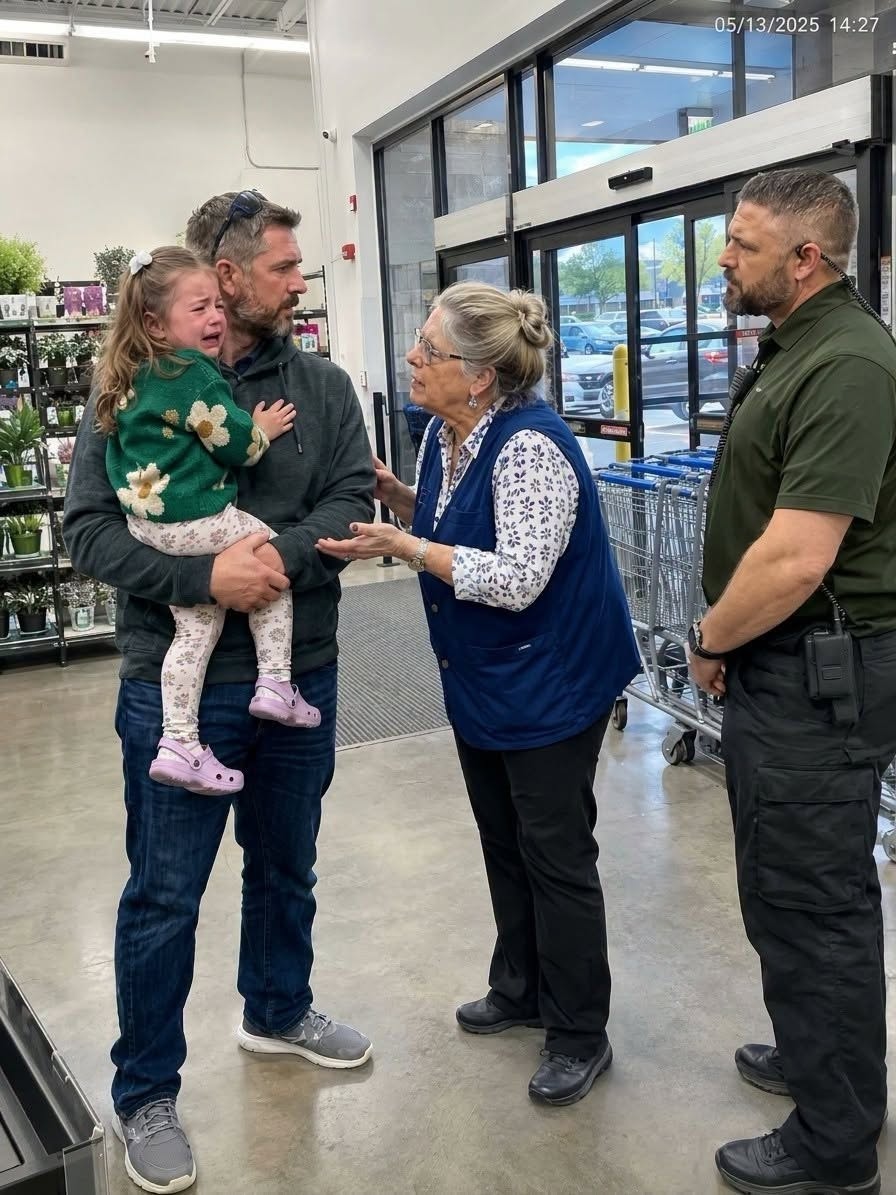
“One afternoon, I saw a little girl crying. She said the man carrying her wasn’t her father. She asked for her mother. She said someone had taken her.”
I looked toward Hannah.
“I didn’t know what was true. I didn’t know who the man was. I didn’t know what had happened before they entered the store.”
I took a breath.
“But I knew something was wrong.”
I looked around the room.
“And I want to say something important. You don’t have to be a police officer to notice when someone may need help. You don’t have to be a doctor to recognize that someone is frightened. And you don’t have to know the whole story before you ask for assistance.”
I paused.
“But you must be careful. Don’t put yourself or anyone else in danger. Don’t try to investigate or physically confront someone. Get trained staff, contact emergency services when appropriate, and share what you actually saw and heard.”
I looked down at my hands.
“I lost my job because I refused to ignore a frightened child. I was sued for $250,000 because I made a phone call.”
The room was completely silent.
“But if I had to make that choice again, knowing everything I know now, I would still call.”
A woman in the second row began wiping her eyes.
I continued.
“Sometimes people say, ‘It’s none of my business.’ Sometimes they say, ‘Maybe it’s just a tantrum.’ Sometimes they say, ‘Someone else will handle it.’”
I looked at Hannah.
“That day, I could have told myself all those things.”
Then I looked at the audience.
“But there was a three-year-old girl looking at me and asking for help.”
My voice broke.
“And I couldn’t pretend I hadn’t heard her.”
The applause began slowly.
Then everyone stood.
I hadn’t expected that.
I looked toward Hannah.
She was crying.
Quinn was sitting beside her, holding a yellow crayon.
When the applause stopped, Quinn climbed out of her chair and walked toward me.
She held up a piece of paper.
It was a drawing.
This time, there were four people.
Quinn.
Her mother.
Me.
And a police officer.
At the top, she’d drawn a giant yellow sun.
Underneath, in letters Hannah had helped her write, were four words:
PEOPLE SHOULD LISTEN.
I bent down and hugged her.
“That’s right, sweetheart.”
By the following spring, my life had changed in ways I hadn’t expected.
I started volunteering at the community center.
I helped organize activities for children.
I read stories on Wednesday afternoons.
I brought stickers.
Always stickers.
Sometimes parents would ask me how I had found the courage to stand up to Wayne Haller.
I’d tell them the truth.
“I wasn’t courageous. I was frightened.”
They would look surprised.
I’d smile.
“Courage doesn’t mean you aren’t scared. Sometimes it means you know someone else is more frightened than you are.”
I never returned to the big-box store.
Mr. Darby eventually transferred to another location.
I heard that the company had changed its procedures for handling missing children and safety concerns.
They introduced staff training.
They established clearer instructions for contacting security and law enforcement.
I didn’t know whether my experience had caused those changes.
But I hoped it had helped.
As for Wayne, the separate investigation continued.
He faced the consequences of taking Quinn without authorization and making false claims about what had happened in the store. I learned about the proceedings only through occasional updates from Hannah.
I didn’t attend.
I didn’t need to.
My fight was over.
My responsibility was to move forward.
One afternoon, almost a year after the day everything happened, I received a package.
Inside was a photograph.
It showed Quinn standing in front of a birthday cake.
She was wearing a pink dress.
There were balloons behind her.
Her mother was kneeling beside her, smiling.
On the back, Hannah had written:
Dear Mavis,
Today Quinn turned four.
She asked me if she could invite the sticker lady to her birthday party.
I told her we would ask.
Thank you for helping give my daughter another birthday with her mother.
We love you.
I held the photograph for a long time.
Then I placed it in a frame.
It went on the shelf beside the photograph of my late husband.
For the first time in many years, that shelf held something new.
Something that reminded me that even after loss, even after fear, even after people disappoint you, life can still surprise you with something beautiful.
On Quinn’s fifth birthday, Hannah invited me to a small party.
There were balloons in the backyard.
A pink cake.
A table full of children.
And, of course, a box of smiley-face stickers.
Quinn ran toward me the moment I arrived.
“You’re late!”
I laughed.
“By three minutes.”
“That’s late!”
“Well, I’m an old woman. We move slowly.”
She giggled.
Then she reached into her pocket and pulled out something.
It was a little yellow sticker.
The same kind I had given her in the store.
Except this one was stuck to a folded piece of paper.
“What’s this?” I asked.
“It’s for you.”
I unfolded it.
There were two sentences, written in Hannah’s careful handwriting.
You stopped because you listened.
We will remember because you cared.
I couldn’t speak.
Quinn looked up at me.
“Do you like it?”
I knelt and hugged her.
“I love it.”
She wrapped her little arms around my neck.
Then she whispered something.
“Thank you for helping me find Mommy.”
I closed my eyes.
And I remembered that Tuesday afternoon.
The pink rain boots.
The frightened little voice.
The man saying, “She’s just tired.”
The manager telling me to step aside.
The photograph of the license plate.
The letter from the lawyer.
The $250,000 lawsuit.
The courtroom.
The young woman standing up.
And the words:
“Quinn is my daughter. Not his.”
For a moment, I felt as though I were watching the entire year pass before my eyes.
Then Quinn pulled away.
“Can I have another sticker?”
I laughed.
“Of course.”
I peeled one from the roll and placed it on her hand.
She ran back to the other children.
I watched her play.
She was laughing.
She was safe.
She was home.
And that was enough.
That evening, after the party, Hannah walked me to my car.
The sun was setting.
The air smelled like freshly cut grass and birthday cake.
“Can I ask you something?” she said.
“Of course.”
“Do you ever regret it?”
I looked at her.
“Regret what?”
“Standing in front of Wayne that day. Calling the police. Taking the pictures. Everything.”
I thought about the question.
I thought about the months of fear.
The legal bills.
The sleepless nights.
The humiliation of being fired.
The day I thought I might lose everything.
Then I thought about Quinn.
I looked back toward the house.
She was sitting at the kitchen window, pressing her birthday stickers onto the glass.
“No,” I said.
“Not even a little?”
I smiled.
“I regret that a little girl had to be frightened in the first place. I regret that her mother had to spend eleven months searching for her. I regret that people who should have helped didn’t.”
I paused.
“But I don’t regret listening.”
Hannah nodded.
Then she hugged me.
“Good night, Mavis.”
“Good night, sweetheart.”
I got into my car.
Before starting the engine, I looked at the photograph on the passenger seat.
Quinn’s fifth birthday.
Her smiling face.
Her pink dress.
Her mother beside her.
I picked up the photograph and placed it carefully in my handbag.
Then I drove home.
I’m sixty-eight now.
I don’t work at the big-box store anymore.
My knees hurt when it rains, and I sometimes forget where I put my glasses.
I still drink too much coffee.
I still talk to my late husband when I’m alone.
And I still carry smiley-face stickers.
You never know when a child might need one.
People sometimes ask me whether I would have done anything differently.
I tell them I wish I’d known how difficult the months afterward would be.
I wish I’d had better support.
I wish my manager had listened.
I wish a frightened child hadn’t needed a stranger to recognize that something was wrong.
But I wouldn’t change the most important thing.
I wouldn’t change the moment I stopped walking.
Because that little girl taught me something I should have understood all my life.
We spend so much time looking for reasons not to get involved.
We tell ourselves that something isn’t our responsibility.
We tell ourselves that someone else will handle it.
We tell ourselves that we might be mistaken.
And sometimes those concerns are reasonable. We must act carefully, avoid assumptions, and get the right help.
But we should never confuse caution with indifference.
Sometimes a child needs an adult to pay attention.
Sometimes an elderly person needs someone to notice they’re confused.
Sometimes a stranger needs someone to ask whether they’re all right.
And sometimes, the smallest thing you can do becomes the biggest thing in someone else’s life.
I was a sixty-seven-year-old greeter.
I didn’t have power.
I didn’t have money.
I didn’t have a fancy title.
I had a phone, a roll of stickers, and enough experience to know when a child was genuinely afraid.
That was all.
But it was enough to make a phone call.
And that phone call brought a mother and daughter back together.
So if you ever find yourself in a situation where something doesn’t feel right, don’t assume you know the whole story. Stay calm. Keep yourself safe. Get appropriate help. Listen carefully.
Because you may never know how much one small act of attention can matter.
And if you ever visit a store and see an old woman standing near the entrance with a roll of yellow stickers in her pocket, stop for a moment.
Say hello.
You might even get a smiley face.
I know I still have plenty.
And somewhere in Fort Smith, a little girl named Quinn is growing up with her mother.
She goes to school.
She plays with her friends.
She has birthday parties.
And every year, on the anniversary of the day she came home, she asks her mother to buy a roll of yellow smiley-face stickers.
Her mother asks her why.
And Quinn always gives the same answer:
“Because one lady listened when I needed somebody.”
Sometimes, you don’t have to save the whole world. You just have to make sure one frightened child isn’t left alone.
And sometimes, the person who changes a child’s life isn’t a police officer, a judge, or a superhero.
Sometimes, it’s just a grandmother with a blue vest and a pocket full of smiley faces.
THE END.