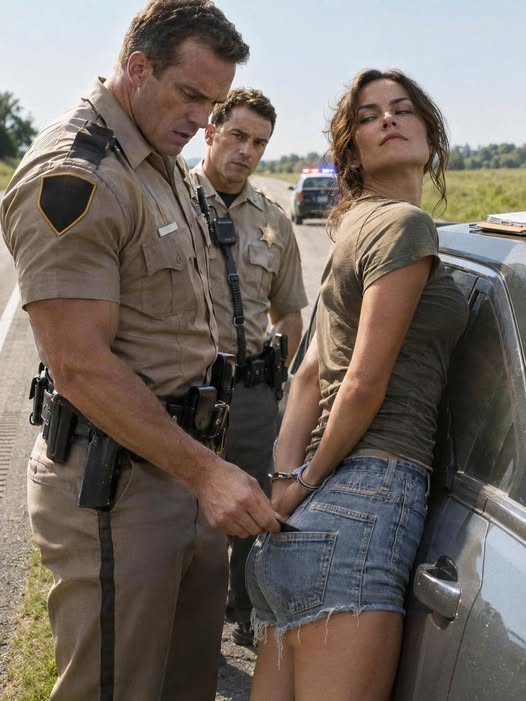
PART 2: THE BADGE THEY NEVER EXPECTED
The officer pulled out a leather wallet.
It was small.
Black.
Worn slightly along the edges.
And completely ordinary
until he opened it.
Then his expression changed.
The grin disappeared.
His fingers stopped moving.
And the afternoon seemed
to become very quiet.
Inside the wallet
was a gold-colored shield
bearing the official insignia
of the State Bureau of Investigation.
Beneath it was my identification.
SPECIAL AGENT VICTORIA HAYES.
PROFESSIONAL STANDARDS DIVISION.
The officer stared at the card.
Then looked at my face.
Then back at the card.
His partner noticed immediately.
“Grady, what’s wrong?”
Officer Thomas Grady didn’t answer.
His hand was trembling.
His partner, Officer Caleb Pike,
stepped closer.
“What is it?”
Grady held out the identification.
Pike leaned forward.
And suddenly,
he wasn’t smiling either.
For several seconds,
both men stood motionless.
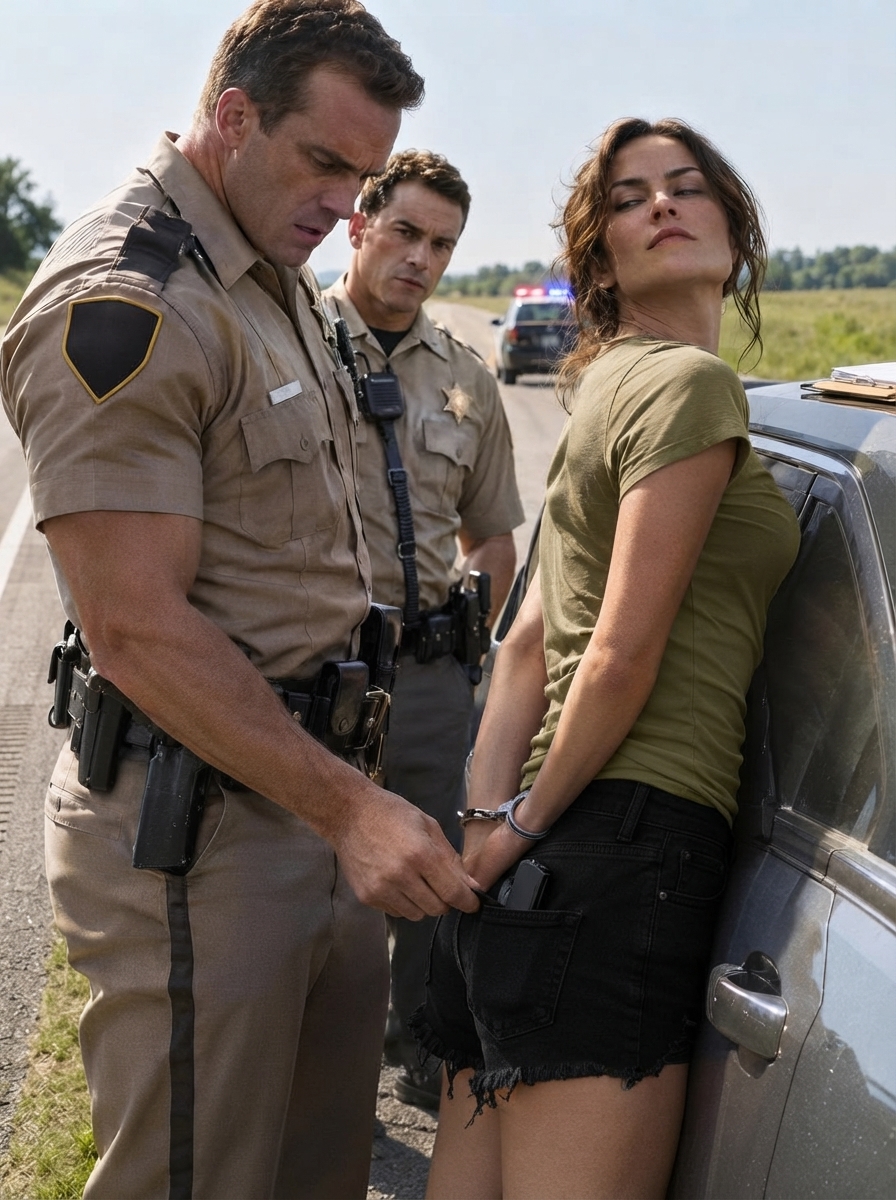
The handcuffs remained tight
around my wrists.
My cheek was still burning
where Grady had shoved me
against the car door.
And my shoulder throbbed
from the way Pike
had twisted my arm.
Finally, Grady whispered,
“You’re a state investigator?”
I looked directly at him.
“Yes.”
His face went pale.
“Why didn’t you say something?”
I almost laughed.
“I asked you to identify yourselves.”
“I asked why you stopped me.”
“And when I tried speaking,”
“you dragged me from my vehicle.”
Pike swallowed.
“Ma’am, we didn’t realize—”
I interrupted.
“That I’m a law enforcement officer?”
He nodded weakly.
I looked at him.
“Would that have made”
“your behavior acceptable
if I weren’t?”
Neither answered.
And for the first time,
I understood how frightened
they had become.
Not because they had hurt someone.
Because they had hurt someone
who might be able
to make them answer for it.
***
Grady quickly closed the wallet.
Then he looked toward the highway.
A delivery truck passed.
Two cars followed.
The afternoon continued normally
for everyone except us.
He lowered his voice.
“Agent Hayes, there’s been
a misunderstanding.”
I stared at him.
“A misunderstanding?”
He nodded.
“We thought you were behaving suspiciously.”
I looked toward my car.
My engine was off.
My registration was valid.
My license was current.
And my only supposed offense
had been asking
why I was stopped.
“Which behavior was suspicious?”
Grady hesitated.
“You reached for something.”
“My phone.”
“We didn’t know that.”
“I told you.”
Pike looked uncomfortable.
Grady shot him a warning glance.
Then turned back to me.
“Let’s get those cuffs off.”
I remained still.
“Before you do anything else,”
“I want your names
and badge numbers.”
Grady cleared his throat.
“Officer Thomas Grady.”
“Badge two-one-four.”
Pike spoke more quietly.
“Officer Caleb Pike.”
“Badge three-oh-seven.”
I nodded.
“Which agency?”
“East Mercer County Sheriff’s Office.”
“And who is your supervisor?”
Grady looked away.
“Sergeant Linda Mercer.”
I took a slow breath.
“Call her.”
He hesitated.
“Ma’am, I think
we can resolve this here.”
I looked at him.
“Call your supervisor.”
Pike reached for his radio.
Grady immediately grabbed his wrist.
“Wait.”
I noticed.
So did Pike.
For a moment,
the younger officer stared
at his partner’s hand.
Then Grady released him.
Pike raised the radio.
His voice wasn’t steady.
***
The dispatcher answered.
Pike reported a roadside detention
and requested a supervisor.
He didn’t mention
that I’d been dragged
from my vehicle.
He didn’t mention
the handcuffs.
And he certainly didn’t mention
that the detained driver
was a state investigator.
I listened carefully.
When he finished,
I spoke.
“Officer Pike.”
He looked at me.
“Please advise dispatch
that a detained person
is reporting injuries
from the use of force.”
His eyes widened.
Grady’s jaw tightened.
“There’s no need for that.”
I ignored him.
“Pike, make the report.”
For several seconds,
he didn’t move.
Then he raised his radio.
He reported
that the detained driver
requested medical assessment.
The dispatcher acknowledged.
Grady turned away,
muttering something under his breath.
I looked toward my car.
A small dash camera
was mounted behind
the rearview mirror.
Its indicator light
was still glowing.
I felt a quiet wave of relief.
The device had recorded
my drive for months.
It automatically preserved
recent footage
when sudden movement occurred.
And being dragged
against my car door
had certainly created sudden movement.
Still,
I didn’t know
what the camera had captured.
I wouldn’t assume
it had recorded everything.
That was something
the investigators would need
to establish properly.
***
Grady stepped behind me.
He removed the handcuffs.
My wrists were red.
One had already begun swelling.
When I lowered my arms,
pain shot through my shoulder.
I couldn’t suppress a grimace.
Pike noticed.
“Are you okay?”
I looked at him.
“No.”
He swallowed.
“Do you need an ambulance?”
“I requested medical evaluation.”
He nodded.
“Right.”
Grady rubbed his forehead.
“Agent Hayes, this really
doesn’t have to become complicated.”
I stared at him.
“You stopped me without explaining why.”
“You used force.”
“You handcuffed me.”
“And now you want
to pretend nothing happened.”
He looked around nervously.
“That isn’t what I’m saying.”
“Then what are you saying?”
He opened his mouth.
Nothing came out.
I waited.
Finally, he whispered,
“I have a family.”
Those words struck me.
I thought of my husband.
Daniel.
My fourteen-year-old daughter, Ava.
My ten-year-old son, Ben.
They were expecting me home
before dinner.
I looked at Grady.
“So do I.”
His face changed.
I continued.
“And every person you stop
has a life beyond this road.”
He lowered his eyes.
But I wasn’t finished.
“Your family doesn’t make
my injuries disappear.”
***
A patrol vehicle arrived
seventeen minutes later.
A woman in her forties
stepped out.
She had dark hair
pulled into a tight bun
and wore a sergeant’s uniform.
She studied the scene immediately.
My swollen wrist.
My dust-covered shorts.
The open driver’s door.
And Grady’s pale face.
“What’s going on?”
Neither officer answered quickly.
I looked toward her.
“Are you Sergeant Mercer?”
She nodded.
“Yes, ma’am.”
“My name is Victoria Hayes.”
I displayed my credentials.
Her expression changed.
But not the way Grady’s had.
She didn’t panic.
She looked concerned.
“Are you injured?”
“Yes.”
She turned toward Pike.
“Was force used?”
He swallowed.
“Yes, Sergeant.”
“What kind?”
He looked toward Grady.
The sergeant noticed.
“Pike.”
Her voice became firm.
“I’m asking you.”
He took a breath.
“We removed her from the car.”
“And restrained her.”
Sergeant Mercer looked at me.
“On what grounds?”
I answered quietly.
“That’s what I’ve been asking.”
***
She requested the officers’ initial explanations.
Grady said he’d observed
suspicious driving behavior.
I asked him to identify it.
He mentioned drifting within the lane.
I stared at him.
“Did I cross a line?”
He hesitated.
“No.”
“Was I speeding?”
“No.”
“Did I commit a moving violation?”
He looked away.
“Not that I observed.”
Sergeant Mercer folded her arms.
“Then what justified the stop?”
Grady’s face reddened.
He looked toward Pike.
The younger officer remained silent.
Finally, Grady said,
“We received a vehicle alert.”
My stomach tightened.
“A vehicle alert?”
Sergeant Mercer looked surprised.
“What alert?”
Grady swallowed.
“From the department.”
I watched her expression.
It became more serious.
“Give me the reference number.”
Grady hesitated.
“I don’t have it.”
“Then contact dispatch.”
He looked down.
The sergeant waited.
Then repeated,
“Now.”
***
Pike contacted dispatch.
The dispatcher checked
the available call and alert records.
Several moments passed.
Then a voice answered
over the radio.
There was no active stolen-vehicle notice.
No outstanding warrant associated
with my registration.
And no ordinary traffic-related alert
that dispatch could identify.
Sergeant Mercer looked toward Grady.
“Explain.”
He swallowed.
“I must have misunderstood.”
I stared at him.
Misunderstood.
The same word people used
when they wanted
to make deliberate choices
sound like accidents.
Sergeant Mercer turned toward me.
“Agent Hayes, I’m requesting
an outside investigative response.”
I nodded.
“Thank you.”
She continued.
“Your complaint involves serious allegations.”
“I don’t want my agency
to be the only one
examining what happened here.”
For the first time,
I felt a little safer.
Not because everything was resolved.
But because someone
was acknowledging the seriousness
of what had happened.
***
The ambulance arrived.
A paramedic examined my wrists.
My right shoulder.
And the painful swelling
along my cheekbone.
He recommended
additional evaluation
at the hospital.
I agreed.
Before leaving,
I asked Sergeant Mercer
to preserve the dash-camera recordings
and the available dispatch records.
She nodded.
“That request will be documented.”
I pointed toward my vehicle.
“My own dash camera
may also contain relevant footage.”
She acknowledged it.
We arranged
for the evidence
to be handled properly.
Then I called Daniel.
He answered immediately.
“Hey, Vic.”
I closed my eyes.
His familiar voice
nearly broke my composure.
“Daniel.”
There was a pause.
“What’s wrong?”
I swallowed.
“I’ve been hurt.”
His voice changed.
“Where are you?”
I explained briefly.
The traffic stop.
The handcuffs.
The injuries.
The ambulance.
For several seconds,
he said nothing.
Then he asked,
“Are you safe now?”
I looked toward Sergeant Mercer.
“Yes.”
His breathing steadied.
“Where are they taking you?”
I told him.
He answered immediately.
“I’ll meet you there.”
Then his voice softened.
“Victoria?”
“Yes?”
“I love you.”
My eyes filled.
“I love you too.”
***
At the hospital,
the physician documented
the bruising on my cheek.
The abrasions around my wrists.
And the shoulder strain.
Nothing appeared life-threatening.
But the injuries were real.
The doctor recommended rest,
follow-up assessment,
and monitoring for worsening symptoms.
I thanked her.
Then sat on the examination bed
waiting for the discharge paperwork.
For the first time,
the full weight
of what had happened
began settling over me.
I had spent sixteen years
investigating serious misconduct.
I had interviewed victims.
Examined recordings.
Reviewed official reports.
And listened to officers
explain decisions made
during moments of pressure.
But I’d never been
on this side
of a roadside detention.
I’d never felt
another person’s hand
force my face
against a car door.
I’d never heard
the click of handcuffs
while knowing
I had done nothing wrong.
And I’d never experienced
the strange helplessness
of asking a reasonable question
and being punished for it.
Now I understood something
that no training manual
could completely explain.
A few minutes
of another person’s abuse
could change how safe
the world felt afterward.
***
Daniel entered the room
just after sunset.
He stopped when he saw me.
His expression changed.
He approached slowly.
“Victoria.”
I tried to smile.
“Hi.”
Then he noticed my cheek.
My wrists.
The way I was holding
my right shoulder.
His eyes filled.
“Oh, honey.”
I began crying.
Not dramatically.
Not uncontrollably.
Just the tears
I’d been holding back
since the highway.
He wrapped his arms
around me carefully.
I rested my head
against his chest.
For several minutes,
neither of us spoke.
Then he whispered,
“I’m so glad you’re safe.”
I closed my eyes.
“Me too.”
***
When we returned home,
Ava was waiting
at the kitchen table.
She stood immediately.
“Mom?”
I smiled gently.
“Hey, sweetheart.”
Then she saw my face.
Her expression changed.
“What happened?”
Daniel looked toward me.
I took a breath.
“Two officers made
some very bad decisions today.”
Ava stared at the bruises.
“Did they hurt you?”
I nodded.
“Yes.”
Her eyes filled.
“But you’re a police investigator.”
I looked at her.
“That doesn’t mean
nobody can hurt me.”
She swallowed.
“Did they know who you were?”
“Not at first.”
She frowned.
“Then why did they stop?”
I paused.
“That’s one of the things
we’re going to investigate.”
Ava looked furious.
“Are they going to get away with it?”
I wanted to reassure her.
To promise swift justice.
To tell her
everything would be fixed
by the following morning.
But I’d spent too many years
working inside the system
to make promises
I couldn’t guarantee.
I took her hand.
“I don’t know what will happen yet.”
“But the evidence will be examined.”
“And I’ll tell the truth.”
Ava nodded slowly.
Then she hugged me.
“That was so unfair.”
My throat tightened.
“Yes.”
“It was.”
***
The following morning,
my division director called.
Her name was Miriam Keene.
She’d supervised me
for nearly seven years.
Miriam was precise,
demanding,
and almost impossible to impress.
But she cared deeply
about the integrity
of our investigations.
“Victoria, how are you?”
I looked toward the garden.
“Sore.”
“Understandable.”
She paused.
“An independent investigative team
has been assigned.”
I nodded.
“Good.”
“Special Agent Malik Brooks
will lead the state investigation.”
I knew Malik.
He was experienced.
Careful.
And unwilling
to accept easy explanations.
Miriam continued.
“You’re the complainant.”
“Not the lead investigator.”
“I understand.”
“Your professional position
doesn’t give you authority
to control the investigation.”
“I wouldn’t want it to.”
She paused.
Then said more gently,
“Victoria, I know
this is difficult.”
I closed my eyes.
“Yes.”
“It is.”
“Then let us do our jobs.”
I nodded.
“Okay.”
***
Malik interviewed me
that afternoon.
He arrived with an investigator
from another regional office.
They recorded the interview
under the established procedures.
I described everything.
My driving.
The flashing lights.
The request for identification.
Grady’s refusal
to explain the stop.
Pike’s insults.
The attempt to record.
The forced removal.
The handcuffs.
And the moment
Grady discovered my badge.
Malik listened carefully.
Then asked,
“Did you physically resist?”
“No.”
“Did you attempt to strike anyone?”
“No.”
“Did you threaten the officers?”
“No.”
“What did you mean
when you said
they had made a mistake?”
I thought carefully.
“That their actions
appeared unjustified and excessive.”
He nodded.
“Did you mention your occupation
before the wallet was retrieved?”
“No.”
“Why not?”
I looked at him.
“Because I shouldn’t need
a badge to receive lawful treatment.”
Malik paused.
Then nodded.
“Understood.”
***
After the interview,
Malik explained
what his team was preserving.
Body-worn camera records.
Dash-camera video.
Dispatch audio.
Location information.
Computer-aided dispatch entries.
Incident reports.
Personnel records
where legally relevant.
And my vehicle’s recording.
They would also seek
any nearby surveillance footage.
The process would take time.
I understood.
He didn’t promise
any particular outcome.
I appreciated that.
Then he asked one final question.
“Victoria, did anything seem unusual
about the officers’ behavior
before they recognized you?”
I considered it.
Then remembered something.
Grady had looked
at my license plate
before approaching the window.
Not unusual by itself.
But afterward,
he glanced repeatedly
toward Pike’s radio.
As though waiting
for confirmation of something.
I described it.
Malik made a note.
“Anything else?”
I thought back.
The questions.
The aggression.
The strange claim
that there had been
a vehicle alert.
Then I remembered
Grady’s expression
when Sergeant Mercer asked
for the reference number.
I looked at Malik.
“He wasn’t surprised
that dispatch couldn’t find it.”
Malik paused.
“What do you mean?”
“He looked frightened
before dispatch answered.”
I took a breath.
“Almost as though
he already knew
there wouldn’t be a valid record.”
Malik nodded slowly.
“We’ll examine that.”
***
Three days later,
Malik called again.
“I need to show you something.”
I sat straighter.
“What happened?”
“We recovered additional footage.”
My heart accelerated.
“From my dash camera?”
“Partly.”
He paused.
“And from Officer Pike’s camera.”
I stared at the wall.
“His body camera?”
“Yes.”
I remembered the younger officer.
His face.
His hesitation.
The way he looked toward Grady
before answering questions.
“Was it recording?”
Malik answered carefully.
“Some of the encounter.”
I closed my eyes.
For the first time,
I felt genuine relief.
Then Malik continued.
“But we also found
a discrepancy in the dispatch records.”
My stomach tightened.
“What discrepancy?”
“An entry was added
after the stop.”
I sat straighter.
“What kind of entry?”
“A notation describing
suspicious vehicle behavior.”
I frowned.
“After the stop?”
“Yes.”
He paused.
“And the entry was made
from a supervisory account.”
I felt cold.
“Whose account?”
Malik didn’t answer immediately.
Then said,
“Captain Lowell Reed.”
I knew the name.
Everyone in our division did.
Captain Reed supervised
East Mercer County’s highway operations.
He had been named
in several earlier citizen complaints.
Nothing had yet established
that he’d committed misconduct.
But his management decisions
had attracted concern.
I took a slow breath.
“Why would Reed
add an entry afterward?”
Malik answered cautiously.
“That’s what we’re investigating.”
***
At the state office,
Malik played the video.
I sat beside my attorney,
Nadia Flores.
I’d retained Nadia
because I understood
that being an investigator
didn’t mean
I should represent myself
in a personal legal dispute.
The footage began
inside Pike’s patrol vehicle.
Grady was driving.
Pike sat beside him.
The road appeared
through the windshield.
Then Grady pointed ahead.
“That’s the car.”
Pike looked up.
“Which one?”
“The gray sedan.”
My stomach tightened.
It was mine.
Pike glanced at the computer.
“Why are we stopping it?”
Grady answered,
“Just do what Reed told us.”
I stopped breathing.
Malik paused the video.
No one spoke.
Then I whispered,
“Play it again.”
He did.
The words were unmistakable.
“Just do what Reed told us.”
I looked at Malik.
“Reed ordered the stop?”
He remained careful.
“The statement suggests
a prior instruction.”
“We haven’t established its purpose yet.”
I nodded.
Then the recording continued.
The patrol car approached mine.
The flashing lights activated.
I pulled over.
Grady stepped out.
Pike followed.
The camera captured
part of the conversation.
My request
for the reason for the stop.
Grady’s irritated response.
Pike’s insulting remarks.
Then the moment
I reached toward my phone.
Grady shouted.
Pike moved forward.
The image shook.
But the audio remained clear.
I heard myself say,
“Take your hands off me!”
Then the impact
against the car door.
My breath caught.
I hadn’t realized
how frightening the sound was.
The metal rattled.
I cried out.
Grady shouted again.
Then Pike said,
“She’s not fighting.”
There was a pause.
Grady answered,
“Cuff her anyway.”
I covered my mouth.
Nadia placed one hand
on my forearm.
Malik let the recording continue.
Then came my warning.
The officers’ laughter.
My request
that they retrieve
the identification from my pocket.
The camera shifted.
Grady opened the wallet.
And the next sound
was his voice.
Quiet.
Panicked.
“Oh, no.”
***
Malik stopped the recording.
I sat completely still.
My shoulder had begun aching
as though the incident
were happening again.
Nadia looked toward me.
“Do you need a break?”
I nodded.
“Please.”
We stepped into the hallway.
I leaned against the wall.
Then I began shaking.
I had known what happened.
I’d lived through it.
I’d described it.
But hearing the recording
was somehow worse.
It revealed
how little control
I’d actually had.
And how easily
the officers had ignored
the younger man’s observation
that I wasn’t resisting.
I closed my eyes.
Nadia remained beside me.
After several minutes,
I took a slow breath.
“I’m okay.”
She looked at me.
“You don’t have to be okay
every minute.”
I nodded.
“I know.”
But I wasn’t sure
I believed it yet.
***
When we returned,
Malik showed us
the officer reports.
Grady’s report claimed
I had refused lawful commands.
It described me
as increasingly aggressive.
It said I attempted
to conceal an unidentified object.
And it claimed
I resisted physical restraint.
Pike’s initial report
contained similar language.
I stared at the page.
Then at the video.
“That’s not what happened.”
Malik nodded.
“The recordings raise
significant contradictions.”
He continued.
“We’re reviewing whether
the reports were knowingly falsified.”
I swallowed.
“Did Reed approve them?”
Malik looked toward his notes.
“Yes.”
My stomach tightened.
“Before or after
the video was reviewed?”
He paused.
“That’s another question
we’re examining.”
I looked down.
The case was becoming
far larger
than a single roadside stop.
***
That evening,
I returned home
and found Daniel
cooking dinner.
He turned
when I entered.
“Hey.”
I smiled weakly.
“Hi.”
He looked at my face.
Then switched off the stove.
“Bad day?”
I nodded.
He approached.
“Want to talk?”
I considered it.
Then whispered,
“They recorded it.”
His expression changed.
“The stop?”
“Yes.”
I looked down.
“Some of it.”
He wrapped his arms around me.
I rested my head
against his chest.
For several minutes,
neither spoke.
Then I said,
“I keep thinking
about the people
who don’t have recordings.”
Daniel held me tighter.
“The ones nobody believed.”
I nodded.
“Yes.”
He kissed my forehead.
“Then maybe this evidence
will help them too.”
I closed my eyes.
I hoped he was right.
***
The following week,
Malik asked me
to attend another meeting.
This time,
two additional investigators
were present.
One specialized
in financial records.
The other
in public corruption investigations.
I immediately understood
that the inquiry had expanded.
Malik explained
that my traffic stop
had revealed
a pattern of unusual enforcement activity.
Several citizen complaints
involved the same officers.
Similar language
appeared in their reports.
Drivers were described
as argumentative.
Uncooperative.
Or suspicious.
Many had been stopped
without clearly documented violations.
And several
reported being threatened
with vehicle impoundment.
I listened carefully.
Then one investigator
placed a photograph
on the table.
It showed a towing truck.
BLACK CREEK RECOVERY.
I recognized the name.
The company had been mentioned
in previous citizen complaints
reviewed by our division.
The investigator continued.
“Grady requested this company
during multiple contested stops.”
My stomach tightened.
“How many?”
“Enough to warrant
a separate financial investigation.”
I looked at the photograph.
The towing truck
was parked beside
a county patrol vehicle.
The investigator turned another page.
“This company is owned
by Travis Grady.”
I stared at him.
“Thomas Grady’s brother?”
He nodded.
“Yes.”
For a moment,
the room was silent.
Then Malik spoke.
“We haven’t reached conclusions
about every transaction.”
“But we have reason
to examine the relationship.”
***
The next document
contained several invoices.
Towing fees.
Storage charges.
Administrative costs.
Some drivers
had paid hundreds of dollars
to recover vehicles
after questionable stops.
Others had been cited
for violations
later dismissed in court.
In several cases,
the tow orders
were issued
without a clear explanation
of why the vehicle
couldn’t remain safely parked.
I looked at the records.
Then at Malik.
“Do the drivers know
their cases are being reviewed?”
“Some have been contacted.”
He paused.
“Others are being identified.”
I thought about
the roadside encounter.
Grady’s arrogance.
Pike’s hesitation.
The urgency
with which Grady
wanted the stop finished
after recognizing me.
Then I remembered
the supposed vehicle alert.
My stomach tightened.
“Malik, what if
the stop wasn’t random?”
He looked at me.
“We’re examining that possibility.”
I leaned forward.
“What if Reed sent them
after my car?”
Malik didn’t answer immediately.
Then he produced another document.
It was an internal message.
Sent the evening
before my detention.
From Captain Lowell Reed.
To Officer Thomas Grady.
The subject line read:
VEHICLE OBSERVATION.
I stared at it.
The message included
a partial description
of a gray sedan.
Its make.
Its general model.
And my license plate number.
My heart began pounding.
I read the final sentence.
“Subject has been making inquiries
related to highway enforcement activity.”
I looked up.
Malik’s expression was serious.
Then he said,
“Victoria, there’s something
you need to understand.”
I could barely speak.
“What?”
“The evidence suggests
your vehicle was identified
before the roadside encounter.”
I stared at him.
He continued.
“And the instruction
did not originate
from an ordinary traffic complaint.”
My hands went cold.
Then he placed
one final page
on the table.
It contained
a second message
from Captain Reed.
This one had been sent
shortly before
the officers stopped me.
The message was brief.
Only five words.
But they changed everything.
“Make sure she gets the message.”
I stared at the sentence.
Then looked toward Malik.
For several seconds,
I couldn’t move.
The stop hadn’t simply been
two arrogant officers
losing control.
Someone above them
had apparently sent them
to intimidate a woman
who was asking questions.
And that woman
had been me.