during my lifetime.
She emphasized
that the arrangement
required careful drafting
and independent financial evaluation.
I listened closely.
Then asked,
“And when I die?”
“The buyer’s future interest
would become possessory,
according to the deed.”
I looked toward Avery.
My granddaughter was quiet.
I took a breath.
“Then Luke wouldn’t inherit it?”
Rachel answered carefully.
“Not if you validly transfer
the relevant ownership interest.”
I leaned back.
For the first time,
I could imagine
protecting myself
without leaving
the house Patrick built.
***
But Rachel raised
an important concern.
“Mrs. Parker,
don’t sell your house
simply to punish your son.”
I looked at her.
“I’m not.”
She waited.
I continued.
“I’m eighty-one.”
“I need financial security.”
“I need control over my life.”
“And I don’t want
Luke making decisions
after I can no longer
protect myself.”
Rachel nodded.
“Those are legitimate considerations.”
She explained
that a sale subject
to a retained life estate
would generally bring
less than an unrestricted sale.
The buyer would have to wait
before receiving possession.
The price needed
to reflect that limitation.
She also discussed taxes.
Maintenance.
Insurance.
Potential long-term care considerations.
And the importance
of avoiding arrangements
that might create
unexpected legal or financial problems.
I appreciated her honesty.
I wasn’t looking
for a magical solution.
I wanted one
that would withstand scrutiny.
***
Then Avery mentioned a name.
“Grandma, do you remember Daniel Ellis?”
I looked up.
“Daniel?”
“Grandpa’s old apprentice.”
My face softened.
Of course I remembered Daniel.
He was sixteen
when Patrick first hired him
to help in the workshop.
His father had died young.
His mother worked two jobs.
And Daniel spent afternoons
learning carpentry
beside my husband.
Patrick taught him
how to choose wood.
How to repair old cabinets.
And how to build furniture
that lasted longer
than the people who made it.
Daniel eventually started
his own contracting business.
He became successful.
But he never forgot Patrick.
He visited us every Christmas.
Until Luke began
discouraging visitors.
“How is Daniel?” I asked.
Avery smiled.
“He owns a restoration company now.”
“And he still talks about Grandpa.”
I looked down.
Then whispered,
“Patrick loved that boy.”
***
Daniel visited Rachel’s office
the following week.
He was sixty-one,
with graying hair
and broad hands
that still showed
years of working with wood.
When he entered,
he stopped immediately.
“Mrs. Parker?”
I stood.
“Daniel.”
His face broke into a smile.
He crossed the room
and hugged me gently.
Then he stepped back.
“You look just like
Patrick said you would.”
I laughed.
“What does that mean?”
He grinned.
“Too stubborn to get old.”
For the first time
in months,
I laughed without forcing it.
We spent nearly an hour
talking about Patrick.
The shop.
The house.
The old porch.
And the maple tree
in the backyard.
Daniel remembered
helping Patrick build
the kitchen cabinets.
He remembered
the crooked stair rail.
And the little sewing room
Patrick designed
especially for me.
When I told him
I was sleeping there
on a folding bed,
his expression changed.
“Mrs. Parker.”
I looked down.
He shook his head.
“Patrick would never have wanted that.”
I felt tears gathering.
“I know.”
***
Rachel explained
the possible property transaction.
Daniel listened carefully.
He didn’t immediately agree.
And that reassured me.
A person trying
to take advantage
would have rushed me
toward a signature.
Daniel asked questions.
About the life estate.
The property’s condition.
Expected maintenance.
And what would happen
if I eventually chose
to live somewhere else.
We arranged
an independent appraisal.
Rachel recommended
separate counsel for Daniel.
And I sought
independent financial advice
before making any decision.
The house’s unrestricted value
was estimated
at approximately four hundred
and five thousand dollars.
But I wasn’t selling
an unrestricted possessory interest.
I intended
to retain my lifetime rights.
The value of Daniel’s interest
was therefore substantially lower.
After careful review,
we agreed on a price
of two hundred
and forty-five thousand dollars.
Daniel would acquire
the future ownership interest.
I would retain
a recorded life estate.
The deed would clearly identify
my right to live there
for the remainder of my life.
The agreement also addressed
responsibility for maintenance,
insurance,
and other property expenses.
There was no rush.
No secret verbal promise.
And no family member
pressuring me to sign.
I read every document.
Asked questions.
And made the decision myself.
***
The transaction closed in March.
Six months before
Luke placed my suitcase
beside the front door.
Rachel confirmed
that the deed had been recorded.
Daniel paid the agreed price.
And the proceeds
went into an account
held under my control.
I updated my estate arrangements
with professional advice.
Avery wasn’t given
control over my money.
Neither was Daniel.
I made sure of that.
They had helped me
recover my independence.
I wasn’t going
to replace one form
of dependency with another.
Rachel also arranged
for my decision-making capacity
to be properly documented
at the time of the transaction.
Not because I was incapable.
Because we anticipated
Luke might eventually
challenge my choices.
I remember leaving
the closing appointment
holding the completed papers.
Avery helped me
into Dad’s old sedan.
Then asked,
“How do you feel?”
I looked toward the sky.
For a moment,
I couldn’t answer.
Then I whispered,
“Like I can breathe again.”
***
I didn’t tell Luke.
Not immediately.
Rachel and I discussed
the safest way
to address his occupancy.
We considered
the escalating behavior
inside my house.
The risk of retaliation.
And my need
for a secure place
if the situation became dangerous.
Avery helped me establish
a private emergency contact plan.
She checked on me regularly.
Sometimes we met for lunch.
Sometimes she called
while Luke was at work.
And once a week,
she brought me groceries
I kept in a small locked cabinet
inside the sewing room.
I hated needing that cabinet.
But I was grateful
for the food.
More importantly,
I was grateful
that someone cared
whether I had eaten.
***
Over the next six months,
I began keeping records.
The three-hundred-dollar payments.
The dates Luke collected them.
The changes Brenda made
without asking me.
The photographs she removed.
The furniture she placed in storage.
And the moments
when they pressured me
to move elsewhere.
I didn’t fabricate anything.
Didn’t provoke arguments.
And didn’t secretly alter
their belongings.
I simply documented
what happened.
Rachel reviewed the information
and advised me
on the appropriate legal steps.
She also helped me
prepare a written notice
concerning Luke and Brenda’s occupancy.
I was ready
to require them to leave
through the lawful process
if they refused voluntarily.
But I hoped,
perhaps foolishly,
that Luke might reconsider
before things reached that point.
Then came yesterday.
***
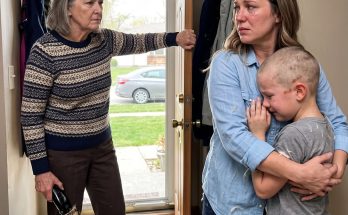
Luke placed my suitcase
beside the front door.
Brenda set the nursing-home brochure
on the kitchen table.
And my son
held out a transfer document
as though he were doing me
some enormous favor.
I looked at the black pen.
Then at his face.
“Sign this house over to us
and be gone by Friday.”
Those were his exact words.
I didn’t scream.
I didn’t cry.
I simply told him
to ask the man
who owned the house.
Luke laughed.
He thought
I was confused.
He thought
the only man
who could challenge his plans
had been buried for two years.
But he was wrong.
Patrick was gone.
Yet his former apprentice
was very much alive.
And my son’s greatest mistake
was believing
nobody had been protecting me
while he waited
for my death.
***
That evening,
I called Avery.
I told her everything.
The suitcase.
The brochure.
The transfer document.
And Luke’s demand
that I leave by Friday.
She listened quietly.
Then said,
“Grandma, we’re ready.”
I felt my hands tremble.
“What if he becomes angry?”
Her voice softened.
“Then we follow the safety plan.”
“You’re not facing him alone.”
I looked toward Patrick’s photograph.
Then asked,
“Will Daniel come?”
“Yes.”
“And Rachel?”
“She’s arranging it.”
I closed my eyes.
For six months,
I’d been preparing.
Now the moment had arrived.
***
The next morning,
Luke came into the kitchen
wearing his work clothes.
Brenda followed him.
She placed the nursing-home brochure
directly in front of me.
“We’ve decided
you should pack today.”
I looked at her.
“Have you?”
Luke sighed.
“Mom, don’t start.”
I took a sip of tea.
“Before I make any decisions,
there’s someone coming over.”
Brenda frowned.
“Who?”
I smiled faintly.
“The owner.”
Luke laughed.
“Not this nonsense again.”
I looked toward the clock.
Eight fourteen.
Exactly on schedule.
Then headlights swept
across the front windows.
A dark pickup truck
pulled into the driveway.
Luke glanced outside.
His expression changed.
“What?”
Brenda moved toward the curtains.
A man climbed out
carrying a leather document case.
Another car parked behind him.
Avery stepped out.
Then Rachel.
Luke stared.
His face suddenly went pale.
“Daniel Ellis?”
I folded my hands.
“Yes, Luke.”
He turned toward me.
“What the hell
is he doing here?”
I looked directly at my son.
“He’s come to explain
why you can’t sell
the house you never owned.”
Then the doorbell rang.
And for the first time
in two years,
Luke looked genuinely afraid
of what might happen
when someone else
entered my front door.