PART 2: THE SIGNATURE THAT WASN’T MINE
Stephen Calder stood so quickly
that his chair struck the table.
“Your Honor, I object.”
Judge Elaine Porter looked at him.
“To what, Mr. Calder?”
He adjusted his jacket.
“To whatever improper allegation
Mrs. Ellison is preparing to make.”
The judge raised an eyebrow.
“She hasn’t made one yet.”
A few people shifted behind me.
Ruth Ellison stopped smiling.
I stood quietly,
my fingers resting
on the first page
of the document.
“Your Honor,
may I identify my exhibit?”
Judge Porter nodded.
“Proceed.”
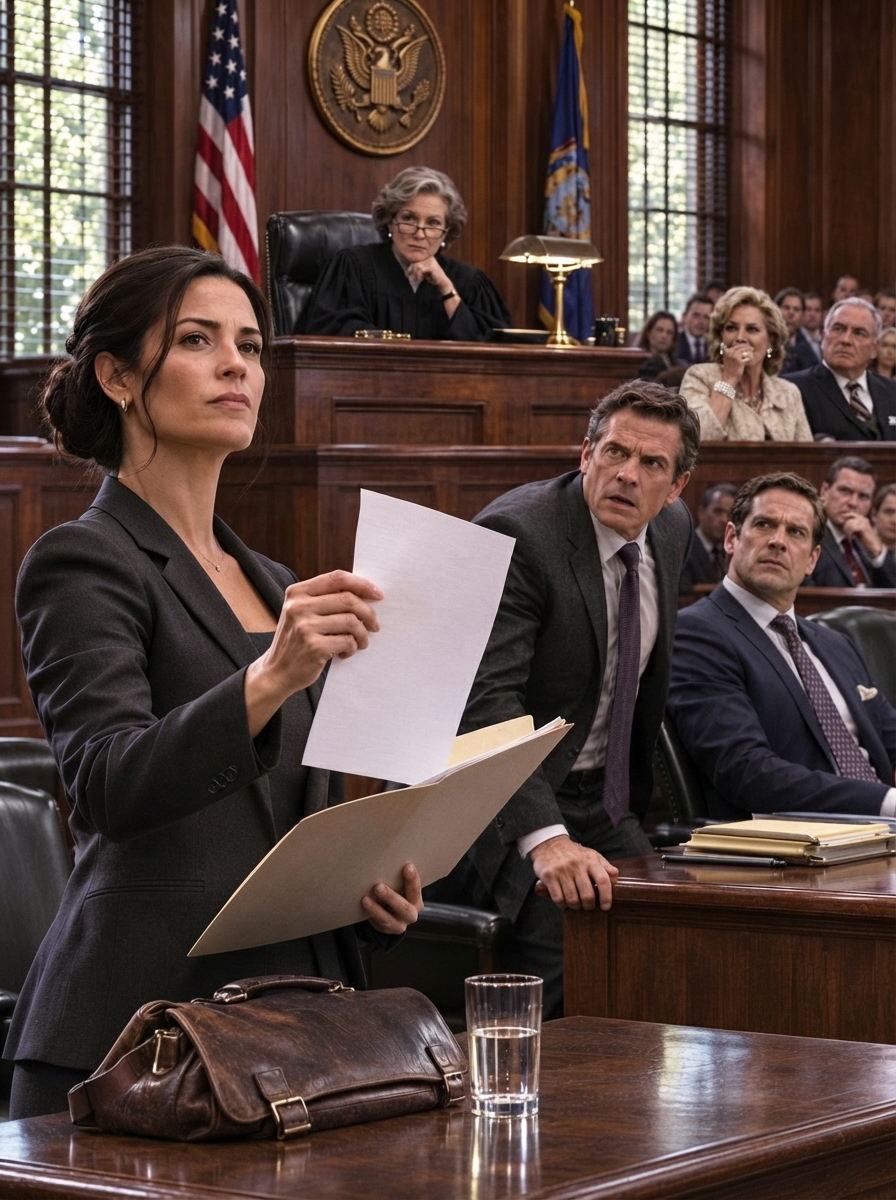
I lifted the paper.
It was a copy
of the marital settlement agreement
Andrew’s attorneys had submitted
with their court filings.
Twenty-seven pages.
Beautifully formatted.
Carefully numbered.
And completely unacceptable.
The agreement awarded Andrew
our marital residence,
the greater portion
of our joint investments,
and the business interests
he claimed were entirely his.
It assigned me
a small cash payment
and responsibility
for certain household debts.
It also included
a broad waiver
of additional financial claims.
And at the bottom
of page twenty-six
was a signature
purporting to be mine.
Mara P. Ellison.
I looked at the judge.
“This document was presented
as an agreement
between my husband and me.”
Calder rose again.
“That is correct.”
I turned toward him.
“Mr. Calder,
did you personally witness
my signature?”
He hesitated.
Then said,
“Your Honor,
I don’t believe
opposing counsel—”
Judge Porter interrupted.
“Mr. Calder,
Mrs. Ellison is representing herself.
She is entitled to present
her position,
subject to the same rules.”
He nodded stiffly.
“Of course.”
The judge looked at me.
“Mrs. Ellison,
continue.”
I took a breath.
“I never executed
this settlement agreement.”
The courtroom became quiet.
I continued.
“I never authorized anyone
to sign it for me.”
Andrew shifted in his chair.
“And I never appeared
before the notary
whose certification
appears on the final page.”
Ruth whispered something
to her husband.
Frank shook his head.
Calder opened his own folder.
“Your Honor,
my client provided
an executed copy.”
I nodded.
“That is precisely
what concerns me.”
I placed
a second document
beside the first.
“This is my sworn statement
disputing the signature.”
Then another.
“This is a record
of my location
on the date
the notarization supposedly occurred.”
Judge Porter leaned forward.
“What date?”
“October nineteenth.”
I turned the page.
“The document states
I appeared in Fairfax
at three twenty
that afternoon.”
I paused.
“At three twenty,
I was attending
a legal education symposium
in Norfolk.”
Andrew looked up sharply.
Calder frowned.
I continued.
“I have the registration records,
hotel receipts,
and contemporaneous photographs.”
The judge studied me.
“Those materials
will need proper authentication.”
“Of course, Your Honor.”
I nodded.
“I’m asking the court
not to treat
this disputed agreement
as a genuine settlement
without examining its execution.”
Judge Porter turned toward Calder.
“Mr. Calder,
what is your position
on the signature dispute?”
He glanced at Andrew.
Then back at the judge.
“Your Honor,
we were informed
the parties had reached agreement.”
I looked at my husband.
He had been smiling
when I entered.
That smile was gone.
Calder continued.
“My office received
a scanned executed document.”
The judge frowned.
“From whom?”
Calder hesitated.
Then looked down.
“From my client.”
A silence followed.
I could hear
the air conditioner
humming above us.
Then Judge Porter asked,
“Mr. Ellison,
did you provide counsel
with this document?”
Andrew swallowed.
“Yes, Your Honor.”
“And you represented
that your wife signed it?”
His jaw tightened.
“Yes.”
I closed my eyes briefly.
There it was.
The first important truth.
Not the entire truth.
But enough
to begin pulling apart
the story
his family had constructed.
The judge looked at Calder.
“The proposed agreement
will not be accepted
as an uncontested resolution
while its authenticity
is materially disputed.”
Calder nodded.
“Understood.”
She continued.
“We’ll address the appropriate
evidentiary procedures
and the remaining motions.”
Then she looked at me.
“Mrs. Ellison,
are there additional matters
you wish to raise today?”
I looked down
at the folder.
There were fourteen tabs
inside it.
Fourteen carefully arranged sections.
Seven years of marriage.
Years of bank transfers.
Financial statements.
Property records.
Emails.
Corporate agreements.
And documents
Andrew had assumed
I would never understand.
I took a breath.
“Yes, Your Honor.”
Andrew’s mother laughed again.
It was a short,
sharp sound.
“Here we go.”
Judge Porter turned toward her.
“Ma’am,
you will remain silent
or leave the courtroom.”
Ruth’s face reddened.
She sat back.
I didn’t look at her.
Instead,
I removed
another sheet of paper.
“Your Honor,
the proposed agreement
isn’t the only document
containing incorrect information.”
Calder stiffened.
“What do you mean?”
I looked toward the judge.
“My husband’s financial disclosures
omit significant business obligations
and misidentify ownership
of certain real property.”
Andrew leaned toward his attorney.
I continued.
“Those omissions
affect both the disputed settlement
and the financial relief
being requested.”
Judge Porter studied me.
“Do you have supporting documents?”
“Yes.”
I lifted a certified deed.
Then a commercial lease.
Then a promissory note.
Calder stared.
Andrew whispered something
I couldn’t hear.
I looked directly at the judge.
“Before I explain them,
I should disclose
my professional background.”
The judge nodded.
“Go ahead.”
“My maiden name
is Mara Pierce.”
I paused.
“I served as a captain
in the United States Army
in the Judge Advocate General’s Corps.”
Calder stopped moving.
Ruth frowned.
Frank looked toward Andrew.
I continued.
“I am an attorney
by training and experience.
I understand
that representing myself here
doesn’t exempt me
from the rules of evidence
or procedure.”
The judge nodded.
“Correct.”
“But I also understand
the significance
of a document
that falsely represents
someone’s consent.”
For the first time
since I entered,
Andrew looked directly at me.
His face had changed.
Not because
I’d shouted.
Not because
I’d threatened him.
Because the woman
he’d spent seven years
calling incapable
had just explained
why she wasn’t.
I heard Ruth whisper,
“An Army lawyer?”
Frank turned toward her.
“Ruth, be quiet.”
But she continued.
“Andrew never said—”
The judge looked up.
“Mrs. Ellison.”
Ruth fell silent.
I lowered my eyes
toward the documents.
My hands were steady.
They hadn’t been
three weeks earlier.
When Andrew first
placed the divorce agreement
beside my breakfast,
I’d felt something
deep inside me fracture.
Seven years.
Seven years
of marriage
reduced to twenty-seven pages
that treated my work
as an inconvenience
and my contributions
as practically nonexistent.
He told me
to sign quickly.
His attorney
would handle everything.
There was no reason
to make the divorce complicated.
I remembered asking,
“Andrew,
why does this document
say I contributed nothing
to the business?”
He barely glanced up.
“Because you didn’t.”
I looked at him.
“I helped finance it.”
He laughed.
“Don’t start.”
I continued.
“I postponed repayment
of the company loan.”
He rolled his eyes.
“Mara,
you don’t understand
how business works.”
I stared.
He was speaking
to the woman
who had reviewed
military procurement agreements,
investigated financial discrepancies,
and spent years
advising commanders
on questions
that carried serious consequences.
But Andrew
had never wanted
to hear about that life.
When we first met,
he found my military background
interesting.
He liked introducing me
as his brilliant fiancée.
He told friends
I could argue with anyone
and usually win.
Then we married.
And gradually,
the introductions changed.
First,
I became Mara,
who was taking a break
from work.
Then Mara,
who handled the house.
Then Mara,
who was happiest
staying out of business.
By our fifth anniversary,
Ruth was introducing me
as Andrew’s little homemaker.
I’d corrected her once.
She laughed.
“Oh, darling,
we know you used to work.”
Used to.
As though my education,
service,
and professional accomplishments
had been erased
the moment I stopped
collecting a paycheck.
I let it go.
Then let it go again.
Because I loved Andrew.
Because his parents
were becoming older.
Because someone
needed to coordinate
medical appointments,
household repairs,
family holidays,
and business dinners.
Because it seemed easier
to keep the peace.
That was how
I disappeared.
Not suddenly.
Not through one terrible decision.
Through a hundred little concessions
that seemed harmless
when viewed separately.
I remembered that
as I stood
before Judge Porter.
Then I looked
at Andrew’s financial disclosure.
“Your Honor,
my husband’s company
operates from commercial property
in Manassas.”
Calder nodded.
“Yes.”
“The disclosure describes
that property
as a company-controlled asset
with a pending purchase option.”
I paused.
“The property
was acquired before our marriage
by Pierce Harbor Properties, LLC.”
Andrew’s eyes widened.
I continued.
“I formed that company
before I met my husband.”
Calder began turning pages.
“The deed identifies
Pierce Harbor Properties
as the owner.”
I looked toward the judge.
“And I am
its sole member.”
For several seconds,
nobody spoke.
Then Frank whispered,
“What?”
Ruth turned toward him.
Andrew’s face drained.
Calder stood slowly.
“Your Honor,
this is the first time
I’ve seen these records.”
I believed him.
His reaction
was too immediate
to look rehearsed.
The judge nodded.
“Then you’ll need
an opportunity
to review them.”
I took a breath.
“Of course.”
I wasn’t asking
for a surprise victory.
I was asking
for a fair examination
of facts
my husband had concealed.
Judge Porter looked toward Andrew.
“Mr. Ellison,
did you disclose
the existence
of this ownership arrangement
to your attorneys?”
Andrew swallowed.
He looked at Calder.
Then at me.
Finally,
he said,
“I thought it was irrelevant.”
The judge frowned.
“Why?”
He hesitated.
“Because the business
uses the property.”
I looked down.
The answer
told me everything.
Andrew had confused
using something
with owning it.
For seven years,
that confusion
had become
the foundation
of our marriage.
He used my time.
My savings.
My contacts.
My professional judgment.
And eventually,
he began believing
that anything
he used
must belong to him.
The judge looked at Calder.
“The ownership issue
will require examination.”
Calder nodded.
“Agreed.”
Then I removed
the next document.
A promissory note.
Dated six months
after our wedding.
The principal amount
was two hundred
and eighty thousand dollars.
The borrower
was Ellison Commercial Services.
The lender
was Pierce Harbor Properties.
The signature
was Andrew’s.
I placed it
beside the deed.
“Your Honor,
this loan
has not been repaid
according to its terms.”
Calder looked startled.
Andrew closed his eyes.
I continued.
“The company has acknowledged
the debt repeatedly
in its internal records.”
Judge Porter studied the document.
“Was this transaction disclosed?”
Calder looked at his client.
Then back at the judge.
“Not in the materials
I received.”
I nodded.
“There are also
supporting bank records
and correspondence.”
The judge leaned back.
“Mrs. Ellison,
these questions
cannot all be resolved
at this hearing.”
“I understand.”
I paused.
“My immediate request
is that the court
not approve
the disputed agreement,
require accurate financial disclosure,
and consider appropriate measures
to preserve the relevant assets
while the issues are examined.”
Judge Porter nodded.
“That’s clear.”
Andrew leaned toward Calder.
His face was gray.
For the first time,
I saw him
looking frightened.
Not angry.
Not superior.
Frightened.
It reminded me
of another afternoon.
Three years earlier.
Andrew’s business
had lost
an important commercial contract.
He returned home
after midnight,
exhausted and shaking.
He told me
the company
might not survive.
I made coffee.
Sat beside him.
Reviewed the figures.
Then helped him
identify obligations
that needed attention.
I didn’t do it
because he ordered me.
I did it
because I loved him.
He held my hand
that night.
“Mara,
I don’t know
what I’d do without you.”
I remembered smiling.
“You won’t have to find out.”
At the time,
I meant it.
Now,
standing in court,
I realized
how much
that promise
had cost me.
The hearing continued.
Calder requested time
to examine the newly identified records.
Judge Porter granted
the appropriate opportunity
for further review.
She directed
the parties
toward a structured process
for addressing
the signature dispute,
financial disclosures,
and preservation concerns.
She did not
declare anyone guilty
of forgery.
She did not
award the business
to either party
on the spot.
And she did not
turn a contested divorce
into an instant judgment
because I had
a compelling folder.
That wasn’t how courts worked.
I’d spent enough years
inside courtrooms
to know the difference
between a dramatic allegation
and a proven fact.
But something important
had changed.
Andrew’s proposed settlement
was no longer
being treated
as a completed agreement.
The false picture
of our finances
was being challenged.
And my husband
could no longer rely
on my silence
to make his story credible.
As the judge prepared
to conclude the session,
Calder approached the lectern.
“Your Honor,
may I address
one additional concern?”
She nodded.
“Briefly.”
He looked uncomfortable.
“My office received
a representation
that Mrs. Ellison
had reviewed
and signed
the settlement agreement.”
The judge listened.
Calder continued.
“We will investigate
how that representation
was made
and preserve
the relevant communications.”
I watched Andrew.
His jaw tightened.
Ruth shifted
in the gallery.
Calder added,
“I also request
that the court allow
appropriate additional disclosure
regarding the property
and loan records
introduced today.”
Judge Porter nodded.
“The procedural arrangements
will be addressed
through the court’s orders.”
Then she looked
toward Andrew.
“Mr. Ellison,
I strongly suggest
you discuss
your disclosure obligations
candidly with counsel.”
Andrew nodded quickly.
“Yes, Your Honor.”
I looked down.
There had been a time
when my husband’s
confident voice
could convince me
that I was mistaken
about almost anything.
Now,
he could barely speak.
The hearing adjourned.
People began standing.
Chairs scraped.
Files closed.
Ruth approached me immediately.
Her heels struck
the polished floor.
“Well.”
I looked at her.
She folded her arms.
“You certainly enjoyed
putting on a show.”
I said nothing.
She continued.
“An Army attorney.”
Her lips twisted.
“How convenient
that you forgot
to mention that.”
I took a breath.
“Ruth,
you never asked.”
Her face reddened.
“Don’t be ridiculous.”
I looked at her.
“Do you remember
our first Thanksgiving?”
She frowned.
“What?”
“You asked me
to organize your kitchen.”
Ruth stared.
“I told you
I was working
on a military legal matter
that weekend.”
She waved one hand.
“And?”
I continued.
“You said
there was nothing
more important
than helping family.”
She looked away.
I took a breath.
“The following Christmas,
you told your friends
I’d never had
a serious career.”
Her cheeks flushed.
“And when I corrected you,
you laughed.”
Frank approached quietly.
“Ruth,
that’s enough.”
She ignored him.
I looked directly at her.
“You didn’t forget
who I was.”
My voice remained calm.
“You decided
it didn’t matter.”
For once,
Ruth had no response.
Andrew approached
from behind her.
He looked exhausted.
“Mara,
we need to talk.”
I studied him.
“About what?”
He glanced toward Calder.
“Everything.”
I nodded.
“Then speak
with your lawyers.”
He flinched.
“Mara.”
I picked up my briefcase.
“You wanted
a legal resolution.”
I paused.
“Now we’ll have one.”
Then I turned
toward the exit.
I had nearly reached
the courtroom doors
when I heard
someone call my maiden name.
“Captain Pierce?”
I stopped.
A woman
in a dark blue coat
was standing
near the back benches.
She was perhaps fifty.
Her hair
was streaked with gray.
For a moment,
I didn’t recognize her.
Then she smiled.
“Colonel Bennett.”
My throat tightened.
She laughed softly.
“Retired colonel.”
I smiled.
“Of course.”
Her name
was Margaret Bennett.
She had supervised me
during one
of my final assignments
in the Army.
We hadn’t seen
each other
in almost ten years.
She approached.
“I was here
on another matter.”
She looked toward
Andrew and his family.
Then back at me.
“I heard your name.”
I smiled faintly.
“It’s been an interesting morning.”
She studied me.
Then said quietly,
“You still know
how to keep a courtroom
focused on the facts.”
I laughed softly.
“Apparently.”
She took my hand.
“Mara,
are you practicing again?”
The question surprised me.
“No.”
She frowned.
“Why not?”
For a moment,
I didn’t know
how to answer.
I thought
about seven years
of appointments,
laundry,
business dinners,
and trying
to make Andrew happy.
Then I whispered,
“I suppose
I lost track
of that part
of my life.”
Margaret looked at me
for several seconds.
Then said,
“It wasn’t lost.”
My eyes filled.
She squeezed my hand.
“It’s still yours.”
I looked down.
For a moment,
I felt
as though someone
had opened a window
inside a room
I’d forgotten existed.
We exchanged numbers.
She invited me
to visit
a veterans’ legal assistance program
where she volunteered.
I promised
to think about it.
Then she hugged me.
When she walked away,
I stood quietly
beside the courtroom doors.
I had expected
that morning
to be a battle
over property.
Instead,
someone from my past
had reminded me
that I possessed
a future too.
That afternoon,
I returned
to the small apartment
I’d rented
after leaving Andrew.
It was above
a neighborhood bookstore.
The walls were plain.
The kitchen was narrow.
And the heating system
made a strange knocking sound
every evening.
But it was mine.
My own small space.
Without Ruth
criticizing my housekeeping.
Without Frank
asking whether I’d arranged
his doctor’s appointment.
Without Andrew
placing another list
of obligations
on the refrigerator.
I made tea.
Set my briefcase
on the table.
Then opened
the final tab
in my folder.
EXHIBIT FOURTEEN.
It contained
a collection
of company emails
that my accountant
had helped me identify
from records
I was lawfully entitled
to access.
For weeks,
I’d been trying
to understand
why Andrew
had insisted
on settling quickly.
The forged agreement
was one reason.
The incomplete disclosures
were another.
But there was
something else.
A planned transaction
involving
the commercial property
owned by Pierce Harbor Properties.
Andrew’s business
had been negotiating
new financing.
The lender
wanted security
for a substantial loan.
And someone
had apparently represented
that Pierce Harbor
would provide
its commercial property
as collateral.
I had never agreed
to that.
I had never
authorized the transaction.
And no one
had contacted me
for my consent.
I studied
the correspondence again.
Then found
a forwarded message
from Andrew
to the company’s finance manager.
The subject read:
OWNERSHIP AUTHORIZATION.
I opened it.
The message was short.
The lender wants
Mara’s signature
before the financing closes.
We cannot delay this.
Mom believes
she can obtain
the required authorization.
I stared
at the last sentence.
Mom.
Ruth.
I read it again.
Then opened
the attached document.
A proposed corporate consent.
It purported
to authorize
Pierce Harbor Properties
to pledge
its commercial real estate
as security
for Andrew’s business debt.
At the bottom
was a signature block.
MARA PIERCE ELLISON.
SOLE MEMBER.
But it wasn’t signed.
Not yet.
I turned to
the most recent email.
It was dated
the previous evening.
Sent from Ruth
to Andrew.
I read it slowly.
Don’t worry about Mara.
Once the court accepts
the settlement,
she won’t have
the money or confidence
to challenge the rest.
Get the authorization ready.
I’ll handle the signature.
I sat completely still.
The clock
above the bookstore
struck six.
Outside,
traffic moved
along the street.
Somebody laughed
on the sidewalk.
Life continued.
But I couldn’t
stop staring
at those words.
I’ll handle the signature.
My mother-in-law
had laughed
when I entered court
without an attorney.
She had mocked me
for believing
I could defend myself.
And all the while,
she had apparently
been planning
to use my name
on another document
that I had never authorized.
I picked up my phone.
Then called
the lender’s legal department
using the verified contact information
in the financing correspondence.
I identified myself.
Explained
my ownership position.
And stated clearly
that I had not
authorized
a pledge
of Pierce Harbor’s property.
The representative
asked me
to send
the supporting information
through the proper channel.
I agreed.
Then I contacted
the attorney
who handled
Pierce Harbor’s corporate matters.
We began preserving
the communications
and taking steps
to prevent
an unauthorized transaction.
I didn’t call Andrew.
I didn’t call Ruth.
I simply documented
the concern.
Then I reviewed
the final attachment again.
At the bottom
was a notation
from the lender.
PROPOSED DISBURSEMENT.
The loan proceeds
were scheduled
to be distributed
among several accounts.
Most belonged
to Andrew’s business.
But one account
was different.
It belonged
to a private family trust.
The Ellison Family Trust.
I frowned.
Then looked
at the amount.
Four hundred
and twenty thousand dollars.
My stomach tightened.
I opened
the supporting memorandum.
The money
was described
as repayment
of family financing
associated
with the project.
But there was
no corresponding loan
in the company records
I’d reviewed.
I read
the memorandum again.
Then checked
the receiving beneficiary.
Ruth Ellison.
Not Andrew.
Not the company.
Ruth.
My mother-in-law
hadn’t merely been
laughing
at my supposed helplessness.
She stood
to receive
a substantial payment
from a transaction
secured by property
that belonged
to my separate company.
Property
I’d acquired
before I ever met
her son.
And suddenly,
the divorce agreement
made terrible sense.
They weren’t only
trying to give Andrew
the marital house.
They weren’t only
trying to minimize
my financial contributions.
They were preparing
to use a false settlement
and another unauthorized signature
to obtain financing
that could put
my premarital property
at risk.
I stared
at the last page.
Then I picked up
the telephone again.
This time,
I called Stephen Calder.
His assistant answered.
I gave my name.
Then said calmly,
“Please tell Mr. Calder
I’ve found another document
his client may have forgotten
to show him.”
There was a pause.
“What document, Mrs. Ellison?”
I looked down
at the proposed authorization.
Then answered,
“One that puts
his client’s mother
in the middle
of the financial dispute.”
The assistant
transferred my call.
Calder answered
almost immediately.
“Mrs. Ellison?”
His voice was guarded.
I took a breath.
“Mr. Calder,
I need you
to preserve all communications
relating to the proposed refinancing
of the Manassas property.”
He was silent.
Then asked,
“Why?”
I looked down
at Ruth’s email.
“Because your client’s family
appears to be preparing
another document
using my name.”
For a long moment,
he said nothing.
Then he asked quietly,
“Mrs. Ellison,
has that document
already been signed?”
I looked again
at the attachment.
The signature block
was blank.
But something
in his question
made me uneasy.
“Not in the copy
I have.”
There was a pause.
Then Calder said
five words
that made my blood run cold.
“I’ve seen a signed version.”