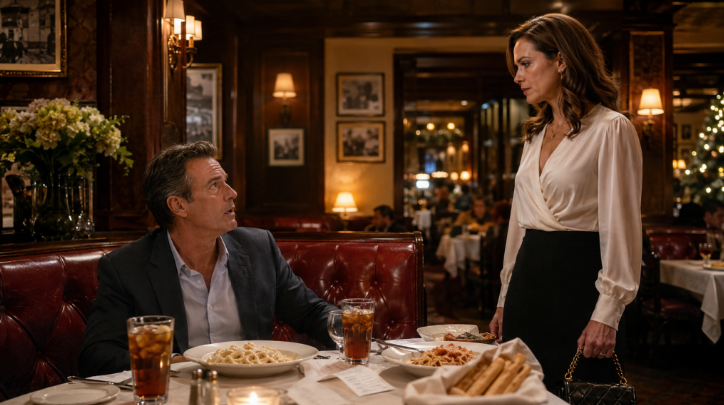
I told my wife on our twenty-fifth anniversary. Olive Garden. Her favorite booth. The one near the window where she always said the light made the breadsticks look “too pretty to eat,” even though she always ate three before the salad came. Dinner was seventy-eight dollars. I remember that stupid number because later, when everything in my life was falling apart, the receipt was still in my jacket pocket. Seventy-eight dollars for chicken alfredo, lasagna, two iced teas, and the end of a marriage
I thought I had already damaged beyond repair years ago. I ordered first. My wife, Elaine, got the chicken alfredo. She smiled at the waitress and asked for extra sauce on the side. She looked beautiful that night. Not young beautiful. Better than that.
She had the kind of face that carried years with dignity. Small lines around her eyes. Silver at her temples. Hands that had held babies, folded laundry, signed mortgage papers, wiped tears, and still reached for mine across tables when she thought I needed comfort.That was the worst part.
She still reached for me.
And I had come there to confess.
I waited until the waitress left.
Elaine lifted a breadstick, broke it in half, and said, “Can you believe it? Twenty-five years.”
I stared at the basket between us.
“No,” I said. “I really can’t.”
She laughed softly, thinking I was being sentimental.
Then I said, “I need to tell you something.”
Her hand stopped halfway to her plate.
The breadstick lowered slowly.
Something in my voice must have warned her, because her smile faded before I said another word.
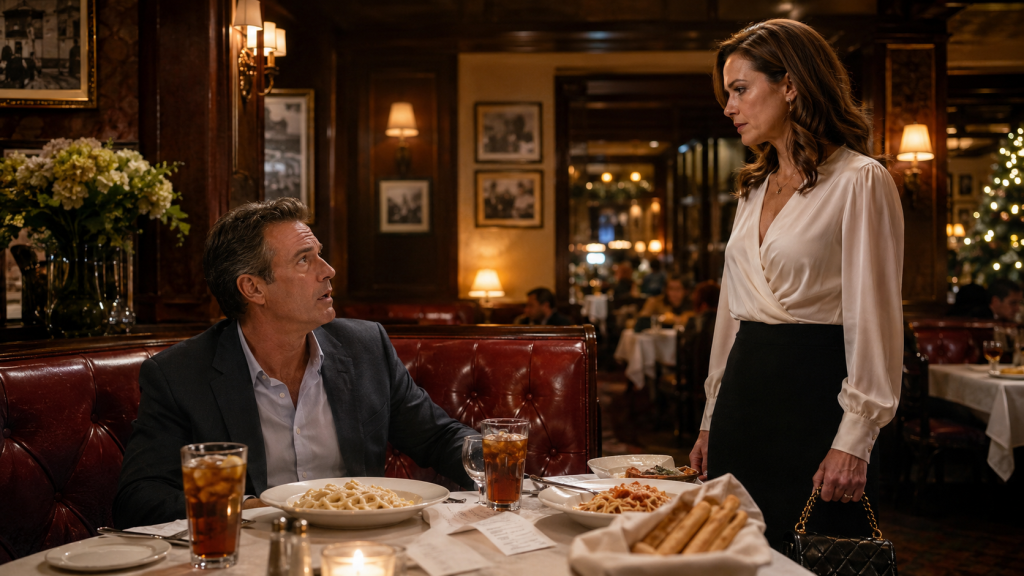
“What is it, Richard?”
I had rehearsed it in the car.
In the bathroom mirror.
In my office after everyone left.
I had imagined saying it clearly, like a man taking responsibility.
But when the moment came, the words crawled out of me like something sick.
“In 2011, I had an affair.”
The restaurant noise seemed to pull away from us.
Forks clinking.
A child laughing.
Someone singing happy birthday three tables over.
Elaine just stared at me.
She didn’t blink.
I kept going because if I stopped, I knew I would never finish.
“It lasted four months. I ended it. I swear to you, I ended it.”
Her face didn’t change.
No tears.
No gasp.
No shaking hands.
Just stillness.
The kind of stillness that made me feel more afraid than yelling ever could.
Finally, she asked, “Why now?”
Not “How could you?”
Not “Who was she?”
Just that.
Why now?
I swallowed.
“The woman called last week.”
Elaine’s eyes sharpened.
“She has a daughter,” I said. “Twelve years old.”
My voice cracked on the next part.
“She looks like me.”
Elaine placed the breadstick down on the small white plate.
Very carefully.
Like it was breakable.
“She has the same birthmark,” I said. “Behind the left ear. The same one I have. The girl needs surgery. Forty-seven thousand dollars.”
Elaine leaned back against the booth.
“And the woman asked you for money.”
It wasn’t a question.
I nodded.
“She said she didn’t want anything before. But now the girl is sick. She needs help.”
“What’s the woman’s name?”
“Marissa.”
Elaine looked toward the window.
Outside, cars passed in the dark. Their headlights moved across her face like water.
Then she picked up her purse.
She stood.
I reached for her hand, but she moved away before I touched her.
“Elaine, please—”
She looked down at me.
Her voice was steady.
Too steady.
“I knew about her.”
My mouth went dry.
“What?”
“I knew about Marissa,” she said. “Since 2012.”
For a moment, I couldn’t understand the words.
My shame had expected discovery.
Anger.
Divorce papers.
Maybe hatred.
But not this.
Not knowledge carried quietly for thirteen years.
“You knew?”
“Yes.”
“How?”
Elaine’s mouth trembled once, but she pulled it back into control.
“Because in 2011, while you were with her, I was at the same hotel.”
The room tilted.
“What are you talking about?”
“Different floor,” she said.
Then she leaned closer.
“With your brother.”
I couldn’t breathe.
My brother.
Daniel.
My younger brother by three years.
The one who stood beside me at our wedding.
The one Elaine always hugged at Christmas.
The one who called me every birthday and ended every message with, “Love you, man.”
I stared at her like she had slapped me.
“No,” I whispered.
Elaine gave a bitter little smile.
“That’s almost exactly what I said when I saw your car there.”
I sat frozen in that booth while she told me everything.
How she had suspected me for weeks.
How I said I was working late, but came home smelling like perfume that wasn’t hers.
How I guarded my phone.
How I became impatient with her for asking normal questions.
One night, she followed me.
Not because she wanted to catch me.
Because she wanted to prove herself wrong.
She drove behind me from a distance, praying I would turn toward the office.
But I didn’t.
I pulled into a hotel parking lot outside town.
And before she even had time to decide what to do, Daniel pulled in too.
She thought he was following me.
She thought maybe he knew.
Maybe he had come to confront me.
Then Daniel saw her sitting in her car.
He walked over.
Elaine said she was shaking so badly she couldn’t unlock the door at first.
Daniel got in beside her and asked, “How long have you known?”
She said, “Known what?”
And he said, “That Richard is seeing someone.”
That was how it started.
Two betrayed people sitting in a car outside a cheap hotel, watching my life become something ugly through a second-floor window.
Daniel did not comfort her at first.
He was angry.
At me.
At the situation.
At himself for knowing too much and saying too little.
Elaine said they sat there for almost an hour, saying the kinds of things people say when pain has nowhere safe to go.
Then she cried.
Daniel put his arm around her.
Then one mistake became another.
Not that night.
She made that clear.
She said she drove home alone.
But over the next few weeks, while I was busy lying to her, she and Daniel kept talking.
At first about me.
Then about themselves.
Then about loneliness.
Then about things that should never have been said.
“And yes,” Elaine said, standing beside that Olive Garden booth with her purse clutched in both hands. “It happened. Once.”
My stomach turned.
“Once?”
“Once.”
“When?”
“The week before you ended your affair.”
I pressed both hands against my face.
Around us, life continued in its ordinary, insulting way.
The waitress came with our food and froze when she saw Elaine standing.
“Is everything okay?”
Elaine looked at the steaming plates.
The extra alfredo sauce.
The anniversary dinner.
“No,” she said softly. “Can you box mine, please?”
Then she walked out.
I should have followed immediately.
Instead, I sat there like a coward while the waitress placed two untouched meals on the table.
My phone buzzed.
It was Daniel.
For one insane second, I thought Elaine had already called him.
But the message had come before the confession.
Happy anniversary, old man. Tell Elaine we love her.
We.
He meant him and his wife.
His wife, Patricia.
The woman Elaine still met for coffee once a month.
The room closed in on me.
I paid the seventy-eight dollars.
Tipped too much.
Took the boxes because I didn’t know what else to do.
Then I walked into the parking lot and found Elaine sitting in her car, both hands on the steering wheel.
I knocked on the window.
She didn’t unlock the door.
“Elaine,” I said through the glass. “Please let me talk.”
She stared forward.
I stood there like a fool holding chicken alfredo and lasagna while families walked past us.
Finally, the window rolled down two inches.
“You don’t get to look wounded,” she said.
That broke something in me.
“I know.”
“No,” she said. “You don’t. You confessed because your affair finally became expensive.”
I flinched.
She was right.
For thirteen years, I had hidden behind time.
I told myself the affair was dead.
That confessing would only hurt her.
That silence was mercy.
But the truth was uglier.
I had stayed quiet because silence protected me.
“I was going to tell you,” I said.
Elaine turned then, and the look on her face made me wish she had screamed.
“No, Richard. You were going to ask me what to do with your possible daughter.”
I couldn’t answer.
Because that was true too.
The girl’s name was Lily.
Marissa had sent me photos.
A child with my eyes.
My chin.
My same uneven smile.
She was thin, pale, and sitting in a hospital bed wearing a purple hoodie.
When I first saw the birthmark behind her ear, I had to sit down.
I wanted to deny it.
I wanted to accuse Marissa.
I wanted to demand a test.
But I knew.
Some part of me knew before proof ever came.
“Did you know about the child?” I asked Elaine.
Her lips pressed together.
“No.”
That was the first time her voice cracked.
“I knew about the woman. I knew about the hotel. I knew about your lies. But no, Richard. I did not know there was a child.”
She looked away.
“That part is new.”
I stood in the cold with the food containers growing warm against my arm.
“I’m sorry,” I said.
Elaine laughed once, but there was no humor in it.
“Sorry is what you say when you spill soup. What do we even call this?”
I had no answer.
When she drove away, she didn’t go home.
I know because I went there.
The house was dark.
For the first time in twenty-five years, I walked into our home and felt like a stranger breaking in.
Her anniversary card was still on the kitchen counter.
She had written my name on the envelope in her careful handwriting.
Richard.
I opened it because I was selfish enough to want to know what she had loved about me that morning.
Inside, she had written:
Twenty-five years. I would choose you again, even with every hard season. Love, Elaine.
I sat at the kitchen table until sunrise.
At six-thirty, Daniel called.
I didn’t answer.
He called again.
Then texted.
Elaine called me. We need to talk.
I wanted to throw the phone through the window.
Instead, I called him back.
The moment he answered, neither of us spoke.
Then he said, “I’m sorry.”
I gripped the edge of the table.
“How long have you been waiting to say that?”
He exhaled.
“Thirteen years.”
“Did you love her?”
Silence.
That silence was a second betrayal.
“Daniel.”
“No,” he said finally. “Not like that. But I cared about her. She was destroyed, Rich. You destroyed her.”
“And you helped?”
“I know.”
“You slept with my wife.”
“You were sleeping with someone else.”
The old anger in his voice stunned me.
As if part of him had been waiting for permission to hate me.
“That doesn’t make it right,” I said.
“No,” Daniel said. “It doesn’t.”
Then his voice dropped.
“But you don’t get to act like I broke something whole.”
I hung up.
Not because he was wrong.
Because he wasn’t.
Elaine came home the next afternoon.
She looked exhausted.
No makeup.
Hair pulled back.
Eyes swollen.
She walked past me into the bedroom and came out with a small suitcase.
“Where are you going?”
“To Laura’s.”
Our oldest daughter.
My heart lurched.
“What did you tell her?”
Elaine stopped by the door.
“The truth.”
My knees nearly gave out.
“All of it?”
Her eyes met mine.
“Not Daniel. Not yet.”
Not yet.
Those two words sat between us like a loaded gun.
“What about Lily?” I asked.
Elaine looked at the floor.
“That child didn’t ask to be born into our mess.”
I nodded.
“She needs surgery.”
“I know.”
“I have to help her.”
Elaine’s face twisted in pain.
“Yes,” she said. “You do.”
That surprised me.
“You think I should pay?”
“I think a twelve-year-old girl should not suffer because adults were selfish.”
Then she added, “But if you take one dollar from our joint savings without a legal paternity test and without telling our children everything they deserve to know, I will file for divorce before the bank opens.”
I believed her.
For the next week, my life became a series of phone calls I had spent thirteen years avoiding.
A lawyer.
A clinic.
Marissa.
Daniel.
My daughters.
Laura cried when I told her.
Our younger daughter, Sophie, went completely silent.
Then she asked one question.
“Do I have a sister?”
I said, “Maybe.”
She whispered, “No, Dad. You know.”
And I did.
The paternity test only confirmed what everyone already understood.
Lily was my daughter.
The surgery was real.
The cost was real.
Marissa was not asking for designer bags or revenge money.
She was asking because she was desperate.
When I finally met Lily, it was in a children’s hospital waiting room.
She looked smaller than she did in photos.
Her hair was tied back in a loose ponytail.
She had a book on her lap but wasn’t reading it.
Marissa stood when she saw me.
For a second, I saw the woman from 2011.
Then I saw the years on her face too.
“Lily,” she said carefully. “This is Richard.”
Not your father.
Not Dad.
Just Richard.
Lily looked up at me.
And there it was.
My eyes in a child who had never asked for them.
“Hi,” she said.
My throat burned.
“Hi, Lily.”
I had imagined guilt before.
But guilt in imagination is clean.
Guilt in real life has a hospital bracelet.
Guilt has thin wrists and nervous fingers.
Guilt asks politely if you like books because she doesn’t know what else to say to the stranger who helped create her.
I paid for the surgery.
Not from the joint account.
I liquidated investments in my name.
Took penalties.
Sold the boat I barely used.
It didn’t make me noble.
It made me late.
Elaine did not come to the hospital.
I didn’t ask her to.
But on the morning of Lily’s surgery, as I sat alone in the waiting room with bad coffee in my hand, I got a text.
It was from Elaine.
Tell her I hope she comes through safely.
I stared at that message for a long time.
Then I cried for the first time since the anniversary dinner.
Lily survived.
The surgery went well.
The doctor said the next few months would matter, but she was strong.
When I told Elaine, she only replied:
Good.
That was all.
One word.
But I knew my wife well enough to understand what it cost her to send it.
Three months later, Elaine asked me to meet her.
Not at home.
Not at a lawyer’s office.
At Olive Garden.
The same booth.
I almost said no.
Then I realized she had chosen it on purpose.
This time, she ordered first.
Chicken alfredo.
Extra sauce.
I ordered soup because my stomach couldn’t handle more.
She looked at me across the table for a long moment.
“I’m not here to punish you,” she said.
“I know.”
“I’m not here because I forgive you either.”
I nodded.
“I know that too.”
She folded her hands.
“I have spent thirteen years thinking silence was strength.”
My chest tightened.
“It wasn’t,” she said. “It was poison. For both of us.”
I looked down.
“I’m sorry.”
“I believe you,” she said.
Those three words hurt more than if she had called me a liar.
Because I didn’t deserve belief.
Then she said, “Daniel told Patricia.”
I looked up sharply.
“When?”
“Last week.”
“What happened?”
Elaine’s face was tired.
“What do you think happened?”
I closed my eyes.
Another marriage bleeding because of mine.
“Elaine…”
“No,” she said. “Don’t make yourself the center of that too. Daniel made his choice. I made mine. You made yours.”
She was right.
Again.
She reached into her purse and placed two envelopes on the table.
One was thick.
One was thin.
“What are those?”
“The thick one is a separation agreement.”
My breath caught.
“And the thin one?”
She touched it gently.
“A letter.”
“To me?”
“To Lily.”
I stared at her.
Elaine’s eyes filled, but the tears did not fall.
“She is innocent. And one day, she may wonder whether everyone hated her for existing. I won’t be one of those people.”
That was Elaine.
Even broken, she found a way to be kinder than the rest of us deserved.
I reached for the letter, but she placed her hand over it.
“No. Marissa can decide when to give it to her.”
I nodded.
Then I looked at the separation agreement.
“So this is it?”
Elaine took a slow breath.
“I don’t know.”
That answer was worse and better than yes.
“I need space,” she said. “Real space. Not you sleeping in the guest room while we pretend we’re mature. I need to know who I am without carrying your secret.”
“And us?”
She looked around the restaurant.
At the families.
At the breadsticks.
At the ordinary world still turning.
“Twenty-five years doesn’t disappear,” she said. “But neither does betrayal.”
I nodded because there was nothing else to do.
When the waitress brought our food, Elaine actually smiled at her.
Small.
Polite.
Heartbreaking.
We ate mostly in silence.
At the end, I reached for the check.
Elaine stopped me.
“No,” she said. “I’ll pay for mine.”
That sentence split me open.
Not because of the money.
Because for twenty-five years, there had never been mine and yours at dinner.
Only ours.
Outside, we stood under the yellow glow of the restaurant sign.
The same place where she had driven away from me months before.
This time, she didn’t leave immediately.
“Do you love her?” she asked.
“Marissa?”
“No,” Elaine said. “Lily.”
I thought about the hospital bracelet.
The nervous smile.
The birthmark behind her ear.
The way she had asked if she could call me Richard for now, and how I told her she could call me whatever made her comfortable.
“Yes,” I said quietly. “I think I do.”
Elaine nodded.
“Then be better for her than you were for me.”
I couldn’t speak.
She turned toward her car.
“Elaine.”
She paused.
“I loved you,” I said. “I still do.”
She looked back at me.
“I know.”
Then she said the words that finally broke me.
“That was never the problem.”
She got into her car and drove away.
I stood there until her taillights disappeared.
The separation agreement was under my arm.
The receipt was in my pocket.
This time, dinner cost thirty-one dollars and forty-two cents.
I kept that receipt too.
Not because I wanted to remember the restaurant.
But because I needed to remember the price of waiting too long to tell the truth.
Some debts cannot be paid with money.
Some apologies arrive thirteen years late and still ask to be heard.
And some anniversaries do not celebrate what survived.
They reveal what was buried.
Ours did both.
And for the first time in my life, I understood that confession was not the end of the punishment.
It was only the beginning of honesty.