The house on the Main Line always smelled of antiseptic and old wood.
A stone manor built to look imposing, which it was, cold in the way that money gets when it calculates everything and warms nothing. The portraits on the dining room walls were oil paintings of men holding scalpels, their expressions arranged into the specific authority of people who have never been told they were wrong about anything important.
Chloe Sterling had grown up under those portraits.
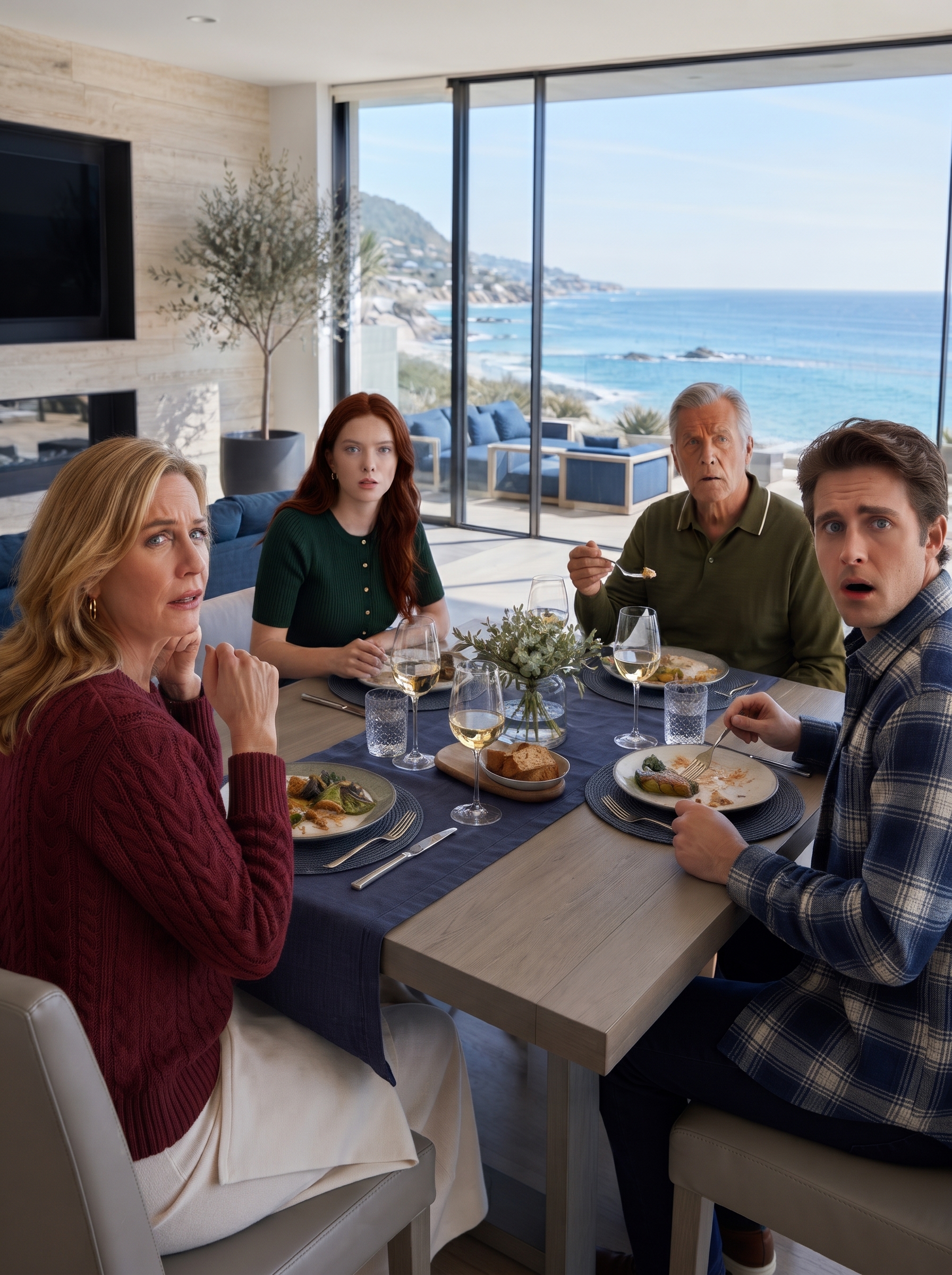
Dinner was at six sharp. Her brother Tyler sat to their father’s right. Chloe sat to his left. Their mother Patricia sat at the foot of the table like a beautiful, carefully maintained piece of furniture that had long since stopped serving its original purpose. The ritual was the same every evening: Dr. David Sterling, chief of surgery, would cut his steak with the precision of a man who considered even his meals a demonstration of technique, and he would conduct the dinner table the way he conducted his operating theater. With total authority and no interest in anything that fell outside the scope of what he had already decided mattered.
“Tyler,” he’d say, “tell us about the aneurysm repair.”
And Tyler would beam and say, “Clean clipping, Dad. Dr. Evans let me close.”
“Excellent.” A nod. Then the pivot to the left. “Chloe. Your rotation.”
She had learned early what the correct answer sounded like.
“Thirty-six hours. Three appendectomies. Perfect sutures.”
She never mentioned the other life. The one that started when the hospital lights dimmed and she found her way to the server room, where she could think without anyone auditing the process. While Tyler memorized anatomy, Chloe was teaching a machine to see it. She saw patterns where her father saw procedure. She saw data where he saw dogma. She saw a future he had not included in his curriculum because he did not believe it was real medicine, and therefore it did not exist.
Her partner Ethan, a coding prodigy she had met in the last month of undergrad, called it Panacea. An AI capable of predicting surgical complications faster than any human brain could process the inputs. The kind of tool that could catch what the best surgeon missed on the worst night of a thirty-six-hour shift.
Her father called technology a servant’s tool.
Real doctors cut. Real doctors had blood on their hands. Everything else was administrative fluff, the soft domain of people who couldn’t handle the operating theater.
So she lived the double life and said nothing and waited.
There was a night, close to the end of it all, when she found her mother in the drawing room with her hands resting on the keys of the grand piano. Not playing. Just touching. The piano gathered dust in the corner, a monument to a version of her mother that had existed before David Sterling had required a particular kind of wife and her mother had decided security was worth the trade.
She had been a concert pianist once.
“Do you miss it?” Chloe asked.
Her mother flinched and pulled her hand back.
“Don’t be silly, Chloe. Your father needs a wife, not a musician.”
Chloe stood in the doorway and looked at her mother’s face, and understood something she had been circling for years without landing on directly. Her mother wasn’t just passive. She was a warning. She had traded her voice for a particular kind of stability, and she had made that trade so long ago that she could no longer afford to acknowledge it was a trade. If Chloe broke free, it would prove the cage door had always been unlocked. And that was something her mother could not survive knowing.
So Chloe kept coding. She kept stitching. She waited for the algorithm to solve the equation of her life.
And then the email arrived.
It was the thirty-sixth hour of her shift. She was scrubbing out of a seven-hour craniotomy, her hands raw, her eyes burning from the fluorescent overhead lights, her mind doing the thing it did after long surgeries where it ran slightly outside herself like a program that hadn’t fully shut down.
She pulled her phone from her pocket.
One email.
Subject: Acquisition complete.
Wire amount: $32,000,000.
She stood very still in the scrub room and looked at the number on the screen and let the blue light wash over the blood specks on her surgical clogs. The number was large enough to look abstract at first, like a reading from a monitor in a room where the patient had already been stabilized. But it wasn’t a flatline.
It was a birth.
She drove straight to the manor. The rain was falling in heavy sheets, turning the Pennsylvania slate black and slick. She didn’t change out of her scrubs. She wanted them to see her in the uniform they worshipped one last time.
Dinner was in progress. The silence in the dining room had the particular weight of a room where everyone has stopped talking about what they are actually thinking. David sat at the head. Tyler was midway through a story about a resident he had humiliated during rounds, the kind of story that passed for entertaining at this table. Patricia was moving peas around her plate with her eyes somewhere else entirely.
Chloe did not sit down.
“I’m resigning,” she said.
David did not look up from his plate.
“Sit down, Chloe. You’re delirious. We’ll discuss your rotation schedule after you’ve slept.”
“I’m not tired,” she said, and her voice was steady and clear, the voice she had been practicing in the server room for three years while her father thought she was memorizing anatomy. “I submitted my letter of resignation to the board twenty minutes ago. I’m done with surgery. I’m done with the hospital. I’m done with this life.”
The silence that followed was the specific silence of a room where something irreversible has just been said aloud for the first time.
David set down his knife and fork with deliberate care. He looked at her the way he looked at equipment that had malfunctioned during a procedure: with the cold assessment of a man calculating the extent of the problem and whether it could be corrected.
“You are a Sterling,” he said. “We cut. That is who we are. Walk away from that residency and you walk away from this family.”
“I’m leaving to lead a technology division,” she said. “I built something, Dad. Something that will save more lives than your scalpel ever could.”
His face flushed deep red, the color climbing his neck.
“Technology? You want to be a technician? Support staff?”
He slammed his hand on the table hard enough to rattle the crystal.
“You are spitting on three generations of legacy. You are humiliating me.”
There it was. Not a father worrying about his daughter’s future. Not a surgeon concerned about the waste of a trained resident. Just a man looking at a mirror that had stopped reflecting what he needed to see, and calling it a betrayal.
“If you leave this house tonight,” he said, his voice dropping to something more dangerous than the shout, “you leave with nothing. No trust fund. No connections. No name.”
“I don’t need your name,” she said. “I have my own.”
“Give me the keys.” He held out his hand. “I paid for the car. I paid for the clothes on your back. If you want to be independent, start walking.”
She reached into her pocket. She put the key fob on the linen tablecloth, next to his untouched wine glass.
“You’re right,” she said. “You paid for everything except my mind.”
She turned and walked out.
Behind her, she heard her mother make a small sound, barely a breath, the sound of someone who has seen the door open and cannot move their feet. But she didn’t speak. She didn’t stand.
The heavy oak door slammed behind Chloe, and the sound of it echoed across the wet stone of the estate.
She walked to the edge of the property, where the manicured lawn met the treeline, and sat on a wet stone wall. She opened her laptop. The screen was the only light in the darkness around her.
Her bank account balance: zero. David had moved fast. The trust fund she had not touched since she was eighteen was frozen. The credit cards were canceled.
Or so he thought.
She logged into her secure cloud server. The acquisition funds sat in escrow, waiting for her final authorization.
She entered the code.
Transfer complete.
Then she looked at housing. Not hotels. Not rentals. She looked at listings in California, because she had been dreaming about the ocean for years in a way that had nothing to do with vacation and everything to do with distance.
She found it.
A fortress in Laguna Beach. Twenty-four and a half million dollars. Brutalist concrete, floor-to-ceiling glass, built on a cliff edge in Emerald Bay. It looked like a bunker designed by a poet, indestructible and beautiful and entirely indifferent to what you thought of it.
She called the realtor at three in the morning California time.
“I want to buy it,” she said. “Cash. Today.”
“Miss Sterling, you haven’t even seen it.”
“Send the papers.”
She closed the laptop. The rain had stopped. The night was quiet around her, and for the first time in as long as she could remember, the quiet felt like something she was allowed to fill.
She did not go to a hotel. She went to the startup office, to the small windowless server room that hummed with cooling fans and filtered air. She curled up on a beanbag chair in the corner in her damp coat and fell asleep listening to the sound of machines doing exactly what they were built to do.
The next morning, she flew to California.
She didn’t tell anyone. She didn’t say goodbye. She simply stopped being in Philadelphia.
The house was more imposing in person than in photographs, which she had not thought possible. A monolith of concrete and glass perched on a cliff with the Pacific Ocean below it, roaring at the rock constantly, indifferent to everything. She stood in the empty living room on the first day and felt not joy, not triumph, but something cleaner and harder than either.
Safety.
She hired a security team. She installed cameras covering every approach. She bought a white Range Rover and drove it along the coast highway with the windows down and the speed climbing and not a single thought in her head about what anyone would say about it.
She healed in the quiet of the concrete sanctuary. She woke when she wanted. She ate what she wanted. She did not report her location or her suture counts or her worth to anyone.
For three weeks, she was a ghost in her own life, and it was the closest thing to paradise she had ever experienced.
Then TechCrunch ran the profile.
The headline was efficient: The surgeon who traded the scalpel for code: inside the $32 million exit. It covered the acquisition, the technology, the clinical applications of Panacea across hospital systems. Near the bottom of the piece, in a paragraph that the writer probably considered a minor detail, it mentioned her relocation to a private estate in Emerald Bay, Laguna Beach.
The news reached Philadelphia faster than a pathogen in a closed system.
Her phone, which had been quiet and dark for three weeks, began to accumulate notifications like a trauma board filling up during a mass casualty event. Cousins she hadn’t spoken to in years. Medical school acquaintances who had pretended not to see her in hallways. Then the inner circle.
Tyler texted first. No greeting, no congratulations. Just a screenshot of the article and three words: Is this real?
It wasn’t concern. It was an audit. She could almost hear the calculations, the net worth differential between a neurosurgery resident and a tech founder, the math resolving into something that made him feel ill.
She didn’t reply.
Her mother called. Chloe let it go to voicemail and listened to it standing beside the infinity pool, the ocean crashing against the cliff below.
“Chloe.” Her mother’s voice cracked in the specific way of a performance that hadn’t been rehearsed quite enough. “Your father is falling apart. He saw the article. We didn’t know, we didn’t understand. We were just worried about you. We’re coming. We need to fix this family before it’s too late. We land Saturday.”
Not a question. An announcement. The old dynamic, unchanged and apparently unquestioned: they set the schedule, and the expectation was that she would scrub in.
But they had miscalculated the venue.
They weren’t coming to Philadelphia, where they held the keys. They were coming to her fortress.
She could have had security turn them away at the gate. She considered it. But she understood, in the way she understood the structure of a problem before she could articulate the solution, that blocking them would preserve the wrong narrative. She would be the runaway daughter, the one who cracked under pressure, the one who couldn’t face them. And they would believe that forever, because they needed to believe it.
She needed them to walk through the house.
She texted two words: Saturday noon.
Then she prepared, not flowers, not softened edges, nothing designed to ease their arrival. She wanted the house to look exactly like what it was: cold and expensive and completely without interest in impressing anyone. She was not setting a table for a family reunion. She was opening a deposition.
She called Ethan.
“They’re coming,” she said.
“Do you want me there?”
“No. Keep the server logs open. I might need the back end.”
“What are you going to show them?”
She looked at the light on the water, the way the sun cut across the surface of the Pacific like something surgical and precise.
“The future,” she said.
They arrived at noon exactly.