I heard the knock from the front porch before the truck even turned into the driveway.
It was a deep, heavy clatter coming from under the hood, like somebody beating a pipe with a hammer. Every time the engine turned over, it knocked. Knock. Knock. Knock.
I set down my coffee cup. My stomach dropped.
I’ve been a diesel mechanic for twenty-eight years. I’ve heard that sound a thousand times. It’s the sound of a spun rod bearing, an engine eating itself from the inside.
My mother’s 1966 Ford F-100 came limping up the gravel drive, red and white, with my nephew Trace behind the wheel. He pulled it up beside the porch, shut it off, and the knocking stopped. In the silence, I could smell hot oil.
Trace climbed out. He’s twenty-two, tall and skinny, with a backward cap and a racing team T-shirt from a dirt track in Hastings.
“Hey, Aunt Nora,” he said. “Grandma’s truck’s making a noise.”
“I heard it from the porch,” I said. “What did you do to it?”
He shrugged. “Nothing. It just started knocking on the way back.”
He looked at his shoes. “Just driving around.”
I walked over and put my hand on the hood. It was hot enough to fry an egg. I pulled the dipstick. The oil came out black and thin, and down at the bottom of the stick, glittering in the September sunlight, were tiny flecks of metal.
That was bearing material. Copper and lead, ground off and floating in the oil.
“Trace,” I said. “How fast were you going?”
He wouldn’t look at me.
My mother came out onto the porch then, in her green cardigan and slippers, holding a dish towel.
“Is something wrong with Harlan’s truck?” she asked.
Everybody in the family still calls it Harlan’s truck, even though Dad’s been gone for six years.
“It’s making a noise, Grandma,” Trace said. “I’ll look into it.”
He got in his own pickup, a lifted black Dodge with a loud exhaust, and drove off. Mom stood on the porch looking at the old Ford with her dish towel in her hands.
I didn’t tell her how bad. Not yet.
My name is Nora Brandt. I’m fifty-one. I’ve been a diesel mechanic at the Clay County Farmers Co-op in Fairfield, Nebraska, for twenty-eight years. I keep the grain trucks, the fertilizer rigs, and half the county’s combines running. I’m the only woman who’s ever held that job, and for the first ten years, most of the old farmers wouldn’t let me touch their equipment. Now they ask for me by name.
My mother, Evelyn, is seventy-nine. She lives alone in the white farmhouse south of town where I grew up, on the last forty acres of the farm. She rents the cropland to a neighbor and keeps a garden, a cat named Mister, and a 1966 Ford pickup.
Every morning at eight, she drives that pickup three miles into Fairfield to the grain elevator for coffee. There’s a little office at the co-op elevator with a coffee pot, a box of donuts, and a row of folding chairs. Every morning, a dozen retired farmers sit there, drinking bad coffee and arguing about the weather, the markets, and the Huskers.
My mother is the only woman who goes. She has been going for six years, ever since Dad died.
And when she pulls into the elevator lot, she honks twice. Beep, beep.
Dad started that. He’d honk twice every morning when he pulled in, to let the guys know he was there. When he died, Mom just kept doing it.
Dad bought that truck from a neighbor named Elmer Voss in 1994 for $1,800.
It’s a 1966 Ford F-100 in red and white two-tone, with a long bed, a 352 V8 engine, and a three-speed manual transmission on the column. Elmer bought it new from the Ford dealer in Hastings. When Elmer’s eyes got too bad to drive, he sold it to Dad, who’d admired it for twenty years.
Dad loved that truck more than he loved most people. He kept it in the machine shed out of the weather. He changed the oil every three thousand miles and wrote it down in a little spiral notebook in the glove box. He hauled sweet corn in it, and firewood, and once, my mother’s whole wedding cake to her sister’s reception in Grand Island.
When Dad died of a stroke at seventy-four, he left everything to Mom. His will was two pages long. The house, the forty acres, the money in the bank, and the truck.
The truck was still titled in his name. A few months after the funeral, I drove Mom to the Clay County Treasurer’s office in Clay Center to transfer the title into her name. Because Dad’s estate was small enough, the lawyer in Fairfield said we didn’t need to go through full probate. Mom just had to sign an affidavit as his heir and bring the death certificate. The woman at the treasurer’s office was very kind. She’d known Dad. She stamped the new title, Evelyn M. Brandt, Owner, and slid it across the counter.
“He loved that truck,” she said.
“He did,” Mom said. “Now I do.”
Mom didn’t drive much before Dad died. He’d always driven. But a month after the funeral, she took the keys off the hook in the kitchen, walked out to the machine shed, and drove that old Ford to the elevator for coffee.
When she pulled in, she honked twice.
Lowell Fisk, who’d been sitting at that coffee pot with Dad for forty years, told me later that every man in the elevator office stood up when they heard it. They thought, for just a second, that Harlan was back.
Then they saw Evelyn behind the wheel, and they all sat back down. And somebody poured her a cup of coffee.
She’s been going every morning since.
That truck is how my mother stayed alive after my father died. I mean that. It got her out of the house, gave her somewhere to go, and gave her a dozen people to talk to every day. Without it, she would have sat alone in that farmhouse with the cat.
My brother Kurt is three years younger than me. He works pipeline construction in North Dakota, laying natural gas lines, gone six weeks at a time. His son, Trace, lives in Fairfield and works at the tire shop on Main Street. In the evenings he builds race cars in his buddy’s garage.
Mom adores Trace. He’s her only grandchild. When he asked if he could borrow the old Ford on a Sunday in September to “haul some stuff,” she didn’t think twice.
She handed him the keys.
On Monday at noon, Trace came back.
I’d taken the day off to stay with Mom, because I knew what was coming and didn’t want her facing it alone. We were at the kitchen table eating tuna sandwiches when his black Dodge pulled into the yard.
He came in without knocking, the way he always does, and sat down across from his grandmother. He pulled three folded hundred-dollar bills out of his wallet and laid them on the oilcloth.
“Grandma,” he said, “I looked at the truck. It’s junk. The engine’s shot. It’d cost way more to fix than it’s worth.” He pushed the money toward her. “I’ll give you three hundred dollars for it and haul it off. That way you don’t have to deal with it.”
Mom looked at the money for a long time.
She didn’t touch it. She didn’t say anything. She just looked at those three hundred-dollar bills on the oilcloth, and I could see her doing arithmetic in her head. How much did a new truck cost? How much did a used truck cost? How would she get to the elevator?
I knew exactly what Trace wanted. He’d been talking about it for months, every Sunday dinner. He was building a dirt track race car, an old Ford Galaxie with a stripped interior and a roll cage. And he needed a 352 V8 block. Those old Ford FE blocks are popular with the guys who race at the dirt tracks in Hastings and Doniphan. A good one sells for eight hundred to twelve hundred dollars on its own, even with a bad bearing.
And Dad’s old Ford had a 352 under the hood.
Trace figured he’d give Grandma three hundred dollars, pull the engine, put it in his race car, and sell the rest of the truck for parts. He figured Grandma would never know the difference. He probably even figured he was doing her a favor.
The truck, running and in good shape, was worth fourteen or fifteen thousand dollars. I’d seen nice ’66 F-100s sell for more than that at the collector car auction in Kearney.
His dad, my brother Kurt, was on a pipeline job in Williston, nine hundred miles away. I could have called Kurt and made him deal with his son. I could have made a scene right there in the kitchen and told Trace exactly what I thought of him.
But neither one of those things would get my mother back to the elevator.
So I reached across the table, picked up the three hundred-dollar bills, folded them neatly in half, and put them back in Trace’s hand.
“No thank you,” I said.
Trace looked at me, startled. “Aunt Nora, it’s junk. I’m trying to help.”
“It’s not junk. It’s a spun rod bearing.” I kept my voice level. “And it didn’t happen by itself, Trace. A rod bearing doesn’t spin in a well-maintained engine that’s driven to the elevator and back every morning at forty miles an hour. It spins when somebody runs an engine wide open for a long time on a hot day. Like on the gravel section roads, racing somebody.”
Trace’s face went red.
“Kenny Dvorak saw you,” I said. “He called the co-op this morning. He said you and the Hofmeister boy were running side by side on the Road M mile, west of the Little Blue, at about eighty miles an hour. He said there was so much dust he couldn’t see his own mailbox.”
Trace opened his mouth and closed it again.
Mom turned and looked at him. It was a long, quiet look.
“Trace,” she said. “Is that true?”
He didn’t answer.
“I see,” my mother said.
She stood up, took her plate to the sink, and stood there with her back to us, looking out the window at the old Ford sitting by the machine shed.
Trace put the money back in his wallet and left without saying goodbye.
That night, I sat at my own kitchen table in Fairfield with a legal pad and figured out what it would take.
I knew diesel engines inside and out. A gasoline V8 from 1966 isn’t much different in principle. But pulling an engine and rebuilding it in a gravel driveway with no shop, no hoist, and no lift is a four-hand job, at least. I’d need someone to hold things while I bolted them, someone to guide the engine out while I worked the hoist, and someone who knew old Ford engines better than I did.
Then there was the money.
I made a list on the legal pad, the way I would for any customer at the co-op.
The crankshaft would need to go to a machine shop to be ground and polished. That would run about $280. A rebuild kit with new pistons, rings, rod bearings, main bearings, cam bearings, and a full gasket set would be about $640 from a parts company in Lincoln. A new oil pump, $85. A new timing chain set, $70. The connecting rods needed reconditioning, maybe $180 at the machine shop. Then oil, filters, coolant, and spark plugs, about $90. If the cylinders needed boring, another $300 or so.
That came to somewhere between $1,350 and $1,700, depending on what I found when I opened it up.
I had the money. I had a savings account at the bank in Fairfield with about $9,000 in it. It wasn’t a lot, but it was enough.
What I didn’t have was four hands.
The next morning, I drove to the co-op elevator at eight o’clock instead of going to the shop.
The coffee crowd was there in their folding chairs: Kenny Dvorak, Bud Simanek, Duane Kohler, the Pospisil brothers. And in the two chairs closest to the coffee pot, where they’d sat for twenty years, Lowell Fisk and Beryl Unger.
Lowell is eighty-one. Beryl is seventy-six. Between them, they ran the co-op’s repair shop for fifty years, from 1968 until they retired in 2018. They trained me when I came on in 1997, back when nobody else in the shop would let a woman touch a wrench. They kept every grain truck, tractor, and combine in Clay County running through blizzards, droughts, and the farm crisis of the eighties.
Lowell is tall and stooped, with enormous ears and a slow, careful way of talking. Beryl is short and round, with thick glasses and a laugh you can hear across a parking lot. Beryl’s hands shake now, from a tremor his doctor in Hastings says is benign. He can’t hold a coffee cup without spilling it.
I sat down in a folding chair across from them, and I told them what happened. The Sunday. The section road. The knock. The three hundred dollars. The 352 block Trace wanted for his race car.
When I finished, nobody in the elevator office said anything for a while.
Then Lowell set his coffee cup down on the folding table, very carefully.
“Saturday?” he said.
“Saturday,” Beryl said.
I didn’t even have to ask.
I called the co-op manager, a young man named Josh Pavlik, and asked whether I could borrow the portable engine hoist from the shop.
“My mother’s truck. Her grandson blew the engine. Lowell and Beryl are going to help me rebuild it in her driveway.”
Josh was quiet for a second. “Lowell Fisk and Beryl Unger?”
He laughed. “Take the hoist. Take the engine stand too. And the parts washer. And whatever else you need.” He paused. “Tell Lowell he still owes me a donut from last Thursday.”
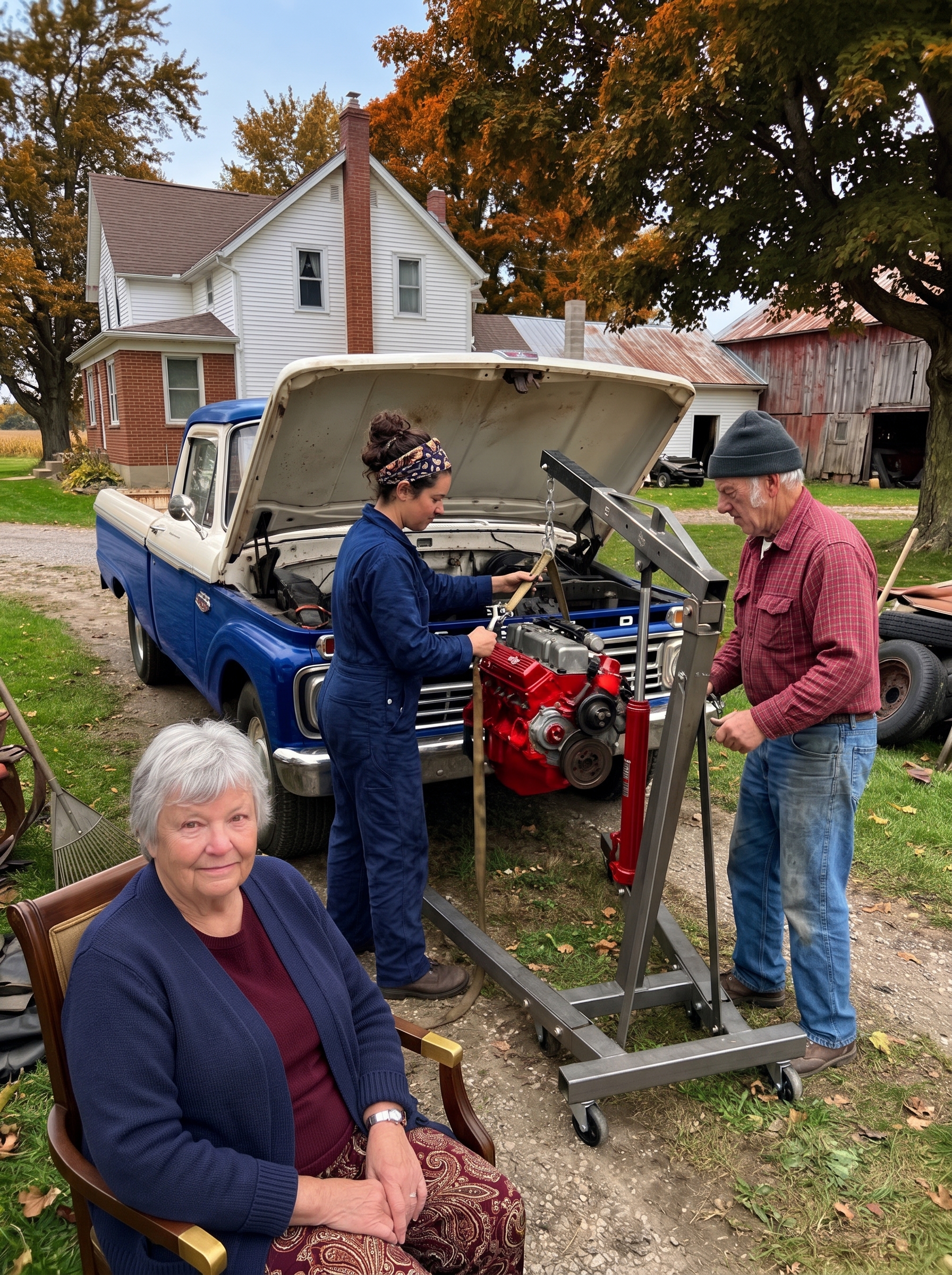
On Saturday morning, Lowell and Beryl showed up at Mom’s farmhouse at seven-thirty in Lowell’s old Chevy, wearing seed caps and flannel shirts, carrying a red toolbox apiece. Beryl had brought a thermos of coffee and a sack of cinnamon rolls from the bakery in Clay Center.
Mom came out on the porch in her green cardigan. She’d set up a webbed aluminum lawn chair at the edge of the gravel, right beside the truck.
“I’m going to watch,” she announced. “If you don’t mind.”
We pulled the engine that first Saturday, right there in the gravel.
It took us six hours. We drained the coolant and the oil, and unbolted the radiator, the fan, the alternator, the starter, the exhaust manifolds, the carburetor, and the wiring harness. Lowell labeled every wire with a piece of masking tape and a ballpoint pen. Beryl put every bolt in a coffee can, with a note written on the lid saying where it came from.
“You don’t remember where it goes,” Lowell said. “You write down where it goes. That’s the difference between a mechanic and a guy with tools.”
When everything was loose, I rolled the co-op’s engine hoist up to the front of the truck and hooked the chain to the engine. Lowell guided it from one side. Beryl, with his shaking hands, steadied it from the other.
“Easy,” Lowell said. “Easy. She’s coming.”
The 352 came up out of the engine bay slowly, swinging a little on the chain. Six hundred pounds of cast iron that had been sitting in that truck since 1966. Under it, the engine bay was a cave of dust and old grease.
I lowered it onto the engine stand, and we bolted it down.
Mom sat in her lawn chair the whole time, watching every bolt come out. She didn’t say much. Once, she got up and brought us glasses of iced tea. Once, she went inside and came back with a plate of egg salad sandwiches.
Around four o’clock, she said, very quietly, “Harlan would’ve liked this.”
Lowell looked at her. “Harlan would’ve been out here telling us we were doing it wrong.”
Mom laughed. It was the first time I’d heard her laugh since Sunday.
On Sunday, I took the engine apart on the stand in Mom’s machine shed.
When I pulled off the oil pan, I found exactly what I expected. The number six connecting rod bearing had spun in its seat. The soft bearing metal had worn away completely, and the steel rod had been grinding directly against the crankshaft. The crankshaft journal was scored and blue from the heat.
The rest of the engine was in surprisingly good shape. The cylinder walls were smooth. The pistons looked fine. The camshaft was barely worn.
Dad’s oil changes every three thousand miles, all written down in that little spiral notebook, had kept that engine healthy for thirty years.
All it took to ruin it was one Sunday afternoon on a gravel road.
On Monday, I drove the crankshaft and the connecting rods to the machine shop in Hastings, a small, dusty place run by a man named Gordy Bauer, who’d been grinding crankshafts since the Nixon administration.
He held the crank up to the light and turned it slowly, looking at the scored journal.
“Somebody ran this wide open,” he said.
“My nephew.”
“Racing?”
“On the gravel. Against the Hofmeister boy.”
Gordy grunted. “Kids think an engine is a light switch. On, off.” He set the crank down on his bench. “I can grind it ten under. Polish it. It’ll be good as new. Two hundred and eighty, plus the rods. Ready Thursday.”
“Thank you, Gordy.”
“Whose truck is it?”
“My mother’s. My dad’s, really. Harlan Brandt.”
Gordy looked up sharply. “Harlan Brandt? The ’66 with the two-tone?” He shook his head slowly. “I rebuilt the carburetor on that truck in 1996. Harlan sat right there on that stool and talked my ear off about the Huskers for two hours.” He picked up the crank again and looked at it differently. “I’ll do it for two-fifty. And I’ll have it Wednesday.”
I ordered the rebuild kit from the parts company in Lincoln that night, on my laptop at Mom’s kitchen table. Pistons, rings, bearings, gaskets, a new oil pump, a timing chain. $868 with shipping. I paid for it out of my savings account and wrote it down in a new spiral notebook. On the cover, I wrote the same thing Dad had written on his: F-100.
The total so far was $1,118.
Mom watched me type in my credit card number.
“Nora, let me pay for that.”
“No, Mom.”
“It’s my truck.”
“It’s my nephew who broke it,” I said. “And it’s my brother who isn’t here.”
She was quiet for a moment. “Have you called Kurt?”
“Not yet.”
“Are you going to?”
“When it’s done,” I said. “I want to tell him it’s fixed. Not that it’s broken.”
She nodded slowly. Then she reached across the table and put her hand over mine.
“Your father always said you were the only one of us who could fix anything,” she said. “He was right.”
The second Saturday, we washed every part by hand.
Josh at the co-op had let us borrow the big parts washer from the shop, a steel tub of solvent with a pump and a brush. We set it up in Mom’s machine shed. Lowell, Beryl, and I spent the whole day cleaning every piece of that engine. The block, the heads, the intake manifold, the oil pan, the valve covers, every bolt and washer and spring.
It’s slow, dirty, boring work. You scrub every surface with a brass brush in the solvent until it’s clean enough to eat off. Then you blow it dry with compressed air and wipe it down with clean shop rags.
Beryl couldn’t hold a brush steady with his tremor, so he sat on an overturned bucket and sorted bolts into coffee cans by size, peering at each one through his thick glasses.
“I used to be able to rebuild a carburetor blindfolded,” he said, a little bitterly. “Now I can’t hold a coffee cup.”
“You can sort bolts,” Lowell said.
“Any kid can sort bolts.”
“Any kid doesn’t know which bolts go where,” Lowell said. “You do.”
Beryl grunted, but he looked pleased.
Around noon, Mom brought out a pot of chili and a pan of cornbread and set it on a sheet of plywood across two sawhorses. We ate standing up, in our greasy clothes, in the cool shade of the machine shed.
“Evelyn,” Lowell said, “this chili is better than Harlan ever deserved.”
“He told me it was too spicy every single time,” Mom said. “Every single time, for fifty-one years. And every single time he had two bowls.”
Lowell laughed so hard he had to set down his spoon.
That afternoon, while we were scrubbing the cylinder heads, a car slowed down on the gravel road in front of the farmhouse.
It was Trace’s black Dodge.
He slowed down to almost a crawl, looking at the yard: the engine on the stand, the parts washer, the three of us bent over the heads, Mom in her lawn chair.
He didn’t stop. He sped up and drove on toward town.
“That the grandson?” Beryl asked.
“That’s him.”
Beryl adjusted his glasses and watched the Dodge disappear down the road in a cloud of dust.
“He’ll be back,” Beryl said.
“How do you know?”
“Because he slowed down,” Beryl said. “A boy who doesn’t care doesn’t slow down.”
On Wednesday, I picked up the crankshaft and rods from Gordy Bauer in Hastings. The crank was ground and polished to a mirror finish. The rods were reconditioned and boxed up neatly. Gordy’s bill came to $412 for everything, and he’d written at the bottom of the invoice in pencil: For Harlan.
That brought the total to $1,530.
That night, my brother Kurt called me from North Dakota.
“Nora, what’s going on with Dad’s truck? Trace called me last night. He sounded weird.”
“Weird how?”
“Like he’d been crying. He wouldn’t tell me what was wrong. He just said, ‘Dad, I messed up Grandma’s truck,’ and hung up.”
I told Kurt everything. The Sunday. The section road. The eighty miles an hour. The spun bearing. The three hundred dollars on the kitchen table. The 352 block for his race car.
Kurt didn’t say anything for a long time.
“I’m going to kill him,” he said finally.
“No, you’re not.”
“He tried to steal Mom’s truck, Nora. For three hundred bucks.”
“He tried to buy a broken truck from his grandmother for less than it was worth,” I said. “It was a lousy thing to do. But it’s not stealing, Kurt. Mom said no. Or I said no for her. That’s the end of that part.”
“I’m going to pay for the engine. Whatever it costs.”
“No,” I said. “Trace is.”
Kurt was quiet.
“He’s twenty-two, Kurt. He works at the tire shop. He’s got a job. He blew the engine. He pays for the engine. Not you, not me, not Mom.”
“He doesn’t have fifteen hundred dollars.”
“Then he’ll pay it a little at a time. Like a grownup.”
There was another long silence on the line.
“You sound like Dad,” Kurt said finally.
“Somebody has to,” I said.
Before we hung up, Kurt said one more thing.
“Nora. Is Mom’s car insurance going to cover any of it?”
I’d already checked. I’d called Mom’s insurance agent, a nice woman named Patty Rezac at the State Farm office in Clay Center, on Tuesday.
“Comprehensive and collision don’t cover mechanical breakdowns,” Patty had said. “If he’d rolled it in a ditch, that’d be one thing. But an engine failure from wear or abuse isn’t covered by any auto policy I know of.”
Then she’d added, “Was Trace listed as a driver on your mother’s policy?”
“No.”
“Then you’re lucky he didn’t roll it,” Patty had said quietly. “If he’d hurt somebody racing on that gravel road, in a truck he wasn’t listed on, your mother could have been in real trouble. A lawsuit could have gone after her house.”
I’d sat in my truck in the co-op parking lot for a long time after that call.
I told Kurt what Patty said.
He swore under his breath.
“I’ll talk to him,” he said.
“Talk to him,” I said. “But don’t fix it for him.”
The third Saturday, we built the engine back up on the stand, piston by piston.
This is the part I love. It’s like putting together a watch. Every part has its place, and every part has to be exactly right.
First, we installed the new cam bearings and slid the camshaft in. Then the new main bearings. Then Lowell and I lifted the freshly ground crankshaft and set it gently into the block, like laying a baby in a crib. Then the main bearing caps, each one torqued to exactly ninety-five foot-pounds, in a specific order.
Then the pistons. I fitted each piston with its new rings, using a ring compressor, and slid it down into its cylinder. Then I attached the connecting rod to the crankshaft journal with the new rod bearings, and torqued each rod cap to exactly forty-three foot-pounds.
That’s where Beryl came in.
His hands shake now. They shake when he holds a coffee cup, a fork, a pen.
But not when he’s holding a torque wrench.
I watched it happen. I held each rod cap in place, and Beryl fitted the torque wrench onto the nut. And his hands went still. Absolutely, perfectly still. He pulled the wrench in one slow, smooth motion until it clicked at forty-three foot-pounds.
Click.
Then he moved to the next one.
Click.
Eight rods. Sixteen nuts. Sixteen clicks. His hands never shook once.
When he finished the last one, he set the torque wrench down on the bench and stared at his hands. They were trembling again, just a little.
“Huh,” he said softly.
“Beryl,” Lowell said. “You still got it.”
Beryl took off his glasses and wiped his eyes with the back of his wrist.
“Fifty years,” he said. “Fifty years, I’ve been torquing rod caps. My hands just know.” He laughed shakily. “Doctor told me I’d never do fine work again. I’d like to see that doctor torque a rod cap.”
Lowell put his big hand on Beryl’s shoulder and left it there.
That afternoon, we installed the new oil pump, the timing chain, the oil pan, and the cylinder heads with new head gaskets, each head bolt torqued in sequence to seventy-five foot-pounds. Then the intake manifold, the valve covers, and the water pump.
By six o’clock, the old 352 sat on the engine stand in Mom’s machine shed, clean and complete, painted Ford blue with a fresh can of engine enamel I’d picked up at the auto parts store in Hastings.
Mom came out of the house and stood in the doorway of the machine shed, looking at it.
“It looks new,” she said.
“It is new,” Lowell said. “Inside, anyway.”
“Can it go back in the truck?”
“Next Saturday,” I said. “And then you can drive it to the elevator.”
Mom pressed her hand against her mouth.
“Next Saturday,” she repeated.
By the fourth Saturday, word had gotten around the elevator.
I don’t know who told first. Probably Kenny Dvorak. Kenny can’t keep anything to himself. But by Friday, every man in the elevator coffee crowd knew that Lowell Fisk, Beryl Unger, and Nora Brandt were putting the engine back in Harlan Brandt’s ’66 Ford on Saturday afternoon in Evelyn’s driveway.
When I pulled into Mom’s yard at seven-thirty Saturday morning, there were already two pickups parked along the road.
By noon, there were eleven.
By two o’clock, pickups lined both sides of the gravel road in front of the farmhouse, from the mailbox to the corner. Half the elevator coffee crowd stood in Mom’s yard with their hands in their pockets: Kenny Dvorak, Bud Simanek, Duane Kohler, both Pospisil brothers. Elmer Voss’s son, Gerald, who’d sold Dad the truck in 1994. Gordy Bauer, who’d driven all the way up from Hastings. Patty Rezac from the insurance office, who’d brought a plate of brownies. Josh Pavlik, the co-op manager, who’d brought a cooler of pop.
Nobody did much. They just stood around in the yard in their seed caps and jackets, talking quietly, watching.
It was a bright fall afternoon, sixty-five degrees, with a high blue sky and the cottonwoods along the creek just starting to turn gold.
We rolled the engine hoist back out of the machine shed and lifted the rebuilt 352 off the stand. Lowell guided it across the gravel. Beryl walked alongside, steadying it with one hand on the valve cover. I worked the hoist.
Then we lowered it slowly back down into the engine bay of the red and white Ford.
Everybody in the yard stopped talking.
“Easy,” Lowell said. “Easy. Left a little. There. Now down.”
The engine settled onto its mounts with a soft clunk. I bolted the motor mounts. Lowell reconnected the transmission. Beryl, sitting on the front bumper, reconnected the wiring harness, reading each of Lowell’s masking-tape labels through his thick glasses.
Then the radiator. The fan. The alternator. The starter. The exhaust manifolds. The carburetor. Fresh oil, five quarts of 10W-30. Fresh coolant. New spark plugs and plug wires.
Lowell and Beryl stood beside me at the fender in their seed caps and flannel shirts, handing me tools one at a time without my having to ask. A 9/16 wrench. A 1/2-inch socket. A screwdriver. They’d done it for me when I was twenty-three and terrified and nobody else in the co-op shop would let me touch a wrench.
I leaned into the engine bay in my blue coveralls and tightened the last bolt, the one holding the air cleaner on top of the carburetor.
I straightened up and wiped my hands on a shop rag.
“That’s it,” I said. “It’s done.”
That was when a pickup I knew turned into the driveway off the road.
It was Trace’s black Dodge.
He parked behind the long line of pickups on the road and got out slowly.
He wasn’t wearing his backward cap or his racing team T-shirt. He wore a plain gray hooded sweatshirt and jeans, and he looked like he hadn’t slept. He walked up the gravel drive and stopped at the edge of the yard, at the edge of the crowd.
He stood there with his hands in his sweatshirt pocket and didn’t say a word.
Nobody else did either.
Every man in that yard knew what Trace had done. It was a small town. Kenny Dvorak had told them all about the race on the Road M mile, and somebody had told them about the three hundred dollars. I watched them look at him, one after another: the old farmers, the retired mechanics, the insurance lady, the co-op manager. Nobody said anything. They just looked.
Trace stood there and took it.
Then my mother got up out of her lawn chair.
She brushed off the front of her green cardigan and patted her white hair. Then she looked at Lowell.
Lowell reached into the pocket of his flannel shirt and pulled out the keys to the truck: a single Ford ignition key on a brass ring, with a little leather fob that said HARLAN in faded gold letters. Mom had given them to Lowell that morning for safekeeping.
He held them out to her.
She took them.
She walked slowly across the gravel toward the red and white Ford. She opened the driver’s door with a creak, climbed in, and pulled the door shut behind her.
Trace took one step closer.
My mother put the key in the ignition. Then she looked at me through the windshield.
I nodded.
She turned the key.
The starter cranked once, twice, three times. The rebuilt engine was dry inside, and the fuel pump had to fill the carburetor bowl. I held my breath. Lowell held his breath. Beryl gripped the fender with his shaking hand.
On the fourth crank, the 352 caught.
It roared to life with a deep, smooth, throaty rumble that I felt in my chest and down into my boots. It idled high for a few seconds, then settled down to a steady, even purr.
No knock.
No clatter.
Just a strong, clean, perfect rumble, like a big cat purring.
Somebody in the crowd let out a whoop. Then everybody was clapping and cheering. Kenny Dvorak threw his cap in the air. Gordy Bauer was laughing and wiping his eyes. Patty Rezac was hugging Josh Pavlik.
Beryl stood beside me with his hands on the fender, tears running down behind his thick glasses.
Lowell took off his seed cap and held it over his heart.
And my mother sat behind the wheel of my father’s truck with both hands on the steering wheel and her eyes closed, listening to the engine purr.
Then she opened her eyes, reached up, and honked the horn twice.
Beep, beep.
The crowd went quiet again.
My mother rolled down the window. She looked across the gravel at her grandson, standing at the edge of the yard in his gray sweatshirt with his hands in his pocket.
“Trace,” she said. “Come here.”
He walked slowly across the gravel to the driver’s side window. His face was pale. His eyes were red.
“Grandma,” he said. His voice cracked. “I’m sorry. I’m so sorry. I was racing. I was racing Cody Hofmeister on the Road M mile, and I had it floored for three miles, and I heard it start to knock and I didn’t stop because I was winning.” He wiped his eyes with his sleeve. “And then I came here and told you it was junk and tried to give you three hundred dollars for it. Because I wanted the engine for my race car.” He was crying now, in front of everyone. “I’m sorry. That was the worst thing I’ve ever done.”
My mother looked at him through the open window for a long time.
“Your grandfather drove this truck for twenty-four years,” she said. “He never once went over fifty-five. He changed the oil every three thousand miles and wrote it down in a notebook in the glove box.” She paused. “Did you look in the glove box, Trace?”
He shook his head.
“Look now.”
Trace reached through the window, past his grandmother, opened the glove box, and took out a small, worn, coffee-stained spiral notebook.
He opened it. Every page was filled with my father’s careful handwriting. Dates, odometer readings, oil changes, tire rotations. Every three thousand miles, for twenty-four years.
On the last page, in a shakier hand, Dad had written one more line. He’d written it about two months before he died.
For Trace, when he’s old enough. Take care of her and she’ll take care of you.
Trace stared at it.
“He wanted you to have this truck someday,” my mother said softly. “He told me so. He said you loved cars the way he did.”
Trace made a sound like something breaking. He bent over the open window with the notebook pressed against his chest and sobbed.
My mother reached out the window and put her small, wrinkled hand on the back of his neck, the way she used to when he was a little boy and scraped his knee.
“I know you’re sorry,” she said. “I could see it when you drove by those two Saturdays.”
“You saw me?”
“I see everything, honey. I’m your grandmother.” She patted his neck. “Now. Your Aunt Nora spent fifteen hundred and thirty dollars of her own money fixing your mess. And Lowell and Beryl gave up four Saturdays.”
Trace straightened up and wiped his face.
“I’ll pay it back,” he said. “All of it. Every dime.”
“I know you will,” my mother said. “But that’s not all.”
She looked over at Lowell and Beryl.
“These two men kept every truck in this county running for fifty years,” she said. “They taught your Aunt Nora everything she knows. And they’re not getting any younger.” She looked back at Trace. “You want to build race cars? Learn to build an engine first. From the inside. The right way.”
Lowell stepped forward. He looked at Trace for a long moment.
“Saturdays,” Lowell said. “My shop. Eight o’clock. You bring the donuts.”
Beryl nodded. “And you bring a notebook.”
Trace looked from one old man to the other.
“Yes, sir,” he said. “Yes, sir.”
My mother drove the truck to the elevator the very next Monday morning, the first Monday in October.
I was there. I’d taken the morning off and was waiting in the co-op parking lot at five to eight, sitting on the tailgate of my own pickup with a cup of coffee.
At 7:58, I heard it coming down the county road from the south: a deep, smooth rumble.
The red and white Ford came around the corner and pulled into the elevator lot, sunlight flashing off the chrome bumper. My mother sat behind the wheel in her green cardigan, both hands on the wheel, sitting up very straight.
She pulled into her usual spot by the scale house.
Then she honked twice. Beep, beep.
The door to the elevator office flew open. Every man in the coffee crowd came out onto the steps. Lowell. Beryl. Kenny. Bud. Duane. The Pospisil brothers. They stood on the steps in their seed caps and jackets, clapping.
My mother climbed down out of the truck, smoothed her cardigan, and walked up the steps.
Lowell held the door for her.
Inside, somebody had already poured her a cup of coffee.
Trace started paying me back the following Friday. He came to my house after work at the tire shop and handed me an envelope. Inside was a check for $200 and a note in his handwriting on a page torn from a spiral notebook.
$1,530 total. $200 paid. $1,330 left. —T
He paid $200 every other Friday, from his paycheck. He paid it off in fifteen weeks, three weeks faster than I expected.
He sold the old Ford Galaxie race car project to a guy in Hastings for $2,100, used part of the money to pay off what he owed a buddy for the roll cage, and put the rest in a savings account at the bank in Fairfield.
“I’m going to build a race car,” he told me. “Someday. But I’m going to do it right. With my own money. Lowell says I’m not ready yet.”
“Are you?”
“No,” Trace said honestly. “I didn’t even know what a rod bearing was until Lowell showed me.”
He went to Lowell’s shop every Saturday at eight o’clock all that fall and winter, with a box of donuts from the bakery in Clay Center and a spiral notebook. Lowell and Beryl taught him everything. How to read a micrometer. How to check bearing clearance with Plastigage. How to torque a rod cap. How to listen to an engine and know what was wrong with it before you ever opened the hood.
Beryl told me in January, at the elevator, that Trace was the best student he’d had since me.
“He’s got the ears,” Beryl said. “Like you. Like Harlan.”
In March, my mother asked me to drive her to see her lawyer in Fairfield, a young woman named Ms. Kubik.
“I want to update my will,” Mom said in the car. “I want to put the truck in it.”
Ms. Kubik’s office was above the bank on Main Street. She was in her thirties, sharp and kind, and she’d handled Dad’s small estate six years earlier. She listened while Mom explained.
“I want the truck to go to my grandson, Trace Brandt, when I die,” Mom said. “But only if he’s taken care of it. If he hasn’t, it goes to my daughter, Nora.”
Ms. Kubik frowned slightly. “That’s a hard condition to put in a will, Mrs. Brandt. Who decides whether he’s taken care of it?”
My mother thought about it.
“Nora decides,” she said. “She’s the mechanic.”
Ms. Kubik wrote the clause carefully. Mom’s 1966 Ford F-100, along with Dad’s maintenance notebook, would go to Trace when she died, provided her daughter Nora Brandt, as executor, was satisfied in her sole judgment that he’d maintained the truck properly in the meantime. If she wasn’t, the truck would go to Nora.
“And one more thing,” Mom said. “Until I die, Trace can drive the truck once a month. To the elevator and back, on a Monday morning. With me in the passenger seat. At fifty-five miles an hour.”
Ms. Kubik smiled. “That’s not really a will provision, Mrs. Brandt.”
“I know,” Mom said. “I just wanted it written down somewhere official.”
So Ms. Kubik wrote it on a separate piece of letterhead, as a letter of instruction, and Mom signed it.
Then Mom called Patty Rezac at the State Farm office and added Trace to her auto policy as an occasional driver. It raised her premium by $14 a month. Trace insisted on paying the difference himself.
That was a year and a half ago.
My mother is eighty now. She still drives the old Ford to the elevator every morning at eight. She still honks twice when she pulls in.
Lowell is eighty-two. He’s slowed down. He doesn’t stand up as fast, and he walks with a cane now. But he still goes to the elevator every morning, and he still sits in the same folding chair closest to the coffee pot.
Beryl’s tremor has gotten a little worse. He can’t drive anymore. Trace picks him up every Saturday morning in his black Dodge and drives him to Lowell’s shop, and then drives him to the elevator on Mondays. Beryl says Trace drives like an old lady now.
“Fifty-five,” Beryl says, rolling his eyes. “Every time. On the highway. I could walk faster.”
Trace is twenty-four. He still works at the tire shop on Main Street, but in January he enrolled in the diesel technology program at Central Community College in Hastings, two nights a week. He wants to work at the co-op someday. He told me he wants my job when I retire.
“You’ll have to wait a while,” I told him. “I’m only fifty-two.”
“That’s okay,” he said. “Lowell says patience is the most important tool in the box.”
On the first Monday of every month, Trace picks up his grandmother at the farmhouse at seven-forty. He drives the red and white Ford to the elevator, his grandmother in the passenger seat in her green cardigan, at exactly fifty-five miles an hour.
He pulls into Grandma’s spot by the scale house.
And he honks twice. Beep, beep.
Every man in the coffee crowd comes out onto the steps to watch Evelyn Brandt’s grandson climb down from the driver’s seat of Harlan’s truck, walk around to the passenger side, and open the door for her.
Last month, I was there. I’d stopped by the elevator to drop off a part for a grain truck. I watched Trace help his grandmother down from the cab. Then I watched him reach into the glove box, take out Dad’s old spiral notebook, and write something in it.
Later, when Mom and Trace were inside having coffee, I walked over to the truck and opened the glove box.
I flipped to the last page with writing on it.
Below my father’s shaky last line, For Trace, when he’s old enough. Take care of her and she’ll take care of you, there was a new line in Trace’s handwriting.
October 6th. 98,412 miles. Oil changed. Drove Grandma to the elevator. 55 mph the whole way. Taking care of her.
I closed the notebook, put it back in the glove box, and shut the door.
Then I stood there in the elevator parking lot in the October sunshine, with the old Ford ticking as it cooled beside me, and listened to the laughter drifting out of the office where my mother and her grandson were drinking bad coffee with a dozen old men.
Somewhere in there, I could hear Lowell telling a story about my father.
And I thought: Dad, she’s running fine.
Every single one of us is.
The Harvest of ’28
The fall Trace turned twenty-six was the year the rains wouldn’t stop, and the corn down in the bottomland along the Little Blue River stood heavy, wet, and late in the field.
By the last week of October, every farmer in Clay County was running ragged. The co-op scales didn’t shut down until near midnight most nights, the air thick with the sharp, dusty smell of freshly shell-dried corn and diesel exhaust. I was working twelve-hour shifts in the co-op shop, greasing augers, swapping out shredded drive belts, and patching together hydraulic lines on combines that had been pushed far past their prime.
On a damp Tuesday evening, just as the sun was dipping down behind a wall of bruised, purple clouds, Trace’s Dodge pulled up outside the shop bay. He hopped out, pulling his seed cap low against the cold drizzle. He’d finished his associate degree in diesel tech at Central Community College back in May, graduating second in his class. He had the diploma framed in his bedroom, right above his workbench, but he still wore the same grease-stained canvas jacket Lowell had given him for Christmas three years ago.
“Aunt Nora,” he said, sticking his head through the service door. “Lowell’s having a rough night. His hip’s acting up with this moisture coming in. He’s sitting over at the farmhouse with Grandma, but he sent me to fetch the grease gun and the torque wrench.”
I wiped a smear of black gear lube off my cheek with the back of my sleeve. “What’s he got cooking?”
“The old John Deere 4020 over at Elmer Voss’s place,” Trace said, stepping inside and shaking the rain off his shoulders. “Gerald broke an axle housing hauling a loaded grain wagon out of the muddy bottom. They need it back in the field by six tomorrow morning or the whole east forty’s going to rot.”
I looked at the clock on the shop wall. It was twenty past seven.
“You and me?” I asked.
Trace grinned, a flash of white against a face already smudged with road road-grit. “Just like Lowell taught us. Beryl’s riding shotgun in the Dodge to supervise. He said he’d hold the flashlight if his hand doesn’t shake too bad.”
We worked in Gerald Voss’s open-sided shed until two in the morning by the light of two halogen work lamps clamped to the tractor’s frame. It was freezing cold, the kind of wet November chill that settles deep into your knuckles and makes a 3/4-inch drive ratchet feel like a block of ice. But Trace didn’t complain once. He crawled under that wet, mud-caked belly pan without hesitation, his fingers moving with a calm, sure rhythm that made me stop and watch him more than once.
He had Beryl’s ear and Lowell’s patience, but he had something else, too—something that belonged purely to my father. He had Harlan Brandt’s quiet respect for the iron. He didn’t force a stubborn bolt; he felt for the thread. He didn’t slam a wrench down when a sleeve stuck; he took a breath, reached for the penetrate oil, and waited.
When we finally torqued the last housing bolt to two hundred foot-pounds, Trace slid out from under the tractor, wiped his brow with an oily rag, and looked over at Beryl, who was sitting on an overturned five-gallon bucket of hydraulic oil wrapped in two heavy blankets.
“How’s that look, Beryl?” Trace asked, his voice hoarse from the cold air.
The old man tilted his head, his thick spectacles catching the yellow light of the work lamp. He didn’t say a word for a full minute. He just reached out with his crooked, trembling fingers and tapped the steel housing where the seam met the gasket.
“Clean,” Beryl whispered. “Tight. Harlan would’ve put another quarter-turn on it, but you done right, kid.”
Trace flushed red right through the dirt on his cheeks.
The next morning, the sun came up clear and cold over a white frost that coated every fence rail from Fairfield to Edgar. I drove out to Mom’s house around seven to check on her before heading back to the co-op shop.
When I turned into the driveway, the red and white Ford wasn’t sitting in the machine shed. It was parked out in the yard, idling softly in the frosty morning air. A plume of white condensation puffed rhythmically from the tailpipe, floating up into the quiet autumn sky.
I got out of my truck and walked over.
Mom was sitting in the passenger seat, wrapped up in her green cardigan with a heavy wool lap robe over her knees. Beside her, sitting behind the wheel with his long legs tucked under the dash, was Trace.
He had the glove box open. He was writing in the spiral notebook with a cheap blue ballpoint pen.
I leaned against the driver’s window. “Where are you two off to so early?”
Mom rolled down her window just an inch to keep the warmth in. “Trace is driving me down to the cemetery, Nora. Today’s six years since your father passed.”
I looked at Trace. He looked up from the notebook, his face serious and still.
“I checked the oil, Aunt Nora,” he said quietly. “It’s right on the top dipstick mark. Coolant’s full. I warmed her up for ten minutes just like Lowell said.”
I reached out and patted the cold, red painted door. The finish was starting to show a little spiderwebbing around the handle, and the chrome on the side mirror was pitting slightly from sixty years of Nebraska weather, but the metal felt solid, thick, and real under my palm.
“Take it easy on the gravel, Trace,” I said softly.
“Fifty-five on the blacktop,” he replied, giving me a small, steady nod. “Not a mile more.”
I stood in the driveway and watched them pull away. The 352 V8 gave off that familiar, low, thunderous purr as Trace shifted from first into second, letting the clutch out so smooth you couldn’t even feel the transition. The truck rolled out onto the county road, its red and white tailgate shining against the frost-covered corn stubble, carrying my mother and her grandson down the long straight mile toward town.
The Passing of the Guard
Time moves at a different speed in a town like ours. It doesn’t rush; it just wears down the edges of things like water over limestone until you look up one day and realize the landscape has quietly shifted beneath your feet.
Lowell Fisk passed away on a Tuesday in the middle of a hot, dry August. He was eighty-four. He’d gone out to his shop after breakfast to sharpen a lawnmower blade for Kenny Dvorak, sat down in his old swivel chair by the bench, and just went to sleep with his seed cap tilted forward over his eyes.
The funeral was the biggest thing Clay Center had seen since the high school basketball team took state in seventy-eight. They held the service at the Methodist church, but there weren’t enough pews to hold half the people. Farmers came from three counties away, men in clean denim overalls and western shirts with pearl snaps, standing three-deep in the aisles and spilling out onto the front steps.
Trace was one of the pallbearers. He wore a navy-blue suit he’d bought at the Montgomery Ward store in Hastings, and he carried his end of Lowell’s casket with his chin set hard and his teeth clenched tight.
After the burial out at the cemetery, everybody gathered back at the elevator office. Kenny Dvorak brought a box of fried chicken from the gas station, and Patty Rezac brewed three giant pots of coffee.
Beryl sat in Lowell’s old folding chair by the coffee pot. He looked small. Without Lowell sitting beside him, Beryl looked like an old fence post left standing after the rest of the line had been cleared away. His hands shook so badly he couldn’t hold his paper cup without spilling it, so Trace sat on a wooden crate beside him, holding the cup for the old man every time he wanted a sip.
“He left you something, kid,” Beryl said, his voice paper-thin and dry as wheat straw.
Trace looked down at his own polished black shoes. “He didn’t have to do that, Beryl. He gave me three years of his time. That’s more than anybody ever gave me.”
“Shut up and listen,” Beryl snapped, though there was no heat in it. “He left you his tool chest. The big red Snap-on box with the top chest. The one his father bought him when he came back from Korea. Keys are on the ring in his bench drawer. You go get it before his nephew from Lincoln comes down here trying to sell it on the internet.”
Trace looked up, his eyes suddenly wet. “Beryl…”
“And another thing,” Beryl said, turning his thick glasses toward the window where the red and white Ford sat parked under the shade of the grain leg. “Your grandma’s getting frail, Trace. She don’t say much about it, but I see her hands. She can’t turn that manual steering box on the Ford like she used to. You need to be driving her every morning now. Not just the first Monday of the month.”
Trace swallowed hard and nodded. “Yes, sir. I’ll be there every morning at seven-thirty.”
And he was.
Every single day for the next two years, rain, snow, or harvest dust, Trace’s Dodge would pull into Mom’s yard at seven-twenty. He’d go inside, drink a cup of black coffee while Mom put her coat on, and then he’d walk her out to the red and white Ford.
He didn’t just open the door for her anymore; he helped her climb up onto the bench seat, tucking her plaid blanket around her legs and making sure the heater was turned up high before he walked around to the driver’s side.
They’d drive to the elevator together. Trace sat behind the wheel, his hands at ten and two, keeping the needle right on fifty-five. Mom sat beside him, watching the telephone poles click past, her hands resting quietly in her lap.
When they pulled into the lot, Trace would honk twice—beep, beep —and the men would come out onto the steps. Kenny, Duane, Bud, the Pospisil brothers, and Beryl, who now came in a wheelchair that Trace loaded into the back of his Dodge every morning.
They’d sit inside for an hour, talking about rain totals, cattle prices, and the old days. And every morning, before they left, Trace would take Dad’s spiral notebook out of the glove box and log the mileage.
July 14th. 102,118 miles. Grease job. Replaced fan belt. Took Grandma to the elevator. 55 mph.
The Legacy of Harlan Brandt
My mother passed away peacefully in her own bed on a Saturday morning in late October, right around the time the cottonwoods along the creek were turning that deep, rich gold. She was eighty-three.
We buried her beside Dad on a cold, bright afternoon when the sky was so blue it hurt your eyes to look at it.
After the service, family and friends came back to the farmhouse for ham sandwiches and potato salad. The house was full of quiet talking, the rustle of Sunday dresses, and the smell of coffee.
Around four o’clock, when the crowd started to thin out, Ms. Kubik, the lawyer from Fairfield, pulled me aside in the kitchen. She carried a thick Manila folder under her arm.
“Nora,” she said softly. “When you have a moment, we should go over your mother’s instructions regarding the truck.”
I called Trace inside. He was standing out by the pump house alone, staring down toward the creek with his hands jammed into his coat pockets. He walked in, his shoulders slightly hunched, and sat down at the kitchen table across from me and Ms. Kubik.
Ms. Kubik opened the folder and took out the letter of instruction Mom had signed four years earlier.
“As per Evelyn’s will,” Ms. Kubik read, her voice clear and formal, “the 1966 Ford F-100 pickup truck, along with the maintenance records associated therewith, is to be bequeathed to her grandson, Trace Brandt, subject to the sole approval and discretion of Nora Brandt, who shall determine whether the vehicle has been maintained to a standard consistent with the late Harlan Brandt’s wishes.”
Ms. Kubik closed the file and looked at me. “Nora? As the executor, what is your judgment?”
I didn’t answer right away. I looked out the kitchen window toward the driveway.
The red and white Ford was sitting there under the big maple tree. The paint was clean—Trace had washed and waxed it just two days before Mom died. The chrome bumpers caught the late afternoon sun, glowing like polished silver.
I got up from the table, walked out the back door, and walked across the gravel to the truck. Trace and Ms. Kubik followed me slowly.
I opened the driver’s door. The smell inside was the same as it had been when I was ten years old: old leather, horsehair padding, gasoline, and the dry, sweet scent of tobacco and peppermint that Dad always carried in his shirt pocket.
I opened the glove box and pulled out the spiral notebook.
The cardboard cover was worn down to the grey fiber at the edges, held together by a strip of black electrical tape Lowell had put on it back in ninety-eight. I turned the pages slowly.
Page after page of my father’s small, tidy writing gave way to Trace’s bolder, squarer hand.
August 12th. 104,200 miles. Replaced brake shoes, front left and right. Adjusted emergency brake cable. September 3rd. 105,110 miles. Changed oil and filter. 5 quarts 10W-30. Flushed radiator. October 22nd. 106,440 miles. Took Grandma for her last ride down Road M. Kept it at forty-five because the bumps hurt her back. She said the engine sounded real sweet.
My eyes filled up, blurring the lines of blue ink until they ran together.
I turned to the very last page. Trace had written a entry just that morning, before the funeral.
October 28th. 106,890 miles. Checked every bolt. Polished the glass. Ready for Harlan.
I wiped my eyes with the back of my hand, closed the notebook, and set it carefully back on the dash.
I turned around to face my nephew. He was standing there in his funeral suit, his hands trembling slightly at his sides, looking at me with the eyes of a frightened boy who was terrified he was about to lose the only thing that mattered.
“Trace,” I said, my voice thick.
“Yes, Aunt Nora?”
“Get in.”
He blinked. “What?”
“Get in the truck,” I said.
He walked around to the driver’s side, opened the door, and climbed up into the seat. He sat there with both hands resting lightly on the thin black steering wheel, looking at me through the open window.
I reached into my pocket and pulled out the brass key ring with the faded gold leather fob that said HARLAN. I handed it through the window to him.
“She’s yours, Trace,” I said. “Your grandfather built her to last. Lowell and Beryl kept her alive. But you… you’re the one who saved her.”
Trace took the keys. He held them tight in his fist, pressing them against his mouth as he looked down at the dash. He didn’t cry loud; he just let a few quiet tears spill over his lashes and drip down onto his collar.
“I’ll never sell her, Aunt Nora,” he whispered, his voice choking. “I’ll never race her. I’ll never go over fifty-five.”
“I know you won’t,” I said softly. “Now start her up.”
Trace put the key in the ignition. He didn’t rush. He pumped the gas pedal once, held it halfway down, and turned the key.
The starter cranked twice.
The 352 V8 caught instantly, coming to life with that deep, glorious, throaty roar that rattled the cab, vibrated through the floorboards, and settled down into that perfect, rhythmic purr that could heal a broken heart at fifty paces.
I stepped back from the truck.
Trace rolled down his window all the way. He looked up toward the house, then down the driveway toward the road, and then back at me.
“Where are you going?” I asked, smiling through my tears.
Trace looked down at the brass key in his hand, then reached up and touched the brim of his seed cap—a cap that had belonged to Lowell.
“Over to the elevator,” Trace said softly, a quiet, steady pride shining in his eyes. “Beryl’s waiting on the steps. And he’s going to want a cup of coffee.”
He put the truck in gear, let off the clutch, and eased the red and white Ford out onto the gravel driveway, the engine purring like a cat that had finally found its way home.