Lily stopped on the top step of my porch and didn’t run into my arms.
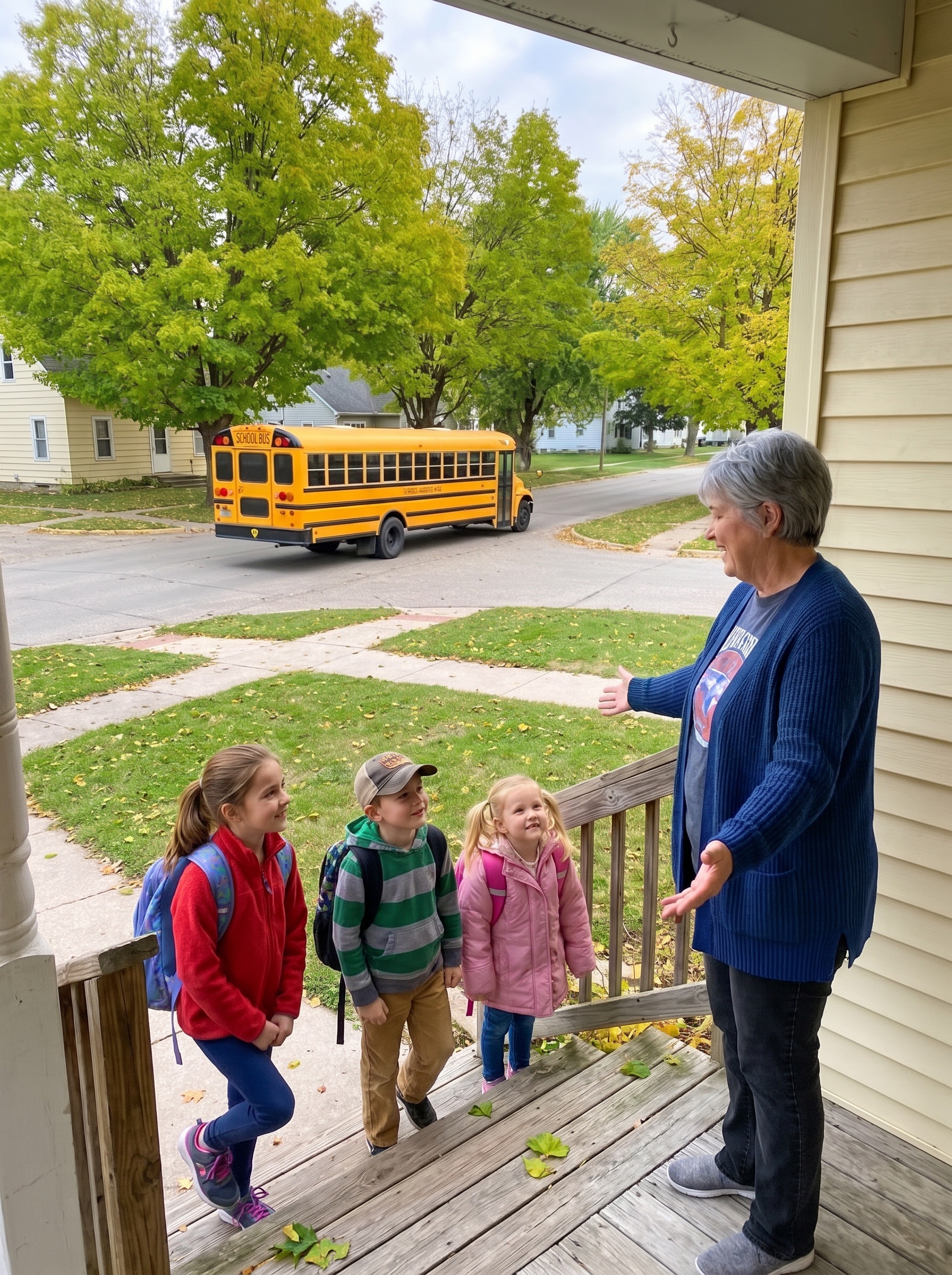
In the six weeks the kids had been coming to my little rental on Third Street, that had never happened. Every school day at 3:40, the bus squealed to a stop at the corner. Lily came off first, Owen next in his ball cap, and Gracie last, with her blonde pigtails bouncing and her pink backpack bright as bubblegum. They ran up my sidewalk, and I waited at the top of the steps in my red cardigan with my arms open.
That afternoon in October, the maples on Third Street had gone orange all at once. The bus pulled away from the corner in a puff of diesel. Owen and Gracie came up the walk behind their sister, and all three of them were too quiet.
Lily slid her backpack off her shoulder.
“Ashley sent something,” she said.
Behind her, Owen pulled his cap down low. Gracie hid half her face behind her brother’s arm.
Lily unzipped the front pocket of her backpack. “She said to give it to you before we did anything else,” she said. “She said you’d know what it was.”
She held out a long white envelope, the business kind. My name was written across the front in neat, round handwriting I didn’t recognize: Mrs. Roxanne Pruitt.
It was thick, and heavier than a letter. My hands started to shake before I even took it.
“Is it bad, Grandma?” Gracie whispered. She was six. She’d learned in the last three years that envelopes and serious faces sometimes meant bad things.
“I don’t know yet, sweet pea,” I said. “Let’s get you some apple slices first.”
I didn’t open it right away. I put it on the kitchen counter next to the toaster, face down, like it might bite. I sliced two apples and spread peanut butter on graham crackers. I poured three glasses of milk. Lily sat down at my little table and opened her math book. Owen dumped his spelling list out on the floor, and Gracie climbed into my lap with her reading folder.
All the while, the envelope sat there on the counter.
To understand why my hands were shaking, you have to know what it cost me to be standing in that rental kitchen in the first place.
Three years ago, on a Tuesday morning in March, my daughter Kelsey stood up from the breakfast table to get more coffee and fell down. She never got back up. It was a brain aneurysm. The doctors at St. Luke’s said it had probably been there her whole life, a weak spot nobody knew about. She was thirty-one years old.
She left three babies. Lily was six then, Owen was four, and Gracie was only three. She also left a husband who was drowning.
I was fifty-seven. I’d carried mail on the same rural route outside Millbrook for twenty-six years, a hundred and twelve miles of gravel roads, cattle guards, and mailboxes shaped like tractors and largemouth bass. I knew every dog by name. I knew which widow needed her heart medicine left inside the screen door, and which farmer would wave me down with a sack of sweet corn in August.
I loved that route. I gave it up in nine days.
I filed for early retirement with the Postal Service the week after the funeral. I was fifty-seven, which is the minimum retirement age for somebody born when I was, and I had twenty-six years in. That let me retire. But the woman at the retirement office in St. Louis explained on the phone, kindly, that leaving before sixty-two would cost me five percent of my annuity for every year I was short.
“Twenty-five percent reduction, Mrs. Pruitt,” she said. “For life. You’d get about $1,140 a month instead of about $1,520. Are you sure you don’t want to wait?”
I looked across Nick’s kitchen at Gracie, who was sitting on the floor in yesterday’s pajamas because nobody had remembered to change her.
“I’m sure,” I said.
Then I sold my house.
It wasn’t much. It was a two-bedroom bungalow on Hackberry Lane with a carport and a crabapple tree I planted the year Kelsey was born. My husband Dale and I bought it in 1992. He died in 2010, and I paid off the last of the mortgage myself in 2017 with my mail carrier checks and a lot of macaroni dinners. It was free and clear, the only thing in the world I owned outright.
I sold it in five weeks for $90,000 to a young couple from the Air Force base. At the title company, the closer, a woman named Barb Kessler who’d been two years behind me in high school, slid the settlement statement across the table and pointed at the bottom line.
“After commission and closing costs, Roxanne, you’ll walk out with $84,312,” she said. “Where do you want it wired?”
“Farmers and Merchants,” I said. “My checking.”
Barb looked at me over her glasses. “You’re putting all of it into checking?”
“I’m going to need it close,” I said.
I moved into Nick’s spare room the following Saturday. I brought two suitcases, my sewing machine, Dale’s old recliner, and a box of Kelsey’s baby pictures. Everything else went to a yard sale or the church donation shed.
A week later, Nick sat at the kitchen table at midnight with a stack of bills. I came out for a glass of water and found him with his head in his hands.
“Nick?”
He didn’t look up. “The mortgage is two months behind,” he said. “Kelsey handled all of it. I didn’t even know. I’ve been on bereavement leave, and the overtime stopped, and the life insurance from her job won’t come for another six weeks, and that’s only $50,000 anyway. It’s already gone to the funeral home and the hospital bill.” He laughed, a terrible broken sound. “Sixty-one thousand dollars for one ambulance ride and nine hours in the ICU. Can you believe that? For nine hours.”
I pulled out a chair and sat down across from him.
“How much do you owe on the house?”
“About a hundred and forty. The payment’s $1,280 a month. I make good money when I’ve got overtime, Roxanne, but I can’t work overtime now. Somebody has to be here.”
“I’m here,” I said.
He finally looked at me.
“Here’s what we’re going to do,” I said. “I’m going to put money on this mortgage. Enough to catch it up and knock the principal down so the payment drops. Those kids are not losing the only home they’ve ever known. Not on top of losing their mother.”
“Roxanne, I can’t take your money.”
“It’s not my money,” I said. “It’s Kelsey’s kids’ money. It just happened to be in my account.”
For almost three years, we lived like that.
It wasn’t easy, and I won’t pretend it was. Nick and I weren’t close the way Kelsey and I had been. He was quiet, a big, gentle man who grew up on a hog farm north of town and never learned to talk about how he felt. We were polite with each other. We worked around each other like two people sharing a narrow kitchen, which was exactly what we were.
But the kids were okay. That was all that mattered. Lily made honor roll. Owen made the Little League all-star team. Gracie learned to read, sitting in my lap at the kitchen table, sounding out “The Cat in the Hat” one stubborn syllable at a time.
Then, last winter, Nick met Ashley.
She was thirty, a receptionist at Dr. Hammond’s dental office on Elm Street. That’s how they met, actually. Gracie had a dental appointment, and Nick took her because I had a doctor’s appointment of my own that day. He came home and mentioned, too casually, that the receptionist had been really nice to Gracie.
Three weeks later, he asked if I’d watch the kids on a Saturday night.
Six weeks after that, he brought Ashley to dinner.
She was soft-spoken, with dark hair pulled back in a clip and a gentle way with the children. She got down on the floor with Gracie and played with the dollhouse. She asked Owen about baseball and actually knew what a stolen base was. She sat beside Lily on the couch and asked to see her drawings.
I liked her. I truly did.
At the end of the night, she found me in the kitchen washing dishes.
“Mrs. Pruitt, thank you for dinner,” she said. “Nick talks about you all the time. He says he couldn’t have survived without you.”
“He’s done fine,” I said. “Those kids are his whole life.”
“I can tell.” She hesitated. “I’m not trying to take anybody’s place. I just want you to know that.”
I dried my hands on a dish towel and looked at her.
“Honey,” I said, “nobody can take Kelsey’s place. But there’s room in those kids’ hearts for more than one person who loves them. Believe me. I’ve checked.”
She smiled at that, and I thought we’d be all right.
They married in June at the Methodist church on the square. It was a small ceremony, maybe forty people. Gracie was the flower girl and dumped the entire basket of petals in one spot at the start of the aisle, then marched the rest of the way empty-handed, looking very pleased with herself. Everybody laughed. Ashley laughed hardest.
I sat in the third row in my good blue dress and cried a little, for Kelsey and for Nick, and for the way life just keeps coming at you whether you’re ready or not.
Two weeks later, Nick sat down across the kitchen table from me.
The kids were in bed. Ashley had gone back to her apartment to finish packing up the last of her things before she moved in for good. It was just the two of us and the hum of the refrigerator.
“Roxanne,” he said. He was turning his coffee mug around and around on the table. “I think it’s time you got your own place.”
I had known it was coming. I’m not a fool. A new wife doesn’t want her husband’s dead wife’s mother sleeping down the hall. I’d have felt the same way at thirty.
So I didn’t argue about leaving.
I asked one question, quietly.
“What about the house money, Nick?”
He didn’t look up from his coffee mug.
“That was rent,” he said. “You lived here almost three years. Room and board, utilities, food. It all evens out.”
Rent.
For raising his children. For six o’clock lunches and three nights in a steamy bathroom with a croupy boy. For the fillings and the broken wrist, and the school pictures, and the shoes. For giving up my route and a quarter of my pension for the rest of my life, and the house where my daughter took her first steps.
He called it rent.
I sat there for a long time. My face felt hot, and my hands were cold.
“I see,” I said.
“I’m not trying to be unfair,” he said. He still wouldn’t look at me. “I just need a fresh start, Roxanne. Ashley needs to feel like this is her home. And the kids… they need to see her as…” He stopped.
“As their mother,” I said.
He nodded.
“With me in the house, Kelsey’s still in every room,” I said.
He flinched, and I knew I’d said the true thing out loud.
I got up and rinsed my mug in the sink. I didn’t argue, and I didn’t cry. I went down the hall to the spare room that had been mine for almost three years and closed the door. I sat on the edge of the bed under the quilt my own mother made, and I cried until three in the morning with my face pressed into the pillow so the kids wouldn’t hear.
He wasn’t cruel by nature. I knew that. He was grieving, and he was tired of grieving, and he wanted to wake up one morning in a house that didn’t smell like the past.
I understood it. I just didn’t know how to survive it.
The next morning, I pulled out my bank statement from Farmers and Merchants. My balance was $11,406.22. That was what remained of a ninety-thousand-dollar house and twenty-six years of saving.
My pension was $1,140 a month. I wouldn’t be able to draw Social Security for another two years without taking another reduction, and I’d already taken one hit for those children. I didn’t think I could stand another.
I sat down at the kitchen table with a pencil and a legal pad and did the math the way I used to figure my route mileage. Rent couldn’t be more than $700, or I’d be eating ramen noodles by spring. I’d need a car insurance payment of $94. My Medicare supplement wasn’t going to start for three more years, so I’d have to buy health insurance off the marketplace. With the subsidy, the cheapest plan was $212 a month with a $6,000 deductible.
I prayed nothing broke.
It took me eleven days to find the little rental on Third Street. It was a one-bedroom bungalow with peeling white paint, a sagging porch, and a landlord named Mr. Okafor who owned six houses in Millbrook and fixed everything himself. The rent was $650 a month, and he wanted first month, last month, and a $500 security deposit.
“Eighteen hundred dollars,” he said, standing on the porch. “You have references, Mrs. Pruitt?”
“I carried your mail for nineteen years, Mr. Okafor,” I said. “You used to leave me a Coca-Cola in the box every Fourth of July.”
He squinted at me, and then he laughed. “The red Jeep! You’re the red Jeep lady!”
“That’s me.”
He waived the security deposit right there on the porch and shook my hand.
But I didn’t choose that house for the rent, or the landlord, or even the porch.
I chose it because the Millbrook Elementary school bus stops at the corner of Third and Locust, right in front of it.
Nick and Ashley both worked until after five. The kids got out of school at 3:15. Somebody needed to be there for those two hours, and before I’d even signed the lease, I knew it was going to be me.
The night I moved out, I asked Nick about it.
“I’ll be at the bus stop,” I said. “Every day. They can come to my porch after school. Homework, snack, whatever they need. You pick them up when you get off.”
He looked relieved, and maybe a little ashamed.
“You’d do that?”
“I’d do it if I had to walk to the bus stop on my knees,” I said.
He signed the transportation change form at the school office the next week, and the kids’ after-school drop-off moved to 418 Third Street.
Every school day since then, at 3:40, they came up my steps. We did homework at my little kitchen table. Lily needed help with fractions, Owen with spelling, and Gracie with everything, because Gracie was six and her favorite word was “why.” I made apple slices with peanut butter, and on Fridays, popcorn.
Nick picked them up at 5:45 sharp. He honked twice from the curb and never came inside. Sometimes he waved. Mostly he didn’t.
Ashley never came at all.
The first few weeks, I told myself she was busy, or that it was awkward for her. But after a month of honks from the curb and an empty passenger seat, I started to understand.
She’d been told what kind of woman I was. I didn’t know exactly what Nick had said, but I could imagine it: the mother-in-law who wouldn’t let go, who held money over his head, who kept the dead wife alive in every room.
I tried not to let it bother me. I had the kids for two hours a day, and that was more than a lot of grandmothers get.
But some nights, after they left, I sat alone on that porch with the streetlight buzzing and wondered whether I’d spend the rest of my life as a babysitter who got paid in honks.
Then came that afternoon in October, with the maples orange, Lily on the top step, and the envelope.
I waited until the homework was done. I waited until Gracie had sounded out her whole reading book and Owen had spelled “neighbor” correctly three times in a row. I waited until the kids were in the living room watching a cartoon about a talking dog.
Then I turned the envelope over and slid my thumb under the flap.
Inside, there was a handwritten letter folded in thirds on yellow legal paper. Behind it, held with a paper clip, were three other pieces of paper.
The first was a photocopy of a bank wire confirmation from Farmers and Merchants Bank. It showed $52,000 sent August 14th at 10:47 a.m. from the account of Roxanne M. Pruitt to Heartland Home Lending, with Nick’s loan number written in the reference line.
The second was a photocopy of my settlement statement from Barb Kessler’s title company, with $84,312 circled in pen at the bottom.
The third was a single sheet of light blue stationery with little daisies printed in the corner. My breath stopped, because I knew that stationery. I’d bought it for Kelsey myself at the drugstore when she was in college. She used it for thank-you notes for the rest of her life.
The handwriting on it was my daughter’s.
I sat down hard in my kitchen chair. I didn’t read Kelsey’s note first. I couldn’t. I unfolded Ashley’s letter instead.
“Dear Mrs. Pruitt,
I don’t know if you’ll want to hear from me. I would understand if you didn’t. I’m asking the kids to bring you this because I couldn’t figure out how to knock on your door and say it to your face. I’m a coward about some things. I’m trying to be less of one.
Three weeks ago, Nick and I went to Tri-County Federal Credit Union to talk about refinancing the house. Rates came down, and we wanted to lower the payment and maybe pull some money out to finish the basement. The loan officer, a woman named Dana Whitfield, pulled the full payment history from Heartland Home Lending. She was going down the list with us, and she stopped and asked, ‘Who made this $52,000 principal payment in August three years ago? It came by wire from an outside account.’
Nick said it was family. He said it fast, and his face went red.
I didn’t think much about it at the time. But that night I couldn’t sleep, so I asked Dana to email me the full history. The wire was from your account, Mrs. Pruitt. Your name was right on it.
Mrs. Pruitt, Nick told me you lived in his house for three years and never put in a dime. He said you sold your house and kept the money and wouldn’t help with anything. He told me you resented me and didn’t want to meet me, and that you’d said things about me to the kids. He told me that’s why I shouldn’t go to your house, because you’d make a scene.
I believed him. I’m so sorry. I believed him because I loved him, and because I didn’t know you.
After I saw the wire, I went looking. I found your closing papers in the junk drawer in the kitchen, under the takeout menus. Then I found a shoebox on the top shelf of the garage, behind the Christmas decorations. It was full of Kelsey’s things: cards, photos, her hospital bracelet from when Gracie was born. And this note.
I think Nick has read it. The paper is soft from being folded too many times.
I’m not trying to start a war in this family. I’ve been in this family for four months, and I already love those three kids more than I knew I could love anybody. But I can’t live in a house that you paid for while you live in a rental by the bus stop and my husband calls your money rent.
Please read Kelsey’s note. Then, if you’re willing, meet me Saturday at nine at the Maple Street Diner. I’ll be in the back booth. Nick doesn’t know about this letter yet. I’ll tell him myself after I talk to you. I promise.
Ashley”
I set the letter down on the table.
From the living room, Gracie laughed at something on the cartoon. Owen said, “That’s not how dogs work.”
I picked up the blue daisy stationery. My hands were shaking so hard the paper rattled.
The note was dated almost four years earlier, the month after Gracie was born. That was when Kelsey and Nick had gone to a lawyer in Millbrook to do their wills. Kelsey called me afterward and said, “Mom, it’s so morbid, but the lawyer said everybody with kids should do it.” I’d told her she was being smart.
“Nick,” the note began.
“The lawyer said I should write down anything that isn’t in the will, so here it is. You’re going to laugh at me, but I’m putting it in the box with the important papers anyway.
If anything ever happens to me, my mom is going to come. You won’t even have to call her. She’ll just show up with a casserole and three suitcases and her sewing machine, because that’s who she is. She’ll give you everything she has. She’ll give it to you before you even ask, and she won’t want anything back, and she won’t want any paper about it.
Don’t let her do that, Nick. Or if she does it anyway, because she will, then make it right later. Make sure she has a home. Make sure she’s never alone. Make sure she gets to be Grandma to our kids for the rest of her life, no matter what happens or who you love next. Because you should love somebody next, babe. I want that for you.
But Mom comes first. She came first for me my whole life. Promise me she comes first for you too.
Love you forever and a day,
Kels”
I don’t remember how long I sat there.
At some point, Lily came into the kitchen. She was nine now, and she has her mother’s eyes and her mother’s way of noticing things nobody wants her to notice.
“Grandma? Are you crying because of Ashley’s letter?”
I wiped my face with a dish towel.
“I’m crying because of your mama, baby,” I said. “Your mama wrote me a letter too. A long time ago. I just didn’t get it until today.”
Lily came over and put her skinny arms around my neck.
“Ashley said you’d be sad,” she said into my cardigan. “She said it was a good sad, though. She said sometimes the truth makes you cry even when it’s good.”
“Ashley’s right,” I said.
At 5:45, Nick honked twice from the curb. I walked the kids down the sidewalk the way I always did. He waved without looking at me.
I didn’t say a word about the envelope. Ashley had asked me to wait, and something told me she deserved that.
But as the truck pulled away, I saw Gracie’s face in the back window. She was pressing her nose against the glass and waving with both hands, and I thought about my daughter’s words.
Mom comes first.
The Maple Street Diner opens at six on Saturdays. I got there at 8:40 because I couldn’t sleep, and because mail carriers are never late. I ordered coffee I didn’t drink.
Ashley came in at 8:55. She had her hair pulled back, no makeup, and her eyes were puffy. She looked like she hadn’t slept either. She slid into the booth across from me and set a manila folder on the table between us.
“Thank you for coming,” she said. “I wasn’t sure you would.”
“My daughter asked me to,” I said. “Not in so many words. But she did.”
Ashley nodded and looked down at the table.
“I need to say something first,” she said. “Before anything else. I’m sorry, Mrs. Pruitt. I’m sorry I never came to your house. I’m sorry I let Nick tell me who you were instead of finding out myself. Every afternoon those kids came home from your porch smelling like peanut butter and talking about you, and I told myself they were just little kids who didn’t understand grown-up things.” She swallowed hard. “They understood fine. I’m the one who didn’t.”
“Call me Roxanne,” I said.
She looked up.
“Roxanne.” She almost smiled. Then she opened the folder.
Inside were printouts from Tri-County Federal Credit Union, with the full payment history on the Heartland loan. There was a current appraisal on the house, dated three weeks earlier and done by a man named Curtis Lowe. It valued the house at $246,000. The remaining mortgage balance was $71,800.
“That’s more than a hundred and seventy thousand dollars in equity,” Ashley said quietly. “Dana showed me how it works. A lot of that is the market going up. But fifty-two thousand of it is you. If you hadn’t made that payment, the house might have gone into foreclosure that first year. Nick was four months behind by the time the life insurance came through. Dana said Heartland’s records show they’d already sent him a notice of default.”
“He never told me it was that bad,” I said.
“He never told me any of it.” Ashley pressed her lips together. “When I asked him about the refinance, he said we’d built all that equity ourselves, him and Kelsey, and then him alone. I believed that too.”
The waitress came over. Ashley ordered coffee and didn’t drink hers either.
“I talked to Dana again on Thursday,” Ashley said. “On my lunch break, without Nick. I asked her what it would take to refinance the house and take out enough cash to pay you back. All of it. The fifty-two thousand.”
I stared at her.
“Ashley, I can’t ask you to do that.”
“You’re not asking,” she said. “I’m telling you that’s what I want. Dana says with the equity in the house and our two incomes, we qualify easily. The new payment would be about $1,140 a month instead of $910. Higher, but we can afford it. I make $38,000 a year at Dr. Hammond’s. Nick makes almost seventy with overtime. We’ll be fine.”
“And Nick?”
Ashley’s face went very still.
“That’s the part I’m scared of,” she said. “His name’s on the house. I can’t refinance without him. And I don’t know what he’s going to say when I tell him what I found.”
“Can I tell you something about Nick?” I said.
Ashley nodded.
“For almost three years, I listened to that man cry in the garage. Two or three nights a week, at first. He never knew I heard. He’d wait until he thought everybody was asleep, and then he’d go out there and sit in Kelsey’s car, she drove a little blue Honda, and he’d cry like his heart was being pulled out through his ribs.” I wrapped my hands around my coffee cup. “He’s not a bad man, honey. He’s a man who got hit by a truck he never saw coming, and he’s been trying to crawl out from under it ever since. When he called my money rent, I don’t think he was trying to cheat me. I think he couldn’t stand owing me. Every time he looked at me, he saw her, and he saw how much he’d needed help, and I think it made him feel like half a man.”
Ashley’s eyes filled.
“So he told you I was a monster,” I said gently. “Because if I was a monster, he didn’t owe me anything. And if he didn’t owe me anything, he could start over clean.”
“That’s not fair to you,” Ashley whispered.
“No. It isn’t.” I set my cup down. “But it’s grief. Grief isn’t fair. It makes good people tell lies they’d never tell on a normal Tuesday.”
Ashley wiped her eyes with a diner napkin.
“There’s something else,” she said. “Something I didn’t put in the letter.”
She reached into the folder and pulled out one more sheet. It was a photocopy of a will, three pages, from the law office of Herman and Doyle, Attorneys at Law, Millbrook. The Last Will and Testament of Kelsey Ann Bauer.
“It was in the shoebox too,” she said. “Article Four. Guardianship.”
I read it.
“In the event that my husband, Nicholas J. Bauer, predeceases me or is unable or unwilling to serve as guardian of my minor children, I nominate my mother, Roxanne M. Pruitt, to serve as guardian of the person and estate of my minor children.”
“She named me,” I said. “If something happened to both of them.”
“She named you,” Ashley said. “And last month Nick and I went to a lawyer to update our wills, because we just got married. Nick named his brother Dale Jr. as guardian. In Montana. The kids have met him twice.” She took a breath. “He didn’t even mention your name. When I asked about you, he said you were too old.”
Too old. I was sixty.
I sat back in the booth and looked out the window at Maple Street, where the leaves were blowing across the sidewalk in orange drifts.
“What do you want to do, Roxanne?” Ashley asked. “I’ll back you up, whatever it is. If you want to get a lawyer and go after the money, I’ll testify that I saw the wire. I’ll give them the payment history.”
I thought about it. I’d thought about it a hundred times, lying awake on Third Street. Before I signed the lease, I’d even made an appointment with an elder law attorney in the county seat, a woman named Marjorie Kline. She charged me $150 for one hour and listened to the whole story without interrupting.
“Mrs. Pruitt, you could bring a claim,” she’d said when I finished. “Unjust enrichment. You conferred a benefit, he knew about it, and it would be unfair for him to keep it without paying. You have the wire record, and that helps. But I’ll be honest with you. Without a written agreement, it comes down to what he says versus what you say. He’ll say it was a gift, or rent. A judge might believe you. A judge might not. And the attorney’s fees could run ten, fifteen thousand dollars before you see a courtroom.”
“And the kids?” I’d asked her. “What happens to the kids if I sue their father?”
Marjorie Kline had put down her pen.
“Legally? Nothing. Practically?” She shook her head. “Practically, Mrs. Pruitt, he controls whether you see them. Grandparents don’t have very strong visitation rights in this state when the parent objects. You could win the money and lose those children.”
So I’d walked out of her office and signed a lease by a bus stop instead.
“I don’t want to sue anybody,” I told Ashley. “I never did. I just want my grandbabies. And I want Nick to stop pretending I was never there.”
Ashley reached across the table and put her hand over mine.
“Then let’s go tell him,” she said. “Together.”
We told him that afternoon.
The kids were at a birthday party at the bowling alley, so it was just the three of us in the house on Sycamore Drive. I hadn’t been inside since the day I moved out. Ashley had painted the living room a soft gray. There were new curtains, and a wedding photo on the mantel next to the kids’ school pictures.
But Kelsey’s picture was still there too, at the end of the mantel, in the silver frame I’d given her for her twenty-fifth birthday. Ashley had left it up. I noticed that, and it mattered.
Nick came in from the garage wiping his hands on a rag and stopped dead when he saw me sitting at the kitchen table.
“Roxanne? What are you doing here?”
“I asked her to come,” Ashley said. She was standing by the counter with her arms crossed, not angry, just steady. “Sit down, Nick. Please.”
He looked at me, then at his wife, and then at the manila folder on the table. His face went pale.
“Ashley, what is this?”
“It’s the truth,” she said. “Sit down.”
He sat.
She laid it out the way she’d laid it out for me: the payment history from Tri-County Federal, the wire from Farmers and Merchants, my closing statement, and Kelsey’s will, open to Article Four.
And last, she put down the blue daisy stationery.
Nick saw it and made a sound I’d never heard from a grown man. It was a sharp, wounded sound, like a dog that’s been stepped on.
“Where did you get that?” he said.
“The shoebox,” Ashley said quietly. “In the garage. Behind the Christmas lights.”
“That’s private. That’s Kelsey’s.”
“It’s addressed to you,” Ashley said. “And it’s about her mother. Who’s sitting right there.”
Nick stared at the note. He didn’t pick it up. He didn’t need to. I could tell from his face that he’d read it so many times he knew every word by heart.
“I read it the week after the funeral,” he said finally. His voice was rough. “I found it in the lockbox when I was looking for the life insurance papers. And then you showed up, Roxanne, with the casserole and the suitcases and the sewing machine. Just like she said you would. Exactly like she said.”
He put his face in his hands.
“Every single day, I’d look at you and think about that note. ‘Mom comes first.’ And I couldn’t do it. I could barely keep myself alive. I couldn’t make anybody come first. I couldn’t pay the mortgage. I couldn’t change a diaper without crying. And you came in and fixed all of it, and you never once made me feel like a failure, and somehow that was worse. Do you understand? It was worse.”
“I understand,” I said.
“When Ashley came along, I thought, finally, a fresh start. I can be the guy who has it together. And you were in the spare room, and every time I walked past that door, I heard Kelsey saying, ‘Mom comes first,’ and I thought, I can’t. I can’t owe her this much. I can’t owe her fifty-two thousand dollars and three years and her whole life. I’ll never pay it back. So I just…” He shook his head. “I made it rent. I made it nothing. Because if it was nothing, I didn’t owe her anything.”
Ashley had tears running down her face, but she didn’t move to comfort him. Not yet.
“And you told me she hated me,” she said.
Nick looked up at her.
“You told me she said things about me to the kids. That she didn’t want to meet me. Nick, those kids came home every single day talking about Grandma Roxie’s porch and her peanut butter apples and how she made them sound out words. Not one time did they ever say she said anything bad about me. Not once. I should’ve seen it. But you’re my husband, and I believed you.”
“I’m sorry,” Nick said. He said it to Ashley. Then he turned and said it to me. “Roxanne, I’m sorry. God, I’m so sorry.”
It took two months to fix the money.
Nick and Ashley went back to Dana Whitfield at Tri-County Federal the following Tuesday. They applied for a cash-out refinance: a new thirty-year fixed loan at 6.1 percent for $128,000. That would pay off the remaining $71,800 on the Heartland mortgage and leave enough to repay me in full, with a little cushion for closing costs. Dana ordered a new title search and a final inspection. Curtis Lowe came back out to update the appraisal.
Nick called me the night they were approved. It was the first time he’d called me in four months for anything other than “Owen forgot his lunchbox.”
“The closing’s December 9th,” he said. “At the title company. Barb Kessler’s office.”
I laughed. “Barb did my closing too.”
“I know,” he said. “Ashley found your settlement statement with her name on it. She called Barb on purpose. She said it should end where it started.” He was quiet for a second. “Roxanne, would you come? To the closing? I want you there when they send it.”
“I’ll be there,” I said.
On December 9th, at 10:00 in the morning, I sat in the same conference room where I’d signed away my house three years earlier. Barb Kessler sat at the head of the table with her glasses on the end of her nose and a stack of papers a foot high.
Nick and Ashley signed for almost forty-five minutes: the promissory note, the deed of trust, the closing disclosure, the right-to-cancel forms. Ashley read every page. Nick signed where Barb pointed.
Then Barb pulled out one more sheet.
“This is the disbursement authorization,” she said. “Mr. and Mrs. Bauer have instructed that $52,000 of the cash-out proceeds be wired directly to the Farmers and Merchants Bank account of Roxanne M. Pruitt.”
Nick reached for the pen, then stopped.
“Barb, can you add something to the memo line?”
“What do you want it to say?”
He looked at me across the table.
“‘Repayment in full, with gratitude,’” he said. “‘Not rent.’”
Barb’s eyes got shiny behind her glasses. She typed it in without a word.
Nick signed. Ashley signed.
Two hours later, while I was sitting in my car in the Farmers and Merchants parking lot because I couldn’t make myself go home, my phone buzzed. It was a text from the bank: “Incoming wire received: $52,000.00.”
I went inside and found Tyler Briggs at his desk. He was a little older now, with a little less hair.
“Mrs. Pruitt,” he said, looking at his screen. Then he looked at me and smiled. “Looks like it came home.”
“It came home,” I said.
I didn’t move back into the house on Sycamore Drive. Nobody asked me to, and I wouldn’t have said yes if they had. Ashley needed her home, and I’d learned to love my sagging little porch on Third Street, and Mr. Okafor’s Coca-Colas on the Fourth of July.
But some things changed.
With part of the money, I opened three 529 college savings accounts at Farmers and Merchants, one each for Lily, Owen, and Gracie. I put $8,000 in each. Tyler helped me name myself as the account owner and Nick as the successor, so the money could never be used for anything but school.
“Your mom would’ve liked that,” Nick said when I showed him the statements.
I put $15,000 in a savings account and named it “Rainy Day,” because I’d learned the hard way that rainy days don’t send a warning. The rest I kept in checking for the next two years, until I could draw my full Social Security without taking another reduction. That was one hit I didn’t have to take.
The week after the closing, Nick and Ashley went back to the lawyer and changed their wills again. Ashley insisted on it. If anything ever happens to both of them, I’m guardian of the children now, just like Kelsey wanted. Dale Jr. in Montana is second, and he said he was relieved.
Ashley brought me a copy, along with something else: a notarized power of attorney for healthcare decisions, so I could take any of the kids to the doctor or the emergency room without waiting for a parent to answer the phone.
“In case Owen breaks his other wrist,” she said.
“Lord, don’t say that out loud,” I said.
But the biggest change was the honking.
The Monday after the closing, at 5:45, Nick’s truck pulled up to the curb on Third Street. I waited for the two honks.
They didn’t come.
Instead, the driver’s door opened, and Nick got out. He walked up my sidewalk, up my sagging porch steps, and knocked on my screen door like a man coming to visit, not to pick up a package.
“Can I come in?” he asked.
“You don’t have to knock,” I said. “But yes.”
He sat at my little kitchen table, the same table where his kids did their homework every afternoon. I poured him a cup of coffee. Owen climbed into his lap and started explaining a spelling word, and Gracie showed him her reading book. Lily watched her father from across the table with her mother’s careful eyes.
“Grandma Roxie makes the best apple slices,” Gracie told him seriously. “It’s the peanut butter. She uses the crunchy kind.”
“I know,” Nick said, and his voice cracked. “I remember.”
He stayed forty minutes. When he left, he hugged me in the doorway. It was awkward, the way big quiet men hug, with too much back-patting and not enough breathing. But it was a hug.
After that, he came inside every day.
Ashley came the next Wednesday.
The bus squealed at the corner at 3:40, and the kids tumbled off. Lily first, Owen next, Gracie last with her pink backpack. But this time a little blue Honda was parked at the curb behind the bus, Kelsey’s old car. Nick had finally stopped crying in it and let Ashley drive it to work.
Ashley got out holding a pie.
“It’s pecan,” she said, standing at the bottom of my porch steps. “It’s my grandmother’s recipe. She lives in Tulsa, and she told me that when you owe somebody an apology this big, you bring a pie. I asked if one was enough. She said, ‘Honey, keep bringing them until it is.’”
I laughed so hard I had to hold on to the porch post.
“Get up here,” I said. “And bring that pie.”
She came up the steps, and I put my arms around her in the doorway of that little rental house. She hugged me back hard and cried a little into the shoulder of my red cardigan.
“Thank you for raising them,” she whispered. “Thank you for keeping them safe until I got here.”
“Thank you for finding the box,” I said.
We ate the pie at my kitchen table, all six of us crowded around a table built for two. Owen got pecan in his hair somehow. Gracie announced that pecan pie was better than apple slices, then took it back immediately when she saw my face. Lily sat beside Ashley and quietly leaned her head against her shoulder, and Ashley looked at me over her head with an expression I’ll never forget. It wasn’t the look of someone replacing anybody. It was gratitude, and a promise.
That Thanksgiving, Nick and Ashley hosted dinner at the house on Sycamore Drive. Ashley set the table with Kelsey’s good china, which had been in boxes in the basement for three years. She’d washed every piece by hand.
“Is that okay?” she asked me in the kitchen, quietly. “Using her plates?”
“It’s more than okay,” I said. “She bought those plates so her family would eat off them on holidays. That’s what they’re for.”
Before we ate, Nick stood up at the head of the table with his water glass. He’d never been a toast man. He looked terrified.
“I want to say something,” he said. “I’m not good at this.”
Everybody went quiet. Even Owen.
“Three years ago, I lost my wife,” Nick said. “And I would have lost everything else too. This house, my mind, maybe these kids. If it wasn’t for one person.” He looked down the table at me. “Roxanne gave up her job, and her house, and her whole life, and she never once asked for anything back. And when it was time to say thank you, I said something else instead. Something I’ll be ashamed of for the rest of my life.”
He set down his glass.
“Kelsey wrote me a note once. She said, ‘Mom comes first.’ I didn’t keep that promise, not when it counted. But I’m keeping it now.” He looked at the kids. “Grandma Roxie comes first. In this family, she always will.”
Gracie started clapping. Then Owen. Then Lily. Then Ashley, with tears running down her face.
I didn’t clap. I couldn’t. I just sat there at the end of my daughter’s table, with her china and her children and her husband and his new wife, and I felt Kelsey in that room. Not as a ghost or a sadness, but the way you feel the sun on your back.
It’s spring now. The maples on Third Street are budding again, little red tips on every branch.
Every school day at 3:40, the bus still squeals to a stop at the corner. Lily is still first off. She’s ten now, and almost too old to run, though she still does when she thinks nobody’s watching. Owen comes next, in a new ball cap because he lost the old one at Little League. And Gracie still comes last, with her blonde pigtails and pink backpack, though the backpack is getting faded now.
I still wait at the top of my porch steps in my red cardigan with my arms open.
Some days Ashley gets off work early and comes by at four with groceries, and we cook supper together in my tiny kitchen while the kids do homework. Some days Nick stops on his way home and fixes something that’s broken. Mr. Okafor told him he was welcome to, and now my porch steps don’t sag anymore. Last month, Nick replaced the whole railing.
“So nobody falls,” he said.
“I’ve been on these steps for a year without falling,” I told him.
“I know,” he said. “That’s not the point.”
On Sundays, we go to the cemetery together, all six of us. We take flowers from the grocery store, and Gracie arranges them, and they always come out lopsided. Ashley stands a little to the side and lets the kids talk to their mama. Sometimes she talks to Kelsey too, very quietly. I’ve never asked what she says. That’s between the two of them.
Last week, Lily asked me something while we were sitting on the porch waiting for her dad.
“Grandma, why did you move here? To this little house? You had a big house before. With a crabapple tree.”
I thought about how to answer. I could have told her about the money, the rent, the long nights, and the math on the legal pad.
Instead, I pointed to the corner of Third and Locust, where the bus stops every afternoon at 3:40.
“Because of that,” I said.
Lily looked at the empty corner. “The bus stop?”
“The bus stop,” I said. “Your mama asked me a long time ago to make sure I’d always be there for you. And this was the closest I could get.”
Lily was quiet for a minute. Then she scooted over and leaned against me the way her mother used to, all elbows and warmth.
“You’re always there, Grandma,” she said. “Every single day.”
Across the street, Nick’s truck turned the corner. He pulled up to the curb, cut the engine, and got out. He didn’t honk. He came up the walk and up the steps, and I watched him come.
He’s not my son, not by blood. But he’s the father of my daughter’s children, and he’s family. He made it right in the end, because a woman he’d only known for four months found a shoebox behind the Christmas lights and decided she couldn’t live with a lie.
Kelsey always did have good taste in people. She picked Nick. And somehow, from wherever she is, I think she picked Ashley too.
The kids grabbed their backpacks. Gracie hugged my legs. Owen fist-bumped me, because he’s eight and hugs are for babies now, except at bedtime. Lily squeezed my hand.
“See you tomorrow, Grandma,” she said.
“Same time,” I said. “Same place.”
At 3:40 every school day, three kids walk up to my porch. I’ll be there every time. I paid for that porch with everything I had, and it was worth every penny.