At Christmas, I was stitching up a man’s chest in the emergency room when my phone lit up in my scrub pocket.
It was a text from my sixteen-year-old daughter.
“They said there’s no room for me at the table.”
I read it between sutures. I thought it was a joke. Some weird teenage thing. A meme I didn’t understand.
It wasn’t a joke.
While I was busy saving a stranger’s life, my own parents and my own sister were turning my daughter away from our family’s Christmas dinner. They sent her back out into a snowstorm to drive forty miles home. Alone. In the dark.
When I finally got home after midnight, her boots were sitting by the front door. Her overnight bag was still zipped. And she was curled up on the couch in her coat, too tired to even cry anymore.
On the kitchen counter, on a paper napkin, there was one slice of cold bread and half an orange.
That was her Christmas dinner.
I didn’t yell. I didn’t call anybody. I didn’t beg anyone to understand.
I just stood there in my kitchen. And I made a decision that would change everything.
My name is Orion Vale. I’m an emergency room physician. And this is how I learned that silence can hurt more than any betrayal. Right up until the day you finally break it.
It was 11:48 p.m. on Christmas Eve when I walked out of Boulder Community Hospital.
The air outside was sharp and cold. My hands still smelled like disinfectant, the way they always do after a long shift. It gets into your skin and stays there.
I’d just finished running a code on a fifty-eight-year-old man who’d come in swearing he was fine. Just a little heartburn, he said. Probably the eggnog.
Twenty minutes later, his heart stopped.
We got him back. It took eleven minutes of CPR and three rounds of shocks. But we got him back. He was in the ICU now, with his wife holding his hand and his grown kids in the waiting room.
It’s the kind of case that clings to you even after you clock out. You keep feeling the rhythm of the compressions in your arms. One, two, three, four.
Snow was falling in soft waves under the orange lights of the parking lot.
All I could think about was getting home. Seeing my daughter. And maybe sitting still for five minutes.
Then I remembered. Lennon wasn’t home.
She was at my parents’ house in Aspen Creek. Like she was every Christmas Eve.
She’d driven herself there for the first time that afternoon. She’d only had her license for six weeks. She was so proud. She’d texted me a photo of her hands on the steering wheel at three o’clock. “On my way!! ”
Then I checked my phone in the car and saw the other text again. The one from 8:15.
“They said there’s no room for me at the table.”
And under it, at 8:16: “It’s ok. I’m heading home. Don’t worry. Love you.”
I drove home faster than I should have in the snow.
When I opened the door to our apartment in East Boulder, the first thing I noticed was the quiet.
No music. No TV. No movement. Just the faint hum of the heater.
Then I saw her boots. Lined up neatly by the door, the way I’d taught her when she was little. Her overnight bag was sitting right next to them. Still zipped.
Lennon.
She was curled up on the couch, still wearing her winter coat. Her knees were pulled up to her chest like she was bracing against the cold, even though the apartment was warm.
She wasn’t asleep. Her eyes opened the second I whispered her name.
“Hey, sweetheart.”
I knelt down next to the couch.
“What happened? Why are you here?”
Her shoulders tensed up under the coat.
“They said there wasn’t any room,” she murmured. Her voice was barely above a whisper.
I blinked at her.
“Room where?”
“At the table,” she said.
She choked halfway through the words. Then she tried to cover it up with a shrug. It didn’t work.
“Grandma said she didn’t expect me. That they already had too many people. She said she couldn’t pull up another chair at the last minute.”
My brain stalled. Like an engine that won’t turn over.
“Did you get there late, honey?”
“No. I was early,” she said quickly. “I got there at four-thirty. I brought cookies. I made the snickerdoodles. And I wore the green sweater Grandma said she liked last year.”
She laughed once. Thin and bitter. A sound I’d never heard come out of my daughter before.
“There were like twenty-eight people inside, Dad. I could see them through the front window. Aunt Sienna’s daughter Nova was sitting in my seat. My usual spot. By the window. Everybody was laughing. Grandma came to the door and stood in it. Like, in the doorway. And she said, ‘Oh, Lennon. It’s just too crowded this year.’”
I couldn’t find any words.
“Aunt Sienna was right behind her,” Lennon said. “She just nodded. Like, yeah. Too crowded.”
Lennon looked down at her hands in her lap.
“I didn’t want to make Grandma mad. So I just left. I wasn’t that hungry anyway.”
I turned toward the kitchen counter. And I saw what she meant by “not that hungry.”
One slice of bread. Cold. Slightly bent at the corner. On a paper napkin.
Next to it, half an orange.
That was my daughter’s Christmas dinner.
Something cracked inside me.
Not anger. Not yet. It was more like glass splintering in slow motion. I could almost hear it.
“They didn’t offer to drive you home?” I said. “In the snow? In the dark?”
She shook her head.
“I didn’t want to bother them.”
She was trying so hard to be brave. Holding herself together with politeness. Like politeness was the only thing keeping her from falling apart.
I sat down next to her on the couch and put my arm around her shoulders. She leaned into me right away. Without hesitating. The way you lean into something when you’ve been holding your breath for way too long.
We sat there like that for a while. The heater hummed. Snow ticked against the window.
“Dad,” she whispered. “I know they don’t like you.”
I didn’t say anything.
“I always knew. Since I was little. I could tell,” she said. “But I thought that was just between you and them. I didn’t think it was about me.”
I didn’t answer. I couldn’t. I just held her tighter.
She fell asleep about an hour later. Right there on the couch. I took off her coat as gently as I could and put a blanket over her.
Then I went into the kitchen and stood there.
I looked at the overnight bag she’d packed so carefully. Her pajamas folded on top. An extra sweater.
And a round tin of cookies. Snickerdoodles. She’d baked them herself that morning. It was still sealed shut with a red satin ribbon tied in a perfect bow.
Nobody had even taken the tin from her at the door.
I opened the refrigerator. It was almost empty. Milk. Mustard. A bottle of water. Half a jar of pickles.
We hadn’t planned a backup Christmas. Why would we?
We trusted them.
That was what broke me.
Not the cold bread. Not the empty apartment. Not even the forty miles of snowy road.
It was the picture in my head. My mother, standing in that doorway, looking straight into my daughter’s eyes. And deciding she didn’t belong.
I stood in that kitchen for a long time.
Then I went to the little desk in the corner of the living room. I pulled open the bottom drawer. And I took out a thick blue folder.
Mortgage statements. Property tax bills. Insurance policies. And the deed.
The house in Aspen Creek.
The house my parents lived in. The house where my mother had just told my daughter there was no room.
I bought that house seven years ago. It’s in my name. Only my name.
My parents have lived in it rent-free ever since.
I sat down at the kitchen table with the folder in front of me. And I started to think about how we got here.
Growing up in Aspen Creek meant living by rules nobody ever said out loud.
Our house wasn’t just a house. It was a stage. And my mother, Marjorie, ran it like a director who never took off her headset.
She owned a little antique shop downtown. She believed appearances were everything. The right tablecloth. The right china. The right people at the right parties.
My father, Richard, taught high school history for thirty-five years. He believed curiosity was dangerous once it went past the textbook.
When I was eight years old, I asked for a microscope for Christmas.
My mother laughed. “A microscope? That’s a toy for kids who like to cut up frogs.”
My father didn’t laugh. He just looked at me over his newspaper.
“Smart people make other people uncomfortable, Orion,” he said. “Don’t make that a habit.”
I got a sweater that Christmas. Itchy, brown, two sizes too big.
At the Vale dinner table, curiosity was a sin. Silence was safety.
So I learned to be quiet.
Until I wasn’t.
When I told them I’d gotten into medical school at the University of Colorado, my mother set down her coffee cup and said, “A doctor. Running around fixing strangers while your own family falls apart.”
My younger sister, Sienna, had dropped out of college the year before. She was starting an event planning business. Weddings. Corporate parties. Holiday galas.
Every failure of Sienna’s became a funny story at dinner. “Oh, Sienna, remember the wedding where the cake fell over?” Everybody laughed.
Every success of mine was some kind of threat.
They loved her for being loud. For being the fun one. For keeping things lively.
I was the serious one.
When I got married, my family didn’t come to the wedding.
Sienna had an event that weekend. A big one. Some tech company’s anniversary party in Denver. And my parents said they couldn’t possibly miss it. She needed them. She couldn’t do it alone.
My wife’s family filled up both sides of the church.
Her name was Clara. She was a pediatric nurse. She was funny and warm and fearless, and she taught me how to laugh out loud again.
Lennon was born two years after the wedding.
Five years after that, Clara died. A heart condition nobody knew she had. She was folding laundry on a Tuesday afternoon, and she just sat down on the edge of the bed and didn’t get up.
I was at work. In the same emergency room. Twelve miles away.
At the funeral, my mother hugged me stiffly by the guest book and said, “Well, Orion. I suppose that’s the price of the life you chose.”
I’ve never figured out what she meant by that.
And I stopped trying to.
So I stopped expecting comfort from my family.
I sent money instead.
About seven years ago, my parents started getting older faster than their savings could keep up. My father’s teacher pension wasn’t much. The antique shop was barely breaking even. They were behind on rent on the old house.
So I stepped in.
I bought them a little two-bedroom house in Aspen Creek. A blue one, with white shutters and a big kitchen. I put it in my name, because the bank wouldn’t give them a mortgage.
I paid the mortgage. Every month. I paid the utilities. I paid for their health insurance. I paid for my mother’s blood pressure medication and my father’s knee surgery.
Seven years of bills. Seven years of quiet loyalty.
And every Christmas Eve, they hosted the big family dinner in that house. The house I paid for.
I used to think it was the least I could give them.
But over the years, I noticed something. The numbers on the utility bills kept climbing. Electric. Gas. Water. And they spiked. Not in winter. Not in summer. They spiked at weird times. Random weeks.
I didn’t connect it at first.
Not until last fall. I drove up to drop off my father’s prescriptions, and there was a pallet of boxes on the front porch. On the shipping label, there was a logo I recognized.
Sienna Vale Events.
My parents’ house. The one I paid for. It had become her storage space. Her prep kitchen. Her warehouse.
And my bank account was paying for all of it.
I didn’t say anything then.
Maybe I was afraid of what all those years of silence had already turned me into.
Two weeks before that Christmas, I found something worse.
My father had asked me to help him set up a new laptop. While I was moving his old emails over, a long chain popped up between my mother and my aunt Ruth in Oregon. It was dated years back. Right after Clara died.
I shouldn’t have read it. I know that.
But I saw my own name, and I couldn’t stop myself.
My mother had written: “Orion’s always been unstable. Too emotional for a man. We love him, but he just doesn’t handle life well. Honestly, I worry about that little girl being raised by him alone.”
I sat in my father’s study and read that line six times.
It hit harder than any rejection I’d ever had.
She’d built a whole story about me. Long before Lennon was old enough to drive. Long before any Christmas dinner.
So the night they sent my daughter home hungry, it wasn’t a mistake. It wasn’t an accident.
It was tradition.
I printed that email out. I don’t know why. I put it in the blue folder with everything else.
And three weeks before Christmas, Sienna called me.
I was standing in my backyard taking out the recycling. My breath was making little clouds in the cold air.
Her name lit up my screen. I already knew what the call would be about. She had a certain sweet voice she used when she needed something.
“Hey, big brother,” she started, stretching the words out like taffy. “So, you know Nova got into that STEM summer camp? The one at the university? It’s this incredible opportunity. Twelve hundred dollars. But totally worth it. And I figured you of all people would understand. You value education so much.”
She said the word “education” like it was a key meant to unlock my wallet.
“I’m really glad she got in,” I said. “That’s great. But I can’t help with that one, Sienna. I’m already covering the house, the utilities, and Mom and Dad’s insurance. You might want to check if the camp has scholarships.”
The silence on the other end cracked like ice.
When she spoke again, all the sweetness was gone.
“Wow,” she said flatly. “Must be nice. Having everything and still being stingy.”
I didn’t reply. I just ended the call and watched the screen go dark.
I didn’t think about that call again for a while.
I should have.
A week after Sienna’s call, I drove up to Aspen Creek to drop off my mother’s blood pressure medication. She’d run out, and the pharmacy in town was closed for inventory.
The blue house looked smaller than I remembered. The windows were glowing with warm yellow light. The kind that used to mean home.
Inside, it smelled like cinnamon and pine. Sienna’s signature holiday scent. She sold it to her clients in little glass jars.
My mother was standing at the kitchen counter, taping a long sheet of paper to the refrigerator.
“Planning for the dinner already?” I asked.
She turned around, startled. Then she smiled at me. That tight, polite smile that meant I’d interrupted something.
“Oh, just trying to stay organized. There are so many people this year.”
I leaned in a little closer to the paper.
It was the Christmas Eve seating chart.
I scanned the names in her neat, slanted handwriting.
Richard. Marjorie. Sienna. Nova. The Keller family, all five of them. The Petersons from down the road. The Hendersons. Even a couple of Sienna’s clients I’d never heard of. Twenty-eight names. Twenty-eight chairs.
Lennon’s name wasn’t on it.
My chest tightened.
“Looks like a full house,” I said carefully. “Lennon’s really looking forward to it, Mom. She wants to drive herself up this year. Her first big drive.”
My mother’s mouth twitched into something that wasn’t quite a smile.
“Well. We’ll see. You know how crowded it gets. It might be easier if she just stays home with you this time.”
I didn’t say what I was thinking.
That Lennon was her only granddaughter on my side. That “crowded” isn’t the same thing as “unwelcome.” That my daughter had been to every single Christmas Eve dinner in that house since the day it was bought.
I just nodded. I handed her the bag of medication. And I walked back out to my car.
But before I left, while she was in the bathroom, I did something I’m not proud of.
I took the seating chart off the refrigerator. I folded it up and put it in my coat pocket.
And I put a blank sheet of paper up in its place, with the same tape.
She never noticed.
That list stuck in my head the whole drive home. The neat handwriting. The missing name. And the little note at the very bottom, underlined twice.
“Special guests — the Kellers.”
The Kellers own a chain of car dealerships in Boulder and Fort Collins. They throw a big company party every New Year’s Eve.
And Sienna had been trying to land them as clients for two years.
Two weeks later, sitting at my kitchen table at two in the morning on Christmas Day, with my daughter asleep on the couch and her cold bread on the counter, I finally understood.
It wasn’t an accident.
It was payback.
Lennon was punished because I said no to a twelve-hundred-dollar summer camp.
That night, while Lennon slept, I took the seating chart back out of my coat pocket. I hadn’t looked at it since I took it.
I unfolded it on the kitchen table.
The back of it wasn’t blank.
It was an invoice. A printed draft from Sienna Vale Events. “Holiday Dinner Service — Keller Account. Catering supplies, linens, florals. Delivery: Vale residence, December 23rd.”
My parents’ house wasn’t just a home that Christmas Eve.
It was a sales pitch. An event venue. And the Kellers were the clients.
They hadn’t run out of chairs for family.
They’d filled those chairs with neighbors and clients and people who could pay my sister’s bills. And they decided my daughter wasn’t worth a seat. Because her father wouldn’t pay for summer camp.
I pressed both palms over my eyes. I felt the weight of it all settle on my shoulders.
Then I went to hang up Lennon’s coat, and something fell out of the pocket.
A small envelope. Pale red. My mother’s handwriting on the front.
“To Lennon.”
Lennon must have found it tucked into the doorframe on her way out. Or maybe my mother handed it to her at the door. As a consolation prize.
The flap was sealed. I opened it.
Inside was a Christmas card. A snowy church on the front, with gold glitter on the steeple.
Inside the card, there were only two words.
“Merry Christmas.”
No “love.” No “Grandma.” No signature at all. Not even a name.
That unfinished card felt heavier in my hand than any of the invoices.
It wasn’t a mistake.
It was proof. They’d made their choice days before she ever pulled into the driveway. They knew she was coming. They had a card ready for her. They just didn’t have a chair.
I put everything together into one white envelope.
The deed. The seating chart with the invoice on the back. The blank Christmas card. Seven years of mortgage statements.
And one more piece of paper. I typed it up on my laptop at four o’clock in the morning. A formal notice. Termination of all financial support, effective immediately. And a sixty-day notice to vacate the property at 14 Pinecrest Lane, Aspen Creek, Colorado.
I sealed the envelope.
My pulse was calm. Not trembling. Not angry. Just clear. Clearer than I’d felt in years.
“I won’t argue with them,” I whispered to the empty kitchen. “I’ll act.”
I set the envelope down on the counter. Right next to the cold bread and the half an orange.
Christmas morning broke gray. No color at all. The sky hung low and heavy, swollen with more snow.
Lennon was still asleep on the couch. Her face looked soft in the half-light. Younger than sixteen.
I made coffee. I picked up the envelope.
Then I called Jonah.
Jonah Brooks is my colleague in the ER and my closest friend. We’ve worked side by side for eleven years. He was the one who drove me home from the hospital the day Clara died, because I couldn’t remember how to start my own car.
“I need a ride to Aspen Creek,” I said. “This morning.”
He didn’t ask a single question.
“I’ll be there in twenty minutes.”
We drove up into the mountains in silence. The windshield wipers thudded back and forth in a steady rhythm against the snow. The road curved up through pine forests so heavy with snow the branches bent almost to the ground.
I tried not to think about the last time I’d made that drive. Last Christmas Eve. Lennon in the passenger seat, singing “Jingle Bell Rock” at the top of her lungs. Her voice was so bright. Too bright for a family that never sang back.
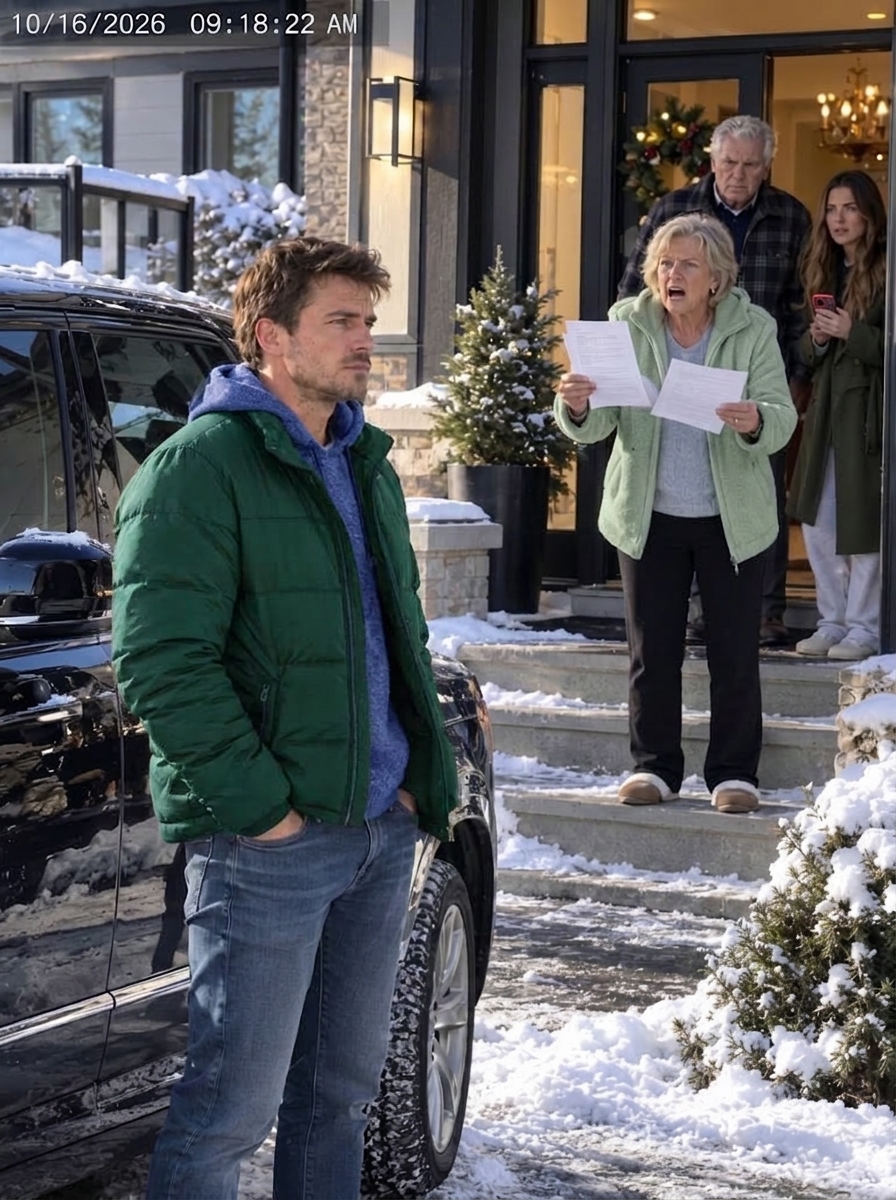
When we pulled up to the blue house, everything was quiet. The driveway was still full of snowed-over cars from the night before. Sienna’s white SUV. Two cars I didn’t recognize.
No lights in the windows. Just a little flicker from the TV in the living room.
I walked up onto the porch and knocked.
Once. Twice.
No answer.
So I crouched down and slipped the white envelope into the crack between the storm door and the frame. Right at eye level, where nobody could miss it.
I stood there for a moment on that porch. The cold bit right through my gloves.
It wasn’t about revenge.
It was about boundaries.
I turned and walked down the steps toward Jonah’s truck.
Behind me, the screen door creaked open.
I turned just enough to see. My mother, Marjorie, in her pink bathrobe, her hair still in rollers, her face pale and puffy with sleep.
She bent down and picked up the envelope. She opened it right there in the doorway, in the cold.
Her lips moved as her eyes went down the pages.
Then she screamed.
“RICHARD! He’s throwing us out!”
I froze halfway to the truck.
My father appeared in the doorway behind her in his undershirt. Confusion on his face. Then the confusion melted into anger.
Then Sienna came stumbling out behind both of them. She was wearing red Christmas pajamas with little reindeer on them. And she already had her phone in her hand. Camera pointed straight at me.
“There!” she shouted. Her voice was shaking with adrenaline. “See? See this? Proof! He’s lost it! He’s completely lost it!”
I didn’t say a word.
I got into the truck.
Jonah reached over and turned the key in the ignition. We pulled away while their voices echoed out across the snowy yard. Growing smaller and smaller. Until all that was left was the hiss of the tires on the ice.
“You okay?” Jonah asked, about ten minutes down the mountain.
“I don’t know yet,” I said.
“That’s fair.”
By the time we got back to Boulder, my phone was vibrating nonstop in my pocket.
Calls. Texts. Notifications. Piling up one on top of another.
Thirty-six missed calls.
Messages from cousins I hadn’t heard from in years.
“Your mother is having a breakdown.”
“What did you DO??”
“You can’t just throw family away like garbage, Orion.”
“On CHRISTMAS?”
Somebody had already sent Sienna’s video to the whole family group chat. The caption said: “He’s evicting our parents on Christmas morning. ”
I opened the video.
It showed my mother in her pink robe, crying, clutching the papers to her chest. Sienna narrating in a shaky voice, like a news reporter at a disaster. “This is my brother. A doctor. Who makes six figures. Throwing his elderly parents out into the snow. On Christmas.”
And in the background of the shot, blurry through the falling snow, there was me. My face turned toward the truck. Unreadable.
I scrolled through the comments under it.
One line stopped me cold.
“He’s forgotten where he came from.”
I set the phone face down on the table.
For a long time, I just sat there. Listening to the soft tick of the heater and the hum of the refrigerator.
Lennon was still asleep. In our small apartment, at least, the world was quiet again.
Then another notification lit up the screen. A social media tag.
Sienna had posted the video publicly. On her business page. Two thousand followers.
And the caption now included our home address.
“If anyone wants to tell this man what they think of him, he’s at…”
It wasn’t about the house anymore.
It was about humiliation.
I walked over to the window and looked out at the snow falling on our empty street. Every lit window I could see reminded me of a table somewhere. Full of warmth. Full of people who believed they were right about everything.
Not one of those messages had asked about Lennon.
Not one person in my whole family had said her name. Not one.
Nobody asked if she got home safe in the storm. Nobody asked if she ate. Nobody asked how a sixteen-year-old girl felt, being turned away at her grandmother’s front door.
They cared about reputation. Not kindness. About being right. Not being decent.
I went back to the kitchen. I made a cup of tea. I sat down in the same chair I’d sat in the night before.
I opened the video one more time. I paused it on my mother’s face. The split second before she started screaming. The disbelief in her eyes, just beginning to turn into fury.
“If they want me to be the villain,” I said quietly, “then I’ll show them what the truth looks like. Signed and sealed.”
I muted my phone. I leaned back in the chair. And I let the silence settle around me.
At ten o’clock, Lennon woke up.
She came into the kitchen in her pajamas, rubbing her eyes. She saw my face. She saw the phone face down on the table.
“What happened?”
So I told her. All of it. The house. The envelope. The video. I didn’t want her finding out from somebody else.
She sat down across from me and listened to the whole thing without saying a word.
When I finished, she was quiet for a long moment.
“Dad,” she said. “Did you do it because of me?”
“I did it because of what they did to you,” I said. “That’s different. That part’s on them.”
She nodded slowly.
Then she got up. She opened the cookie tin with the red ribbon. She put two snickerdoodles on a plate and set it in front of me.
“Merry Christmas, Dad,” she said.
We ate the whole tin that day. The two of us. Sitting on the couch, watching old movies. It was the best Christmas dinner I’ve ever had.
Three days after Christmas, the doorbell rang just after sunrise.
The world outside was swallowed in fog. Pale and soundless.
I opened the door, and my mother was standing there. Wrapped in her pink fake-fur coat. Her breath turning to mist in the cold.
In her hand, she was holding the crumpled white envelope.
“Can I come in?” she asked.
She was already stepping over the threshold before I could answer.
She marched into the kitchen and slapped the envelope down on the table like a weapon.
“After everything we’ve done for you, Orion,” she said. “This is how you thank us?”
I took a breath. I steadied my voice.
“You mean the house I bought? The bills I’ve paid for seven years? Or the part where you let your granddaughter eat cold bread alone on Christmas Eve?”
She froze. Just for a moment.
Then she let out a sharp, humorless laugh.
“Oh, don’t be so dramatic, Orion. There were twenty-eight people. We simply couldn’t add another chair. There wasn’t any room.”
“There was room, Mother,” I said quietly. “You just didn’t want her in it.”
Her eyes went hard.
“You always twist things. You’ve always been so sensitive. We raised you better than this.”
“You raised me to stay quiet,” I said.
She sighed. Like I was a fly buzzing around her head.
Then, slowly, she picked the envelope back up off the table. She tore it right down the middle. Then again. Then again. She let the pieces flutter down onto my kitchen floor like snowflakes.
“There,” she said. “Problem solved.”
She brushed off her hands.
“Now. You’ll transfer the twelve hundred dollars for Nova’s science camp. And we can all just forgive each other and move on.”
There was no anger in her voice. Just certainty.
She truly believed I would obey. Like I always had.
The familiarity of it almost made me laugh.
“Those were copies, Mom,” I said. “The originals are with an attorney.”
That wasn’t true yet. But it would be by the end of the week.
She blinked at me.
“There’s nothing left to forgive, Mother,” I said. “Only lessons to learn.”
She stared at me like she didn’t understand the words. Then she turned toward the door.
Before she left, she looked back over her shoulder.
“You’ll regret this, Orion. Sienna is already talking to a lawyer.”
I didn’t answer.
I just stood in my kitchen doorway and watched her pink coat disappear into the fog.
Then I swept the torn paper off the floor and threw it in the trash.
A few hours later, my phone buzzed.
A text from Sienna.
“Don’t forget. That house carries the family name. Everything you do will come back to you.”
I didn’t respond.
By noon, I got an email alert from my bank.
A new account had been opened in my name. A line of credit. Tied to the Aspen Creek property. Five thousand dollars, already partly spent.
Attached to the application was a signature that looked almost like mine. Almost. But not quite. The O was too round.
I recognized the formatting on the document. It came from one of Sienna’s client contracts. I’d signed one years ago, when I lent her money for her first business license. She still had my digital signature on file.
She’d copied it. And used it.
When I showed it to Jonah in the break room that night, he let out a long, heavy breath.
“Orion. They’re setting you up,” he said. “You need real help. This isn’t a family fight anymore. This is a legal problem.”
He tore a corner off a patient intake form and scribbled a name and a number on it.
“Elaine Rhodes. Attorney. She handled my divorce.” He handed it to me. “She doesn’t play around.”
That night, I sat in the on-call room at the hospital between patients, watching the heart monitors flash in their quiet, steady rhythm.
Across the hall, a patient was waking up from anesthesia. His heart rate was steady. Up, down. Up, down.
I envied that machine. Its clarity. Those clean lines rising and falling with no confusion at all.
I thought about my mother in her pink coat, tearing up paper like it could undo the truth.
And I thought about Lennon’s snickerdoodles.
I looked down at my hands. The same hands that stitched people back together every night. That pressed on the chest of a dying man on Christmas Eve and brought him back.
“If kindness gets trampled,” I said to the empty room, “then the law will have to speak for it.”
The next morning, I called the number.
Elaine Rhodes’s office was on the third floor of a red brick building on Pearl Street in downtown Boulder.
When I walked in, she was already standing by the window waiting for me. A sharp woman in her late forties. Silver hair pulled back tight. Reading glasses on a chain. Eyes that looked like they’d seen every kind of manipulation human beings could come up with.
“Dr. Vale,” she said, shaking my hand firmly. “Jonah told me you’d be coming. Let’s see what you’ve got.”
I handed her the blue folder.
The deed. Seven years of bank statements. The seating chart with the invoice on the back. The blank Christmas card. The old email where my mother called me unstable. The fake line of credit with my forged signature. And a link to Sienna’s video, with our home address in the caption.
She read everything. Page by page. She didn’t interrupt once. She didn’t say a word for almost twenty minutes.
Then she took off her reading glasses and looked at me.
“You have more than enough,” she said. “The house is yours. Clean title. The eviction is straightforward. And if they keep harassing you, we’ll go after defamation. And the forged credit application is fraud. That one’s a police matter.”
She tapped the folder.
“You’ve been bleeding money into these people for years, Dr. Vale. It’s time to stop the bleeding.”
Her words were clinical. Like a diagnosis. One I already knew, but needed somebody else to say out loud.
We spent two hours drafting the formal filings. The eviction. A fraud report on the credit line. A cease-and-desist letter to Sienna about posting our address.
When Elaine slid the papers across her desk for me to sign, I hesitated. Only once.
Then I signed my name. Cleanly. Clearly.
She looked at the signature. She nodded.
“They’ll be served within the week.”
By the time I got home, the sun had gone down.
My phone was full of messages again. I didn’t even need to open them.
Sienna had already weaponized the story.
The family group chat was exploding with screenshots. Somebody had snapped a photo of me in a hospital hallway, in my scrubs, with a pen in my hand. I was signing a patient chart. But that’s not what the caption said.
“Signing the papers to throw out Mom and Dad. The same day a patient DIED under his care.”
A patient had died that day. An eighty-nine-year-old woman with end-stage heart failure. Her whole family was there. They thanked me for keeping her comfortable.
Dozens of replies flooded in under the photo.
“How could you?”
“Your poor mother.”
“She gave you life and this is how you repay her?”
That evening, Lennon was sitting at the dining table scrolling on her phone. Her face was pale in the blue light.
“Dad,” she said quietly. “There’s a post about you. It’s everywhere.”
I looked over her shoulder.
It was a local Facebook group with eleven thousand members. “Boulder Community Watch.” The headline said: “ER Doctor Evicts Elderly Parents for Money on Christmas.”
The comment section was on fire. Hundreds of strangers. Outraged. Furious. People who didn’t know a single thing about us.
“I hope he loses his medical license.”
“Somebody should report him to the hospital.”
“Imagine being his patient.”
Lennon didn’t cry.
She just closed her phone. Then she reached into her backpack and took out the red Christmas card. The one from her grandmother with just two words inside.
She’d taken it out of the trash after I threw it away.
She folded it carefully and tucked it inside the front cover of her notebook. Like something precious.
“They don’t need proof, Dad,” she said softly. “They just need somebody to blame.”
I wanted to tell her it would pass. That people would forget. That it would all blow over.
But I didn’t believe that myself.
The next morning, Elaine called.
“Sienna’s lawyer filed a motion to pause the eviction,” she said. “And you’re not going to like their argument.”
“Tell me.”
“They’re claiming you’re mentally unstable. Unfit to make financial decisions. They want the court to appoint someone to manage the property on your behalf.”
I laughed once. The kind of sound that has no humor in it at all.
“Of course they did.”
“There’s more,” Elaine said. “They’ve referenced your medical records. Apparently you were treated for insomnia after your wife passed?”
I closed my eyes.
Eight years ago. For three months after Clara died, I couldn’t sleep. At all. I’d lie awake until four in the morning, staring at the ceiling. My doctor prescribed something mild to help.
My mother knew because she called my doctor’s office pretending to be my emergency contact.
“They’re framing that as a history of mental instability,” Elaine said.
I sat back in my chair.
“So my grief,” I said slowly, “is now a legal weapon.”
“Only if you let it be one,” Elaine said. “Do you have anything that shows how financially dependent they are on you? Anything that shows the real motive?”
“I have everything,” I said. “Seven years of it.”
That afternoon, Jonah stopped by my office at the hospital. He was holding a little black USB drive.
“You’re going to want this,” he said.
“What is it?”
“Remember last spring? When Sienna called your work line begging for money for her business? You put her on speaker in the break room because you were eating lunch?”
I did remember. She’d called the hospital’s main line because I wasn’t answering my cell.
“All calls on that line are recorded,” Jonah said. “Hospital policy. For liability. I asked the IT guy to pull it.” He set the drive on my desk. “Listen to it.”
After he left, I plugged it into my computer.
Sienna’s voice filled my small office. Syrupy sweet at first. Then cold as ice when I said no.
“You’re the only one in this family with real money, Orion. You’re basically the family’s wallet. So be useful for once in your life.”
I closed my eyes.
There it was.
Not just greed. Contempt.
I sent the file to Elaine. She called me back in less than five minutes.
“That’s it,” she said. “That’s the one. That cuts through every single lie they’re spinning. We’re taking this to court.”
That night, I drove around aimlessly. Through quiet streets. Snowflakes blurring the edges of the streetlights.
On the radio, “Silent Night” was playing. Too calm. Too peaceful for the storm that had taken root inside me.
I pulled over on a bridge above Boulder Creek. I left the engine running and stared down at the black, half-frozen water below.
My reflection looked back at me from the window glass. It looked like somebody else. Somebody who’d spent his whole life apologizing for being right.
For years, I’d mistaken endurance for peace.
Now I knew the difference.
“Silence keeps the night calm,” I said to myself. “But silence for too long becomes its own kind of sin.”
When I got home, Lennon was asleep on the couch again. A blanket pulled up to her chin. A psychology textbook open on her chest.
I turned off the lamp. I sat down beside her for a while in the dark. And I let the apartment settle around us.
The snowstorm outside was finally easing.
But the war inside our family had only just begun.
The courthouse in Larimer County was smaller than I’d imagined.
Pale winter light. Glass doors streaked with frost. The low hum of old heaters fighting against the cold.
The hearing started at nine o’clock sharp.
I sat at the plaintiff’s table next to Elaine. Across the aisle sat my mother, my father, and Sienna. My mother wore her pearls. My father wore the gray suit he’d worn to every school board meeting for thirty years. Sienna wore black, like she was at a funeral.
Their lawyer looked young. Maybe twenty-eight. He kept clutching his tablet and avoiding eye contact with Elaine.
The judge came in. A gray-haired man with calm eyes and reading glasses perched on the end of his nose. The bailiff called the court to order.
“This is the matter of Vale versus Vale,” the clerk read. “Eviction proceeding and counterclaim regarding mental fitness and financial control.”
Sienna’s lawyer stood up first. His voice shook a little.
“Your Honor, my clients wish to state on the record that Dr. Vale has demonstrated erratic behavior, emotional instability, and an abuse of financial control over his elderly parents. This action isn’t about money. It’s about protecting two aging people from a son who has, frankly, lost his way.”
My mother nodded hard. Her eyes were glistening with tears. Well-rehearsed ones. I’d seen them before.
Elaine rose slowly.
When she spoke, her voice cut through the room like a clean blade.
“Let’s talk about protection, then, Your Honor.”
She walked to the front of the table.
“My client has paid every single bill tied to that house for seven years. The mortgage. The insurance. The utilities. The property taxes. His parents’ health insurance premiums. Every penny. He is the sole legal owner of that property. His parents live there entirely at his expense.”
She paused.
“And on Christmas Eve, his minor daughter, sixteen years old, was turned away at the door of that house. The house her father pays for. Where twenty-eight other people were seated for dinner. Including neighbors and business clients. And then he made a lawful decision to end the arrangement.”
The judge raised an eyebrow.
“You have proof of payment, counselor?”
Elaine set a folder on the bench in front of him. It was three inches thick.
“Seven years of mortgage receipts, Your Honor. Bank transfers. Utility bills. Medical coverage statements. All in Dr. Vale’s name. All paid from Dr. Vale’s account.”
Sienna’s lawyer jumped up.
“Objection. Relevance. This doesn’t speak to…”
The judge lifted one hand.
“Overruled. Continue.”
Then Elaine pressed a key on her laptop.
The courtroom speakers crackled to life. And Sienna’s voice filled the room.
“You’re the only one in this family with real money, Orion. You’re basically the family’s wallet. So be useful for once in your life.”
Silence swept through the courtroom.
Even the clicking of the court reporter’s keys stopped.
Sienna lowered her head. Her face went bright red.
My mother went pale. White as paper.
My father just stared straight down at the table. His jaw was locked tight. A muscle jumped in his cheek.
Elaine let the recording play all the way to the end. Then she looked at the judge.
“Your Honor. This is not a man who abandoned his family. This is a man who finally refused to keep being used by it.”
The judge turned to me.
“Dr. Vale. Do you wish to add anything?”
I stood up. I pressed my palms flat on the table to steady them.
“They told my daughter there was no room for her,” I said. “At Christmas dinner. No room at the table with her own blood. There were twenty-eight chairs in that house on Christmas Eve, Your Honor. And somehow not one of them was for her.”
My voice cracked. I let it.
“She drove home alone in a snowstorm. Forty miles. Sixteen years old. With a tin of cookies she baked for them that nobody even opened. And she ate a slice of bread and half an orange for Christmas dinner.”
The courtroom was dead quiet.
“I made my choice,” I said, “because I will never again let my daughter stand outside the window of her own family. Looking in.”
I sat down.
My mother suddenly stood up. Her voice was breaking.
“That was a misunderstanding! She could have stayed if she’d just asked! She didn’t even ask!”
The judge’s gavel came down once. Sharp.
“Mrs. Vale. You will sit down.”
She sat.
Elaine handed the judge one last piece of paper. The seating chart. In my mother’s handwriting. Twenty-eight names. Every single guest. And not Lennon.
“Please turn it over, Your Honor.”
He turned it over. He read the invoice on the back. Sienna Vale Events. Keller account. Delivery to the Vale residence. December 23rd.
He studied it quietly for a long moment. Then he looked over his glasses at the table across the aisle.
“The court finds the eviction notice valid,” he said. “The property title is held solely by Dr. Orion Vale. The opposing parties have no legal standing to remain beyond the notice period. The motion regarding Dr. Vale’s mental fitness is denied. Grief is not a disability, counselor.”
He looked at Sienna’s lawyer when he said that last part.
“And I’m referring the matter of the forged credit application to the district attorney’s office.”
A murmur went through the courtroom.
My mother’s hand gripped the edge of the table so hard her knuckles went white.
Sienna wouldn’t look at me.
When the session ended, I gathered up my papers.
As we stepped out into the hallway, my mother brushed past me. She leaned in close and whispered in my ear.
“You’ll regret this, Orion.”
“Maybe,” I said. “But today, the truth finally got a seat at the table.”
Outside, snow was drifting across the courthouse steps.
Lennon was waiting by the glass doors. She’d insisted on coming. Coat zipped up to her chin. Her eyes searching my face.
“Is it over?” she asked.
“For now.”
I put my hand on her shoulder.
“Let’s go home, kiddo.”
But the quiet didn’t last long.
By that evening, my phone was buzzing nonstop again. Lennon’s classmates had found the courtroom footage. Somebody had leaked a clip of my mother standing up and shouting. They were mocking her voice in videos. And then they started mocking Lennon. For having the same last name.
Then an email came in. From my father.
It was short.
“You did the right thing, Orion. But don’t come back. Your mother will never forgive you.”
I read it three times.
You did the right thing.
It was the closest my father had come to taking my side in forty-four years.
Then a message request popped up from a reporter at the Daily Camera, Boulder’s local newspaper.
“Dr. Vale, we’d like to interview you about the case. The story has been gaining a lot of traction, and we’d like to hear your side.”
I turned around. Lennon was standing in the kitchen doorway, reading the same news on her own phone.
She looked up at me. Calm. Steady.
“If they’re lying about you, Dad,” she said, “then let the world hear the truth.”
I nodded.
Snow tapped softly against the window.
“We will,” I told her. “We already started.”
I gave one interview. Just one. I sat in the reporter’s office and told her everything. The house. The seating chart. The cold bread. The half an orange.
When the article came out, it was on the front page of the Sunday paper.
The headline said: “No Room for Cruelty at My Table.”
The comments on the Boulder Community Watch post started changing that week. One by one.
“I owe this man an apology.”
“I read the actual article. Wow.”
“That poor girl. Half an orange?”
Somebody started a fundraiser for the Boulder County Food Bank in Lennon’s name. “No Empty Plates for Christmas.” It raised eleven thousand dollars in a week.
Lennon cried when she saw it. Happy tears, this time.
My parents moved out of the Aspen Creek house in early March. Sixty days, exactly.
They rented a small two-bedroom place near Fort Collins. Living mostly off my father’s pension and what was left of their savings.
Sienna was charged with fraud for the forged credit application. She took a plea deal. Probation and full restitution. She lost the Keller account. She lost a lot of accounts, actually, once the article came out.
I sold the Aspen Creek house that summer. A young couple bought it. A schoolteacher and a carpenter, with a baby on the way.
Two years went by before life finally felt like peace again.
It was June. Boulder’s summer air was shimmering with warmth. The cherry tree in the little backyard of our new house was heavy with fruit.
Lennon was eighteen now. She was packing for college in Seattle. She’d been accepted to the University of Washington.
She chose psychology.
“So I can understand why people hurt the ones they love,” she said, with a wry little smile.
I still worked nights at the ER. On my days off, I’d started teaching the new residents. How to run a code. How to talk to families on the worst day of their lives.
Life had quieted into something steady.
Last spring, the young couple who bought the Aspen Creek house sent me a postcard. A photo of the blue house with a baby stroller on the porch.
“We planted cherry trees along the old fence,” it said on the back. “Thank you for giving us a start.”
I pinned it on the refrigerator. Right next to Lennon’s college acceptance letter.
I hadn’t spoken to my parents in almost a year.
Then one afternoon, a letter came in the mail.
The handwriting on the envelope was unmistakable. My father’s. Shaky now. But careful. Deliberate.
“Orion,” it began. “We all lost something in this fight. But at least Lennon won. That has to count for something.”
There was no apology in it. Not exactly.
Just a quiet admission, wrapped up in resignation.
Inside the same envelope was a folded newspaper clipping. It was soft and worn at the creases. Like it had been unfolded and refolded many times.
It was my article. “No Room for Cruelty at My Table.”
My mother had added it to the envelope. I could tell. There was no note from her. No signature.
Just the faint smell of her perfume on the paper.
She hadn’t written to me.
But she’d kept the article. For two years.
That was her way of speaking without surrendering.
That evening, the sky turned gold.
Lennon was setting the table out on our back porch. Two plates. Two glasses of lemonade. A little vase with cherry blossoms from the tree.
I stepped outside, and she looked up at me.
“I added a third chair,” she said. “Just in case somebody ever wants to join us.”
Her voice was light. But the meaning landed deep in my chest.
I looked at that empty chair. Then I looked at my daughter.
“As long as they know what it means to deserve it,” I said.
She smiled.
“Then it’ll always be waiting.”
Right then, my phone rang.
Sienna’s name lit up on the screen.
I hesitated. Then I answered. It was a video call.
Her face appeared on the screen. She looked older somehow. Tired. Her eyes were rimmed with exhaustion. No makeup. Her hair in a messy bun.
“Hi, Orion.”
“Hi, Sienna.”
“I wanted to say I’m sorry,” she said quietly. “For all of it. For Christmas. For Lennon. For the video. For your signature. All of it.”
She looked down.
“I thought standing with Mom was the only way to be loved in that family. I thought if I was the good one, the fun one, she’d keep loving me. And you’d be the one she was mad at instead of me.”
She wiped her eyes.
“I was wrong. I was so wrong. And Nova asked me last week why she never sees her cousin anymore. And I didn’t have an answer.”
I didn’t know what to say. So I didn’t say anything.
She gave a small nod. Like she understood.
Then she ended the call, before the silence could turn awkward.
When I turned back around, Lennon was looking out at the horizon. The sunlight was catching her hair. The cherry blossoms were swaying in the warm breeze.
“Was that Aunt Sienna?” she asked, without turning around.
“Yeah.”
“Did she say she was sorry?”
“She did.”
Lennon was quiet for a moment.
“Good,” she said. “That’s a start.”
My phone rang again. Elaine.
“Congratulations, Orion,” she said. “The final sale paperwork is complete. The last of the restitution came through this morning. You’re free and clear. Legally and financially. It’s done.”
“Thank you, Elaine,” I said. “For everything.”
“Go have dinner with your daughter,” she said. And she hung up.
I joined Lennon at the table on the porch.
She looked over at the third chair again. Then back at me.
“Now the table’s finally full,” she said softly. “Right, Dad?”
I looked out across our little garden. Cherry petals were drifting down in the amber light, like slow snow.
“It’s full,” I said. “And it always will be. For the people who’ve earned their place at it.”
She raised her glass of lemonade. I raised mine.
For a long moment, neither of us said anything.
The evening air carried the faint smell of cherry blossoms. And somewhere a few yards over, the sound of a family laughing at a barbecue.
Two years ago, there had been no room.
Now, every chair at our table was a choice.
I thought about that night in the ER. Stitching up a stranger while my phone lit up in my pocket. I thought about the cold bread and the half an orange on a paper napkin. And the girl who came home ashamed, but still kind. Still polite. Still careful not to bother anybody.
Everything I did after that night was about one thing. Giving her back what they took from her.
A seat at the table. A place that was hers.
If anybody asks me now whether I regret what I did, I’ll tell them this.
I only regret the years I stayed silent.
Because sometimes the most loving thing you can do for your family is to draw a line. Right where kindness ends and dignity begins.
Sometimes family doesn’t break you with loud words. It breaks you with silence. With the empty chair you were never offered.
But healing starts the moment you decide to build your own table.
Even if it only seats two, at first.
I’ve learned that boundaries aren’t cruelty.
They’re proof that your kindness finally learned how to stand up for itself.
The next Christmas Eve, the first one after Lennon left for Seattle, she flew home. She walked in the front door with her suitcase and a round tin tied with a red satin ribbon.
Snickerdoodles.
“Is there room at the table?” she asked, grinning.
“There’s always room for you,” I said.
And there always will be.