Tammy wouldn’t come all the way into the room.
She stood in the doorway of the bride’s room at the church with one hand on the frame. She was wearing the sage green dress I had picked out for her back in June. And she stared at the carpet the whole time she talked.
“Mom says you ought to give the ring back today. Before anybody goes home.”
I was sitting on the little bench in front of the mirror. My bouquet was in my lap. I had been holding it so long that the wet stems had left a damp spot on the front of my dress.
“All right,” I said.
“And she says.” Tammy stopped. She swallowed hard. “She says the family is out nine thousand dollars. For the rehearsal supper at the steakhouse last night, and for the cruise. She says she expects you to make that right. Since it was all done for you.”
Behind me, in the folding chair by the radiator, my Grandma June set her cane down flat on the floor.
That was the only sound in the room.
“Nine thousand,” I said.
“She wrote it down.”
Tammy held out a church offering envelope. On the back, in pencil, in the neat, square numbers of a woman who had kept the books at the lumberyard for twenty-six years, it said:
Rehearsal supper 2,100. Honeymoon cruise 6,900. Total 9,000.
The wedding dinner wasn’t on there. She couldn’t put that on there. My father had paid for the wedding dinner.
I took the envelope. I don’t know why. I think because somebody handed me something, and my mother raised me to take what I was handed and say thank you.
“Thank you, Tammy.”
“Amy Jo, I’m so sorry. I didn’t want to be the one. She’s out in the car and she won’t come in, and she said if I didn’t tell you, she would.”
“I know you didn’t want to.”
“He’s my brother,” Tammy said, “and I could wring his neck.”
“I know that too.”
She was twenty-six years old and her mascara had run halfway down her face. I got up and hugged her. Bouquet and envelope and all. Then she went back down the hall carrying her heels in her hand.
It was 3:41 in the afternoon. I know because the clock in the bride’s room was one of those old school clocks with a red second hand, and I had been watching it go around since three o’clock.
Three o’clock was when I was supposed to walk down the aisle.
Here’s how you find out your groom isn’t coming.
Nobody tells you. Not at first.
At three o’clock, the organist was still playing the music she plays while people are being seated. At five after three, she started the same four hymns over again from the beginning. My maid of honor, my cousin Beth, kept slipping out to check and coming back in with a different look on her face every time.
At 3:10 she said the boys were running a little behind.
At 3:20 she didn’t say anything at all.
At 3:20, Derrick’s brother Jeff came to the door instead.
Jeff was the best man. He was in his gray suit, and the flower pinned to his lapel had already started to wilt. He held his phone out to me like it was something that had died in his hand.
There was a text on the screen from Derrick. It had come in at 3:17.
I can’t. Tell her I’m sorry.
That was it. Six words. And he hadn’t even sent them to me.
I called him. People have asked me since why I didn’t just get the man on the phone and talk to him. I did try. I called him eleven times in twenty minutes. It went straight to voicemail every single time. His voice, cheerful, saying leave a message. You can’t talk sense into a man who won’t pick up.
Jeff had better luck. He kept dialing, over and over, and inside the hour Derrick answered him. Once.
He was sitting in his pickup out at the lake. The spot where he liked to fish. He wasn’t hurt. He wasn’t in a ditch somewhere. He just wouldn’t come.
Then he hung up on his own brother and turned his phone off.
So that’s where things stood when his mother sent her envelope in.
A hundred and forty people sitting in the sanctuary. An organist on her third trip through the same four hymns. A groom in a pickup truck at the lake.
And a bill.
My father came in next. He must have passed Tammy in the hallway.
Daddy’s name is Ray. He was sixty-six that fall. He worked maintenance at the cement plant for thirty-one years, and he drove a fuel tanker in the Gulf War in 1991. He is not a talker.
He had on the first new suit he’d bought since my mother’s funeral. Charcoal gray. He’d let Beth pin a rose on it that morning. And he looked like exactly what he was. A man who had been standing at the back of a church for forty minutes, ready to walk his daughter down the aisle.
He looked at the envelope in my hand.
“What’s that?”
I gave it to him. He read it the way he reads everything. Slow. Chin tucked down. Then he read it a second time.
“Lorna sent this.”
“She sent Tammy with it.”
“Today.”
“Just now.”
He folded the envelope once, carefully, and put it in the inside pocket of his suit coat. His hand wasn’t quite steady doing it.
“Jeff says he’s out at the lake,” Daddy said. “I can be in the truck in two minutes.”
“And do what?”
“I’d think of something on the way.”
“Daddy.”
“I would.”
“I know you would. That’s exactly why you’re not going.”
I sat back down on the bench, because my knees had quit on me.
“If you have to go fetch a man and drag him back here,” I said, “I don’t want what you’d be bringing.”
He stood there a long time. I could see him wanting to argue with me and not finding any place to start.
Then Grandma June spoke up from her chair by the radiator.
“Raymond. What’s Connie got in the warmers over at the hall?”
Daddy turned around. “What?”
“The supper. What did you buy?”
“Roast beef. Cheesy potatoes. Green beans, slaw, rolls.” He said it like he was reading off a parts list at the plant. “A hundred and forty plates at thirty-five dollars a plate. Connie put the beef in at six this morning.”
“And the band?”
“Fifteen hundred. They’re already set up. I saw their trailer when I drove by at noon.”
“So that’s what,” Grandma said. “Sixty-four hundred dollars?”
“Yes ma’am. Sixty-four hundred.”
“Paid?”
“Paid Tuesday.”
Grandma June was eighty-four. She has a hip that came from a hospital in Wichita and a cane she mostly uses for pointing at things. She pointed it at me now.
“Then there’s a hot supper for a hundred and forty people sitting four blocks from here. Bought and paid for by your father. And there’s a hundred and forty people in that sanctuary who put on their good clothes and drove in from all over creation and haven’t had a bite since noon.”
She let that sit in the air.
“Your cousin Mark came all the way from Amarillo. The Hendersons are in their eighties and they drove up from Coffeyville. I don’t know what you want to do, sugar. But I know what’s going to waste if you do nothing.”
Daddy was looking at me.
“It’s yours,” he said quietly. “I didn’t buy that supper for him. I bought it for you. You tell me what you want done with it, and I’ll do it.”
I turned and looked at myself in the mirror.
Thirty-one years old. Dark hair pinned up by a girl at the salon on Main Street who told me that morning I looked just like my mother. A plain white dress. No beading. White satin heels that had been pinching my toes since two o’clock.
I thought about the other choice.
Pastor Dale going out front and saying something soft. A hundred and forty people filing past me on their way to the parking lot with their eyes on the floor. Me lying on my old bed at Daddy’s house in this dress. And four blocks away, a woman named Connie scraping roast beef into black trash bags.
I thought about Lorna’s envelope too. I could have sent Tammy back out to that car with a sentence of my own. Believe me, I had a few ready. But a sentence wasn’t going to feed the Hendersons. And it wasn’t going to make me feel one bit less left.
“Beth,” I said. “Hand me my bag. The blue one.”
In the blue bag were the white canvas sneakers I’d bought for dancing at the reception.
I took off the satin heels. I set them side by side under the bench, neat, the way you’d leave something you weren’t coming back for. I put on the sneakers, and I tied them in double knots.
Grandma June watched me do it.
“One more thing,” she said. “Don’t you dare send that band home.”
“Grandma.”
“I mean it.”
She planted her cane and pushed herself up out of the chair.
“Your granddad and I got married in the parsonage parlor in Erie on a Tuesday in 1962,” Grandma said. “The preacher’s wife and the hired man were our witnesses. Then we went home and milked the cows.”
She steadied herself on the cane.
“I have been married, and widowed, and I’ve been to sixty years of other people’s weddings. And I have never one time had a wedding dance. You keep that band.”
“Yes ma’am,” I said.
Pastor Dale offered to make the announcement. Daddy said no thank you. He said it was his to make.
So the two of us went in through the side door by the piano. The organist saw us and stopped right in the middle of a measure.
I didn’t know a church could get that quiet with that many people in it.
Every face turned toward us. My fourth grade teacher. The girls from the pharmacy, where I’d worked the counter for nine years. Daddy’s buddies from the VFW post in their sport coats.
On the other side of the aisle sat Derrick’s people. Fifty or sixty of them. Aunts and cousins, and the men he worked with at the co-op. They looked like folks who had shown up at the wrong funeral.
The front pew on his side had a gap in it. Right where Lorna had been sitting.
My father does not speak in front of people. In thirty-one years of my life, I had never once heard him do it. He walked to the front of the church. He didn’t climb up on the platform. He stood on the floor, down on the same level as everybody else, and he held his hands together in front of him.
“Folks,” he said. “I’m Ray. Most of you know me.”
Somewhere a baby fussed and got shushed.
“There’s not going to be a wedding today. Derrick has decided he’s not coming. That’s about all I know, and it’s about all I intend to say about it.”
A sound went through the whole room at once. Not a word. Just a hundred and forty breaths going out.
“Now,” Daddy said. “There’s a roast beef supper for a hundred and forty waiting over at the VFW hall. It’s hot and it’s paid for. There’s a band. And my sister made a cake you ought to see. My daughter would like you all to come and eat it with her.”
He cleared his throat.
“That’s the whole thing. Supper’s at five thirty. You know where the hall is.”
He looked over at me, in case I wanted to add anything.
I hadn’t planned to. But I was looking at Derrick’s side of the church. At his Aunt Judy with her purse already in her lap. At his little cousins in their clip-on ties. I could see every one of them figuring they were the ones who ought to slip out the back quietly.
“That means both sides of the aisle,” I said.
My voice came out steadier than I felt.
“Nobody in this room did anything wrong. You drove a long way, and you got dressed up. Please come eat.”
For a second, nobody moved.
Then old Harold Dawson stood up in the fourth row.
Harold was ninety-one years old. He was at the Chosin Reservoir in Korea when he was nineteen, and he has sat at the same end of the bar at the VFW post since before I was born. He was wearing a brown suit that I believe he got married in.
“Well,” he said. Loud, because he doesn’t hear well. “I never turned down a roast beef in my life.”
And people laughed.
They laughed the way you laugh when you’ve been holding your breath too long. And then they started standing up.
My niece Emma was six, and she was my flower girl. She came over and tugged on my dress. Her little basket was still full.
“Aunt Amy Jo? Do I still get to throw my petals?”
“You surely do,” I said. “You can throw them at the hall. You can throw them wherever you want.”
If you’ve never been in the VFW hall in Chanute, Kansas, it looks like every VFW hall you’ve ever been in. Brown paneling. Drop ceiling. The flags lined up along the west wall, and the black POW flag by the door. A kitchen with a pass-through window. And the canteen on the other side of a door that stays shut during family doings.
The post had let Daddy have the hall for just the cleaning deposit. Thirty years of dues and Friday fish fries will get you that.
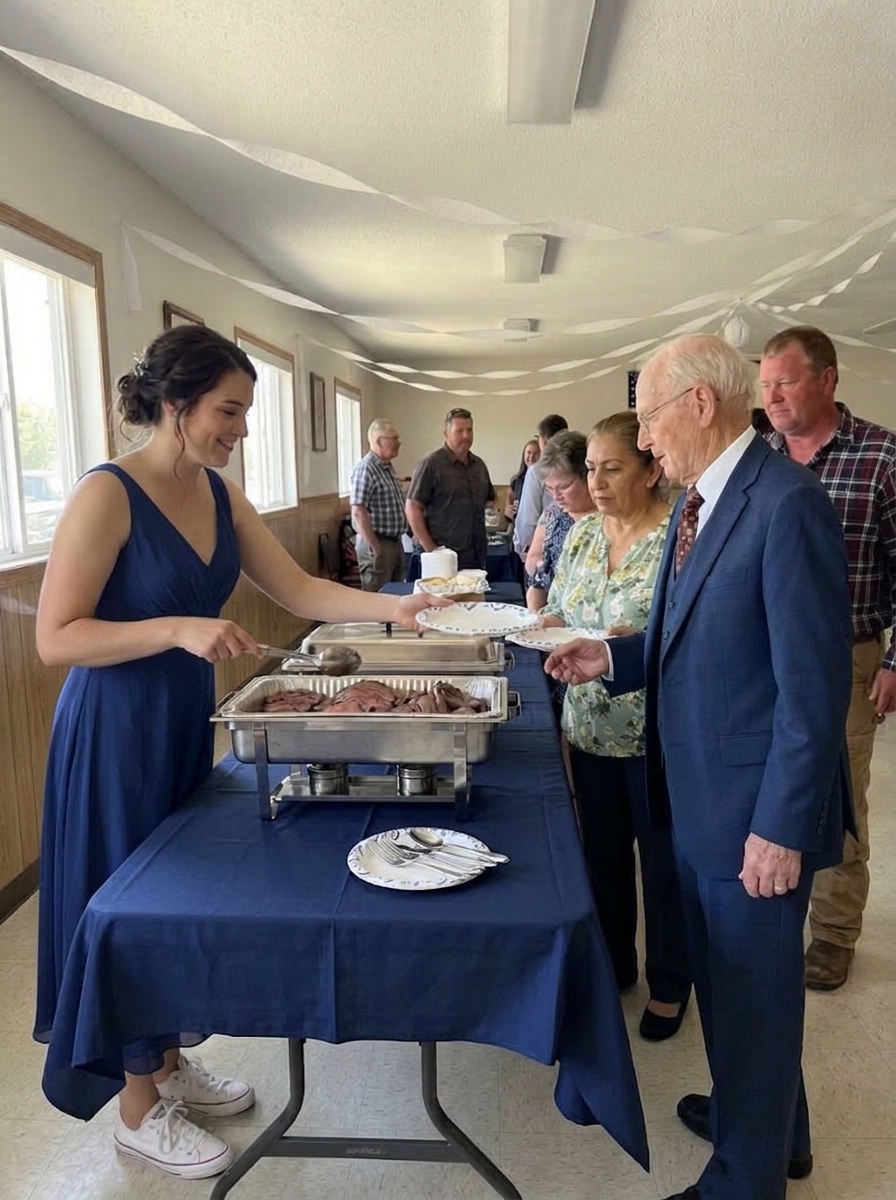
The auxiliary ladies had been in there Friday with Beth and me, and they’d done what could be done. White paper streamers swagged from the middle of the ceiling out to the corners. Long rows of tables with white plastic covers and mason jars full of mums from Aunt Deb’s yard. A head table across the front with twelve chairs.
On the two chairs in the middle, somebody had tied big white bows.
I untied one of them myself and stuck it in a mason jar.
Connie met me at the kitchen door. She runs the cafe out on the highway and caters out of the back of it. She had four high school girls in black aprons and six steam pans going. She already knew. In a town of nine thousand people, news can get across four blocks faster than a bride can.
“Honey,” she said. “You tell me what you want. I can hold it. I can box it up. I can carry it down to the shelter in Parsons. Your dad’s not getting a nickel back from me, because I already spent it on beef. But I’ll do anything else you say.”
“I want you to open the line at five thirty, like we planned.”
“You want to sit down and let me bring you a plate?”
“No,” I said. “I want a spoon.”
I couldn’t have told you why, exactly. I only knew I couldn’t sit up at that head table next to an empty chair with a bow on it and be stared at. If a hundred and forty people were going to look at me, and they were, then I wanted something in my hands. I wanted to hand each one of them a hot plate.
Connie looked at me a long second. Then she tied an apron around my waist, right over the wedding dress, and handed me the long serving spoon for the beef.
So that’s where I was at 5:30. Standing at the head of the buffet line in a white wedding dress and canvas sneakers, with beef juice up to my wrist.
Harold Dawson was first in line. Naturally. He’d been standing by the stack of plates since 5:15.
“Give me an end piece if you’ve got one,” he said.
“I’ve got one.”
I laid it on his plate and handed it across. He didn’t move along. He stood there holding that plate in both hands, and he looked at me with his pale old eyes.
“I got a letter in Korea,” he said. “Winter of fifty-one. From a girl I’d been writing to since basic training. She’d married a fella from Fredonia.”
He nodded slowly.
“Thought it’d kill me. Then I met Dorothy at a box supper the year I got home. We had fifty-eight years.”
“Thank you, Harold.”
“I’m just telling you what happened,” he said, and he shuffled off down the line toward the potatoes.
They came through like that for forty minutes.
The pharmacy girls hugged me across the steam pans and got gravy on their sleeves. Daddy’s friends from the post couldn’t think of a thing to say, so they all said “looks good” about the beef. Derrick’s Aunt Judy took my free hand and held it against her cheek for a second and couldn’t say anything at all.
Emma threw petals at every single one of them.
And at about ten minutes to six, with sixty people still in line, the door by the POW flag opened.
Lorna came in.
She had changed her shoes, I noticed. She’d been wearing navy heels at the church. Now she had on flats. She was still in the navy dress with the matching jacket. The one she and I had driven all the way to Joplin together to find. She had her purse on her arm and her car keys in her hand.
She didn’t look around. She came straight up the side of the room along the paneling, right past the whole line.
The band wasn’t playing yet. So when the talking died down, table by table, as people saw her, there was nothing to cover the quiet.
She stopped across the steam table from me.
Lorna was sixty-two. She’d been a widow for eight years. She’s a small, upright, careful woman who irons her pillowcases. And in the four years I’d dated her son, she had never once been unkind to me.
That was the part I couldn’t get past, standing there.
She taught me her mother’s noodle recipe. She sat with me at the hospital in Wichita for six nights the week my own mother died, because Derrick had to work.
“Amy Jo,” she said.
“Lorna.”
“I’ll take the ring now. I’d just as soon not make a second trip.”
She said it quietly. But it was a quiet room.
The ring was her mother’s. A small round diamond in a yellow gold setting from 1948. Derrick hadn’t bought it. Lorna had taken it out of her own jewelry box and handed it to him to give to me, and she’d cried while she did it.
I was never going to keep that ring. There was no version of that day where I kept it.
But it was also on my left hand. And my left hand was wrapped around a serving spoon, dripping with beef juice, in front of a hundred and forty people.
I could feel every one of them waiting to see what kind of person I was going to be.
Up at the head table, Daddy had started to get up. I caught his eye and shook my head. Just barely. He stopped where he was.
I picked a clean plate up off the stack.
“You’ll have it tonight,” I said. “In its box. Wiped clean. The way your mother would have kept it. I’m not going to pull it off my finger over a steam pan and hand it to you greasy.”
Her mouth went tight. “I don’t think that’s for you to—”
“I’m serving supper right now, Lorna. There’s sixty people behind you.”
I laid a slice of beef on the plate. Then a second one, because she never takes enough.
“There’s a place for you at the head table,” I said. “It’s the same one that was always going to be yours. And there’s cake after. I’d like you to stay for it.”
She looked at that plate like I’d held out a snake.
“I am not going to sit up there and—”
“Lorna.”
That wasn’t me.
It was her sister Judy, three places back in line. She didn’t say it loud.
“Your whole family is in this room,” Judy said. “Every one of us. We’re going to sit down and eat this girl’s supper, because she asked us to, and because it’s the least we can do. You can sit with us. Or you can go sit out in that car by yourself.”
She paused.
“But I’ll tell you which one people are going to remember.”
Lorna stood there.
I think she’d figured on a half-empty hall. A crying girl. A quick errand. Instead there was her own sister in the buffet line. Her own daughter Tammy at a table with the bridesmaids. And her son Jeff over by the wall, still in his best man’s suit, looking at his mother like he was asking her for something.
If she left now, she’d be leaving alone. In front of all of them.
She put her keys in her purse.
She took the plate.
“Potatoes are next,” I said. “Tell Connie’s girl to give you the corner. That’s the crispy part.”
I served until the very last person had come through. Then Connie took the spoon right out of my hand, put a plate in its place, and told me she’d come after me with a dish towel if I didn’t go sit down.
So I went up and sat at the head table after all.
Somebody had quietly taken away the other chair with the bow. I never found out who. Grandma June was on my left. Daddy was on my right.
And on the other side of Daddy, because it was the place that had always been hers, sat Lorna. Back as straight as a yardstick. Her beef cut into little pieces she wasn’t eating.
Nobody at that table said one cross word to her.
I’ve heard this story told back to me around town with things added to it, and that’s one of them. People say somebody gave her a piece of their mind. Nobody did. Daddy passed her the rolls. Grandma June asked after her tomatoes. Beth refilled her iced tea.
That was harder on her than a cross word would have been. I could see it on her face.
If somebody had lit into her, she’d have had something to stand up against. Instead she had to sit there and be passed the butter by the very people she’d sent a bill to. In front of a hundred and forty neighbors who all knew about that envelope by then.
About halfway through supper, she set her fork down.
“Ray,” she said. Low. “I expect you saw what I sent.”
“I did.”
“I put that cruise on my own credit card. Sixty-nine hundred dollars. It sails Monday out of Galveston, and they won’t give back a dime this close.” Her voice had a shake in it that she was working hard to hold down. “I don’t have that, Ray. I have never in my life carried a balance. I don’t know what I’m going to do.”
Daddy picked up a roll and buttered it. He took his time.
“Lorna, I’m going to say this one time,” he said. “And then I’m not going to say it again. Not tonight. Not ever.”
He didn’t raise his voice. He’s never needed to.
“A supper got eaten last night by thirty-eight people, and you and I were two of them. A boat’s going to sail Monday whether anybody’s on it or not. My girl didn’t order either one. And she didn’t cancel either one. You’ve brought it to the wrong house.”
Lorna looked down at her plate.
“I’ve got sixty-four hundred dollars in this room myself,” Daddy said, more gently now. “I’m not sending anybody an envelope. I’m sitting here watching Harold Dawson go back for thirds. I figure I got my money’s worth.”
He set the buttered roll on her bread plate.
That was the last time I ever heard anybody speak of the nine thousand dollars.
A little later, Jeff came up behind my chair and crouched down next to me, the way you’d do to talk to somebody at a ball game.
“He texted me again,” he said. “You want to know or not?”
I thought about it. “Is it short?”
“Yeah.”
“Go ahead.”
Jeff read it off his phone. Derrick had left the lake and driven south down Highway 169 to their cousin’s place in Tulsa. He said he’d known since spring that he didn’t want to get married. He kept thinking the feeling would pass. And every week it got harder to say out loud, until that morning it was just easier to drive.
That was the whole reason.
There was no other woman. There was no big secret. There was just a man who was too scared to have one hard conversation back in April.
“Okay,” I said.
“You want me to say anything back?”
“Tell him his mother’s here. And she’s eating.”
Jeff almost smiled. “That’ll scare him worse than anything.”
“I’m not trying to scare him,” I said. “I just think he ought to know where she is.”
The band was four men from Parsons who played country music and some old rock and roll. The leader was a heavyset fellow with a white beard. He came and found me while the plates were being cleared, holding his hat in his hands.
“Ma’am, we’ll do whatever you want. We can pack up right now, no hard feelings. Or we can play quiet. We had a first dance worked up, but we can skip right on past that.”
“What was it?”
He told me. It was the old Anne Murray waltz. Derrick hadn’t cared one way or the other what we danced to, so I’d picked it. Because my mother used to sing it at the kitchen sink when I was a little girl.
“Play it,” I said.
“You sure?”
“I’m sure. Play it first.”
He went back up on the little stage, and they started in.
Nobody got up, of course.
A hundred and forty people sat there holding their coffee cups and stared at an empty square of linoleum with a waltz playing over it. For about eight bars I thought I’d made a terrible mistake. I sat there with my face burning.
Then I heard the cane.
Grandma June was getting up. She didn’t ask anybody for help. She pushed her chair back, squared her shoulders, and came around the end of the head table one slow step at a time in her lavender dress with the pearl buttons.
She stopped in front of me. And she held out her hand, palm up. The way a boy would have done in 1958.
“I believe this is mine,” she said.
I took her hand.
We walked out onto that floor together. Eighty-four and thirty-one. A cane and a pair of canvas sneakers. She hung the cane over her wrist and put her other hand on my shoulder.
She couldn’t really waltz anymore. We swayed. That was all. She smelled like Jergens lotion and the peppermints she keeps in her pocketbook.
“I’m sorry it’s just me, Grandma,” I said.
“Hush. I’ve waited sixty years for this, and I’m not going to have it apologized over.”
“I mean for you. I’m sorry your dance had to be this one.”
She leaned back so she could see my face. Her eyes were wet. Her voice wasn’t.
“Amy Jo, you listen to me. I buried a husband. And a daughter-in-law. And a baby boy you never knew about, who’d have been your uncle. I know what a bad day is.”
She squeezed my shoulder.
“A bad day is one where there’s nobody to feed and nobody to dance with. Look around this room, sugar. This is not a bad day. This is a hard day. They are not the same thing. When you’re my age, you’ll know the difference by the sound.”
That’s when I finally cried.
Right there in the middle of the dance floor, with my forehead down on my grandmother’s shoulder, and her patting my back in time to the steel guitar.
I heard a chair scrape. Then another one.
When I got my head back up, Daddy was standing at the edge of the floor with his hand held out to his sister Deb. Harold Dawson had gotten hold of one of the auxiliary ladies. Derrick’s Aunt Judy and her husband were out there. Emma was dancing all by herself, turning in circles, throwing the last of her petals straight up in the air so they came down on her own head.
By the end of that song, there wasn’t room on the floor to swing your arm.