My son called me from an airport gate to tell me he’d gotten married.
The day before.
“It was just for close friends, Mom,” he said. “People with status.”
I smiled. I told him congratulations.
That same afternoon, I had every lock changed on my beach house. The house he and his new wife had planned to live in. For free.
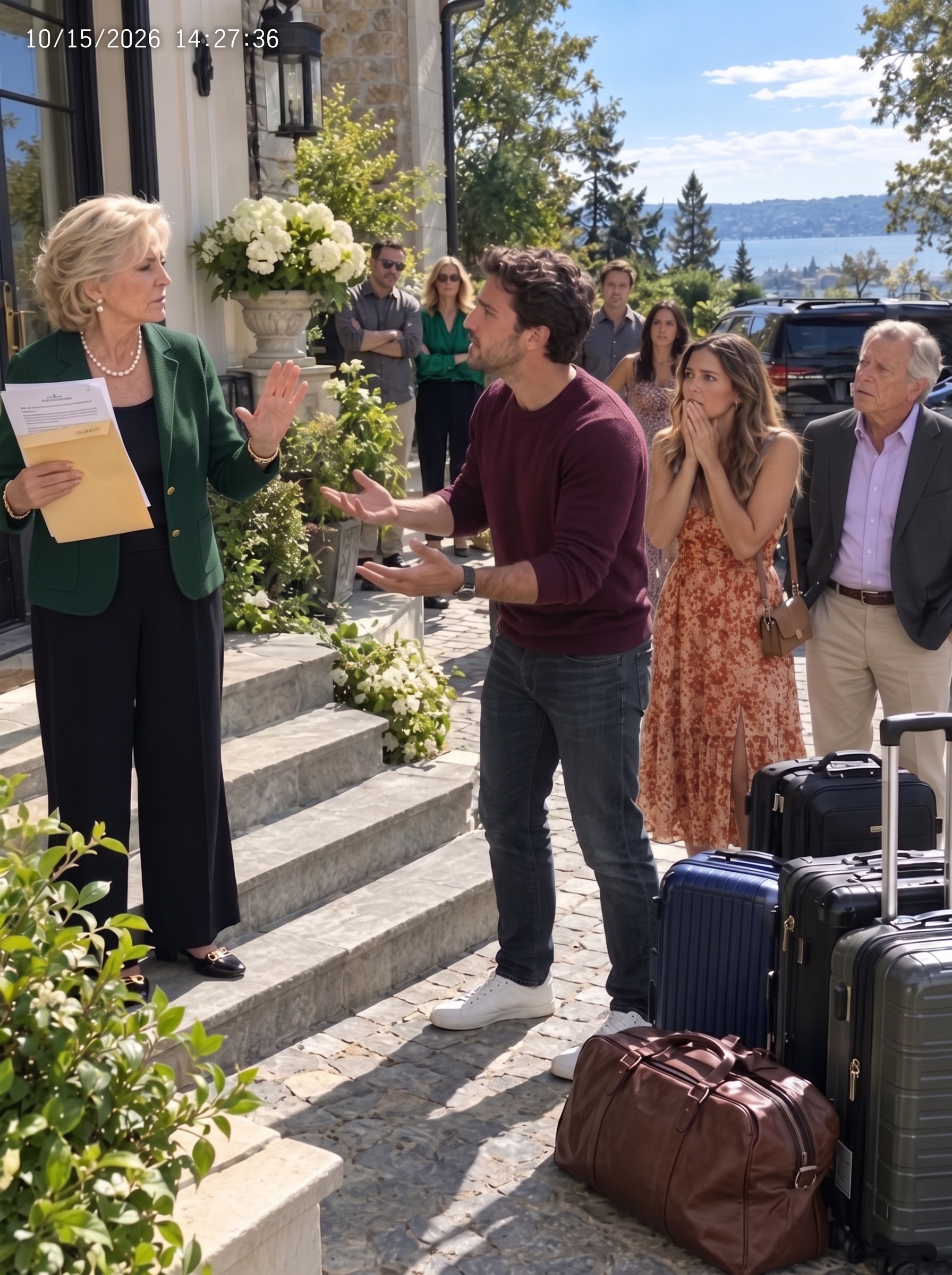
Then I carried their suitcases out onto the lawn.
Twelve nights later, they flew home from Hawaii. And his new mother-in-law had invited thirty-four people with status to stand on my lawn and watch me hand over the keys.
What I said from my porch step that day, not one of them saw coming.
Least of all my son.
My name is Saraphina Tumi. I’m seventy-one years old.
It was the thirteenth of September. A Sunday. Twenty minutes to ten in the morning.
I was standing in my kitchen in Cranston, Rhode Island, with my second cup of coffee. The one I drink slowly, because nobody’s waiting on me anymore.
The phone said Cullen. My only child. Thirty-three years old.
Behind his voice, I could hear a gate announcement. A boarding group being called. A child crying somewhere nearby.
“Mom, hey. So. Big news.”
He laughed the way he used to laugh when he dented the car.
“Blythe and I got married yesterday.”
I set my cup down on the counter very carefully. The way you set down something you suddenly suspect is cracked.
“Yesterday?”
“At the Chadborn Club in Bington. Forty-six people. It was beautiful.”
Forty-six people.
I priced risk for a living for thirty-eight years. The habit never leaves you. So I did the arithmetic without wanting to.
Forty-six chairs.
And not one of them had been mine.
“It was just for close friends, Mom,” he said again. “People with status. Honestly, you’d have hated it.”
Would I?
“And listen,” he went on. “When we land on the twenty-sixth, we’re going straight to the point. Just till we find something. You’re never down there in the fall anyway.”
The point. My beach house.
He said it the way you’d mention the weather. As if it had already been settled by somebody more important than me.
“Who gave the toast?” I asked.
“Miles did. Blythe’s dad. It was great.”
Another boarding group was called.
“That’s us, Mom. Eleven-oh-five to LA, then Maui.”
“Congratulations, sweetheart,” I said.
And I smiled. Because smiling is what my face does when the rest of me goes very still.
“Have a safe flight.”
I hung up first. I set the phone face down on the counter.
And I went to find my car keys.
You should know who you’re listening to. So let me tell you plainly.
My father polished brooches and cufflinks in a jewelry factory in Cranston for twenty-six years. He died at his workbench in 1973. I was eighteen.
There was no insurance worth mentioning. There was no plan.
So at nineteen, I took a job as a typist at Uppam Mutual Insurance. Typing other people’s policies all day long.
At night, I took math classes. One at a time. Because one at a time was all I could afford.
It took me seven years to finish a degree that takes most people four. I graduated at twenty-six. Then I started the actuarial exams. The kind of tests that make grown men cry in parking lots.
I passed the last one in 1987.
If you’ve never met an actuary, here’s the short version. We calculate how likely things are to go wrong. And what it’ll cost when they do.
People find us boring at parties. That suits us fine.
I retired in 2019. As chief actuary. Of the same company that once hired me to type.
I married a high school shop teacher named Nile Tumi in 1984. Our son Cullen came along in February of 1993. I was thirty-seven.
Now here’s the part I’m less proud of. I’d rather you hear it from me.
I grew up poor. So I learned to show love by providing. Tuition. Cars. A cushion under every fall.
And every Fourth of July, sitting on that beach house porch, I’d look at my boy and say, “Someday, this will all be yours.”
I taught my son that sentence.
I never taught him the second half.
The second half is that someday is the giver’s word.
Not the receiver’s.
The house sits at 14 Wicket Point Road in Quanet. On a little thumb of land that pokes out into the sound, about fifty minutes south of Cranston.
The old summer families have been there since the 1920s. We were not one of them.
In August of 1991, Hurricane Bob tore the porch clean off that little gray cottage and pushed half the lawn into the water. It sat empty for five years. Plywood on the windows. A sign nobody answered.
On the fifteenth of June, 1996, Nile and I bought it for eighty-six thousand dollars. Every penny we had. And some we didn’t.
For six summers, we rebuilt it ourselves. On weekends.
Nile did the framing and the porch. I did the math, the permits, and the painting.
Cullen was three when we started. His job was handing his father nails. One at a time. Very seriously.
The front door had an old brass lock that stuck. You had to lift the key a little, then turn.
In 1997, Nile put a dab of blue paint on my key, because I kept handing him the wrong one out of my purse.
“There,” he said. “So you always know which door is ours.”
Offshore, past the rocks, there’s a bell buoy. Nile used to say it rang harder when the weather was about to turn. He said it was the only neighbor on the point who never lied about the weather.
Nile died of a heart attack on the third of November, 2012. He was sixty-one.
The house is paid off. In August, an appraiser for my insurance company put it at one million, nine hundred and forty thousand dollars.
That Sunday, I drove down to see what “straight to the point” meant.
I pulled into the gravel drive at a quarter to one.
The tide was out. The whole point smelled like warm seaweed and somebody’s late roses.
The front door was locked the way I’d left it on Labor Day. But inside, the house had been rearranged.
In the front room, lined up by the stairs like soldiers, were four matching suitcases. Navy blue. The expensive kind, with leather corners.
Next to them sat six cardboard boxes. Each one labeled in black marker. KITCHEN — POINT.
Every suitcase wore a leather luggage tag. Monogrammed in gold.
Mr. and Mrs. C. Tumi.
I stood there and read that tag three times.
They’d ordered those tags before they ever told me there was going to be a wedding.
Somebody had picked out a font.
In the main bedroom, Blythe’s white bathrobe hung on the hook behind the door. My own robe had been folded up and set on a shelf in the hall closet. Like something waiting for Goodwill.
Then I looked at the mantel.
For fourteen years, a photo of Nile had stood there. Grinning in his paint-spattered shirt on the half-built porch.
It was gone.
I found it in the hall drawer. Face down. Under a stack of takeout menus.
On the kitchen counter sat a hardware store receipt for two rolls of shelf liner. Dated Wednesday, September ninth. Two days after Labor Day. Two days after I’d locked up and driven home.
They’d let themselves in with the spare key I gave Cullen in 2019. For emergencies.
Nobody had slept in a bed. There was no food in the refrigerator. No mail on the table.
Just luggage. Boxes. A bathrobe.
And my husband, face down in a drawer.
I put Nile back where he belonged.
Then I picked up the phone.
My Son Married Without Inviting Me Because I Had “No Status” Then He Came Home From Hawaii Expecting the Keys to My $1.94 Million Beach House
PART 2
Palumbo Lock and Safe has been on Main Street in Quanet since before I bought the house. And Nunio Palumbo answers his own phone on Sundays. Because, as he once told me, burglars don’t keep business hours.
He pulled up at three in a little white truck. About sixty-six. Gray mustache. Reading glasses on a cord.
“Mrs. Tumi,” he said. “Sunday rates. Two-forty. You know that?”
“I know that.”
“I’ll need your license too. And something with this address on it. That’s my rule on Sundays.”
I showed him my license. And the property tax bill stuck to my refrigerator with a lobster magnet.
He read both. He nodded. He went to work.
Front door. Back door. The side door to the garage. It took him an hour.
He handed me three shiny new keys on a paper tag.
I tried my old brass key in the new front lock. Just to see.
It slid in halfway and stopped.
I kept it on my ring anyway. Blue dab facing up.
While Nunio packed his tools, I carried their things outside. Four suitcases. Six boxes.
I set them on the grass by the drive in two neat rows. Gold tags facing the road.
And I took a picture with my phone.
I want to be very clear about one thing.
My son and his wife had never lived in that house. They’d never slept one night there. Never gotten a single letter there. Never paid a dollar. Never signed a word.
They’d dropped off luggage in a house that wasn’t theirs.
That’s all.
At 4:52, I sent Cullen the picture. With a message.
Congratulations again. I’ve changed the locks at the point. Your things are safe. They’ll be on the lawn when you land.
Then I put my phone in the cookie jar.
And I made a cup of tea.
They were in the air when I sent it. Their flight left Boston at 5:11.
At 5:40, the cookie jar started buzzing.
I let it buzz three times before I lifted the lid.
WHAT ARE YOU DOING.
A minute later:
We told everyone we’re living there, Mom. EVERYONE.
I sat with that word for a while.
There’s a particular kind of loneliness in finding out a whole room full of strangers knew your plans before you did.
Then came a voice memo from Blythe. She was crying. Or doing a very good job of it. With an airport echo all around her.
“We have nowhere to go, Mrs. Tumi. We gave up our apartment on the thirty-first. Please.”
They’d given up their apartment on the thirty-first of August. Two weeks before they ever told me they were married.
That was a decision. And it was theirs.
I typed exactly one reply.
You have a honeymoon to go to. Go have it. Enjoy Hawaii.
The last text came while I was rinsing my cup. From Cullen. Only half a sentence.
Miles thinks it’s done. Mom, you don’t get it.
I read it twice.
Miles thinks what is done?
I had no idea. And I didn’t like having no idea. That’s a professional weakness.
Around seven, the sky over the sound turned the color of a bruise. The radio said rain by midnight.
So I went back out to the lawn and carried all ten of their things into the garage. Out of the weather.
I’d promised them the lawn.
I hadn’t promised them the rain.
That night, I couldn’t sleep. So I let myself remember the engagement dinner. Which I’d spent ten months politely trying to forget.
It was Saturday, the fifteenth of November, last year.
The Havstocks hosted it at the Chadborn Club in Bington. The kind of place with oil paintings of sailboats on every wall and a man whose only job is holding the door.
Blythe’s father, Miles Havstock, owns Havstock Marine. A big boat dealership up the bay.
He spent the whole soup course explaining horsepower to me.
Blythe’s mother, Laurelai, wore pearls the size of chickpeas and a smile that never quite reached her eyes. She’s fifty-eight. Very blond. Very careful about where she stands in a photograph.
Over the fish course, she turned to me.
“And what did you do, Saraphina? Before?”
“I was an actuary.”
“Oh,” she said. “An accountant for dead people.”
She laughed.
“How restful.”
The whole table laughed with her.
And my son, sitting next to his new fiancée, laughed too.
Not loudly. But I saw it.
Then Laurelai asked me about the house.
“Cullen tells me you have a place on Wicket Point.”
She said the name slowly. Like she was tasting a wine.
“How many bedrooms?”
“Three.”
“Water view from all of them?”
“Two.”
She asked about the point twice more before dessert. Each time, I gave her the same short answer.
“It’s my house.”
Blythe, I noticed, never once watched her fiancé during any of this. She watched her mother. The way a student watches the teacher right before the test.
When the valet brought my 2011 Volvo station wagon around, Laurelai looked at it for a long moment. Then at me.
I didn’t know yet that my beach house had been sitting at that table longer than I had.
I stayed at the point on Monday the fourteenth. I wasn’t in any hurry to leave a house with new locks and old memories.
At two in the afternoon, my phone lit up with a post from Blythe.
A sunset over the water at Wailea. Two champagne glasses held up against the orange sky. Her new ring catching the light.
The caption read: Mr. and Mrs. 12 nights of paradise. Next stop: our beach house on the point.
Two hundred and twelve people liked it by dinnertime.
Somebody named Tish wrote: Living the dream, girl!
Somebody else wrote: Can’t wait to visit you on Wicket!
At six o’clock, Laurelai called.
“You have humiliated my daughter on her honeymoon,” she said.
No hello.
“Good evening, Laurelai.”
“Those kids were promised that house.”
“By whom?”
“Don’t play games with me. You’ll open that door when they come home.”
Then she lowered her voice. Almost friendly.
“And you won’t fuss about it either. Women like you never make a scene.”
Women like you.
I thought about Cullen’s voice at the airport. People with status.
I’d wondered where my son picked up that vocabulary.
Now I was listening to the teacher.
“Nobody promised them anything, Laurelai.”
“Ask your son,” she said, “what he promised my husband.”
And she hung up on me. Which was a new experience. I’m usually the one who ends calls.
I sat on the porch until the light went.
Out past the rocks, the bell buoy rang slow and lazy. Fair weather.
For once, the buoy was wrong.
Something was coming. I just didn’t know its name yet.
What did my son promise his father-in-law?
I didn’t know. So I did what I always do with a number I don’t understand.
I went back to where it started.
Cullen was nineteen when his father died. A sophomore at URI. I drove up to get him myself. He cried in my car for two hours straight. I drove and said nothing. Because there was nothing to say.
After that, I handled everything. Tuition. His first car. His first apartment deposit.
I never let him see a bill.
I thought I was protecting him.
I was actually teaching him that bills were somebody else’s weather.
He sold commercial insurance for ten years. He was decent at it.
Then, in May of last year, Miles Havstock offered him a job as sales manager at the dealership. Cullen took it that same week.
After that, little things changed.
A new watch. New shoes that cost more than my first car payment. New words.
People with status. Our kind of crowd.
Once, at Easter dinner, he called the waiter “the help.” I asked him to repeat it.
He didn’t.
And he started asking me a question he’d never asked before.
“How much is the point worth now, Mom? Just curious.”
I’d tell him I didn’t know.
That wasn’t true. I always know.
I’m not telling you this to make him a monster. I’m telling you because I helped.
Every Fourth of July for twenty years, I sat on that porch and said, someday this will all be yours.
In my head, someday had a date. I’d picked it out myself
My Son Married Without Inviting Me Because I Had “No Status” Then He Came Home From Hawaii Expecting the Keys to My $1.94 Million Beach House
PART 3
On Tuesday the fifteenth, the wedding album appeared online.
A bridesmaid named Reagan posted sixty-three photographs from the Chadborn Club. With a little heart. Best night ever.
I’m not proud of it. But I looked at every single one.
White hydrangeas. Linen tablecloths the color of sand. Blythe’s dress with a long lace train. My son looking handsome and nervous and happy. The way his father looked at our wedding.
Then I came to the cake.
Three white tiers.
And on top, instead of a little bride and groom, there was a tiny sugar cottage. Gray shingles. A wraparound porch.
And a blue front door.
My house. On top of their wedding cake.
I enlarged the picture with two fingers. I stared at that little blue door for a long time.
Nile painted the real one himself in 2001. It took three coats.
Two photos later, I found table number three.
And sitting there in a lilac jacket, raising a champagne glass, was Anoria Endicott.
Anoria is eighty-six. She’s lived next door to me on the point for thirty years.
Anoria had been at my son’s wedding.
I had not.
Under the toast photo, somebody had left a comment.
So sorry your mom couldn’t make it, Cullen. Hope she’s feeling better!
Feeling better.
I read it twice.
I hadn’t had so much as a sniffle since March.
So that was the story going around that room. Not that the groom’s mother wasn’t invited.
That she was sick. Too frail to drive twenty minutes to Bington.
It was just for close friends, Mom. People with status.
And the people with status had been told I was dying.
My house was on the cake.
I wasn’t even on the list.
On Wednesday the sixteenth, at ten in the morning, I was sitting on the front porch with my coffee when I heard the bell buoy clanging hard out past the rocks. The wind had swung northeast overnight.
Then I heard tires on the gravel.
A white SUV pulled into my drive. Followed by a van that said CAIN LOCK AND KEY.
Laurelai Havstock stepped out of the SUV in white linen trousers and enormous sunglasses. Like she was arriving at a yacht race.
A man in his forties climbed out of the van with a toolbox. He looked at the house. Then at me on the porch. And I watched him read the situation before anybody said a word.
“This is my daughter’s house,” Laurelai told him. Pointing at my front door. “She’s away. We need it opened.”
“Sure, ma’am,” he said. “I’m Dermit. I’ll just need to see ID with this address on it. Or a deed.”
“I’m her mother.”
“Yes, ma’am. Does your daughter get mail here?”
Laurelai didn’t answer.
I stood up.
“I’m Saraphina Tumi,” I said. “I own this house. I can show you my license and my tax bill, if it helps.”
Dermit Cain looked at Laurelai. Then at me.
Then he set his toolbox back in his van.
“No proof of address, no service,” he said. “Sorry, ma’am. Not my first family fight.”
“Would you like a cup of coffee, Mr. Cain?”
He smiled for the first time.
“Thank you, no. You have a good day, Mrs. Tumi.”
Laurelai watched his van back out. Her face had gone very still. The way mine does.
Then she turned to leave. And she stopped at the edge of my lawn. And she looked over at Anoria’s house. At the old iron gate between the hedges.
“The Endicott gate still sticks, I see,” she said.
She got in her car and left.
I stood there holding my cup.
How on earth did Laurelai Havstock of Bington know that Anoria’s gate stuck?
That evening, Blythe called me from Hawaii.
I almost didn’t answer. Then I did. Because she’s my son’s wife now. Whether I was there to see it or not.
“Mrs. Tumi.”
Her voice was small and wet.
“Please. My mother is so upset. She’ll never forgive me if this goes wrong.”
“If what goes wrong, Blythe?”
“Everything’s planned for after Saturday the twenty-sixth—”
She stopped short. Like somebody who’d stepped on a loose board.
“I mean coming home. Just coming home.”
“What’s planned for the twenty-sixth?”
“Nothing. Please don’t make this ugly. Cullen’s really hurt.”
Cullen was really hurt.
I was the one who found out from a stranger’s comment that I was supposed to be sick.
But I didn’t say that.
“I hope you’re enjoying the beach, Blythe,” I said. “Wear sunscreen.”
Everything’s planned for after Saturday.
Something was waiting for me on the twenty-sixth.
And apparently, I was the only person who hadn’t been told what.
On Thursday the seventeenth, at a quarter to four, the phone rang again.
Miles Havstock.
I’d given him my card at the engagement dinner. He’s the kind of man who keeps cards.
“Saraphina,” he said. Calm. Polite. Careful. Like a man walking across a dock he isn’t sure will hold. “I’ll be direct. Is there some kind of problem with the paperwork?”
“Which paperwork?”
A pause. I could hear a radio behind him. A forklift beeping. The sounds of a boatyard.
“For the house,” he said. “Cullen told me back in June it was done. Signed.”
I didn’t say anything.
In my old job, when a number doesn’t add up, the best thing you can do is let the other person keep talking.
“I made some decisions based on that,” Miles said.
“What decisions?”
“Business decisions. Family decisions.” He cleared his throat. “Is it signed or isn’t it?”
“There is no signed paperwork, Miles,” I said. “There never was.”
The silence on that line went on so long I checked whether the call had dropped.
“I see,” he finally said. Very quietly.
And he hung up.
I sat on my porch step with the phone in my lap.
Signed.
He’d used that exact word. And Cullen’s half sentence came back to me.
Miles thinks it’s done.
There was only one piece of paper in the whole world my son could possibly mean.
And it wasn’t at the point.
It was in a drawer in my front hall in Cranston. Where I’d put it in March.
Where, as far as I knew, nobody had ever touched it.
That night, I lay awake replaying a Sunday in April. Frame by frame. The way you replay a fender bender to figure out who rolled the stop sign.
April twelfth. Cullen came to dinner in Cranston alone. Blythe had a work thing.
I made lasagna. His father’s favorite. He ate two helpings.
During coffee, my phone rang. Nile’s sister, calling from Florida about her hip. She’s not a woman who can be rushed.
I took the call in the kitchen. Almost ten minutes.
When I came back, Cullen was standing in the front hall. By the little table where I keep my keys and my mail.
He said he was looking for a pen.
He was cheerful the rest of the night. Strangely cheerful.
When he left, he hugged me twice. Once at the door. Once at his car.
Cullen hasn’t hugged anybody twice since he was eight years old.
In May, he started asking odd questions. What kind of wedding gifts do families like ours give? Do you still use the same lawyer? Is Mort Gilman still practicing?
I thought he was making conversation.
I thought he was growing up.
At five the next morning, I got in my car and drove north to Cranston in the dark.
I let myself into my house at ten minutes to seven on Friday the eighteenth. The kitchen still smelled a little like Sunday’s coffee.
I went straight to the little table in the front hall. I opened the drawer.
The envelope was right where I’d left it. A long cream envelope from the law office of Mort Gilman.
On the front, in his secretary’s neat printing:
GIFT DEED — 14 WICKET POINT ROAD — FOR SIGNATURE.
Here’s what was inside. And here’s the secret I’d kept from everyone.
In March, I’d asked Mort to draw up a deed giving my beach house to my son.
All of it. The porch Nile built. The blue door. The view of the buoy. The one point nine four million dollars.
The deed was dated March eighteenth. It named Cullen Tumi as the one receiving it.
The line for my signature was blank. So was the notary box.
And clipped to the top with a paper clip was a small square of paper torn off a lumber pad. Written in pencil, in Nile’s blocky capitals.
I found it in his tool chest in 2012. A week after the funeral.
FOR THE BOY WHEN HE MARRIES. — N.
That was my plan.
That spring, Cullen told me they’d probably get married next summer. So I meant to sign that deed the week of his wedding. And hand it to him. In his suit. With his father’s note on top. In front of everybody who loved him.
Then I turned the envelope over.
The flap had been slit clean. With a knife or a letter opener.
And then sealed back shut with clear Scotch tape.
I have never taped an envelope in my life. I lick them. I’m old-fashioned that way.
He read it on April twelfth. In the ten minutes I was on the phone with his aunt.
He read his father’s note before I ever got the chance to hand it to him.
And then I understood all of it.
My son didn’t keep me away from his wedding in spite of the gift.
He kept me away because of it.
He’d already seen it. He didn’t need me there to give it to him.
He just needed me not to be there to ask questions.
My Son Married Without Inviting Me Because I Had “No Status” Then He Came Home From Hawaii Expecting the Keys to My $1.94 Million Beach House
PART 4
I drove back to the point that afternoon with the envelope in my purse. I didn’t want it out of my sight again.
On Saturday morning, the nineteenth, somebody knocked on my screen door.
Anoria Endicott. In a cardigan and pearls. Leaning on her cane. Holding a cream-colored card.
“This came in yesterday’s mail,” she said. “I think you should see it.”
It was an invitation. Heavy card stock. Gold edges. A little hand-drawn hibiscus in the corner.
ALOHA, HOME! Please join us to welcome Blythe and Cullen to their beach house. 14 Wicket Point Road. Saturday, September 26th, at noon. Hosted by Miles and Laurelai Havstock.
Their beach house.
My address. Printed in gold.
So that was Blythe’s Saturday. A brunch on my lawn for her mother’s friends. The morning they flew home.
Anoria lowered herself into my porch rocker.
“Laurelai told me in August you were giving the children the house,” she said. “That you’d decided. So I wrote their sponsor letter for the Bathing Association.”
The Wicket Point Bathing Association is the little beach club at the end of the point. It’s been there since 1921. Membership is only for people who own a house on the point or live there year-round.
Anoria has sat on its admissions committee for forty years.
“The committee votes Wednesday the thirtieth,” she said. “Is it true, Saraphina? Did you give them the house?”
“It’s still my house, Anoria,” I said. “It always has been.”
She was quiet for a long moment.
“Then I’ve signed something I shouldn’t have.”
“Why did you go to the wedding?” I asked. As gently as I could.
“Laurelai said you were ill. She said you’d want me there. For you.”
She looked at me over her glasses.
“I’ve known you thirty years, Saraphina. And nobody asked me why you weren’t there.”
“Nobody asked me either,” I said.
Sunday the twentieth came in under a thick fog. You couldn’t see the rocks from the porch. The bell buoy sounded muffled. Slow. Like it was ringing from inside a closet.
I sat out there anyway, in Nile’s old canvas work jacket, holding my key ring.
That brass key with the blue dab didn’t open anything anymore.
So you always know which door is ours.
I thought about everything I could do.
I could find out who those thirty-four strangers were and call every one of them with the truth. I could call the caterer. I could call Laurelai and say something sharp and satisfying. The kind of thing you think of in the shower and never say out loud.
I did none of those things.
I decided I wouldn’t cancel their party. I wouldn’t call a single guest. I wouldn’t argue on the phone with anybody.
I’d simply be on my own porch. On my own step. At my own house. At noon on Saturday.
And if anybody asked me a question, I’d answer it honestly.
Silence isn’t surrender.
In my experience, it’s just waiting for the right question.
On Monday the twenty-first, my son called me himself.
His voice was soft this time. The airport voice was gone. This was the voice he used at twelve, when he’d broken something in the garage.
“Mom. I’m sorry about how the wedding happened. It just sort of got away from us. Blythe’s mom had a lot of opinions about the list.”
“I see.”
“But Mom. You were going to give us the house anyway. So why are you doing this?”
“What makes you think I was going to give you the house?”
There was a tiny hitch on the line. A quarter of a second. The sound of a man stepping around a hole.
“Dad always said,” he said.
His father died when he was nineteen. His father never once said that. Because Nile didn’t believe in promising things that weren’t done yet.
Nile’s promises went on paper. Or nowhere.
“Who was at your wedding, Cullen?”
“Mom, come on.”
“Who was there?”
He sighed. “People with status. Okay? Miles’s people. Important people.”
“And who wasn’t?”
He didn’t answer that.
Instead his voice got tight and fast.
“Miles is counting on this, Mom. You don’t understand what’s riding on it.”
“Then tell me what’s riding on it.”
Behind him, I heard Blythe’s voice. Sharp. Close.
“Don’t.”
And the call ended.
A house isn’t a horse.
But apparently, my son had placed a bet on it.
Mort Gilman’s office is on the second floor above an Italian bakery on Atwood Avenue in Cranston. Every client leaves smelling like anise cookies.
I’ve been his client since 1996.
On Tuesday at ten sharp, I set the envelope on his desk.
He put on his reading glasses. He looked at the flap. At the tape. Then he looked at me.
“Well,” he said. “That’s not how my office seals things.”
“No.”
He read the deed slowly. Even though he wrote it.
“Unsigned, Saraphina. This is just a nice piece of paper. It doesn’t give anybody anything.”
“I know.”
“And the locks. Did they ever sleep there? Get mail there? Pay you a dime? Sign a lease?”
“No. No. No. And no.”
“Then they were guests with luggage,” Mort said. “You can change your own locks whenever you like.”
He folded his hands.
“Do you want me to shred this?”
“No,” I said. “Somebody may ask me about it on Saturday.”
“Are you going to sign it?”
I looked at the pencil note clipped to the top.
For the boy when he marries.
“I’m going to answer whatever I’m asked,” I said. “Honestly. That’s all.”
Mort leaned back in his chair and looked at me over his glasses for a long moment. He’s known me thirty years. He knew my husband.
“That,” he said, “is exactly what scares people about you, Saraphina.”
I bought a half dozen anise cookies on the way out.
On Wednesday the twenty-third, at three in the afternoon, a white van pulled into my drive.
On the side, in pretty green script: MOLTON SHORE CATERING.
A woman in her forties climbed out with a clipboard and a tape measure. She walked my lawn from the porch all the way down to the seawall. Measuring. Writing. Frowning at the slope.
I went down the steps to meet her.
“Hi there,” she said. “Clea Molton. I’m doing the site visit for Saturday. Brunch for thirty-four. Tent on the lawn.” She glanced at her clipboard. “Are you the homeowner?”
“I’m Saraphina Tumi.”
Her pen stopped.
“Mrs. Havstock told me it was her daughter’s house.”
“It isn’t,” I said. “It’s mine. It’s been mine since 1996.”
Clea held that clipboard and looked at me. She had the face of a woman who’d seen a lot of family events go sideways and had learned to read the weather.
“Okay,” she said slowly. “So here’s my problem. My contract requires the owner’s written consent. So does my insurance. For any event on private land. That’s not me being difficult. My insurer won’t cover a tent on a lawn without it.”
“That seems very sensible.”
“I’ll need your signature by ten-thirty Saturday morning. Or I can’t set up here. The deposit’s already paid.”
“I won’t be signing, Miss Molton,” I said. “I’m sorry for your trouble.”
She nodded once. She walked back to her van and made a phone call with the door open.
I could only hear her half.
“No, ma’am. Not your daughter. The owner.” A pause. “Yes, ma’am. She’s standing right here.”
Clea held the phone away from her ear. Even from the porch, I could hear Laurelai’s voice coming out of it. Small and furious. Like a wasp in a jar.
Laurelai’s real answer came that night at 9:12. In a text message.
You will sign that paper Saturday in front of 34 people, or every one of them will know exactly what kind of mother you are.
I didn’t reply.
I set my phone face down on the kitchen table. And I made a cup of chamomile tea.
Here’s what I thought about that night. Because it was simple arithmetic.
Laurelai had printed my address in gold on thirty-four invitations.
She’d told Anoria Endicott, the most respected woman on the point, that I was giving away my house.
She’d told her wedding guests I was too sick to come.
If she canceled the brunch now, she’d have to explain why. To every single one of those people. She’d have to tell the truth.
And Laurelai Havstock would rather stand on my lawn and dare me to tell it for her.
She was betting I wouldn’t.
She was betting a quiet old woman in a station wagon would fold in front of thirty-four pairs of eyes.
She’d built herself a stage. She’d sold the tickets.
What she’d forgotten to check was whose floor it was standing on.
Let me tell you something my son never knew. I never told anybody in that family. Because nobody ever asked.
The beach house has been paid off since 2004.
When I retired in 2019, I was chief actuary and a senior vice president of Uppam Mutual. I have a good pension.
And over the years, I put money away the way my father never could. Forty dollars a week in 1975 when I was a typist. More later, when I could. I never touched it. I let it sit and grow while I drove the same cars until they quit.
Today, not counting the house, I have about three point four million dollars.
My son thinks I live on a teacher’s pension. Because his father was a teacher. And because I drive a 2011 Volvo. And because I buy my blouses on sale.
I never corrected him.
Why live small with that much?
Because I spent thirty-eight years reading claims files. I’ve seen exactly what money does to a person who expects it before it comes.
It turns them into somebody waiting by a door.
That gift deed in my purse was the largest thing I’d ever planned to give anybody in my whole life.
I’d pictured the moment for months. My son in a suit. His father’s note on top. Everybody he loved, watching.
And now it turned out everybody was finally going to be there.
Thirty-four of them. On my lawn.
It just wasn’t going to look the way I’d pictured it.
On Thursday evening, Anoria called.
“Saraphina. Laurelai Havstock telephoned me this afternoon. She was very sweet.”
“I’ll bet she was.”
“She says that on Saturday at the brunch, you’ll hand the children their keys. As a surprise. She asked me not to spoil it.”
I closed my eyes.
So that was the final shape of it.
If I didn’t hand over keys in front of thirty-four people, I’d look like the cruel one.
And if I did, Laurelai would have everything she ever wanted.
“The committee chair called me too,” Anoria said. “Before Wednesday’s vote, he wants me to confirm they live there. Since I wrote the letter.”
“So you’re coming Saturday?”
“I’m coming to see for myself,” Anoria said. “At eighty-six, dear, I don’t sign anything twice.”
I hung up. And I went to the closet to get out the ironing board.
Friday the twenty-fifth was the calmest day I’d had in two weeks.
I ironed my burgundy silk blouse and my black pencil skirt. My board meeting clothes. The ones I wore when I had to walk into a conference room and tell twelve men that their favorite plan was going to lose them nine million dollars.
I hadn’t worn them since I retired.
I washed my hair and pinned it up in a high ponytail. The way I wore it for thirty-eight years of meetings. It’s still the dark brown my mother gave me, with gray streaks coming through. Nile used to call it salt and espresso.
I put the envelope in my purse. Nile’s note still clipped on top.
And I took the brass key with the blue dab off my key ring for the first time in twenty-nine years. I hung it on the little nail beside the front door where Nile used to hang his truck keys.
Then I went out to the garage and checked their things.
Four suitcases. Six boxes. All dry. All exactly as they arrived.
I lined them up by the garage door. Gold tags facing out.
Mr. and Mrs. C. Tumi.
Ready to go.
At 1:40 in the morning, my phone buzzed on the nightstand. I read it at six with my coffee.
From Cullen. From LAX, changing planes for the red-eye to Boston.
Be there at noon. Please don’t do this in front of everyone.
In front of everyone.
Now my son was worried about the guest list.
Saturday, the twenty-sixth of September, came up bright and windy from the southwest.
Out past the rocks, the bell buoy was ringing steady and hard. The way Nile said it did before a change.
At seven, I opened the garage. I carried their things back out onto the lawn. One at a time. Four suitcases. Six boxes. Two neat rows by the edge of the drive. Gold tags facing the road.
I left their suitcases on the lawn twice, if you’re counting.
I always am.
Then I got dressed. I made coffee. And I sat down on the top step of my porch.
At ten-thirty exactly, the white Molton Shore Catering van turned into the drive.
Clea Molton got out. She looked at the suitcases. She looked at me. She walked halfway up the lawn.
“Morning, Mrs. Tumi. I have to ask. Do I have your consent?”
“You do not.”
“Understood.”
She didn’t seem surprised. She went back to her van and never opened the back doors.
At ten-fifty, a white SUV came down Wicket Point Road way too fast and stopped crooked in my drive.
Laurelai got out. Pale yellow linen. Sunglasses. Just as Clea was backing out.
Clea rolled down her window as she passed.
“Your deposit’s nonrefundable, Mrs. Havstock. Thirty-nine hundred. It’s in the contract you signed.”
Laurelai stood in my driveway and watched that van go, its little reverse beeper still chirping.
Behind it, the first guests were already turning onto the point. A silver sedan. A dark green convertible. A black SUV with a yacht club sticker in the back window.
Laurelai looked at the cars coming. Then at me on my step. Then at the suitcases on the grass.
Then she walked to the back of her own SUV and popped the trunk.
She’d brought folding chairs.
You have to admire a woman who brings her own chairs to somebody else’s lawn.
My Son Married Without Inviting Me Because I Had “No Status” Then He Came Home From Hawaii Expecting the Keys to My $1.94 Million Beach House
PART 5
She snapped open twelve folding chairs and set them in a half circle facing my porch. Like the audience for a school play.
Then she put on her brightest smile and walked down the drive to greet her guests.
“A little hiccup with the caterer! We’ll have mimosas in a minute. Sit, sit!”
They came in twos and threes. Linen trousers. Boat shoes. Straw hats. Good watches.
Two women I recognized from the wedding album. Anoria told me later they both sat on the Chadborn Club social committee. A couple who owned half the marina in Bington.
One man pointed at the rows of luggage and boxes on the grass.
“Moving day?”
Laurelai laughed loudly.
“Oh, that’s Saraphina’s idea of a joke. Mothers! They always need a moment.”
Nobody laughed with her this time.
They looked at the suitcases. And then at me. Sitting on my step in burgundy silk with my coffee cup.
I said good morning to everybody who said good morning to me.
That’s all I said.
Miles arrived at eleven-forty in a dark gray SUV. He got out. He looked at the lawn. He didn’t sit down. He didn’t speak to his wife.
He went and stood by the hedge with his arms folded.
By a quarter to twelve, twenty-eight guests had arrived.
Then Anoria came across from her house on her grandson’s arm, with her cane, and took a place by my porch rail.
Twenty-nine.
She nodded at me once.
At 11:52, a long black car service sedan turned onto Wicket Point Road.
Their red-eye had landed in Boston a little after eight. They’d been driven straight down. Two hours in the back of a car, still in their airplane clothes.
The car stopped.
Cullen got out first. Tan. Fresh haircut. A purple orchid lei around his neck.
Blythe climbed out behind him in a white sundress. A lei of her own.
The driver set two carry-on bags on the gravel and drove away.
For a second, my son just stood there. Looking at the crowd on my lawn. Like he’d walked into the wrong party.
Then Blythe saw the suitcases.
Four navy bags. Lined up in the grass. Gold tags facing the road.
Mr. and Mrs. C. Tumi.
And her whole face fell. The way a cake falls when somebody slams the oven door.
Cullen saw them a second later.
His jaw went tight. He looked at the guests. Then at me.
“Mom,” he said. Loud enough for every one of them to hear. “Open the door. Now.”
“Welcome home, sweetheart,” I said. “Congratulations again. Your things are right there.”
“This isn’t funny.”
“No,” I agreed. “It’s a lawn.”
Somebody near the hedge coughed into his fist.
Laurelai swept forward. All smiles and sharp edges.
“Saraphina. Give the children their keys. Everyone’s waiting. Don’t make this awkward.”
I looked at her.
Then I looked at the twenty-nine people standing on my grass in their good shoes. I recognized a lot of their faces. I’d studied that wedding album very carefully.
“It was just for close friends, Laurelai,” I said quietly. “Wasn’t it? People with status?”
The guests shifted. A few of them looked down at their shoes.
Cullen took two steps up toward me. His voice got louder.
“This house was always going to be mine! You know that! You were giving it to us!”
“She promised,” Laurelai told the guests, spreading her hands. “She promised them.”
I set my coffee cup down on the step beside me. Very gently.
“Who told you that, Cullen?”
“Nobody had to tell me!”
His voice cracked across the whole lawn.
“I saw the deed, Mom! In your front hall! It’s done!”
And then everything went silent.
Twenty-nine people had just heard my son announce that he’d gone through his mother’s drawer.
Laurelai’s smile froze halfway.
Blythe put her hand over her mouth.
Over by the hedge, Miles slowly lifted his head.
I opened my purse. I took out the long cream envelope.
And I held it up. Turned so the flap faced the lawn. So everybody could see that strip of clear tape shining in the sun.
“This one?” I asked.
Cullen’s face went the color of skim milk.
I slid the deed out. I read the top line out loud. In my meeting voice.
“Gift deed. 14 Wicket Point Road. Prepared March eighteenth.”
Then I turned to the last page. And I held it up so the front row could see.
“And this is the line where I sign,” I said. “It’s blank.”
I unclipped the little square of pencil paper. And I read that out loud too.
“For the boy when he marries. N.”
Blythe made a small sound.
“Your father wrote that in 2012, sweetheart,” I said. “I found it in his tool chest.”
I looked at my son. At his orchid lei. His good haircut. The little boy who used to hand his father nails. One at a time.
“I was going to give it to you at your wedding,” I said.
I let that sit.
Somewhere down the lawn, a neighbor’s sprinkler ticked around in a slow circle.
“I wasn’t invited,” I said.
Nobody said a word.
Not one of the twenty-nine.
You could hear the buoy. The sprinkler. A seagull. And nothing else.
Then Anoria Endicott tapped her cane once on my porch rail.
Anoria didn’t raise her voice. At eighty-six, she’s never needed to.
“Cullen,” she said. Clear as a church bell. “Your application to the Bathing Association says you own this house. I signed a letter saying so.”
My son opened his mouth. Nothing came out.
“I’ll be withdrawing my letter on Wednesday,” Anoria said. “I’m sorry, dear. I don’t sign things twice.”
Then Miles Havstock walked out from the hedge.
He came slowly across the grass. Through the half circle of folding chairs. He stopped at the bottom of my steps, a few feet from his new son-in-law.
He spoke quietly at first.
“You told me in June it was signed. You stood in my office. You said, ‘It’s signed, Miles. Record it next week.’”
“Miles, I can explain—”
“You told me it was done.”
His voice was rising now. And it didn’t stop rising.
“I advanced you forty-five thousand dollars on that! Forty-five thousand!”
A woman in a straw hat actually gasped.
“Daddy,” Blythe said. “Not here. Please.”
Miles spun around toward his daughter.
“Here is exactly where, Blythe! In front of my friends! The same friends I stood up in front of at your wedding!”
He jabbed his finger toward the guests.
“I gave the toast! I stood up and said, ‘To the kids in their beach house!’”
He turned to the crowd. Red in the face. Hands shaking.
“She wasn’t even invited,” Miles said. “His own mother. And I stood there and gave the toast.”
My son looked at the gravel.
Blythe looked at her father.
And Laurelai, I noticed, wasn’t looking at any of them.
She was looking straight at me.
Miles turned his back on all of us. He walked to his gray SUV. He got in and sat there with the door open. Staring at the steering wheel.
That’s when Laurelai came across the lawn.
“You did this on purpose!” she shouted.
Her sunglasses were in her hand now. Her eyes were wild.
“You waited! You sat on that step and waited for this!”
“I waited to be invited,” I said.
“Invited?”
She laughed. High and ugly.
“Do you know what I was on this point? Do you have any idea?”
She flung her arm out toward the houses along the water.
“I cleaned these houses. Summers of eighty-four, eighty-five, and eighty-six. I was sixteen years old. Side doors. Every single one. Through the kitchen. Never the front.”
She pointed at Anoria’s iron gate. Then at the big house with green shutters down the road.
“That gate. That house. I scrubbed their floors on my hands and knees.”
So that’s how she knew about the gate.
“I swore,” Laurelai said. And for one second her voice broke and she sounded sixteen. “I swore my girl would sleep in one of these houses. Through the front door.”
I’ll be honest with you.
For one moment, I felt sorry for her.
I grew up with a father who came home with jeweler’s rouge under his fingernails. I know what a side door feels like.
“Then you know what it costs to keep one, Laurelai,” I said softly.
The moment passed. Her face hardened again.
“Women like you—”
“You were right about one thing,” I said. “I didn’t make a scene. I just didn’t leave.”
Behind her, the two women from the club social committee were already walking back to their cars. Not saying goodbye.
A man folded up one of Laurelai’s chairs, leaned it against the hedge, and left.
One by one, the people with status found their car keys.
In ten minutes, the lawn was almost empty.
And my son was standing alone at the foot of my porch steps.
His lei had slipped sideways. His eyes were wet.
“Mom,” he said. “Where are we supposed to sleep tonight?”
I looked at the four navy suitcases on the grass.
“Your suitcases are already packed,” I said. “That’s a start.”
Blythe rounded on him. Her voice shrill.
“You said it was signed! You told me it was signed!”
“I thought it would be,” Cullen said. “I thought she’d sign it anyway.”
And that, right there, was the whole story.
He thought I’d sign it anyway.
I stood up from my step for the first time all morning. I smoothed my skirt.
“Cullen,” I said. “When you want to talk about us, and not about the house, call me. Just you.”
He looked at me for a long time.
He didn’t say anything.
Miles started his engine. He backed his SUV up to the edge of the lawn. He got out. And without a word to anybody, he started loading the suitcases into the back. All four. Then all six boxes.
Blythe climbed into his back seat.
Laurelai got into her own car and sat there with her sunglasses on.
My son was the last one to get in.
He looked at the house once. At the blue door his father painted.
Then he got into his father-in-law’s car.
At 12:40, the last of them pulled out onto Wicket Point Road.
I went inside. I locked my front door with my new key.
Through the window, I could see one folding chair leaning against the hedge. And the sprinkler next door still ticking around.
Out past the rocks, the bell buoy rang once.
And then the wind dropped. And it was quiet.
Here’s what happened after. Because I know you’ll ask.
My son and his wife moved into the Havstocks’ basement in Bington that same afternoon.
Blythe’s cousin told Anoria’s grandson, who told Anoria, who told me, that those four navy suitcases are still standing in a corner down there. Still wearing their gold tags.
Mr. and Mrs. C. Tumi.
Still waiting for a house.
On Wednesday the thirtieth, Anoria withdrew her letter. That same evening, the Bathing Association announced that the application for 14 Wicket Point Road had been withdrawn.
On Thursday, October first, Miles moved Cullen from sales manager back down to the sales floor. He’s paying back the forty-five thousand dollars at fifteen hundred a month. Out of his commissions. At that rate, he’ll be done in thirty months.
Laurelai lost her thirty-nine hundred dollars.
On Monday, October fifth, she stepped down from the social committee at the Chadborn Club. I’m told nobody asked her to stay.
Blythe deleted every photo that mentioned the point.
The cake is gone too.
Anoria came over for coffee that week.
She sat in my porch rocker for a long time before she said anything.
“She cleaned my house,” Anoria finally said. “One of those summers. I keep trying to remember her face. And I can’t.”
She looked out at the water.
“That’s the part I’ll be thinking about, Saraphina.”
“So will I,” I said.
On Saturday, October third, on a cold, clear evening, I lit the wood stove at the point.
I took the deed out of its taped envelope. And I fed it into the fire. One page at a time.
I kept Nile’s pencil note.
That belongs to me.
Mort called me the following Monday.
“Shredded?” he asked.
“Burned,” I said.
“Even better,” said Mort. “Nobody can tape that back together.”
On Sunday the fourth, Cullen sent me a message. The first thing he’d said to me since my lawn.
You weren’t invited. I know. I’m sorry, Mom.
It was short.
It didn’t ask for anything.
That was new.
I live at the point full-time now. The Cranston house goes on the market in the spring.
In the mornings, I take my coffee on the porch and listen to the buoy. I’ve started reading novels again. The long ones I never had time for.
Some evenings, Anoria comes over through her sticking iron gate. And we sit on the porch and say very little for an hour.
At our age, that’s its own kind of status.
The only kind I ever wanted.
The brass key with the blue dab still hangs on its nail by my front door.
It doesn’t open anything anymore.
I keep it there anyway.
A key that fits nothing still reminds me who built the door.
On Wednesday, the seventh of October, my phone buzzed.
Cullen.
Can we talk? Just us?
I read it twice.
Then I typed my answer.
Sunday at 10. Just close friends. No one with status.
He sent back one word.
Okay.
I don’t know yet how that Sunday will go.
He’ll come up the steps. He’ll knock first. Because the old key doesn’t work anymore. And the new ones aren’t his.
We’ll sit at the kitchen table. I’ll make lasagna. Because it was his father’s favorite.
I’ll listen.
I won’t sign anything.
There’s no deed in my purse anymore. Just my reading glasses and a bag of anise cookies from the bakery under Mort’s office.
If my son wants a relationship with his mother, the door is right there.
It’s blue.
His father painted it.
Three coats.
A gift is something you hand to the people who let you in.
And anybody who tries to take it without inviting you was never goin