After five years of trying to become a mother, three different specialists eventually gave me the same devastating answer.
I would never carry a child.
I remember sitting in that doctor’s office, staring at the floor while the words settled over me.
There was nothing more they could do.
No treatment.
No procedure.
No hopeful next step.
The doctor spoke gently, as though a softer voice could somehow make the truth hurt less.
My husband, Rick, reached across the space between us and squeezed my hand.
“We’ll find another way,” he whispered.
I wanted to believe him.
That night, I cried until the morning sun began creeping through our bedroom curtains.
Rick stayed beside me.
He didn’t try to tell me everything would be fine.
He didn’t tell me to stop crying.
Instead, he talked about adoption.
“We can still be parents,” he said quietly.
“A family doesn’t have to begin in a hospital room.”
Those words gave me something I hadn’t realized I’d lost.
Hope.
Four months later, we drove to a children’s home two counties away.
I remember feeling nervous the entire way.
I wondered whether I would know immediately.
I wondered whether I would connect with a child.
I wondered whether a child would even want us.
The director, Mrs. Palmer, led us into a bright recreation room filled with board games, puzzles, donated books, and children who watched every adult who walked through the door with the careful interest of people who had learned not to hope too quickly.
Then I noticed Owen.
He was sitting near a window.
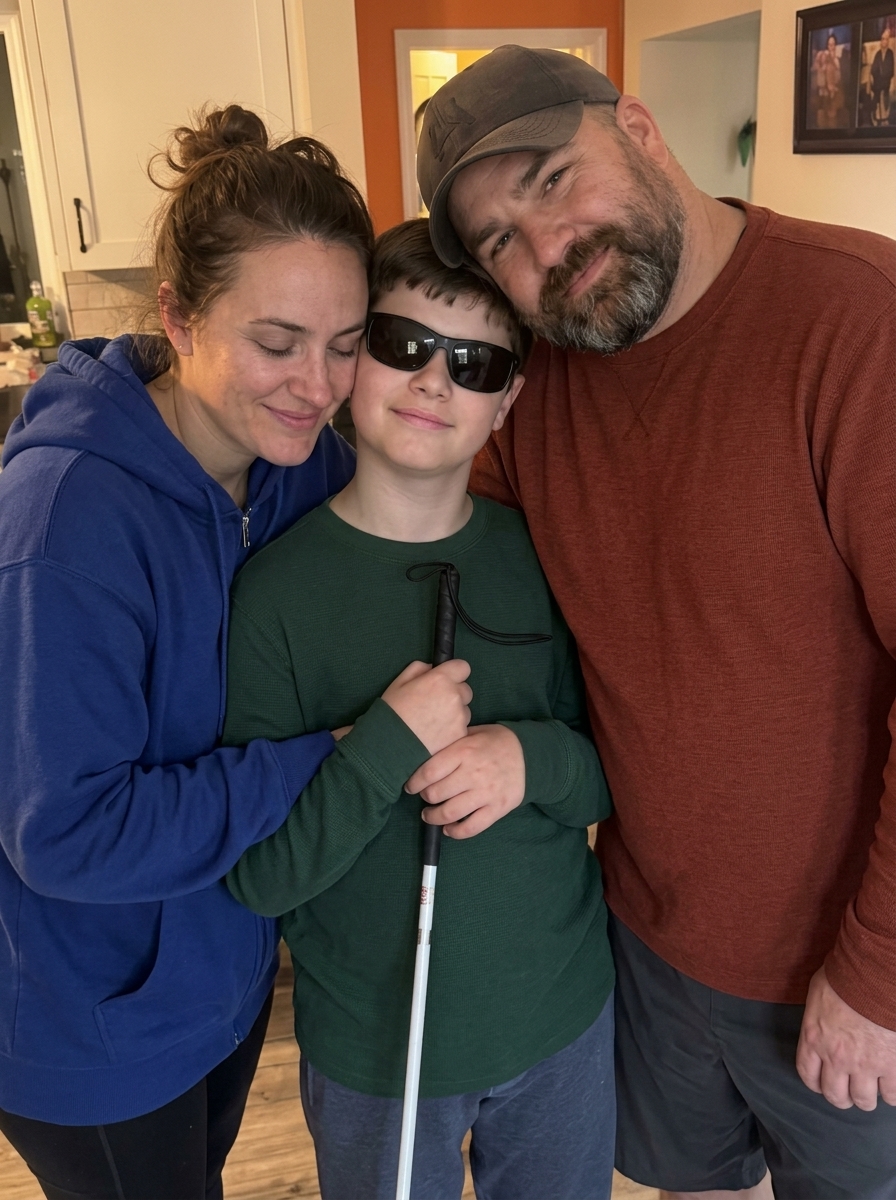
He was nine years old then, small for his age, with dark hair falling across his forehead.
A white cane rested beside his chair.
His fingers moved slowly over the raised dots of a book.
Mrs. Palmer lowered her voice.
“Owen lost his sight in an accident five years ago.”
She paused.
“His mother cared for him until she passed away.”
Then came the part that made my heart ache.
“Apparently, his father placed him here rather than raise a blind child alone.”
I looked at Rick.
He had stopped walking.
I assumed the story had upset him.
I didn’t understand why.
Not yet.
I walked over and sat beside Owen.
“What are you reading?” I asked.
He tilted his head toward my voice.
“You smell like cinnamon.”
I laughed.
“I work in a bakery.”
“Do you make cinnamon rolls?”
“Every morning.”
He closed his book.
“I love them, but I’ve never had a warm one.”
I smiled.
“Then somebody has failed you terribly.”
He laughed.
It was a small laugh.
But it stayed with me.
“What are you reading?” I asked again.
“A mystery.”
“Is it good?”
“The dog found the missing necklace before the detective did.”
I smiled.
“That sounds like a talented dog.”
Owen laughed again.
And just like that, something inside me clicked.
I loved him.
Not in the way a mother loves a child she has already raised.
Not yet.
But in the strange, immediate way you sometimes recognize that someone is supposed to become part of your life.
On the drive home, however, Rick barely spoke.
His hands were wrapped tightly around the steering wheel.
His knuckles were white.
Finally, he spoke.
“He will need specialists.”
I looked at him.
“Of course.”
“Appointments. Constant care.”
I frowned.
“We knew that.”
“We cannot handle that.”
I stared at him.
“We are choosing a son, Rick. Not whichever child requires the least effort.”
“You connected with him after one conversation.”
“You looked like you liked him too.”
“I did not.”
His answer came too quickly.
I looked at him.
He kept his eyes on the road.
Over the following weeks, Rick delayed the adoption paperwork.
The first time, he said his work schedule was unstable.
The second time, he said we needed a larger emergency fund.
Each delay hurt me.
But I could see that it hurt Owen too.
He never complained.
He never demanded anything.
Instead, during our visits, he began asking careful questions.
“Are you still coming next Saturday?”
“Yes.”
“Are you still thinking about me?”
“Every day.”
He smiled.
Those questions broke my heart.
One afternoon, Owen reached toward Rick’s voice.
Rick stepped backward.
Later, when we were alone, I confronted him.
“I am giving him space,” he said.
“He was reaching for your hand.”
“He barely knows me.”
“He is trying.”
“I don’t want to overwhelm him.”
“You’re not overwhelming him,” I said. “You’re avoiding him.”
Rick looked away.
Two months after our first meeting, Owen finally came home.
The first night, he walked around the house with his cane, carefully counting his steps.
Within a week, he knew the entire layout.
Twelve steps from his bedroom to the bathroom.
Seven from the kitchen door to the table.
Three from the couch to the bookshelf.
At night, I could hear the soft tapping of his cane moving along the hallway.
One evening, I found him standing outside his bedroom.
“Are you all right?” I asked.
“I am memorizing.”
“You can do that tomorrow.”
He shook his head.
“I sleep better when I know where everything is.”
Rick stood silently behind me.
Then something happened that I will never forget.
Owen turned toward him.
“Dad?”
Rick flinched.
It was the first time Owen had called him that.
“Yes?” Rick answered.
Owen smiled.
“I think I know that smell.”
Rick touched his neck.
“Do you always wear the same aftershave?”
“Usually.”
“I think I know that smell.”
Rick laughed.
But it was a strained laugh.
Afterward, he changed his aftershave.
I noticed.
I just didn’t understand why.
Owen kept trying.
He asked Rick to listen to audiobooks with him.
He asked for help with homework.
He asked him to walk around the neighborhood.
Rick always found a reason to leave.
One night, I finally confronted him.
“You’re not even trying.”
“I don’t want to overwhelm him.”
“You’ve said that three times.”
“Because it’s true.”
“What would be fair, Rick?” I asked. “Waiting until he stops asking?”
He didn’t answer.
Six months after the adoption, a specialist reviewed Owen’s medical records.
Dr. Shah spent nearly an hour examining his eyes.
Then she asked us to come into her office.
“The damage is serious,” she said.
My stomach tightened.
“But part of it may be treatable.”
I looked at her.
“What does that mean?”
She leaned forward.
“With surgery, Owen might regain some vision.”
My breath caught.
“Some?”
“Shapes. Colors. Movement. Perhaps more, depending on how he heals.”
I started crying.
Owen reached for my hand.
“Could I see Mom’s face?”
Dr. Shah smiled.
“That is possible.”
My heart nearly broke.
But then I looked at Rick.
He had gone pale.
“No,” he said.
The doctor looked at him.
“There are risks.”
“It’s too dangerous.”
“There are risks,” Dr. Shah repeated, “but they are manageable.”
Rick shook his head.
“No.”
I stared at him.
“It’s not just your decision.”
“It’s expensive.”
“I have savings.”
“Those savings are for our future.”
I looked directly at him.
“Owen is our future.”
We argued for weeks.
Rick talked about the risks.
The cost.
The possibility that the surgery could fail.
He kept saying it was too dangerous.
Then one night, he finally said what he really thought.
“You’re obsessed with fixing him.”
I stared at him.
“I don’t think he is broken.”
Rick didn’t respond.
The next morning, he left town for work.
I called Dr. Shah.
“I believe this should be your choice too,” she told me.
So I made the decision.
I used every dollar I’d saved over the years.
I scheduled the operation.
Then I told Owen the truth.
“Your father doesn’t agree,” I said carefully. “But I believe this should be your choice too.”
Owen sat quietly.
“Are you scared?” I asked.
“Yes.”
“Do you still want it?”
“Yes.”
“Then I’m with you.”
The operation lasted four hours.
Four hours that felt like four years.
When it was over, bandages covered Owen’s eyes.
For two days, we waited.
I slept beside his hospital bed.
I held his hand.
I prayed.
I tried not to imagine the worst.
Then Dr. Shah came in.
She carefully removed the bandages.
Owen blinked.
The light seemed to hurt him.
His eyes moved slowly.
I stood beside his bed, afraid to breathe.
He looked toward me.
Everything was blurry.
But he could see.
Colors.
Shapes.
Movement.
His eyes found my face.
“You look lovely,” he whispered.
I covered my mouth.
Tears streamed down my face.
“Yes,” I whispered.
“You’re my mom.”
I bent over him and held him as tightly as I could.
He cried.
I cried.
And for the first time, I allowed myself to imagine the future.
I imagined the three of us becoming a real family.
I imagined Owen seeing our home.
Seeing the bakery.
Seeing the trees outside his bedroom.
Seeing my face.
I thought the hardest part was finally over.
I was wrong.
Two days later, Rick walked through the front door.
His suitcase fell from his hand.
His smile disappeared.
Owen was standing in the hallway.
No cane.
No dark glasses.
Just standing there.
Seeing.
Rick stared at him.
Owen stared back.
Rick’s face turned white.
“No,” he whispered.
I thought the surgery and medication had confused him.
But then Rick spoke again.
“No.
It cannot be you.”
He clutched my arm.
“Mom, you have no idea what he did to me five years ago!”
I stared at him.
Owen looked frightened.
“We have never met,” he said.
Rick shook his head.
“We have never met.”
Owen took a step backward.
“You sat in the green chair.”
Rick froze.
“What chair?” I asked.
“The green chair in our old living room,” Owen said.
“You watched television while Mom took me to appointments.”
Rick’s face lost all color.
Owen pointed at him.
“You hummed the same song every time you washed dishes.”
I knew exactly what he meant.
Rick had hummed that song hundreds of times.
Then Owen hummed four notes.
The same four notes.
Rick tried to recover.
“He heard me doing that here.”
“No,” Owen said.
“You’ve never done it while I was here.”
Rick looked at me.
“He’s confused.”
I stared at my husband.
“Rick?”
“He’s confused.”
Owen’s voice shook.
“He is my father.”
The words seemed to freeze the room.
Rick looked toward the door.
I stepped in front of it.
“Tell me he’s mistaken.”
Rick said nothing.
“Tell me.”
Finally, his shoulders dropped.
“I was married to his mother.”
My heart stopped.
Rick continued.
“Her name was Melissa.”
He looked at the floor.
“After the accident, everything changed. There were doctors, therapy, bills. Then she died, and I was alone.”
I couldn’t believe what I was hearing.
“What did you do?”
“I thought the home could give him more than I could.”
Owen’s expression changed.
“You never came back to find out.”
“It was supposed to be temporary.”
“You never came back.”
“I meant to.”
I looked at Rick.
“Did you surrender your rights?”
He didn’t answer.
“Rick.”
“Yes.”
That single word shattered whatever remained of the man I thought I knew.
“You told me you had no children.”
He lowered his head.
“You signed him away.”
“I was ashamed.”
“You told me you had no children.”
“I wanted a fresh start.”
My hands began shaking.
“When I couldn’t have a baby, why did you suggest adoption?”
Rick rubbed both hands over his face.
“I thought you would leave if motherhood became impossible.”
“So you agreed to adopt a child.”
He said nothing.
“When I chose Owen, you delayed the papers.”
“Yes.”
“Knowing he might still be somewhere out there.”
“There were dozens of children,” he said. “What were the chances?”
I felt sick.
“You pulled away when he reached for you.”
“I panicked.”
“Why?”
“He might have recognized me.”
Everything suddenly made sense.
The hesitation.
The delays.
The aftershave.
The distance.
The fear.
Rick had known who Owen was from the beginning.
He hadn’t wanted to adopt a stranger.
He had been terrified of adopting his own abandoned son.
“And the operation?” I asked.
Rick looked at me.
“You wanted me blind.”
His face tightened.
“If he saw me, everything would come out.”
I stared at him.
“You were afraid he would recognize you.”
“Yes.”
Owen’s voice was barely audible.
“You wanted me to stay blind.”
“No,” Rick said quickly.
“I was afraid.”
Owen began to cry.
Not angry tears.
Not loud tears.
Just the quiet, devastating crying of a child who had finally understood why someone had repeatedly stepped away from him.
I couldn’t stay in that house.
I packed two bags.
Rick followed me upstairs.
“You cannot take him.”
I turned around.
“Watch me.”
“I am legally his father.”
“You surrendered him once and lied your way back into his life.”
I stared at him.
“Don’t stand there and talk to me about being his father.”
Owen and I stayed with my sister.
The next morning, I called Mrs. Palmer.
I requested every document connected to Owen’s placement and adoption.
The records arrived three days later.
Then I called Rick’s mother, Elaine.
I needed answers.
I needed to know whether anyone else had known.
Owen’s original placement file had been archived separately from our adoption papers.
No one had compared the signatures.
Rick had counted on that.
The surrender forms carried his full legal name.
I asked Owen whether he wanted to see the records.
“Not yet,” he said.
I respected his decision.
Then I called Rick’s family.
His mother came.
His sister Jenna came too.
Jenna held an old photograph in her hands.
She looked at Owen for a long time.
Then she turned toward Rick.
“You told us Melissa took Owen overseas after the divorce.”
Rick lowered his head.
“I didn’t know what else to say.”
Elaine stood.
“You did not only abandon your son.”
Her voice trembled.
“You made the rest of us abandon him without knowing.”
“Mom, I can explain.”
“No.”
She shook her head.
“I have a grandson.”
She looked at Owen.
“I have a grandson.”
Rick said nothing.
Jenna began crying.
She walked toward Owen but stopped several feet away.
“I am so sorry,” she said.
Owen didn’t answer.
“I didn’t know.”
She swallowed.
“I will not ask you to forgive anyone.”
She looked at him.
“But may I earn a place in your life?”
Owen looked at me.
“The choice is yours,” I told him.
He looked back at Jenna.
“Maybe.”
He paused.
“Slowly.”
Jenna nodded.
“Slowly.”
Rick tried to defend himself.
“I wasn’t prepared to raise a child with additional needs.”
I placed the photograph on the table.
“Owen didn’t need a perfect father.”
Rick looked at me.
“He just needed a dad who was there for him.”
Rick looked toward Owen.
“I made terrible choices.”
Owen’s expression didn’t change.
“You made the same choice every day for five years.”
I filed for divorce.
I also filed for sole custody.
Once the court reviewed Rick’s surrender papers and the lies he had told during the adoption process, he stopped fighting me.
Elaine and Jenna began visiting Owen.
But only when he agreed.
Some weeks he wanted dinner with them.
Other weeks he didn’t.
I never pressured him.
I knew he had spent too many years having decisions made for him.
This time, the choices were his.
Eight months later, Owen performed in his first school concert since his vision improved.
He stood onstage with a recorder in his hands.
I sat in the audience.
Then I noticed someone at the back of the room.
Rick.
I hadn’t invited him.
He stood alone.
Owen’s eyes moved across the audience.
Then he saw him.
He looked away.
A few minutes later, after the concert, Rick waited near the doors.
Owen took my hand.
We started walking toward the parking lot.
Halfway there, he stopped.
“Do you want to speak to him?” I asked.
“No.”
We continued walking.
Then Owen stopped again.
He looked up at me.
“He may be the reason I am here.”
I didn’t say anything.
He squeezed my hand.
“But you are the reason I came home.”
I looked down at him.
For years, I had thought becoming a mother meant giving birth.
I had believed motherhood was something that began in a hospital room, with a newborn placed into your arms.
Owen taught me otherwise.
Motherhood was waking up in the middle of the night because someone was scared.
It was learning the number of steps from a bedroom to a bathroom.
It was sitting through surgery.
It was spending your savings on someone’s chance to see the world.
It was believing a child when the adults around him had spent years lying.
And sometimes, motherhood meant standing between a child and the person who had already abandoned him once.
Owen had been blind when I first met him.
But in many ways, he saw more clearly than any of us.
He knew who loved him.
He knew who was afraid of him.
And eventually, he knew who had chosen him.
Rick had once believed he could erase his past by hiding it.
He couldn’t.
The truth was waiting for him in a twelve-year-old boy’s face.
A boy who finally opened his eyes and saw the man who had abandoned him.
And then chose, slowly and carefully, who he wanted in his future.
As we walked toward the car that afternoon, Owen slipped his hand into mine.
I squeezed it.
He smiled.
And for the first time, I understood that he had never needed someone to rescue him.
He needed someone willing to stay.
I stayed.
And I always would.