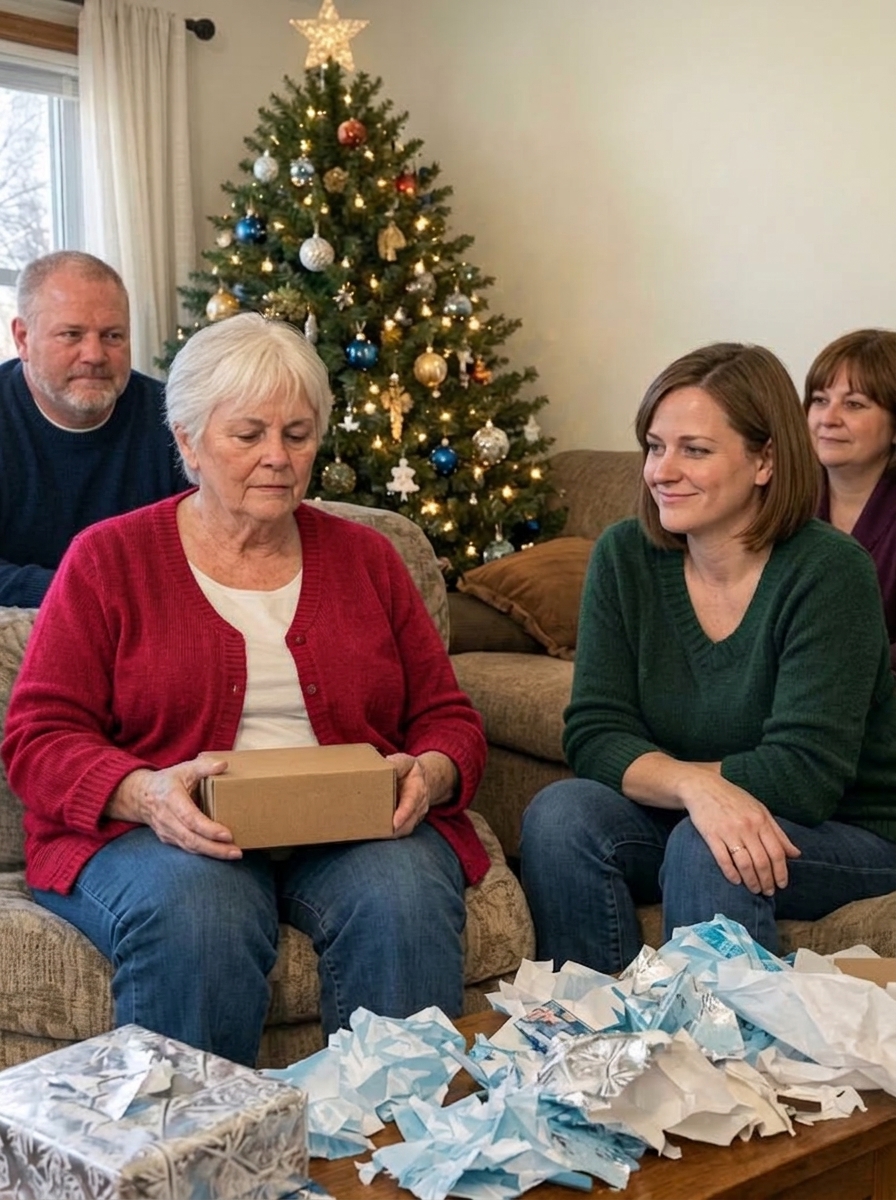
My daughter-in-law held my Christmas gift up over her head like a referee calling a foul.
“This is not a forty-dollar box,” she said.
Then she looked around the living room. At my son’s cousins. At her own mother. At my sister-in-law. At my grandchildren.
“Some people,” she said, “just cannot follow simple rules.”
She meant me.
I didn’t say a word.
I sat there on her couch in my red cardigan with my hands folded in my lap. And I let her finish.
Because I knew something she didn’t know. And I wasn’t going to hand it to her early.
My name is Carol Ann Mink. I’m sixty-seven years old. I’ve lived in Harlow, Ohio, my whole life. It’s a town so small the water tower has our name spelled wrong on it, and nobody’s ever bothered to fix it.
I raised one son in this town. I buried one husband in the cemetery behind the Methodist church on Route 9.
And last December, I sat through the ugliest ten seconds of my life, in my own son’s living room, on Christmas Eve afternoon.
I didn’t flinch. Flinching wasn’t going to help the thing I’d hidden.
Harlow is the kind of place where the feed store still keeps a pot of coffee on for anybody who stops in. Where the Methodist church basement smells like the same seventeen casserole dishes every Wednesday night. Where everybody knows whose truck is whose from two streets over.
Our snow comes early and stays late. The Christmas Eve service is by candlelight, the same as it’s been since before I was born. The whole town more or less fits inside the two churches on Route 9, Methodist and Baptist. And everybody waves at everybody, no matter which door they walk through on Sunday morning.
I’m telling you all this because it matters. It matters what kind of place raised a man like my Wendell. And it matters what kind of place I was sitting in, when his memory got held up over somebody’s head like evidence in a courtroom.
But I need to back up first.
You need to understand what that forty-dollar limit meant. Before you can understand why it mattered so much that she broke it over my head.
Three years ago, before any of this, our family’s Christmas gift exchange had gotten out of hand.
Not rich-people trouble. Nothing like that.
Just the ordinary kind of trouble that happens when fourteen people are supposed to buy for each other, and some of them have more to spend than others.
One year, my husband’s cousin Pam showed up with an espresso machine for Brett and Shay. A fancy one. Silver, with dials. It cost more than Wendell’s work truck was worth.
My sister-in-law, Linda, had brought a knitted scarf she’d made herself.
She took one look at that espresso machine, and she went into my kitchen and cried. Right there by the stove, with the turkey still in the oven.
It wasn’t a mean thing Pam did. I want to be clear about that. Pam’s got money, and she’s generous, and she didn’t think.
It was just a hard thing. For people who watch every dollar to sit across a room from somebody who doesn’t have to.
So the next year, my daughter-in-law, Shay, stood up at the dinner table.
Shay is organized the way some people are tall. Just born that way.
“From now on,” she said, “we’re doing a forty-dollar limit. No exceptions. Everybody puts their name in a hat. Everybody draws one person. And that’s that.”
I liked her for it.
I want that on the record. Shay has her hard edges. But setting that limit wasn’t one of them. It was the kindest thing anybody in this family did that whole year.
I told her so, too. Right there at the table.
And I’ll tell you something about Shay that most of this family doesn’t say out loud. It’s not really anyone’s business. Except it explains some of what happened later.
Shay didn’t grow up the way Brett did.
Her father walked out when she was nine. Her mother raised three kids on what she made doing hair two towns over.
Shay told me once, years ago, early on, that there were Christmases when she and her mother and her two brothers got exactly one gift apiece under the tree.
And her mother would go into the bathroom afterward and cry. Thinking nobody could hear her through the door.
Shay heard her. Every single year.
So when Shay married into a family where somebody’s cousin could show up with an espresso machine worth more than a used truck, it didn’t look like generosity to her.
It looked like the thing that used to make her mother cry in the bathroom. Except now it was happening in her own living room. To people she loved.
That forty-dollar rule wasn’t about being tightfisted.
It was about making sure nobody at her table would ever have to feel what her mother felt.
I want that understood. Because what Shay did to me in that living room was wrong. But it didn’t come out of nowhere.
And I wasn’t going to spend the rest of my life pretending she was just a hard woman with no reason behind it.
This past December was the third Christmas under that rule.
It was also the first Christmas without Wendell.
My husband died fourteen months before. A heart attack. Out by the hay barn, in the cold, on a Tuesday in October.
He was gone before the ambulance from Harlow Fire even turned onto our road.
Forty-six years married.
I don’t say that number to make anybody feel sorry for me. I say it because it matters to what was inside that box.
Wendell wasn’t a man who talked much.
He fixed things. That’s what he did.
He fixed the church furnace twice without ever being asked. He fixed Brett’s truck every single time it broke down, until Brett was thirty-five years old and still calling his dad about it. He fixed my sewing machine and the neighbor’s lawn mower and the swing set at the elementary school.
And in our whole marriage, there was only one time he ever sat me down and told me a real story about himself.
It was about a cigar box.
He was fourteen years old when his father gave it to him.
An old wooden cigar box with a brass hinge. His father had smoked the cigars out of it one at a time, over ten years of Sunday dinners.
Wendell kept his lawn-mowing money in it.
Not in a bank. In that box. Under his bed. Because he didn’t trust banks yet. But he trusted that box.
He mowed eleven lawns a summer, for three summers. And he kept every single dollar of it in there, folded in half, until he had thirty-one dollars saved.
Back then, thirty-one dollars was not a small amount of money for a boy.
He used that thirty-one dollars, plus a little more he’d put by since, to buy my wedding ring.
Not the ring I wear now. That came later, when we could afford better.
The first one.
The one he slipped on my finger in his mother’s kitchen before he’d even properly asked my father. Because he was seventeen and I was sixteen, and we were both too impatient to do things in the right order.
He kept that box his whole life.
It sat on his dresser for forty-six years. Right next to his wallet and his reading glasses and his pocketknife.
He only told me the whole story of it once. All the way through, properly.
It was on our fortieth anniversary.
We were sitting out on the back porch with two cups of coffee going cold between us. Neither one of us wanted to break the quiet to go warm them up.
I asked him, half teasing, why he’d never gotten rid of that old thing. The hinge squeaked. The lid didn’t even sit flush anymore.
He was quiet a minute.
“Because it’s the only thing I ever built something out of nothing with,” he said.
He looked out at the fields.
“Eleven lawns a summer. Mr. Pruitt paid a dollar fifty. Old Widow Hastings paid two, because she liked having somebody young around to talk to while I worked. I’d come home smelling like cut grass and gasoline, and I’d fold every dollar in half and put it in that box under my bed.”
He smiled a little.
“And I never touched it. Not once. Not for a baseball glove. Not for anything. Because I’d already decided what it was for. Before I’d saved the first dollar.”
“You decided you were going to marry me before you’d saved the first dollar,” I said.
“I decided a lot of things before I had the money to back them up.”
He laughed the quiet way he always laughed. Mostly through his nose.
Then he reached over and took my hand. The hand that still wore the ring that thirty-one dollars bought. It’d been upgraded twice since. But in my mind it was never replaced. To me, it was always the same ring.
“Thirty-one dollars doesn’t sound like much now,” he said. “It took me three summers. I used to lie in bed and count it in my head before I fell asleep. Like some boys count sheep.”
I didn’t know, sitting on that porch, that six years later I’d spend four nights at my kitchen table sanding that same box smooth. Trying to put back the finish that forty-six years and one fourteen-year-old boy’s thumbprints had worn away.
All I knew, listening to him that evening, was that I’d married a man who built the rest of his life the same patient way he built that thirty-one dollars.
One dollar at a time. Never touching it. Never explaining himself to anybody who hadn’t earned the explanation.
After he died, I couldn’t look at that box for months.
It sat on his dresser where he’d left it. I’d walk past the bedroom door and look away.
Then one night last fall, I couldn’t sleep. I got up and went into the bedroom and picked it up.
The green felt lining inside had gone to pieces. It crumbled in my fingers. The brass hinge had turned green with age and rust. The wood was dry and gray along the edges, where his hands had held it.
And I thought: I’m going to fix this box.
Because it’s the one thing of his I can still fix.
I’m not a woman with a workshop.
I have a kitchen table, a junk drawer, and whatever my husband left behind in the garage.
I found a pack of sandpaper on his workbench. Three different grits, the way he always kept them. I sat at my kitchen table four nights in a row and sanded that box down by hand.
The first night, I only got through one side. I kept stopping. Every time I ran my thumb over the wood, I thought about his thumb doing the same thing. Fifty years of his thumb.
The second night, I finished the outside.
The third night, I drove to the hardware store in town and bought a can of Danish oil. Nine dollars. Earl, who runs the register, asked me what I was working on.
“Wendell’s cigar box,” I said.
He didn’t say anything. He just nodded and knocked a dollar off.
I rubbed the oil into the wood with an old T-shirt of Wendell’s. Slow. Coat after coat. And the grain came up dark and warm, the way it must have looked when his father first handed it to him.
I bought a new brass hinge for four dollars. The old one had rusted clean through. Putting it on took me an hour, because my hands aren’t as steady as they used to be, and the screws were the size of rice grains.
On the fourth night, I relined the inside.
I had a scrap of green velvet left over from a sewing project years back. Just enough. I cut it to size and glued it in with a steady hand.
And before I glued down the piece that went inside the lid, I did one more thing.
I sat down at the table with a pen and a piece of notebook paper. Wendell’s reading glasses were still in the kitchen drawer, six inches from my elbow. I couldn’t bring myself to move them.
I wrote a letter.
Then I went to the shoebox of old photographs in the hall closet and found the one I was looking for. A black-and-white picture, yellowed at the edges.
I folded the letter in quarters. I laid the photograph on top of it. I taped them both flat against the inside of the lid.
And then I glued the velvet down over them, so nobody would know they were there unless they went looking.
All told, I spent about twenty-two dollars. And four nights of missing him.
When I was done, that box looked the way it must have looked the day Wendell’s father handed it to a fourteen-year-old boy.
My granddaughter Emma had drawn my name out of the hat that December.
She’s fifteen. She’s quiet and careful, and she’s the one grandchild who still asks me real questions about her grandpa. Instead of just nodding when his name comes up.
I decided the box was for her.
Not because of what it cost.
Because it needed somebody who would ask about it.
Now. Here’s the part I’m not proud of. But I’m going to tell you anyway.
Because my friend Sharon, who works the dispatch office down the road, would ask me the same thing if she heard this story. And she’d be right to ask it.
Why didn’t I just tell Shay, right then, what the box was?
Why did I sit there on that couch and let her hold it over her head?
Because the second I opened my mouth to explain Wendell, I was going to cry.
And I was not going to cry in that living room while that woman stood over me making her point.
And because explaining myself right then would have sounded exactly like what she was accusing me of. Somebody trying to talk her way out of breaking the rule.
So I decided, sitting right there with my hands in my lap, that the box could speak for itself. In its own time. To the one person in that room who would actually listen to it.
I just didn’t know it would happen quite that fast.
So let me take you back to those ten seconds.
We were all in Brett and Shay’s living room. The one with the tall front window that looks out onto their street. Snow was coming down steady outside. The tree was lit up with the same ornaments Shay’s mother has been collecting since Shay was in diapers.
Fourteen of us were crammed onto couches and kitchen chairs dragged in from the dining room.
Brett had gone back to the kitchen to pull the ham out of the oven. Because somebody has to mind the ham, and that somebody is always Brett.
My grandson Tyler, who is eleven and has never once in his life sat still through a gift exchange, was already halfway into the box of Legos somebody had gotten him.
Emma opened my gift last. That’s just how the draw fell.
She peeled the paper back slowly. The way she does everything. And she lifted the lid of the shirt box.
And there it was.
This small, dark wooden box with a brass hinge, catching the lights from the tree, sitting in a nest of tissue paper.
Emma’s mouth opened a little.
And before she could even pick it up properly, Shay leaned over.
She was sitting two feet away from her daughter. She reached right over and lifted the box out of Emma’s hands. And she turned it over once in the light, like she was appraising it at a pawn shop.
“This is not a forty-dollar box,” she said.
It wasn’t loud.
It was worse than loud. It was flat and certain. The voice of a woman reading out a verdict she’d already decided on before she opened the file.
“Shay,” I said.
That was all I managed. Because I truly didn’t expect what came next.
She held the box up over her head.
The way you’d hold up a trophy. Or a confiscated cell phone.
She looked around the room. At her own mother. At Wendell’s cousins. At my sister-in-law, Linda.
And she said the words I started this story with.
“Some people just cannot follow simple rules.”
Nobody laughed.
A few people looked down at their shoes. Linda’s mouth fell open a little.
Tyler, God bless him, didn’t even look up from his Legos. Because he’s eleven, and the only thing on his mind was plastic bricks.
And I sat there with my hands folded, and I didn’t say a word. I let her finish.
Because underneath that green velvet lining, taped flat against the inside of the lid where nobody looks when they’re busy appraising a box’s resale value, was a folded piece of notebook paper and a little black-and-white photograph.
And I knew that whatever Shay said next was not going to be the last word in that room.
It was only going to be the loudest word. For about four more minutes.
Shay lowered the box.
And Emma reached up and took it back.
She didn’t grab it. She wasn’t rude. She was just a fifteen-year-old quietly reclaiming the thing that was actually hers.
She turned it over in her lap. She ran her thumb along the hinge. The exact way her grandfather used to run his thumb along anything he was fixing.
And she must have felt it. Where the velvet inside the lid didn’t sit quite flush. Where it was a hair thicker than it should be.
Because she frowned.
She pressed on the velvet with one finger.
And she found the edge of the tape.
“There’s something under here,” she said.
The room went from embarrassed to curious in about one second flat.
Shay, to her credit, didn’t stop her. Nobody did.
Emma peeled the velvet back from the corner. Carefully. The way I’d have wanted her to.
And there underneath it was the paper, folded in quarters. And the photograph, a little bent at one corner.
She unfolded the paper first.
And Emma read it out loud. Because that’s the kind of girl she is. She doesn’t keep things to herself when they belong to everybody in the room.
“Emma,” she read.
“This was your grandpa’s box when he was younger than you are now. He mowed eleven lawns a summer for three summers, and he kept every dollar of it folded up in here. Because he didn’t trust banks yet. But he trusted this box.”
Her voice started to shake. She kept going.
“When he had thirty-one dollars saved, he used it, plus a little more he’d put by since, to buy my wedding ring. The first one. Before he’d even properly asked my father.”
She stopped for a second. She swallowed.
“He kept this box on his dresser for forty-six years. I fixed it up myself this fall, because it was the one thing of his I could still fix.”
She looked up at me. Then back down at the paper.
“It did not cost forty dollars, Emma. It cost twenty-two dollars and four nights of missing him. I wanted you to have it because you are the one who still asks about him. Love, Grandma.”
Then she held up the photograph.
Black and white. Yellow at the edges.
A boy of about fourteen, standing next to a push mower older than anything in our shed. Grinning like he’d just won something. One hand jammed in his pocket where, I like to think, he was holding onto whatever dollar he’d earned that week.
“That’s Grandpa,” Emma said.
Mostly to herself.
Then louder. To the whole room.
“That’s Grandpa. When he was my age.”
I’d like to tell you the room exploded into something.
It didn’t.
It went quiet. That particular kind of quiet a room gets when everybody in it is doing arithmetic they don’t want to say out loud.
Linda put her hand over her mouth.
Wendell’s oldest cousin, Ray, who’s eighty-one and remembers Wendell as a boy, said, very soft, “I remember that box. His daddy gave him that box.”
Shay didn’t say anything for a long moment.
She was still standing right where she’d been standing when she held it over her head. Except now her arms were empty.
And her face had gone the color of a woman realizing, in front of fourteen people, that she’d just stood in judgment over a box that held somebody’s whole marriage folded up inside it.
For twenty-two dollars.
Brett came back in from the kitchen right about then.
He still had the oven mitts on both hands. He was asking if everybody was about ready to eat.
He stopped in the doorway.
Even a man who’d missed the whole thing could read a room like that one.
He looked at Emma, holding up the photograph. He looked at his wife, standing there with her hands empty. He looked at me.
“What’d I miss?” he said quietly.
It wasn’t really a question.
Nobody answered him right away.
Emma held the photograph out so he could see it. Brett pulled off one oven mitt and crossed the room and took it from her gently. The way you take something that might tear.
He looked at his father’s fourteen-year-old face for a long few seconds.
Then he looked at the box in Emma’s lap.
And I watched my son’s jaw do the thing it used to do when he was a boy trying not to cry in front of his friends.
“Dad kept lawn money in this,” he said. “I remember this box on his dresser my whole life. I never knew the history of it. I just knew not to touch it.”
“He bought my first ring with what was in it,” I said.
That was the first thing I’d said out loud since Shay held it over her head.
And my voice came out steadier than I expected. Because by then, the box had already done the talking I couldn’t have done myself.
Brett set the photograph down carefully on the arm of the couch.
He walked over to his wife.
He didn’t raise his voice. He didn’t make a scene of it. That’s not who my son is, and it’s not who I raised him to be.
He just put his hand on her shoulder.
“She wasn’t trying to break your rule, Shay,” he said. Low enough I almost didn’t catch it. “She was trying to keep something alive.”
Shay’s eyes had gone wet by then.
And to her credit, she didn’t try to argue her way out of it in front of everybody. Some people would have. And I wouldn’t have blamed her too hard if she had. Nobody likes being wrong in front of fourteen relatives at Christmas.
She just nodded.
“I’m sorry,” she said. To the whole room. “I didn’t know.”
And then, quieter, straight to me.
“I’m sorry, Carol Ann.”
I told her it was all right.
I mostly meant it. I wasn’t looking to make her carry that moment around her neck the rest of the holiday.
I’ve buried a husband. I know the difference between a wound that needs tending, and one that’s better left to close up on its own.
But I’ll tell you this. I didn’t let the whole thing go without saying one true thing.
Later that evening, after the ham, after the pie, Shay came and found me alone at the kitchen sink.
I was doing the last of the dishes. Everybody else was in the living room watching Tyler build something out of Legos that he insisted was a fire truck.
Shay picked up a dish towel without asking and started drying.
She apologized again. Properly this time. No audience.
“I was wrong,” she said. “In front of everybody. I’m so sorry.”
Then she asked if she could see the box again sometime. Actually look at it. Not appraise it.
“Yes,” I said.
And then I said the thing that needed saying. Because I wasn’t going to pretend I hadn’t felt what she did to me in that living room.
“The box never cost you anything, Shay. I just wanted you to know what it was worth. Before you decided what it wasn’t.”
She didn’t argue with that.
She dried dishes next to me for the next twenty minutes. We didn’t talk about the box again. And that was fine. Some things settle better in silence than in more words.
Near the end, though, she said one more thing.
She wasn’t looking at me. She was just setting a plate in the rack.
“I grew up watching my mother cry over a Christmas tree with three presents under it,” she said quietly. “I promised myself I’d never let anybody at my table feel small over money again.”
She folded the dish towel.
“I didn’t stop to think there were other ways to make somebody feel small.”
I didn’t say anything right away.
I was turning that over. The way you turn over a stone in the garden to see what’s living underneath it.
Then I told her I knew some of that story. Brett had mentioned it once, years back. And that I’d never once thought less of her for it. Only more.
“Grief and money fears do some of the same work on a person,” I said. “They both make you brace yourself before anybody’s even swung at you.”
She looked at me.
“I understand bracing better than most people in this house,” I said. “I’ve been doing it myself for fourteen months.”
“I’m not asking you to forget what I did,” she said.
“I know,” I said. “I’m telling you I’m not going to carry it around either. There’s a difference.”
She nodded.
And she reached over, and just for a second, she put her hand on top of mine on the edge of the sink.
The way you’d do with somebody you were deciding, right then, to trust a little more than you had the day before.
We finished the dishes.
Neither one of us cried. I think we were both, in our own stubborn ways, grateful for that.
We still went to the candlelight service that night. All fourteen of us.
Because that’s what Harlow does on Christmas Eve, no matter what happened at anybody’s house that afternoon.
Emma carried the box in her coat pocket the whole service. I only found out on the walk home, when she showed me. Her mittened hand was closed around it in her pocket, the way you’d hold something that might fly off if you let go.
The organist played the same four carols she’s played every year since I was a young mother sitting in that same pew, with Wendell’s arm around my shoulders.
When the lights went down for the candle lighting, Emma leaned over to me.
“I wish Grandpa could see what I got for Christmas,” she whispered.
I looked down at her face, lit up gold by her little candle.
“Honey,” I said. “I think he’s got a better view of it than either of us.”
Afterward, down in the church basement, over coffee and a plate from the same seventeen casseroles, Betty Hargrove caught me by the elbow.
Betty sits two pews ahead of us. She’s farmed longer than most people in this town have been alive.
She asked what all the commotion had been about that afternoon. Because word travels fast in a town this size, no matter how quietly you try to keep a kitchen conversation.
I told her the short version.
She laughed. Not unkindly.
“My mother always used to say money arguments are just grief arguments wearing a disguise,” she said. “Took me three Christmases after my Harold passed to figure out what she meant.”
I’ve thought about that more than once since.
Emma kept the box.
It sits on her dresser now. The same way it sat on her grandfather’s dresser for forty-six years.
And she’s started asking me for more stories about him. One at a time. Slow and real. The way you’d want a fifteen-year-old to ask. Not for a school project. Just because she wants to know.
Last month, she asked me what he smelled like.
I had to think about it.
“Cut hay,” I said. “And WD-40. And that orange hand soap from the sink in his shop.”
She wrote it down.
She keeps a notebook now, just for him. Everything I tell her goes in it. The lawns. The thirty-one dollars. Mr. Pruitt’s dollar fifty and the Widow Hastings’s two. The ring in his mother’s kitchen.
All written out in her own handwriting. So she won’t need to ask me again someday, when I’m not around to answer.
About a month after Christmas, Shay showed up at my front door on a Sunday afternoon.
She’d never done that before. Not once in nine years of marriage to my son.
She was holding a plate of cookies. Store-bought. She looked embarrassed about it.
“I’m not much of a baker,” she said.
“Neither was I, at your age,” I said. “Come in.”
We sat at my kitchen table. The same table where I’d sanded that box four nights in a row.
She was quiet for a while. Then she asked.
“Will you tell me about him? Wendell. I feel like I never really knew him. He was always just out in the garage.”
So I told her.
I told her about the furnace at church. About Brett’s truck. About the swing set at the elementary school that he rebuilt one summer after a storm knocked it down, and never told the principal who’d done it.
I told her about the porch, and the coffee going cold, and the thirty-one dollars.
She listened to every word. She didn’t check her phone once.
When I finished, she sat there quietly for a long time.
“He sounds like he was a good man,” she said finally.
“He was,” I said. “He was stubborn and quiet and he drove me crazy. But he was a good man.”
She looked down at the cookies she’d brought.
“I think I would’ve liked him,” she said.
“He’d have liked you,” I said. And I meant it. “He always liked people who stood up for the ones who didn’t have as much. He’d have liked that rule of yours.”
Her eyes filled up.
“Even after what I did with it?”
“Especially after what you did after,” I said.
We still do the forty-dollar limit.
Shay still runs the drawing out of the same old hat.
But this year, when she stood up at Thanksgiving to explain the rule again, she added one line to it. A line that wasn’t there before.
“The limit is on what you spend,” she said. “Not on what you’re allowed to mean by it.”
Nobody argued with that either.
And I noticed that, when she said it, she looked over at me. Just for a second. Like she wanted me to know the line was mine to keep, if I wanted it.
I did.
Shay and I aren’t the kind of mother-in-law and daughter-in-law who call each other every week now. I didn’t expect that to change overnight. It hasn’t.
But she comes by on Sunday afternoons sometimes. More than she used to.
And twice this past summer, out of nowhere, she asked me to tell her something about Wendell she hadn’t heard before.
Both times, I could tell she was actually listening. Not just being polite to an old woman.
That’s more than I had before last Christmas. And I don’t take it lightly.
I think about Wendell more at Christmas than any other time of the year. I suppose that’s true for most widows.
And I think about that box, sitting on my granddaughter’s dresser. Holding nothing now but the memory of eleven lawns, and thirty-one dollars, and a boy who grew up to slip a ring on my finger before he’d even asked my father.
I didn’t need Shay to say she was sorry in front of everybody.
I didn’t need the room to turn against her.
I only needed one person in that house to open that lid far enough to find what was really inside it.
And as it turned out, I got exactly the one I was hoping for.
That’s the whole story.
Not a dramatic one, in the end.
Just a box. And a boy who used to be my husband. And a granddaughter with good hands, and better instincts than her mother gave her credit for that afternoon.
I let Shay finish her piece that day. Because I already knew mine was going to outlast it.
And this fall, watching the leaves come down outside my kitchen window the same way the snow will before long, I find I’m still glad I waited.