The smoke alarm was still screaming when Brent threw my suitcase into the hallway.
It hit the wall so hard the handle snapped off and skittered across the hardwood floor. My laptop bag came next. Then my winter coat, the gray wool one Dad bought me the year I graduated from college. It landed in a heap at the top of the stairs like something dead.
“Useless leech,” my brother said. “You contribute nothing to this house. Nothing.”
The kitchen behind him was full of smoke. The pot roast I’d put in the oven before my last meeting of the day was black on the edges, because the meeting ran forty minutes long, and by the time I got home and took it out, it was 7:40 instead of 7:00.
Forty minutes. That was my crime.
“Brent,” I said. “Put my things back.”
“No.” He was standing in the doorway of my bedroom with his arms crossed. He was twenty-seven years old, six-foot-one, and wearing the same gray sweatpants he’d been wearing for three days. His headset was still hanging around his neck. Behind him, through his open bedroom door across the hall, I could see the glow of his three gaming monitors. “Dinner’s at seven in this house. Everybody knows that. You couldn’t even do that one thing.”
“I was working. I was on a call with the Frankfurt office.”
“Nobody cares about your little calls.”
I turned around. My mother was standing at the bottom of the stairs, holding a dish towel, fanning at the smoke detector.
“Mom,” I said.
She didn’t look at me. She looked at the dish towel.
“Mom. Tell him to put my things back.”
She finally looked up. I knew her face better than my own. I’d watched it for thirty-four years. And I already knew, before she opened her mouth, what she was going to say. I just didn’t know how much it was going to hurt.
“Naomi, honey,” she said softly. “You know your brother’s going through a hard time.”
“He’s been going through a hard time for ten years.”
“He’s under a lot of stress.”
“From what? Losing at Call of Duty?”
“Don’t,” Brent snapped. “Don’t you dare make fun of me in my own house.”
“Your house?” I laughed. I couldn’t help it. “Brent, I pay the mortgage on this house. Three thousand dollars a month. Every month. For three years. I pay the electric bill. I pay the gas. I pay for the internet you use to play your games eighteen hours a day.”
Brent’s face went red. He looked down the stairs at our mother.
“Tell her.”
My mother twisted the dish towel in her hands.
“Tell her, Mom.”
“Naomi,” my mother said, and her voice was almost a whisper. “He’s the owner of this house. You should leave.”
The smoke alarm finally stopped. In the sudden silence, I could hear the refrigerator humming and the tick of the oven cooling down and my own heartbeat, loud as a drum.
“What did you say?”
“Two years ago,” my mother said, still looking at the dish towel. “I added him to the deed. In case something happened to me. So he’d always have a place to live.” She swallowed. “He’s an owner, Naomi. You’re not. So if he says you need to go, then… maybe you should go to a hotel for a few nights. Until he calms down.”
I stood at the top of the stairs in my work clothes, with my broken suitcase and my coat on the floor, and I looked at my mother.
For three years, I’d been paying the mortgage on a house that I didn’t own. That my brother did.
And nobody had told me.
“Okay,” I said.
That was all. Just okay.
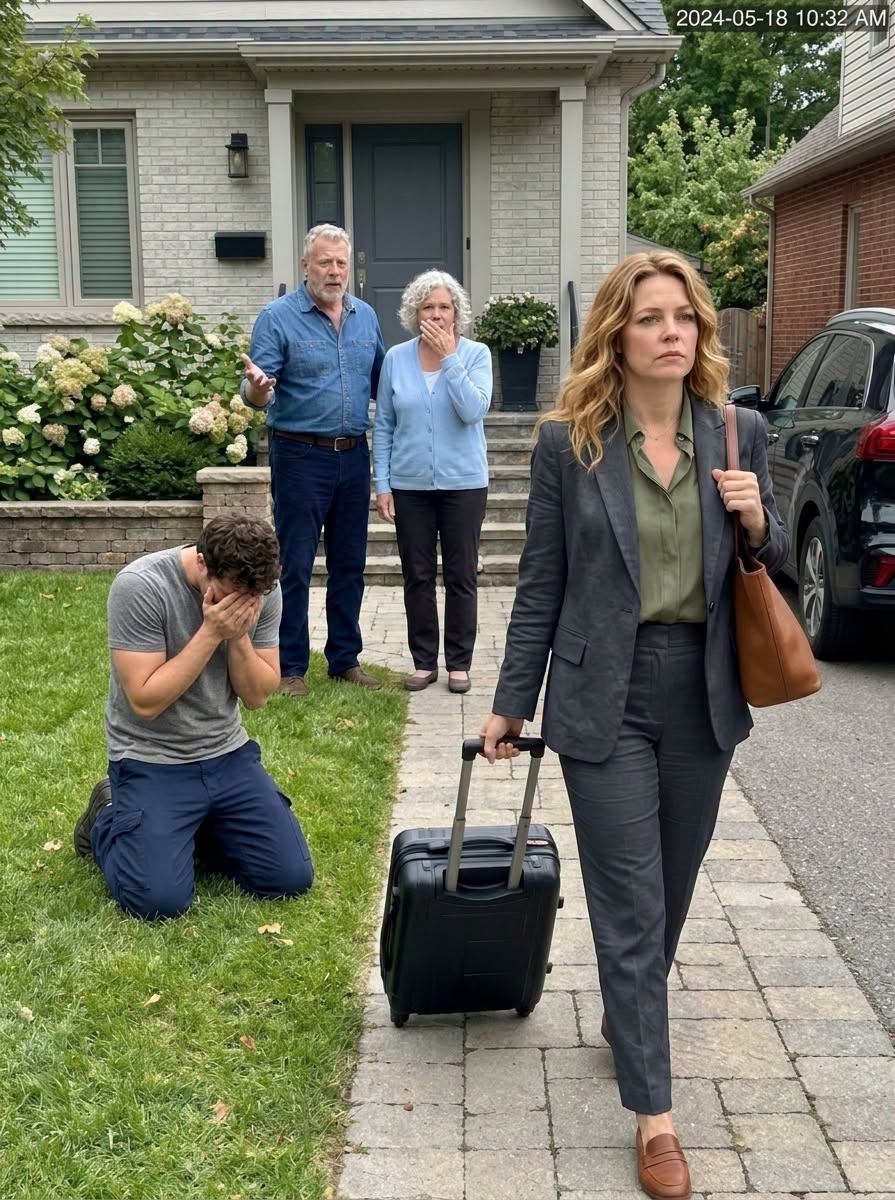
I picked up my coat. I picked up my laptop bag. I picked up my suitcase by the bottom, since the handle was gone. And I walked down the stairs past my mother, out the front door, into the cold October rain.
Nobody followed me.
My name is Naomi Kessler. I’m a cybersecurity architect. I build the systems that keep banks from getting robbed by people in hoodies on the other side of the world.
Which is funny, when you think about it. Because I spent three years letting the people in my own house rob me blind, and I never once noticed.
My father died when I was thirty-one. Pancreatic cancer. From diagnosis to funeral, it was eleven weeks. He was a high school shop teacher for twenty-eight years. He built the back patio of our house in Naperville, Illinois, with his own hands, one brick at a time, the summer I turned ten. I handed him the bricks.
He left the house to my mother. That was what everyone expected. What nobody expected was the mortgage.
Six years before he died, Dad had refinanced to pay for Brent’s second attempt at community college and a business idea Brent had about selling custom phone cases. Neither one worked out. By the time Dad died, there was still $340,000 owed on a house that had been paid off once already.
My mother’s only income was her Social Security survivor’s benefit and a small pension from her years as a school secretary. About $2,100 a month, total. The mortgage payment alone was $2,240.
At the funeral, she held my hands in the receiving line and cried.
“I don’t know what I’m going to do, Naomi. I’m going to lose the house. Your father’s house.”
I was thirty-one. I’d just been promoted to senior security architect at a financial firm in downtown Chicago. I was making $165,000 a year. I had my own apartment in Lincoln Park and a savings account I was proud of.
“You’re not going to lose the house, Mom,” I said. “I’ll help.”
That’s how it started. I’d send $3,000 a month to cover the mortgage and the property taxes and the utilities. Just until Brent got a job. Just until things settled down.
Then, a few months later, my mother called crying again. The house felt so empty without Dad. She was having panic attacks at night. Brent was no help; he stayed up until five in the morning gaming and slept until two in the afternoon.
“Would you think about moving home, honey? Just for a while? You could save so much on rent.”
So I gave up my apartment in Lincoln Park and moved back into my childhood bedroom in Naperville. I commuted an hour each way on the Metra. I worked from the kitchen table on Fridays. And I kept paying.
Three thousand dollars a month. Plus, without anyone ever asking out loud, I started buying the groceries. Then cooking the dinners, because my mother said her back hurt too much to stand at the stove and Brent said cooking was “a woman thing.”
Then it was seven o’clock. Dinner had to be on the table at seven o’clock. Because that was when Brent took his break between gaming sessions. And if it was late, he’d stand in the kitchen doorway and sigh loudly and tell my mother that I was disrespecting the household.
Three years. Thirty-six payments. $108,000.
And the whole time, my brother’s name was on the deed.
I spent that first night at a Hampton Inn off Route 59. I sat on the edge of the bed in my damp work clothes with my laptop open and did what I always do when something goes wrong.
I gathered data.
I logged into the Illinois county recorder’s website and searched the property records for our address. It took me four minutes.
There it was. A quitclaim deed, recorded twenty-six months earlier. Grantor: Linda Kessler. Grantees: Linda Kessler and Brent Kessler, as joint tenants with right of survivorship.
My mother had signed it eight weeks after I moved home. Eight weeks after I gave up my apartment. Two months into my payments.
I opened my banking app and scrolled back through three years of transfers. Every single one labeled the same way in my memo line. “Mortgage – Mom.” Thirty-six of them, lined up like soldiers.
Then I did something I’d been avoiding for months. I opened Brent’s Twitch channel.
My brother streams his gaming sessions online. He has about four hundred followers. He calls himself “BKommander.” He keeps a webcam running in the corner of the screen so his viewers can watch his face while he plays.
His stream was still going. It had been live for six hours.
I scrolled back through the recording. Back, back, back. Past him yelling at a twelve-year-old in Ohio for stealing his kill. Past him eating a bag of Doritos with his headset on.
Until I found it.
At 7:41 p.m., Brent took off his headset and stood up from his chair. The camera kept rolling. And because his bedroom door was open and mine was directly across the hall, the webcam caught everything.
Brent dragging my suitcase out of my room. My voice, faint but clear, asking him to stop. His voice, very clear: “Useless leech. You contribute nothing to this house.”
And then, from the bottom of the stairs, my mother’s voice.
“He’s the owner of this house. You should leave.”
In the chat window beside the video, his viewers were typing.
“lmaooo”
“bro is SAVAGE”
“wait she pays the mortgage tho??”
“bro she pays your bills what”
“ratio”
Brent had live-streamed throwing me out of my own family to four hundred strangers. He thought it was funny.
I downloaded the full recording. Then I saved it in three places. My laptop, my cloud backup, and an external drive I keep in my bag for work.
Then I sat in that hotel room until two in the morning and thought about my life.
I was thirty-four years old. I’d spent three years and $108,000 paying for a house I didn’t own, cooking dinners for a man who called me a leech, and taking care of a mother who stood at the bottom of the stairs and told me to leave.
I thought about my father. About handing him those bricks for the patio. About him saying, “You’ve got good hands, Nomi. You build things that last.”
I hadn’t built anything that lasted. I’d just held up something that was falling down.
At 2:14 in the morning, I opened an email that had been sitting in my inbox for three weeks. It was from the head of security at a bank headquartered in Lisbon, Portugal. They were building a new cybersecurity division for their European operations. They wanted someone to lead it.
I’d turned them down the first time without even thinking about it. I couldn’t leave Mom. Who would pay the mortgage?
I read the email again.
Then I typed: “If the position is still open, I’d like to talk.”
The bank called me back at nine the next morning. Lisbon is six hours ahead. The head of security, a woman named Inês Carvalho, had already talked to my references.
“We were hoping you’d change your mind,” she said. “How soon could you start?”
“How soon do you need me?”
“Yesterday,” she laughed.
“Give me six weeks.”
The salary was $310,000 a year, with housing for the first six months. Almost double what I was making in Chicago.
I didn’t go back to the house that day. I didn’t call my mother. I drove downtown to my office and gave my notice. My boss was disappointed but not surprised. “Everybody leaves eventually,” he said. “Go be brilliant somewhere with better weather.”
Then I called Sarah Feldman.
Sarah was the attorney who’d handled my father’s estate. She was in her fifties, with sharp gray eyes and a little office on LaSalle Street full of plants she forgot to water. She’d sat with me and my mother three years earlier and walked us through Dad’s will and the mortgage and the probate paperwork. She’d been kind to my mother. She’d been honest with me.
I met her for lunch at a deli near her office and told her everything. The deed. The thirty-six payments. Brent’s stream.
When I showed her the video on my phone, she watched the whole thing without saying a word. When it ended, she set the phone down very carefully, like it was something fragile.
“Naomi,” she said. “Let me ask you a few questions. Are you on the mortgage?”
“No. Dad’s name was on it, and then after he died, it was Mom’s. The bank let her assume the loan.”
“Are you on the deed?”
“No. I just found out Brent is.”
“Did you ever sign anything promising to make these payments? A contract? A note? Anything?”
“No. I just… sent the money. Every month.”
Sarah leaned back in her chair.
“Then here’s the truth. Legally, you have no obligation to that house. None. You were never on the loan. You were never on the title. You were a very generous daughter making voluntary payments. And you can stop being a very generous daughter any time you want.”
“What about the money I already paid?”
“That’s harder,” Sarah admitted. “Gifts to family are generally gifts. Unless there was an agreement to pay you back, it’s very difficult to get it back. I’m sorry. But you can stop the bleeding today.”
“If I stop paying,” I said slowly, “what happens to the house?”
“The mortgage is in your mother’s name. If she can’t pay it, eventually the bank will foreclose. In Illinois, that takes a long time. A year, sometimes more. There’ll be plenty of warning. Plenty of chances for her and Brent to catch up, or sell, or work something out with the bank.”
“And me? My credit? Can they come after me?”
“For a loan you never signed? No.” She looked at me over her reading glasses. “Naomi, you’ve been carrying a weight that was never legally yours. I’m not going to tell you what to do. But I will tell you that you’re allowed to set it down.”
I thought about it. I thought about the stream. About my mother at the bottom of the stairs.
“I want to set it down,” I said.
“Then let’s make it clean.” Sarah pulled a legal pad toward her. “Cancel the automatic transfers. Remove your name from every utility account at that house. Change your mailing address. Collect your things with someone present, so there’s no argument later about what’s yours. Document everything. And whatever you do, don’t sign anything they put in front of you.”
“Should I tell them?”
“That’s up to you. But if you do, put it in writing. One letter. Calm. Clear. And then you don’t owe anybody a conversation.”
I went back to the house for my things on a Saturday afternoon, eleven days after Brent threw me out. I brought my friend Dana from work. Dana is six feet tall and played volleyball in college and has a stare that could stop a train.
My mother opened the door. She looked smaller than I remembered. Older.
“Naomi! Oh, honey, thank God. I’ve been so worried. Come in. I made coffee.”
“I’m here for my things, Mom.”
“Your things? Honey, Brent’s calmed down now. He’s sorry. You can come home.”
From upstairs, I heard Brent’s voice through the floor, yelling at his game. He didn’t sound sorry.
“I’m not coming home,” I said. “I took a job. In Portugal. I leave in five weeks.”
My mother’s face went white. “Portugal? Naomi, you can’t. Who’s going to—”
She stopped. But I heard the end of the sentence anyway, the part she didn’t say.
Who’s going to pay?
“Dana’s going to help me pack,” I said. “We’ll be about two hours.”
It took us an hour and forty minutes. Clothes. Books. My grandmother’s quilt. The little wooden box Dad made me in his shop class when I was seven, with my initials carved into the lid. My mother followed me from room to room, crying and talking.
“You’re overreacting. You know how Brent gets. He doesn’t mean it. We need you. I need you.”
Brent didn’t come out of his room once.
When the last box was in Dana’s SUV, I stood in the front hallway and handed my mother an envelope.
“What’s this?”
“A letter. Please read it.”
I’d written it the night before at Sarah’s suggestion. It was one page. It said that effective immediately, I would no longer be making payments on the mortgage, utilities, or any other expenses for the house. It said I had removed my name from all household accounts. It said the mortgage, the house, and the bills were the legal responsibility of the owners, Linda Kessler and Brent Kessler. It said I loved her. And it said that if she wanted to reach me, she could email me.
She read it standing in the hallway. Her hands started to shake.
“You can’t do this,” she whispered. “The payment’s due on the first. That’s two weeks.”
“Then you have two weeks to figure out what to do,” I said. “That’s more notice than I got.”
“Naomi, please. I’m your mother.”
“I know, Mom. And he’s the owner of this house.” I picked up my coat. “You told me so yourself.”
I walked out to Dana’s SUV. Behind me, I heard my mother start to wail, a long, broken sound. Then I heard Brent’s door bang open upstairs.
“What’s going on? What did she do now?”
Dana started the engine. I didn’t look back.
I flew to Lisbon on a Tuesday in early December, five weeks later.
Before I left, I did everything on Sarah’s list. I canceled the automatic transfer to the mortgage servicer. I called the electric company, the gas company, the water department, and the internet provider. One by one, I had my name and my credit card removed from the accounts. Each of them said the same thing: the service would stay on, but billing would transfer to the account holder at that address, Linda Kessler.
I changed my mailing address to Sarah’s office. I set up a new phone number with a Portuguese carrier. I kept my old number but muted it.
And I made a folder in my email inbox. I called it “Home.” I set up a filter so that any message from my mother, my brother, or any number or address I didn’t recognize would go straight into that folder without ringing my phone or popping up on my screen.
The first message came the day after the November mortgage payment was due.
“Naomi, the bank sent something. I don’t understand it. Please call me.”
Then, two days later: “Naomi, you know your brother is going through a hard time. This is affecting his mental health.”
Then: “Naomi, please call me.”
“Naomi, where are you?”
“Naomi, the electric company says I owe $412. They are threatening to disconnect the power.”
By the second month, the messages stopped coming from my mother’s number. Instead, they started coming from numbers I didn’t recognize. Prepaid phones. Gmail accounts with strange names. One from a Facebook account called “Concerned Family Member” with no profile picture.
I didn’t block any of them. I let the filter catch them all.
Once a week, usually on Sunday afternoon, I sat on the little balcony of my new apartment in the Alfama neighborhood of Lisbon with a tiny cup of espresso, and I opened the folder and read them.
It was strange, watching the tone change from four thousand miles away. Like watching a movie with the sound turned down.
In month three, my mother wrote: “Naomi, the bank sent another notice. They said the mortgage hasn’t been paid for two months. They’re adding late fees. I tried to explain that you always paid it, but they said they don’t know who you are. They said the loan is in my name and I’m responsible. How can that be?”
I took a sip of espresso and watched a yellow tram rattle down the cobblestone hill below my balcony.
I knew exactly what the bank was telling her. The same thing Sarah had told me. Banks don’t have hearts. They don’t have ears. They don’t care that you’re a widow, or that your daughter used to pay, or that your son is going through a hard time.
Banks have contracts. And my mother’s name was the only one on the contract.
In month four, Brent texted me from a friend’s phone.
His usual arrogance had turned into something strange. A mix of legal threats and wounded pride.
“You can’t just abandon a legal obligation, Naomi. I talked to a lawyer online. What you did is called constructive eviction. You forced us out of our standard of living with no notice. You could get sued.”
I laughed out loud on my balcony. A pigeon flew away.
Constructive eviction. From the person who was paying for everything out of charity. The person he’d thrown into the rain.
I forwarded the message to Sarah. She replied in ten minutes.
“Constructive eviction is a claim a tenant brings against a landlord. You were never his landlord. You were never anyone’s landlord. You have no contract, no lease, and no obligation. If he files anything, it will be dismissed, and I’ll ask the court to make him pay your legal fees. Also, please tell him that ‘a lawyer online’ is not a lawyer.”
I didn’t tell him anything. I just saved Sarah’s email.
In month five, the high-speed fiber internet went dark.
I knew because it was the first message in my folder that came in all capital letters.
“THEY SHUT OFF THE INTERNET. ARE YOU HAPPY NOW. I CANT STREAM. I HAVE SUBSCRIBERS NAOMI. PEOPLE DEPEND ON ME.”
For Brent, losing the internet was like losing oxygen. He couldn’t stream. He couldn’t play his tournaments. He couldn’t download his game updates. He couldn’t browse forums all night while the rest of the world worked.
He bought a prepaid data plan for his phone. According to my mother’s next message, it ran out in two days.
In month six, winter came to Illinois.
My mother couldn’t pay the $400 heating bill, so she turned the thermostat down to fifty degrees. Then the gas company shut off service entirely for nonpayment. The tankless water heater I’d paid to install two years earlier stopped working.
“We’re boiling water on a hot plate to wash,” she wrote. “Brent says it’s like living in the Stone Age. Please, Naomi. It’s so cold.”
I read that one twice.
For a long time, that sentence would have destroyed me. I would have bought a plane ticket that same night. I would have flown home and paid the gas bill and the electric bill and the internet bill and apologized for leaving in the first place.
I set down my phone. I looked out at the Tagus River glittering in the late-afternoon sun.
Then I picked it back up and wrote one sentence. The first message I’d sent to my mother since I left.
“Mom, the Illinois Department of Human Services has an energy assistance program for seniors on fixed incomes. Call 211 and they will help you apply.”
I sent it. I closed my email. And I went inside and called Inês about a server migration.
I wasn’t heartless. I just wasn’t her wallet anymore.
In month eight, I got an email from Mrs. Higgins.
Mrs. Higgins lived next door to my parents for thirty-one years. She was eighty-two, with soft white hair and a flower garden that won a ribbon from the Naperville Garden Club four years running. When I was little, she used to give me a quarter for every dandelion I pulled out of her lawn. I made seven dollars one summer and thought I was rich.
“Naomi, dear,” her email began. “I hope you are doing well wherever you are in the world. Your mother told me you moved to Europe. I am writing because I am worried about your mother.”
She described the house.
The front lawn, which I used to pay a landscaping company to mow every Tuesday, was waist-high with weeds and dandelion stalks. Empty Amazon boxes and black trash bags were piled up in the driveway, because Brent kept forgetting to take them to the curb on trash day. Raccoons had gotten into them twice.
The Village of Naperville had taped two code violation notices to the front door. Overgrown vegetation. Accumulation of refuse.
“Last Thursday, your brother got into a terrible argument with the village inspector,” Mrs. Higgins wrote. “He threw a water bottle at the inspector’s car and screamed that the government had no right to tell him what to do on his own property. The police came, Naomi. They didn’t arrest him, but they gave him a stern warning. Your mother sat on the porch steps and cried. I brought her a cup of tea. She asked me if I’d heard from you.”
“I didn’t know what to tell her,” she finished. “So I am telling you. I’m not asking you to do anything, dear. I just thought you should know.”
I sat on my balcony with that email for a long time. The sun went down over the red rooftops.
I felt something. A faint throb in my chest. The last little ember of the guilt that used to run my whole life.
It flickered for about three seconds.
Then it went gray and cold and blew away.
I wrote back to Mrs. Higgins. I thanked her. I told her I was all right. I told her I was sorry she’d had to see all that. And I told her that if she ever needed anything, anything at all, for herself, she should email me.
Then I closed my laptop, walked down to the market in Campo de Ourique, and bought fresh crusty bread, black olives, garlic, and a whole octopus. The man behind the counter taught me how to cook it in broken English and hand gestures.
I spent the evening in my little kitchen learning to make a traditional Portuguese stew. It took four hours. It was the best thing I’d ever cooked.
I ate it at eight-thirty. Nobody stood in the doorway sighing.
In month ten, the bank filed a foreclosure lawsuit.
Illinois is a judicial foreclosure state, which means the bank can’t just take a house. It has to go to court. Sarah explained it to me over a video call, because the bank’s lawyers had sent a copy of the complaint to my old address, and my mother had forwarded it to Sarah’s office with a note scrawled across the top in shaky handwriting: “FOR NAOMI. PLEASE HELP.”
“You’re not a defendant,” Sarah said. “You’re not named anywhere in the complaint. The defendants are your mother and Brent, as the owners. The bank says they’re nine months behind. With late fees and legal costs, the amount to bring the loan current is about $28,000. The full balance is a little over $310,000.”
“What happens now?”
“Now it goes through the court process. That takes months. Your mother and Brent will have chances to catch up, to work out a modification with the bank, or to sell the house themselves before it goes to a sheriff’s sale. The court even has a mediation program for this. If they sold now, Naomi, they’d probably walk away with a good amount of money. The house is worth around $480,000.”
“Have they done any of that?”
Sarah sighed. “Your mother called my office twice. Both times, she asked me to call you. I told her I can’t represent her, because I represent you. I gave her the number for a free housing counseling agency and the legal aid hotline. I don’t know if she called.”
“Do I have any liability? Anything at all?”
“No. You were never on the loan. Your credit is untouched.”
“Then let it go,” I said.
Sarah was quiet on her end of the line. Then she said, “Are you sure, Naomi? That was your childhood home. Your father built that patio with his own hands.”
“My father died in that house,” I said softly. “And he isn’t in the bricks, Sarah. He’s in me. The people living in that house now ruined every good memory I had of it. If they want to save it, they have every chance. They own it. Not me.”
My mother never called the housing counselor. I found that out later.
She didn’t call legal aid. She didn’t try to sell. She didn’t ask the bank for a loan modification.
Because Brent told her not to.
“He kept saying Naomi was bluffing,” my cousin Jenna told me later on the phone. “He said you’d crack. He said you’d see the foreclosure papers and feel guilty and wire the money. He said, ‘She always pays. She’ll pay this time too.’ And Aunt Linda believed him.”
Up until the day the judge entered the foreclosure judgment, Brent genuinely believed I was playing a game of chicken. That eventually daughterly duty, or sisterly guilt, or plain weakness, would make me give in. He thought I was sitting somewhere in a dark room, crying, waiting for him to forgive me.
He had no idea I was standing in a glass office twelve floors above the Avenida da Liberdade, leading a team of nineteen engineers from six countries, building security frameworks for banks across Europe. He had no idea I’d just gotten a raise. He had no idea I was sleeping eight hours a night for the first time in three years.
The judgment was entered in month thirteen. The court scheduled a judicial sale for a Tuesday in late October. A notice of sale was posted on the front door.
That was when reality finally crashed through Brent’s wall.
He tried to get a job.
He was twenty-nine years old now, with no work history for the last ten years, no college degree, no certifications, no references. And an ego that told him entry-level jobs were beneath him.
He applied for project manager jobs at software companies. The automated screening systems rejected him before a human ever saw his name.
He applied at a Home Depot and a Jewel-Osco. When the hiring managers asked him to explain the ten-year gap on his résumé, he got defensive. At one interview, he told the manager he’d been “building a personal brand in digital entertainment.”
At an AutoZone on Ogden Avenue, the manager asked if he’d be comfortable working weekends under a twenty-two-year-old shift supervisor. According to Jenna, whose friend worked there, Brent stood up and said he was “the man of his household” and he didn’t take orders from children. The manager asked him to leave. When he didn’t, the assistant manager walked him to the door.
He never got a single callback.
With the sale date three weeks away and no money left, my mother made one last desperate move.
She called her older sister. My Aunt Clara.
Aunt Clara is sixty-nine and lives in Dayton, Ohio. She was a nurse for forty years, retired as head of the ICU at Miami Valley Hospital. She is stern, sensible, and allergic to nonsense. She’d never liked Brent. When he was twelve, she caught him stealing money out of her purse at Thanksgiving, and she never let my mother forget it.
But Aunt Clara was also the one person in our family everyone respected. If Aunt Clara said something was true, it was true. If Aunt Clara said you were wrong, the whole family knew it by dinnertime.
My mother called her sobbing. She told Aunt Clara that I had abandoned her. That I’d moved to Europe without a word and left her to freeze to death in the dark. That I’d stopped paying bills out of pure spite. That her own daughter had gone crazy and cut off all contact because she was cold and greedy.
Aunt Clara hung up and called me immediately.
Unlike the burner phones and the Gmail accounts, Aunt Clara’s number wasn’t filtered. My phone rang on my desk at work. I stepped out into the hallway and answered.
“Naomi,” she said. Her voice was careful and grave. “Your mother just called me in tears. She says you left her with nothing and walked away. She says they’re losing the house. Is this true?”
I took a deep breath.
“Aunt Clara, before I say anything, I’m going to send you some documents. Please look at all of them. Then I’ll answer anything you want to ask.”
“Send them.”
While she waited on the line, I emailed her a folder I’d put together months earlier, on Sarah’s advice, just in case.
Thirty-six bank transfer receipts. $3,000 every month for three years. $108,000.
Utility statements showing my credit card on the electric, gas, water, and internet accounts. Property tax receipts with my name on the payment confirmations.
A copy of the quitclaim deed adding Brent to the title, recorded two months after I moved home.
And a link to a video. Twelve minutes, cut from my brother’s own Twitch stream. Brent dragging my suitcase into the hallway. “Useless leech. You contribute nothing.” And my mother at the bottom of the stairs: “He’s the owner of this house. You should leave.”
The chat window, scrolling beside it. “wait she pays the mortgage tho??”
For almost ten minutes, Aunt Clara didn’t say a word. I could hear papers rustling. The click of her mouse. And then, faintly, Brent’s voice through her computer speakers, and my own voice asking him to stop.
When she finally spoke, her voice was shaking. Not with anger at me. With something closer to disgust.
“My God,” she whispered. “My God, Naomi.”
“I’m sorry you had to see that.”
“He called you a leech. While you were paying every bill in that house.” I heard her take a sharp breath. “And he put it on the internet. For strangers to laugh at.”
“Yes.”
“And your mother… she put him on the deed. Behind your back. And then she stood there and told you to go to a hotel.”
“Yes. She chose him.”
There was a long pause.
“Naomi,” Aunt Clara said, and her voice was firm now. Her ICU voice. “You listen to me. You do not owe them one more penny for as long as you live. Not one. Do you hear me?”
“I hear you, Aunt Clara.”
“Good. Now go back to work. I have a phone call to make.”
I wasn’t there for what happened next. But by the end of the week, I’d heard about it from four different relatives.
Aunt Clara called my mother back. She told her she had seen every bank statement. Every bill. The deed. The video. She asked my mother how she could let her son call her daughter a leech while that daughter was paying for the roof over his head. She asked her how she could put Brent on the deed and never tell me.
My mother tried to explain. She said Brent needed security. She said a mother has to protect her weakest child.
“Linda,” Aunt Clara said, according to my cousin Jenna, who was sitting in Aunt Clara’s kitchen at the time. “Naomi was never your strongest child. She was just the only one you were willing to let carry everything.”
Then Aunt Clara did what Aunt Clara does. She told the family.
Within forty-eight hours, every uncle, aunt, and cousin on my mother’s side had heard the real story. The story my mother had been telling for a year, the one about her cruel daughter who abandoned her, fell apart like wet paper.
When my mother called her brothers to ask for money to stop the sale, every single one of them said no.
My Uncle Marcus, who owns a roofing company in Joliet and had never in his life said a harsh word to his little sister, told her straight out.
“Naomi gave you a hundred and eight thousand dollars, Linda. And you let that lazy boy throw her out in the rain and put it on the internet for laughs. You made your bed with Brent. Now the two of you can sleep in it.”
Three days later, Uncle Marcus called me. I’d only talked to him twice since Dad’s funeral.
“Naomi, I’m sorry,” he said, gruff and awkward. “We should have asked. We all just figured you were fine. You were always the one who was fine.”
“I wasn’t fine, Uncle Marcus.”
“I know that now,” he said. “We all know it now.”
The judicial sale happened on a cold, gray Tuesday in late October. Fourteen months after I left.
The house my father bought thirty-two years earlier, the house where I learned to ride a bike and handed him bricks for the patio, was sold at auction to a real estate company that buys distressed properties, renovates them, and rents them out. The sale price covered the mortgage, the late fees, and the bank’s legal costs. There was a little left over.
Sarah told me later that if my mother and Brent had sold the house themselves a year earlier, they would have walked away with more than $150,000. Instead, after the court confirmed the sale and everything was paid off, there was about $11,000 left for the two of them.
“It’s always the same,” Sarah said quietly. “People wait. They think someone’s going to rescue them. And by the time they realize nobody’s coming, all the good choices are gone.”
After the court confirmed the sale, the new owner gave my mother and Brent notice to move out. They had thirty days.
Brent ignored it. He told my mother they couldn’t make him leave. He said it was still his house. His name was on the deed.
It wasn’t anymore. But he didn’t understand that.
So the new owner went back to court and got an order of possession. And on a frozen morning in early December, the Sheriff of DuPage County enforced it.
Mrs. Higgins watched the whole thing from behind her living room curtains. She wrote me an email about it that night. I’ve kept it ever since.
Two sheriff’s deputies arrived at nine in the morning, with a moving crew of four men in matching blue jackets. The deputies knocked. My mother opened the door in her bathrobe.
The movers went in and started carrying things out to the driveway. Furniture. Boxes. Lamps. My mother’s recliner. They set it all down on the cold, wet pavement.
Brent came out of his bedroom in his sweatpants, screaming that his constitutional rights were being violated. He said he was a property owner. He said he’d call his lawyer.
One of the deputies, a tall woman with a calm face, told him the court had already decided. The property belonged to someone else now. She told him to step off the property line or he’d be arrested for trespassing.
He didn’t move.
She put her hand on her belt and repeated herself. Slowly.
Brent moved.
He stood on the sidewalk in his sweatpants and a stained hoodie, in December, in the cold, and watched strangers carry his three gaming monitors, his custom chair, his consoles, his dusty clothes, and his unwashed sheets down the front walk and stack them in a pile at the curb.
My mother sat on a folding lawn chair at the edge of Mrs. Higgins’s driveway, clutching her purse to her chest, crying into a handkerchief. Thirty-two years of her life, carried out the front door in less than three hours.
“I brought her a blanket,” Mrs. Higgins wrote. “And a cup of tea. She held it but didn’t drink it. Then she said, ‘Naomi used to bring me tea.’ That was all she said, the whole morning.”
With the $11,000 from the sale and my mother’s Social Security, they couldn’t afford much. And with a foreclosure and an eviction order on the public record, no landlord in Naperville would rent to them.
They ended up in a one-bedroom apartment in an old brick building on the far side of Joliet, next to a freight rail line. Jenna drove out to see my mother at Christmas and told me about it. The trains went by day and night. When they did, the windows rattled in their frames and the dishes clinked in the cupboards.
There was only one bedroom. My mother took it.
Brent slept on a secondhand couch in the living room. The man of the house.
Without anyone holding up the ceiling for them, things between them fell apart quickly. Jenna said they fought constantly. My mother finally saw what she’d done. She’d traded her daughter, the one who paid and cooked and cared for her, for a son who couldn’t keep a roof over her head. She blamed him for losing the house.
Brent blamed her for not having enough money. He couldn’t afford new gaming equipment. Couldn’t afford fast internet. Couldn’t afford DoorDash. His Twitch channel went dark. His four hundred followers drifted away.
In January, he finally got a job. Night shift security guard at a storage facility off Interstate 80. Twelve hours a night. Fourteen dollars an hour. Standing in a little guard booth with a space heater that worked half the time, watching a gate that nobody ever tried to get through.
Jenna said he took the bus. It was a forty-minute walk from the bus stop. In the snow, it was longer.
I’d like to say I felt something when I heard that. Triumph, maybe. Satisfaction.
Mostly I felt tired. And then I felt nothing at all. Which was its own kind of freedom.
About a year after the eviction, I got a letter.
Not an email. A real letter, with a stamp, forwarded from Sarah’s office. The return address was the apartment in Joliet. The handwriting on the envelope was my mother’s, shakier than I remembered.
I didn’t open it for three days. It sat on my kitchen counter in Lisbon, next to the bowl where I keep lemons.
On the fourth day, I opened it on my balcony with an espresso.
It was two pages long. No requests for money. No crying. No “your brother is going through a hard time.”
“Naomi,” it began. “I’ve started this letter eleven times. I’m not good with words. Your father was the one who was good with words.
“I watched the video. Clara made me. She sat at my table in this terrible little apartment and played it for me on her phone. I’d never seen it. I didn’t know Brent had put it on the internet. I heard myself say it. ‘He’s the owner of this house. You should leave.’ I heard what I sounded like.
“I put Brent on the deed because I was afraid. I told myself he was weak and you were strong, and that a mother protects the weak one. But Clara said something that I can’t stop thinking about. She said I didn’t protect Brent. I protected him from ever having to grow up. And I used you to pay for it.
“I’m not asking you to come back. I’m not asking for anything. I just wanted you to know that I know. And that I’m sorry. Your father would be ashamed of me. I’m ashamed of me.
“Brent works nights now. He’s tired all the time. He doesn’t talk much. Last week he came home and said, ‘Naomi did this for three years. Every day. And she cooked too.’ I don’t know what that means. Maybe nothing. Maybe something.
“I hope Portugal is warm. I hope you’re happy. You deserve to be happy. You always did. Love, Mom.”
I read it twice. Then I folded it up and put it in the little wooden box my father made me in his shop class, with my initials carved on the lid.
I didn’t write back. Not yet.
But I didn’t throw it away, either.
Two years after I left Chicago, I stood on the deck of a small sailboat drifting along the coast of the Algarve, in southern Portugal.
The sun was warm on my face. The air smelled like salt and wild pine. The water under the hull was an impossible shade of turquoise, so clear you could see the sand forty feet down.
Next to me stood Marco Bellini. He’s an Italian marine architect who designs sailboats in a workshop near the docks in Lisbon. I met him at a gallery opening in Chiado eight months earlier. He’d been standing in front of a painting of a shipwreck and said, to no one in particular, “Bad design. The keel is all wrong.” I laughed. He turned around. That was that.
Marco handed me a glass of chilled white wine with a smile that went all the way up to his dark eyes.
“What are you thinking about, Naomi?” he asked in his accented English, and put his arm around my shoulders.
I took the glass. I looked out across the water, at the horizon where the sea met the sky with nothing in between.
“I was thinking about home,” I said honestly.
He looked a little worried. “Do you miss it?”
I thought about the house in Naperville. About the smoke alarm and the burned pot roast and my suitcase hitting the wall. About my mother at the bottom of the stairs. About three years of seven o’clock dinners. About thirty-six transfers labeled “Mortgage – Mom.”
I thought about my father, too. About handing him bricks on a summer afternoon. “You’ve got good hands, Nomi. You build things that last.”
“No,” I said, and for the first time in my thirty-six years, it was completely true. “Not the house. Not even a little.”
“But your father?”
“My father I carry with me,” I said. “He’s not in Illinois. He’s right here.”
Marco squeezed my shoulder.
I’d paid what I owed to the past. More than I owed. I’d carried weight that was never mine, fought battles for people who turned on me, and given away three years trying to buy love from people who only loved what I could pay for.
Now the ledger was balanced. The debt was settled.
That night, back in Lisbon, I sat at my kitchen table and wrote a letter. Real paper. A stamp.
“Dear Mom. Portugal is warm. I’m happy. I got your letter. I’m not ready yet. But I read it. Maybe someday. Naomi.”
I mailed it the next morning on my way to work.
Then I walked into my office, where nineteen engineers from six countries were waiting for me, and got back to building things that last.
THE END…!