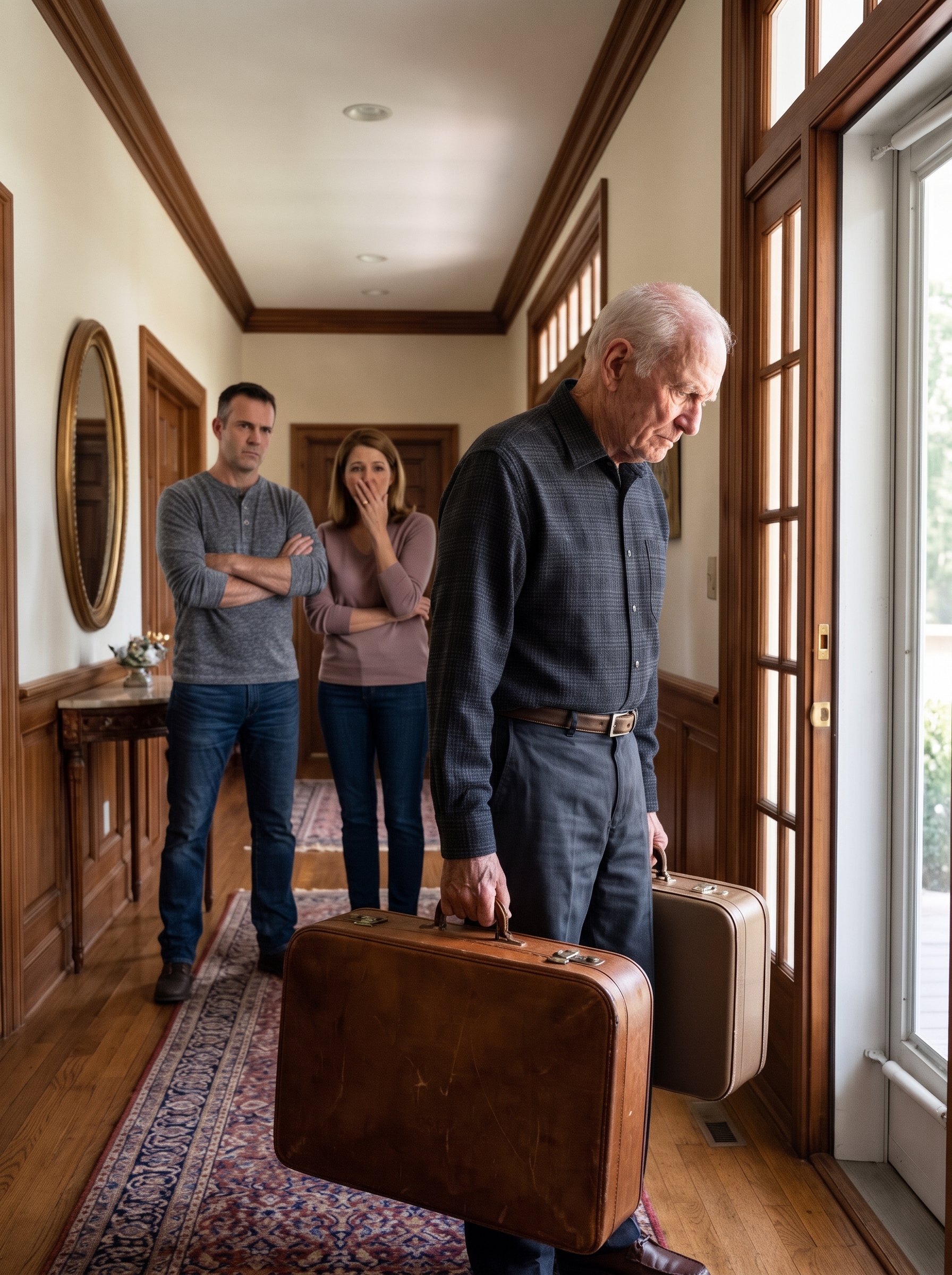
Brandon remained silent instead of defending his own father, so I quietly packed two suitcases and walked away without a single argument.
My son had no idea I had quietly saved eight hundred thousand dollars when his wife humiliated me in front of their guests and told him I needed to leave their home. Brandon chose silence instead of standing up for his own father, so I packed two suitcases and disappeared without an argument.
Three weeks later, when I removed my name and my money from everything holding their life together, they finally realized who they had thrown away. My name is Walter Finch, and I am sixty-eight years old.
I spent forty years working as a certified corporate accountant, and I have always believed that money speaks the loudest when nobody knows you have it. When my beloved wife died six years earlier, Brandon asked me to move in with him and his wife, Courtney, into their suburban home in Tampa.
At first, I truly believed I had found a warm second home where I could spend the rest of my quiet days. Slowly and steadily, however, Courtney began treating me like an embarrassing burden around the house.
She asked me to eat in the kitchen whenever guests came over for dinner on weekends. Later, she started telling me to stay tucked inside my bedroom whenever anyone rang the front doorbell.
Once, she even insisted that I enter the house through the back patio door because company was already visiting in the living room. I endured every single humiliation because Brandon always seemed much happier whenever I stayed completely silent.
What neither of them ever understood was that I was not a poor old man living off their charity. Behind my modest government pension and my faded sweaters were decades of disciplined savings and diversified stock investments.
More importantly, I had quietly co-signed business loans and guaranteed financial agreements that made their comfortable lifestyle possible in the first place. Then came that miserable Monday evening in October.
Brandon had invited several colleagues from his construction firm over for a dinner gathering. I spent nearly three hours in the kitchen preparing stuffed mushrooms, which had always been Brandon’s favorite snack since he was a boy.
Courtney walked into the kitchen with a silver tray in her hands and looked directly at me. “Walter, stop hovering around the guests like that,” she muttered under her breath.
I immediately stepped back toward the edge of the kitchen island to stay out of her path. A few minutes later, she walked back into the room while everyone was chatting and laughing together.
“Why don’t you stay in your bedroom tonight?” she asked brightly.
Then, loudly enough for several of their guests to hear across the open room, she turned toward my son. “Brandon, are you going to handle this right now?”
The entire room went completely silent as the music played softly in the background. I looked directly at my son, hoping he would say something kind to protect my dignity.
Brandon looked down into his glass of bourbon, swirling the ice cubes without looking up. “Dad, maybe you could give us some space tonight,” he whispered to the floor.
Something deep inside my chest went still, and I realized that my presence was only tolerated when I was invisible. “I will not be in the way of your guests,” I answered quietly.
I set my glass on the counter, walked down the hallway to my bedroom, and shut the door behind me. I sat on the edge of the mattress and listened through the drywall to the loud party continuing without me.
Someone in the living room asked Courtney where she had found the expensive tile backsplash in the kitchen. I remembered signing the check for that backsplash two years ago, paying for every single piece of tile myself.
My wife, Rachel, had passed away seven years earlier from ovarian cancer. Rachel had taught elementary school for thirty-one years, and half the adults in town remembered learning how to read in her classroom.
When she died, our home became too painful to live in because every corner held a memory of her voice. That was why I sold our house and agreed to move into Brandon and Courtney’s home in the first place.
Over those six years, Brandon’s residential remodeling business, Finch Craftsmen, struggled with cash flow because he was a gifted carpenter but a terrible businessman. Three years ago, when the local bank demanded collateral for his business credit line, I stepped in and pledged my investment account to secure the funding.
I also signed a formal promissory note for one hundred eighty-six thousand four hundred dollars to renovate their house, giving them a minimal interest rate and flexible terms. On top of that, I funded an account every month for their groceries and utility bills, letting them use the debit cards freely.
Before sunrise that next morning, I packed my tax records, legal files, Rachel’s framed photograph, and two suitcases. I placed my brass house key on the kitchen counter right next to that expensive backsplash, walking out the door without leaving an angry note.
The next morning, I walked into a quiet law office in downtown Saint Petersburg to meet with my longtime contract attorney, Nora Caldwell. I laid every single loan agreement, banking document, and legal note across her wide wooden desk.
Nora adjusted her reading glasses and examined the signatures on the paperwork. “What exactly do you want to do with all of these agreements, Walter?” she asked.
“I want to separate my finances from theirs completely,” I replied without any hesitation. “I want to stop carrying obligations for adults who treat me like an unwanted piece of furniture.”
Nora nodded slowly, understanding the weight of the moment. “Then we do it properly, by the book, and give them formal legal notice.”
Three weeks later, on a sunny Tuesday morning, a courier delivered three thick envelopes by certified mail directly to Brandon and Courtney’s front porch. I sat inside a parked sedan a block down the street, watching Courtney step out to retrieve the mail with a mug of coffee in her hand.
She ripped open the first envelope, and the casual smile on her face vanished in an instant. She tore open the second envelope, and her entire posture stiffened as if she had been struck by lightning.
When she opened the third envelope, she dropped her coffee mug onto the concrete porch and sprinted back inside the house. Less than ten minutes later, my mobile phone began buzzing continuously against the dashboard of my car.
I stared at Brandon’s name glowing on the bright screen, listening to the chime repeat itself over and over. For the first time in six years, I did not answer his call, letting it go straight to voicemail.
They were in a state of absolute panic, and they still had no idea about the eight hundred thousand dollars sitting in my private portfolio.
PART 3
I had rented a simple furnished apartment across the bay in Clearwater, where the rooms were quiet and uncluttered. It had two comfortable chairs, a small dining table, and white walls that carried no painful history.
Later that afternoon, I sat in the conference room of Nora’s office while the phone in my jacket buzzed again. Nora kept her eyes focused on the legal copies spread across the mahogany table.
“You do not have to answer that phone today, Walter,” Nora said softly. “You do not even have to answer it tomorrow if your mind is not ready.”
“I know that, Nora,” I said, resting my hands on my knees. “I just want to be certain we handled every detail according to the law.”
“The first envelope was from the bank, confirming that your pledged securities have been withdrawn from Brandon’s credit line,” Nora explained. “The bank has given him thirty days to either provide substitute collateral or refinance the entire debt.”
“And the second envelope?” I asked, looking out the large window.
“The second envelope is the formal demand for the repayment of the house loan,” Nora replied. “One hundred eighty-six thousand four hundred dollars, plus the agreed interest, due by the end of this financial quarter.”
“I do not want to leave them homeless on the street,” I murmured. “I just want them to realize that adulthood requires responsibility.”
“And the third envelope was from your investment custodian,” Nora added. “It removes Brandon and Courtney as authorized users on the living expense account, cutting off any future automated deposits.”
Brandon remained silent instead of defending his own father, so I quietly packed two suitcases and walked away without a single argument.
I looked down at the documents, seeing terms like revoked, demanded, and terminated staring back at me. “It looks harsh on paper, even though I spent six years giving them everything I had.”
“You are not punishing them by refusing to fund their lives, Walter,” Nora said with a gentle tone. “They simply confused your quiet generosity with a permanent entitlement.”
“I never wanted them to need my money,” I said. “I just wanted them to love me enough to let me sit at their table.”
“Those are two very different things, my friend,” Nora replied gently.
When I returned to my apartment that evening, my phone showed seven missed calls from Brandon, three from Courtney, and one long voicemail. I listened to my son’s voice trembling over the speaker, asking where I was and begging me to explain why the bank had notified him.
I deleted the message without responding because I knew that answering while angry would only lead to shouting. The following morning, the phone rang again, and I decided to pick up on the fourth ring.
“Dad, is that really you?” Brandon asked, his voice cracking with anxiety.
“Yes, Brandon, I am here,” I answered evenly.
“Where did you go? Why are you doing this to us?” he asked frantically.
“I moved into my own place because I could no longer live in a house where I had to hide in the back room,” I said.
“Dad, you took this way too personally,” Brandon insisted. “Courtney was just stressed that night because her friends were visiting.”
“She told me to disappear in front of twelve people, and you looked down at your bourbon,” I reminded him. “You made your choice, so now I am making mine.”
“The bank says I have thirty days to find four hundred thousand dollars in collateral, or they will freeze my business,” Brandon pleaded. “We do not have that kind of money anywhere.”
“You signed those bank documents with me three years ago, Brandon,” I replied. “You knew the pledge was only temporary while you stabilized your business.”
“I thought you were helping family!” Brandon shouted through the line. “You never told me you could pull the rug out from under my company!”
“A guarantee is a legal instrument, not a gift,” I said calmly. “I will meet you tomorrow afternoon at the diner near the Clearwater library, but you must come alone.”
“Courtney wants to come with me to apologize,” Brandon said.
“No, Brandon,” I stated firmly. “I am not ready to speak with Courtney yet, so come by yourself or do not come at all.”
The following afternoon, I arrived early at the corner diner and took a booth near the rear wall. Brandon walked through the glass doors fifteen minutes late, looking exhausted with dark circles under his eyes.
He sat down across from me, his hands shaking slightly as he picked up the paper menu. “You look tired, Brandon,” I said honestly.
“I have not slept in three days because the bank is calling me every morning,” Brandon replied, rubbing his temples. “How could you do this to your own son after everything we shared?”
“Because carrying your life had become more important to me than preserving my own self-respect,” I answered. “You allowed your wife to treat me like a servant, and you never said a single word in my defense.”
“I was embarrassed, Dad,” Brandon confessed, looking down at the vinyl table. “I was embarrassed by the friction between you two, and I foolishly hoped that ignoring it would make it go away.”
“Ignoring disrespect never makes it go away, Brandon,” I said. “It only teaches the other person that their cruelty has no consequences.”
The waitress arrived and poured two cups of black coffee, leaving the small ceramic pot on the table. Brandon took a sip and stared at me with searching eyes.
“Courtney thinks you have a secret fortune hidden away somewhere,” Brandon said quietly. “She said nobody could guarantee a four hundred thousand dollar line of credit without holding massive assets.”
“I was a certified accountant for forty years, Brandon,” I replied. “I spent my career managing assets, so of course I saved my earnings.”
“How much do you actually have?” he asked directly.
“That is none of your business,” I said firmly. “The real question is why you assumed I was obligated to fund your luxury lifestyle while you pushed me into a corner.”
Brandon looked away, unable to meet my eyes across the small table. “I never wanted you to feel unloved, Dad.”
You did not care how I felt until the money stopped flowing into your accounts,” I told him plainly. “Go home, Brandon, and figure out what kind of man you want to be when this storm passes.”
He walked out of the diner with his head down, looking smaller than I had ever seen him look before.
Later that evening, Brandon returned home to find Courtney sitting at the kitchen island with stacks of unpaid invoices. The three certified envelopes were arranged side by side across the polished counter.
“Did he agree to cancel the notices?” Courtney asked eagerly, jumping up from her stool.
“No, he did not,” Brandon said, shaking his head. “He told me that every single agreement will be enforced legally.”
“Then he really does have a hidden fortune,” Courtney said, her voice rising with frustration. “The loan officer hinted that your father’s investment balance was substantial before the pledge was withdrawn.”
“Stop talking about his money, Courtney!” Brandon snapped, finally losing his temper. “You treated him like dirt in front of our friends, and now you only care about his bank account!”
“I was trying to keep our social life intact!” Courtney shouted back. “You never told me that the money he gave us for the new kitchen was a formal loan!”
Brandon froze in place, realizing that his own deception had finally caught up with him. He had taken the one hundred eighty-six thousand dollars from me and told Courtney it was an inheritance advance, hiding his failure to provide for their lavish renovations.
After Courtney went upstairs in tears, Brandon walked over to the metal filing cabinet I had left behind in the utility room. He pulled open the second drawer and searched through the folders until he found my old tax records.
Inside the folder was a verification statement from my brokerage firm, printed four years ago when the business loan was renewed. Brandon looked at the bottom right corner of the document and stopped breathing.
The verified liquid portfolio balance read eight hundred three thousand four hundred seventeen dollars and twenty-nine cents. Brandon leaned against the counter, realizing that the quiet old man he had sent away held enough wealth to buy their entire neighborhood.
Beneath the financial statement lay a faded envelope written in my late wife’s neat handwriting. Rachel had written the letter from her hospice bed three weeks before she passed away.
Brandon opened the envelope and read his mother’s final words under the kitchen light.
“Walter, you will want to give the boy everything because of your soft heart. Please do not do that, my love. Give him enough ground to stand upon, and then let him learn how to stand on his own feet. If there is ever extra money left over that nobody needs, find a retired schoolteacher who cannot pay her rent. There are so many of us who gave away our lives to children and saved nothing for ourselves. I love you, and please stop worrying about everyone else.”