It did not belong anywhere.
One second, the backyard still smelled like burgers on the grill, beer sweating in red plastic cups, sunscreen on children’s arms, and vanilla frosting softening in the afternoon heat.
The next second, every sound in my parents’ house had been swallowed by one sharp crack.
My daughter was three years old.
She had walked into the kitchen because she was thirsty.
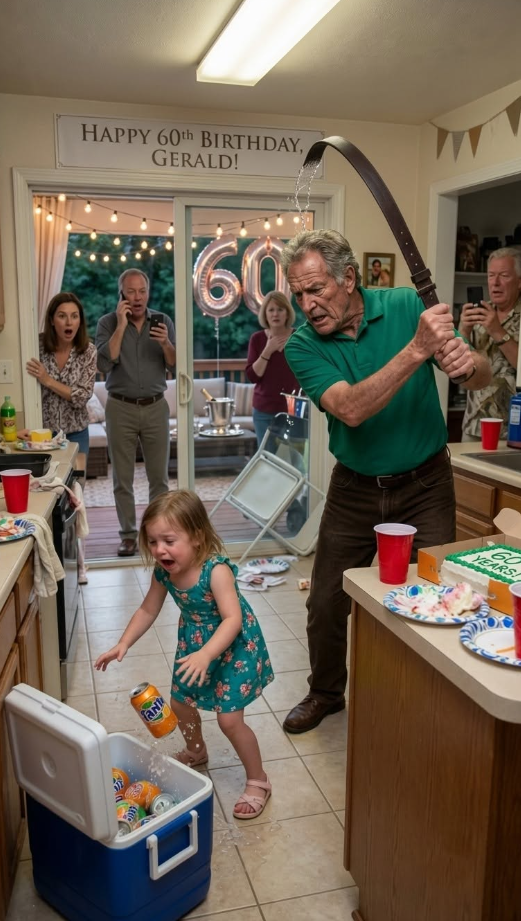
She opened the cooler, picked up a soda, and held it in both hands the way little kids hold things they know might be too big for them.
My father, Gerald Hutchinson, followed her in and snapped, “That’s mine. You don’t touch things in my house without asking.”
Lily looked up at him with those wide, trusting eyes and said, “I’m sorry, Grandpa. I didn’t know.”
Then my father yelled, “So you think you can just take whatever you want?”
His hand went to his belt.
I saw the leather slide free from his jeans.
Before I could reach the kitchen, he swung it at her.
Lily stumbled backward, slipped on the tile, and hit the back of her head so hard the conversation outside died like someone had cut a wire.
By the time I dropped to my knees beside her, blood was spreading under her hair.
Then my mother, Patricia, looked down at my unconscious three-year-old and said, “Your daughter deserved it for being disrespectful.”
She did not scream it.
She did not say it through tears.
She said it calmly.
Like my baby had spilled juice on a tablecloth.
My name is Rebecca Hutchinson, and before I became a criminal defense attorney, I spent eight years as a prosecutor.
That does not make me fearless.
It means I know what evidence looks like before anyone else in the room wants to call it that.
I know how a statement made in anger can become an admission.
I know how a shaky phone video can become a timeline.
I know how one object on the floor can matter more than ten people’s excuses.
But I did not learn any of that so I could use it against my own father.
The party had started around midafternoon at my parents’ suburban house, the same house where I had grown up learning which footsteps meant trouble.
My mother had decorated the backyard like a lifestyle magazine had sneezed on it.
Matching trays sat along the folding table.
Balloons were tied to the porch railing.
A small American flag fluttered near the steps, because Patricia believed respectability was something neighbors should be able to see from the street.
Gerald was turning sixty.
To everyone outside our family, he was the loud, charming man at the grill, the guy who remembered your truck trouble and your kid’s Little League schedule.
To us, he was the weather system everyone planned around.
You learned when to laugh.
You learned when to disappear.
You learned that apologies were cheaper than safety.
I had left town after college because I could not keep living under the rules that made my brother Travis proud and my sister Vanessa quiet.
Travis stayed nearby and ran a dealership less than ten minutes from my parents’ house.
He inherited my father’s volume, his certainty, and his belief that fear was proof of authority.
Vanessa married young and stayed close too.
She had three children and the same tight smile my mother wore whenever something cruel happened in public.
I married James and built our home differently.
We did not scream.
We did not humiliate.
We did not hit and then rename it discipline.
Lily grew up in a house where adults apologized when they were wrong, where spills were wiped up instead of punished, where a child could ask for help without studying the room first.
I used to think that was strength.
At my parents’ house, it made her unprepared for danger.
James did not want to go to the birthday party.
He stood in our kitchen that morning with a paper coffee cup in one hand and Lily’s little cardigan in the other, and he said, “Rebecca, your parents don’t do normal. They do performance.”
I knew he was right.
But my mother had called three times that week.
She said Gerald was getting older.
She said it would mean something to him if all his children came.
She said Lily should have memories with her grandparents.
She said maybe everyone could try.
That word always got me.
Try.
In families like mine, “try” usually means the safest person has to swallow the most.
Still, I told James we would go for a few hours.
We would stay through cake.
Then we would leave.
When we arrived, the driveway was already full.
There were SUVs parked along the curb, an old pickup near the mailbox, and kids running between lawn chairs while adults pretended the family was warmer than it was.
My mother met us at the sliding glass door with a smile that tightened when Lily hid behind my leg.
“Well,” Patricia said, “somebody is shy today.”
“She just needs a minute,” I said.
My father looked over from the grill and raised his beer.
“There’s my city lawyer,” he called.
That was what he called me when he wanted everyone to remember I had left.
I smiled because Lily was watching.
James put a hand low on my back.
It was his quiet way of saying, I’m here.
For the first hour, nothing dramatic happened.
That is how these gatherings fool you.
There are burgers, paper plates, people asking about work, children chasing each other near the fence.
The harm is not always immediate.
Sometimes it is just the old pressure settling over your shoulders until you forget how hard you are holding yourself.
Lily tried to play with Travis’s boys.
They were older, louder, and rough in the way children become when adults reward roughness as confidence.
One took her purple crayon.
Another blocked her from the little plastic slide.
When she looked confused, they laughed.
She came back to me with her coloring book hugged to her chest.
“Mommy,” she whispered, “can we go soon?”
I kissed the top of her head.
“After cake, baby.”
She nodded because she trusted me.
That trust is the part I replay more than any other.
At 5:18 p.m., Lily asked for a drink.
I remember the time because later I checked my phone.
The screen had been open to a text from James asking if I wanted him to start the goodbye rounds.
I told Lily her water cup was on the kitchen counter.
The sliding glass door was open.
The kitchen was only a few steps away.
The house was familiar.
I watched her walk inside in her little pink sandals, and I turned back toward my mother only because Patricia had asked whether I was still “doing that defense work.”
I never answered.
Gerald’s voice cracked through the kitchen.
“Hey. That’s mine.”
Every adult in the backyard seemed to hear it at the same time.
The change was small but instant.
Shoulders stiffened.
A laugh broke off.
Someone lowered a paper plate.
I turned toward the door and saw Lily standing beside the cooler with a soda can pressed against her chest.
Gerald was in front of her.
He was too close.
His face was red.
His finger was pointed downward at her small body.
“You don’t touch things in my house without asking,” he said.
Lily’s mouth trembled.
“I’m sorry, Grandpa. I didn’t know.”
I stood so fast my chair scraped backward and fell.
James moved at the same time.
Gerald shouted, “So you think you can just take whatever you want?”
Then he reached for his belt.
There are sounds from childhood your body recognizes before your mind gives them language.
Leather sliding through belt loops was one of mine.
I was not eight years old anymore.
I was not hiding in a hallway anymore.
I was a grown woman, a wife, a mother, an attorney.
But for one fraction of a second, the sound still made something old and frozen open inside me.
Lily shrank back.
He swung.
I do not describe that moment because I want to make it larger than it was.
I describe it because it was exactly as large as it needed to be to change everything.
The belt did not need to leave a mark for the act to be violent.
The threat, the force, the adult body towering over a toddler, the panic that made her slip backward on tile, all of it belonged to the same moment.
The soda can dropped from Lily’s hands and rolled under the kitchen table.
Her sandals lost traction.
Her arms flailed.
The back of her head hit the floor.
The room stopped.
Outside, a red cup tipped over on the patio table and beer slid toward the edge.
One of Vanessa’s children froze with a cupcake halfway to his mouth.
A plastic fork hung in Travis’s hand.
My mother’s wind chime kept tapping softly near the porch as if the world had not just split open.
Nobody moved fast enough except James.
He was already calling 911 before we reached Lily.
I dropped to the floor beside her and forced myself not to pick her up.
I had handled enough cases, heard enough medical testimony, seen enough bad decisions made from panic.
Head injury.
Possible neck injury.
Bleeding.
Unconscious.
Do not move her unless you have to.
I grabbed a clean kitchen towel from the counter and pressed it gently near the wound.
Not hard.
Not on her neck.
Just enough.
Her little body jerked for a few seconds.
Then she went limp.
“Lily,” I said.
No response.
“Lily, baby, open your eyes.”
Nothing.
James’s voice was shaking, but his words were clear.
“Three-year-old female, head injury, bleeding, unconscious but breathing. Address is…”
Gerald stood above us.
He still had the belt in his hand.
“She took a soda without asking,” he said.
That sentence did something to me.
It cleared the fog.
Vanessa looked down at Lily, then away.
“Maybe now she’ll learn respect,” she said.
My mother stepped into the kitchen.
Her face was not horrified.
It was annoyed.
Like the party had become inconvenient.
Then she said, “Your daughter deserved it for being disrespectful.”
Some families do not protect cruelty because they do not understand pain.
They protect it because the truth would make their whole history collapse.
If Gerald had gone too far with Lily, then maybe he had gone too far with us.
If Lily did not deserve it, then maybe none of us had.
That was too much truth for Patricia to let into her kitchen.
So she chose the lie.
Several guests had their phones out.
At first I thought they were calling for help.
Then I saw one of my father’s old coworkers backing into the doorway, phone raised, recording with a shaking hand.
Another woman kept whispering, “Oh my God,” over and over.
Travis said, “Everybody needs to calm down.”
I looked at him once.
He stopped talking.
The attorney in me arrived before the daughter could fall apart.
I saw the belt.
I saw the cooler.
I saw the soda can under the table.
I saw the towel.
I saw the witnesses.
I heard the admissions.
I registered James’s 911 call, still active, still recording his side of the emergency.
I noticed the time on the stove clock.
5:22 p.m.
I noticed Patricia’s words.
I noticed Gerald’s explanation.
I noticed Vanessa’s shrug.
Everyone else was in a family disaster.
I was kneeling in a crime scene.
At 5:24 p.m., the first siren turned onto the street.
My mother heard it and changed instantly.
The flatness left her face.
Her eyes snapped toward the driveway.
“Rebecca,” she said quietly, “you need to think before you talk to them.”
I kept my hand on the towel.
Gerald’s jaw tightened.
“This is family business,” he said.
It was such an old phrase.
Family business.
It had covered slammed doors, broken toys, bruised arms, ruined birthdays, and children learning to apologize before they understood what they had done wrong.
But family business stops being private when a child is unconscious on the floor.
The first officer came through the kitchen door with his hand near his radio.
A second officer followed, then moved quickly to clear space for the paramedics coming behind him.
The officer looked at Lily first.
Then at me.
Then at the belt still in Gerald’s hand.
“Ma’am,” he said, “what happened here?”
My father looked at me.
Not with remorse.
With expectation.
He expected me to soften the edges.
He expected me to say there had been an accident.
He expected me to protect the family name because that was what Hutchinson daughters had always been trained to do.
Swallow it.
I looked up at him and felt the last thread of daughterly fear snap.
“My father struck my three-year-old with a belt,” I said, “and she fell backward and hit her head on the tile.”
The room went perfectly still.
My mother moved first.
“That is not what happened,” she said quickly. “Rebecca is emotional. She has always been dramatic.”
I did not raise my voice.
“There are multiple witnesses,” I said. “At least two phones recorded it. He also stated that she took a soda without asking.”
The officer turned toward Gerald.
“Sir, put the belt down.”
For the first time since I had known him, my father looked unsure of the room he was standing in.
He opened his hand.
The belt hit the floor.
It made a soft, ugly slap against the tile.
The paramedics came in then, and all my attention went back to Lily.
They took over with practiced calm.
One asked me questions.
Had she lost consciousness?
How long had she been unresponsive?
Had she vomited?
Had she seized?
I answered each question as clearly as I could.
My voice sounded like it belonged to someone else.
James stood near my shoulder, still pale, still holding the phone, still giving information when asked.
When they lifted Lily onto the stretcher, I wanted to scream.
Instead I put my hand near her foot because it was the only part of her I could touch without getting in the way.
Her sandal strap was crooked.
That small detail nearly broke me.
A crooked pink strap.
A birthday party.
A soda.
My mother tried to follow us toward the door.
One officer stopped her.
“We need everyone to remain available for statements,” he said.
“I’m her grandmother,” Patricia said.
The officer looked at Lily on the stretcher, then back at my mother.
“Then you can wait.”
In the ambulance, I sat strapped beside Lily and watched the monitor while a paramedic checked her pupils.
James followed in our SUV.
I could see his headlights behind us through the small back window, steady and close.
At the hospital intake desk, my hands shook so badly I could barely sign the form.
The nurse gave me a clipboard and a pen.
The document said PEDIATRIC EMERGENCY INTAKE across the top.
I remember that because I stared at the words until they blurred.
A doctor examined Lily.
They ordered imaging.
They cleaned the wound.
They asked what had happened, and I repeated it again.
Then again.
Then again.
Each time, I kept to facts.
My father swung a belt.
My daughter recoiled.
She fell.
Her head struck tile.
She lost consciousness.
The police report would later note that the first 911 call was placed at 5:20 p.m.
It would note that responding officers observed a leather belt on the kitchen floor.
It would note that multiple witnesses were present.
It would note that one guest provided video footage from a personal cell phone.
It would note Gerald’s spontaneous statement that Lily had taken a soda without asking.
Those words mattered.
They mattered more than my mother’s outrage.
They mattered more than Travis’s excuses.
They mattered more than Vanessa’s fear.
Lily woke up later that evening in a hospital bed, small and confused, with a bandage near her hairline and James sitting rigidly beside her.
Her first word was “Mommy.”
I took her hand and pressed my mouth to her fingers.
“I’m here,” I said.
Her eyes filled with tears.
“Is Grandpa mad?” she whispered.
That question did what the blood had not done.
It broke me.
Because she had been the one on the floor.
She had been the one unconscious.
And still her first fear was whether the adult who hurt her was angry.
That is what families like mine teach children.
They teach them to manage the feelings of the person who scares them.
James turned away, one hand over his mouth.
I leaned close to Lily and said, “No, baby. You did nothing wrong.”
She watched my face like she needed to borrow certainty from it.
“You are not in trouble,” I said. “You are safe.”
The investigation moved faster than my family expected.
By the next morning, an officer had taken my formal statement.
The phone video had been copied and logged.
Hospital records documented the injury.
The emergency intake form, imaging notes, discharge instructions, and police report became a stack of paper that made it impossible for anyone to call the incident a misunderstanding.
My mother called seventeen times before noon.
I did not answer.
She texted once.
You are destroying this family.
I looked at that message in the hospital hallway while Lily slept with a stuffed rabbit tucked under her arm.
For the first time in my life, I did not feel the need to defend myself to Patricia Hutchinson.
I typed back one sentence.
Gerald did that when he lifted the belt.
Then I blocked her for the day.
The fallout was immediate.
Travis accused me of trying to ruin our father over “one bad moment.”
Vanessa cried and said she did not want her kids dragged into it.
My mother told relatives that I had exaggerated because I hated being corrected.
But the video did not exaggerate.
The belt on the floor did not exaggerate.
The medical chart did not exaggerate.
The 911 timestamp did not exaggerate.
Evidence is not loyal.
That is why people who depend on silence fear it so much.
Weeks later, when the case reached its first formal hearing, Gerald looked smaller than he had in my childhood memories.
Not weak.
Just finally measured by something outside his own house.
He wore a pressed shirt and the expression of a man offended that consequences had arrived through the front door.
Patricia sat behind him.
She did not look at me.
Vanessa came too, pale and restless, twisting a tissue in her hands.
James sat beside me, one hand wrapped around mine.
I was not there as the prosecutor.
I was not there as the attorney steering the room.
I was there as Lily’s mother and as a witness.
That was enough.
When the video played, the courtroom changed.
It is one thing to hear adults argue about discipline.
It is another thing to hear a three-year-old say, “I’m sorry, Grandpa,” and then watch a grown man raise a belt.
Patricia lowered her face.
Travis stared at the table.
Vanessa started crying silently.
Gerald did not look at the screen after the first few seconds.
He looked at me.
Maybe he wanted the daughter he remembered.
The one who would smooth over the story.
The one who would call harm tradition because everyone else did.
But that daughter had been gone for years.
He had just refused to notice.
The legal process did what legal processes do.
It moved slowly, formally, through statements, motions, conditions, orders, and consequences that did not care about Patricia’s reputation at church or Gerald’s birthday photos.
There were no grand speeches.
There was paperwork.
There were recorded facts.
There were medical records.
There was a child whose fear mattered more than an old man’s pride.
Lily healed physically before I did.
Children can laugh with a bandage still visible.
They can ask for pancakes the morning after terror.
They can hold a stuffed rabbit and watch cartoons while adults stand in doorways learning how much anger they have been carrying for twenty years.
But sometimes she flinched when a man’s voice rose in a grocery store.
Sometimes she asked if she was allowed to take a juice box from our own fridge.
Sometimes she said, “I forgot to ask,” with panic already in her face.
Each time, James or I would stop what we were doing and remind her.
This is your home.
You are allowed to be thirsty.
You are allowed to make mistakes.
You are safe.
That became our echo for months.
You are safe.
At first, I thought the family split would hurt more.
It did hurt.
There is no clean way to lose people who were never safe but were still yours.
My mother sent messages through relatives.
Travis stopped speaking to me entirely.
Vanessa eventually called one night after her kids were asleep.
She cried so hard she could barely form words.
“I keep seeing her on the floor,” she said.
I waited.
Then she whispered, “And I keep seeing us.”
That was the closest anyone in my family had ever come to saying the truth out loud.
I did not forgive her that night.
Forgiveness was not the work in front of me.
Safety was.
But I told her she should talk to someone.
I told her her children deserved a home where fear was not mistaken for respect.
She did not answer for a long time.
Then she said, “I know.”
A year later, Lily no longer remembers every detail.
She remembers the hospital bracelet because she thought it looked like a paper watch.
She remembers the stuffed rabbit.
She remembers that Daddy drove behind the ambulance.
She remembers that Mommy told the police the truth.
I hope that is the part that stays.
Not the crack of tile.
Not the belt.
Not her grandmother’s cold sentence.
I want her to remember that the room asked us to swallow what happened, and we did not.
I want her to remember that love is not silence.
Love is the hand that keeps pressure on the wound.
Love is the voice that stays clear when everyone else wants fog.
Love is telling the truth while your whole history stands in front of you daring you not to.
For years, I thought surviving my family meant getting far enough away from their rules.
I was wrong.
Surviving them meant refusing to pass those rules down.
My daughter once trusted me when I told her we would leave after cake.
I could not undo what happened before cake ever came.
But I could make sure the lesson she carried from that kitchen was not that she deserved pain for being thirsty.
The lesson was simpler.
The adults who hurt you do not get to define what happened.
And family business stops being family business the moment a child is bleeding on the floor.