PART 2
By the time I stepped into the parking garage, my hands were no longer trembling.
That scared me more than the betrayal itself.
Shock often made people careless. Anger made them noisy. Grief made people fragile in moments when they needed to remain precise. But as I moved between the rows of parked cars, I felt none of it—only the clean, empty stillness of a woman walking away from a funeral she had been expecting for years.
My marriage had not ended at the airport.
It had been dying for a long time, in countless quieter moments.
At the dining table, where Ethan replied to hospital emails while I told him about my day.
In our bedroom, where he turned his back to me as though I were nothing more than background noise.
At charity functions, where he rested his hand lightly on my waist for the cameras, then pulled it away the second the flashes stopped.
In conversations where I said, “Something feels wrong,” and he watched me with that calm, clinical patience he reserved for terrified patients.
“Madison,” he would say gently, “you’re spiraling again.”
Again.
That single word had become a prison.
Every instinct, every faint suspicion, every lonely ache inside me—he transformed all of it into a diagnosis. I had not been deceived, he suggested. I was insecure. Overemotional. Irrational.
But I was not irrational.
I was paying attention.
And now I had witnessed the truth with my own eyes.
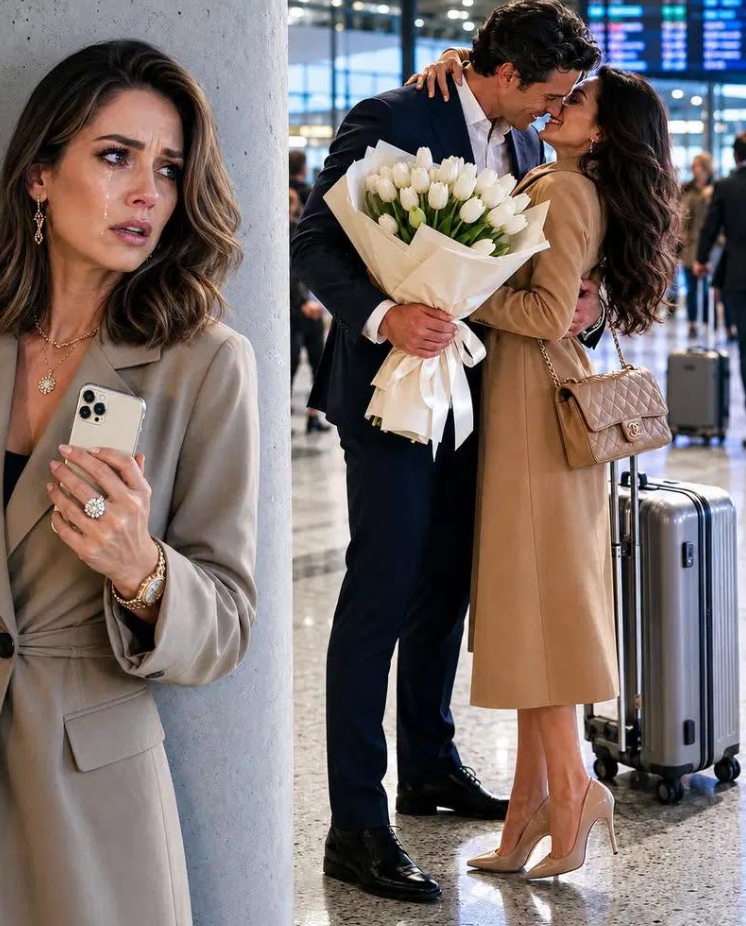
I sat inside my Range Rover for several minutes without turning on the engine. Around me, the airport garage buzzed with movement. Tires shrieked softly against concrete. Somewhere close by, a child was crying. A suitcase rolled noisily over a crack in the floor.
I opened Ethan’s text again.
“Keep tomorrow evening free, Madison. I have something special planned. I want you to feel like the most important woman in my world.”
The phrasing made my stomach tighten.
Not “my wife.”
Not “the woman I love.”
The most important woman in my world.
A sentence crafted to feel intimate while still leaving room for loopholes.
For a second, I almost respected the arrogance.
Then another message appeared.
“Wear the navy gown. The one from the Baylor gala. You looked beautiful in it.”
For one breathless moment, my body froze.
Ethan never remembered my clothes.
Not for anniversaries. Not for benefits. Not even for the ceremony where he accepted the hospital’s lifetime innovation award while I stood beside him in a silver gown that had required three fittings and six weeks to complete.
But he remembered the navy gown.
The Baylor gala had taken place nine months earlier.
Sophia Bennett had been there.
I shut my eyes, and the memory became sharper.
A ballroom soaked in golden light. Crystal glasses. White orchids. Ethan beside the bar with Sophia, both of them laughing too quietly, standing too close. Me walking across the room with a smile pinned to my face. Ethan stepping away the instant he saw me.
“You remember Sophia,” he’d said.
Sophia had offered her hand. Cool fingers. Diamond bracelet. Flawless smile.
“Madison, your events are legendary,” she said. “Ethan talks about your work all the time.”
Ethan had not spoken about my work in years.
Back then, I had swallowed the small, slicing humiliation and pretended I had not noticed.
Now I noticed every single thing.
I drove home in silence, without music. The Dallas skyline climbed in front of me, its glass towers glowing orange beneath the late afternoon sun. The city looked polished, costly, and completely indifferent.
Our house stood in Preston Hollow behind iron gates and perfectly trimmed hedges Ethan had once described as “a tasteful privacy measure.” I had selected the limestone exterior, the antique brass details, and the broad oak floorboards. I had softened his sterile preferences with linen curtains, artwork, flowers, and candlelight.
I used to believe a home was something two people created together.
But when I stepped inside, the silence met me like a witness.
“Mrs. Carter?” Elena called from the kitchen.
Our housekeeper stepped out, drying her hands on a towel. She had been with us for twelve years and had seen more of my marriage than most therapists ever would.
“Will Dr. Carter be home for dinner?”
I placed my purse on the console table.
“No,” I said. “He has a hospital meeting.”
The lie slipped out easily because he had handed it to me so many times before.
Elena studied my face. “Should I prepare anything?”
“No. Take the evening off.”
Her eyebrows rose slightly. “Are you sure?”
“Yes.” I smiled. “I have work to do.”
After she left, I remained beneath the chandelier Ethan had once called excessive until three separate guests complimented it. After that, he began calling it “our best design choice.”
Our.
That word had turned into theft.
I went upstairs to his study.
For fifteen years, I had honored Ethan’s privacy. Not because I was foolish, but because I had believed privacy was one expression of love. I had never checked his phone. Never opened his emails. Never searched his pockets like a jealous wife in some cheap melodrama.
But privacy belonged to marriages.
This was an investigation.
His study carried the scent of leather, cedar, and the expensive cologne he wore only for public appearances. The desk was spotless, as usual. Ethan believed visible mess suggested a weakness of character. Behind him, his diplomas hung in a flawless line: Harvard, Johns Hopkins, UT Southwestern. Framed articles celebrated his surgical innovations. One magazine cover named him “The Heart of Modern Medicine.”
I nearly laughed.
Beside his awards sat a silver-framed photo from our tenth anniversary. In it, he kissed my cheek while I smiled at the camera. We looked wealthy, steady, respected.
We looked convincing.
I sat at his desk and pulled open the drawer where he stored spare chargers, cufflinks, and old conference badges.
Nothing.
The second drawer was locked.
That was new.
Ethan had always trusted me not to search.
Now he trusted a lock more.
I stood, went down to the kitchen, took the small emergency toolkit from the mudroom, and came back with a flathead screwdriver. It took under three minutes. Event designers handled disasters with whatever they had nearby—floral wire, tape, pins, borrowed screws, and manufactured confidence. A locked desk drawer was barely a problem.
The lock surrendered with a quiet metallic click.
Inside were documents.
Not many. Just enough.
A narrow black folder. A bank envelope. A velvet jewelry box.
My pulse slowed.
I opened the jewelry box first.
Inside was a necklace: a fine platinum chain holding a sapphire pendant framed by tiny diamonds.
Not something I would wear.
I preferred emeralds.
A card had been tucked beneath the velvet lining.
“S—For the night we stop pretending. E.”
For a moment, the room shifted beneath me.
Not because of the necklace.
Because of the certainty in the note.
The night we stop pretending.
Tomorrow night.
Next, I opened the bank envelope.
Receipts.
A suite at The Adolphus Hotel.
Two plane tickets to Paris, dated three weeks later.
A wire transfer confirmation to an account named Bennett Consulting Group.
Forty-eight thousand dollars.
I stared at the figure until it began to blur.
Sophia worked in medical technology. She had no reason to need “consulting” money from my husband. At least, not money quietly sent from his private account.
Then I opened the black folder.
And everything shifted.
Inside were printed documents, emails, and a draft agreement stamped confidential. The first page carried the Whitestone Medical Foundation logo, followed by language so dense it might have put anyone less interested to sleep.
But I had organized foundation events for years. I understood donor contracts. Sponsorship terms. Naming rights. Board positions.
This was not romance.
This was strategy.
Ethan was arranging a private partnership between Whitestone Medical Foundation and Sophia’s company, Bennett Helix Systems. The agreement involved an experimental cardiac monitoring platform, hospital procurement access, investor funding, and a pilot program backed by the foundation.
The numbers were staggering.
Eight figures.
Possibly more.
At the bottom of one email chain, Sophia had written:
“Once Madison is no longer a complication, optics become easier. Tomorrow needs to be handled cleanly. Publicly, if necessary.”
I read the line three times.
Madison is no longer a complication.
Not wife.
Not human being.
Complication.
My mouth went dry.
There were other emails.
Ethan to Sophia:
“She suspects but has no proof. She won’t make a scene if handled correctly. Her entire identity depends on social composure.”
Sophia answered:
“Then use that. Make her doubt herself first. The foundation cannot afford instability before the vote.”
I sat completely motionless.
The affair was no longer the injury.
It was the camouflage.
They were not merely deceiving me. They were managing me. Planning around me. Shrinking fifteen years of marriage into a barrier standing between a man, his mistress, and a fortune disguised as medical advancement.
Then I reached the final page.
A draft statement.
My name appeared in the first paragraph.
“With compassion and respect, Dr. Ethan Carter confirms that he and his wife, Madison Carter, have been privately navigating difficulties related to her emotional well-being…”
The silence in the room became almost physical.
Her emotional well-being.
My fingers clenched around the page.
They were planning to make me appear unstable.
Tomorrow night’s “special surprise” had nothing to do with reconciliation. It was containment.
I could see the whole thing unfold. Ethan would take me to the gala, maybe deliver a tender speech, maybe announce some temporary separation with dignified sadness. He would hint at concern. He would look honorable. Sophia would hover nearby, elegant and sympathetic. By the time the board cast its vote, the whispers would already be spreading through the room.
Poor Ethan.
Brilliant man.
Difficult wife.
So sad.
So brave of him.
I returned every document exactly where I had found it—except the folder.
That one came with me.
Then I went to my office.
Unlike Ethan’s study, my office had life in it. Fabric swatches spilled from trays. Floor plans covered the walls. Floral samples hung upside down near the window to dry. Photographs from past events filled the shelves: governors, athletes, actresses, oil families, tech billionaires, brides with seven-foot trains, and mothers who had cried over napkin colors.
People hired me because I understood beauty.
They underestimated me because they assumed beauty was gentle.
I turned on my computer and opened the master file for the Whitestone gala.
Of course I had the file.
My company was designing the event.
Ethan had insisted that I handle the contract myself.
“It’ll be good for both of us,” he said two months ago. “A Carter family contribution.”
Now I understood.
He wanted me inside the system because he thought he understood how I functioned. He believed I would never risk damaging my professional name. He believed I would choose perfection over revenge.
He was partly correct.
I would never damage my reputation.
I would engineer his destruction perfectly.
The gala was set for six o’clock the following evening in the Crescent Hotel ballroom. Five hundred confirmed guests. A press platform near the back. Three camera crews. A donor recognition video. Ethan’s keynote at eight-fifteen. Board vote at nine. Champagne service at nine-thirty.
Ethan’s speech was the center of the evening.
That was where he intended to command the room.
So that was where I would take the room away from him.
I opened the production timeline and started making calls.
Not desperate calls.
Measured ones.
The kind people picked up because my name meant control.
First, I called my audiovisual director, Marcus.
“Tell me the final video reel is still editable,” I said.
He laughed softly. “Madison, I love when you greet me like a bomb has already been planted.”
“Is it editable?”
“Until noon tomorrow.”
“Good. I need a private insert prepared.”
“What kind?”
“The kind that cannot accidentally play early, cannot be accessed by anyone except you, and cannot be traced to the hotel system.”
A pause followed.
“That sounds expensive.”
“It is.”
Another pause. “Send me the assets.”
Then I called Nina, my senior planner.
“I need you to revise the table placement for tomorrow.”
“At this hour?”
“Yes. Move Sophia Bennett from table twelve to table three.”
“Table three is front center.”
“I know.”
“Is there a reason?”
“Yes.”
Nina waited.
I said nothing.
At last, she answered, “Understood.”
That was exactly why Nina was worth every dollar I paid her.
After that, I called Whitestone’s communications director, a nervous woman named Claire who seemed permanently terrified of upsetting donors.
“Claire,” I said warmly, “I need the final speaker order confirmed in writing tonight. No surprise additions. No edits from Ethan’s office without my approval.”
“Dr. Carter mentioned he might have a personal acknowledgment during his remarks.”
“I’m aware.”
“He said it was important.”
“I’m sure he did. Send me the final program.”
She hesitated. “Is everything all right?”
I looked down at the folder on my desk.
“Everything is exactly as it needs to be.”
By ten o’clock, the house was still empty.
At ten-fifteen, Ethan called.
I let it ring twice before I picked up.
“Hi,” I said.
“Madison.” His voice carried that polished exhaustion he used whenever he wanted absence to seem noble. “I’m sorry, I got trapped in meetings.”
“With Whitestone?”
“Yes. Foundation chaos. You know how these things are.”
“I do.”
A pause settled between us. Maybe he heard something in my voice. Maybe guilt had sharpened his senses.
“Are you okay?” he asked.
It was almost amusing.
“I’m fine.”
“You sound distant.”
“I’m tired.”
“Tomorrow will be good for us,” he said gently. “I mean that.”
I turned the sapphire necklace box slowly in my hand.
“What should I expect?”
He released a quiet breath. “Something honest.”
My gaze lifted to the dark window, where my reflection stared back at me.
“Honesty would be refreshing.”
Another silence.
Then he said, “Wear the navy gown.”
“I will.”
“Good. I want you beside me.”
No, I thought.
You want me positioned.
“Of course,” I said.
After the call ended, I did not go to bed.
Instead, I opened the security footage stored in our home archive.
Ethan had put cameras in after a break-in happened two streets away. He adored systems. Adored control. Adored evidence, evidently, when he thought it was under his ownership.
The footage showed Sophia walking into our house four months earlier while I was in Aspen coordinating a winter wedding. Ethan answered the door himself. She was wearing a red coat and carried no work documents.
She remained there for three hours.
I saved the clip.
Then another one.
And another.
By sunrise, I had constructed a timeline.
Not only an affair.
A campaign.
Hotel visits hidden beneath conference schedules. Transfers labeled as consulting. Meetings held before board decisions. A draft statement meant to undermine my credibility. A partnership arrangement that could make both of them richer if approved beneath the glow of philanthropy.
At seven-thirty, Ethan returned home.
I was sitting in the breakfast room in silk pajamas, drinking coffee, with a vase of fresh white tulips placed in the middle of the table.
His stride faltered when he noticed them.
Only briefly.
But I noticed.
“Morning,” I said.
He lowered his briefcase. “You’re up early.”
“So are you.”
“I told you, meetings ran late.”
“Of course.”
His gaze shifted back to the tulips. “New flowers?”
“Yes. I suddenly remembered how much I like them.”
He examined my face.
I smiled.
Ethan had built his career on reading tiny facial changes from frightened families before explaining surgical results. But men like him often missed the expressions of women they had trained themselves to underestimate.
He bent down and kissed my cheek.
I allowed it.
His cologne was familiar.
Beneath it, faintly, was another fragrance.
Sophia wore jasmine.
“Tonight matters,” he said.
“I know.”
“I need you to trust me.”
That nearly loosened something inside me. Not tears. Laughter.
Instead, I placed my hand over his.
“I trusted you for fifteen years, Ethan.”
His expression softened, but not out of love.
Out of relief.
He mistook my words for surrender.
At noon, I arrived at the hotel.
The Crescent ballroom had entered that beautiful phase of organized chaos. Men stood on ladders, adjusting lighting rigs. Florists unpacked hydrangeas, roses, and white tulips—Ethan had apparently requested those for the stage arrangements. Linen teams steamed tablecloths. The catering manager checked champagne totals. A violinist tested a phrase that floated over the noise like something delicate.
My staff moved around me with clipboards and headsets.
This was my kingdom.
Not Ethan’s hospital. Not his foundation board. Not Sophia’s investor world.
Mine.
Here, nothing occurred unless someone on my team permitted it.
Nina came toward me with two coffees and a face filled with questions she was too professional to voice.
“Sophia Bennett is now at table three,” she said.
“Good.”
“Dr. Carter’s office requested a teleprompter revision.”
“Denied.”
“Already done.”
I accepted the coffee. “You’re perfect.”
“I’m concerned.”
“I know.”
“Do I need to be more than concerned?”
I looked across the ballroom toward the stage where Ethan would stand beneath flattering light and attempt to bury me beneath sympathy.
“Yes,” I said. “But not yet.”
Nina’s eyes sharpened.
She had worked beside me for eight years. She had watched me handle drunken fathers of brides, collapsing tents, missing cakes, fainting debutantes, power failures, and one famous actor who insisted the moon was “too bright” during an outdoor reception.
She knew the face I wore before disaster.
“What do you need?” she asked.
“Keep the press cameras live through Ethan’s speech. No cutaways. No interruptions. And make sure the ballroom doors are closed after he begins.”
“Closed?”
“Quietly. Fire code compliant. But closed.”
Nina gave one nod.
By five-thirty, the ballroom had become something else entirely.
Candlelight glittered across silver chargers. Tall arrangements of white tulips and blue delphinium rose from the tables like refined lies. The stage backdrop shone with the Whitestone logo. A string quartet played near the entrance as waiters moved through the lobby carrying trays of champagne.
I went upstairs to the suite set aside for event staff and changed into the navy gown.
Ethan had selected it deliberately.
It was beautiful, yes. Deep blue silk, off the shoulder, shaped at the waist. But it was also controlled. Proper. Wife-like. The kind of dress made for standing beside a powerful man while he thanked donors and rewrote the truth.
I put on diamond earrings, applied lipstick, and studied myself in the mirror.
The woman looking back did not appear destroyed.
She appeared expensive.
That would be useful.
My phone vibrated.
A message from an unknown number.
“Be careful tonight. You don’t know everything.”
I stared at it.
No name.
No explanation.
Then another message appeared.
“Ethan isn’t the only one using Sophia.”
My skin tightened.
I typed, “Who is this?”
No reply.
I called the number.
Disconnected.
For the first time since the airport, uncertainty entered the room with me.
Then Nina knocked.
“They’re arriving.”
I slipped the phone into my clutch.
“Then let’s begin.”
The first hour moved like a dream designed for rich people.
Guests kissed cheeks and complimented the flowers. Donors pretended they were not comparing table assignments. Doctors exchanged praise with the polished hostility of competitors. Reporters searched the room for scandal without realizing they were already standing inside one.
Ethan arrived at six-forty.
He wore a black tuxedo and the expression of a man stepping into a portrait painted for him. People naturally turned toward him. He had that gift. Presence. Weight. The effortless authority of someone used to rooms shifting around him.
When he saw me, he smiled.
It was handsome.
It was rehearsed.
It was nothing like the smile he had given Sophia at the airport.
“Madison,” he said, taking my hands. “You look stunning.”
“Thank you.”
His eyes searched my face. “Are you ready?”
“For your surprise?”
A tiny flicker crossed his expression.
“Yes.”
“I’ve been looking forward to it.”
He kissed my forehead.
To anyone watching, it looked tender.
To me, it felt like being prepared for sacrifice.
Then Sophia walked in.
The room did not stop moving, but Ethan’s attention did.
Only for a heartbeat.
A fraction of a second.
Enough.
She wore ivory.
Of course she did.
An ivory column gown beneath a soft champagne wrap, her dark hair swept over one shoulder, sapphire earrings shining at her ears.
Sapphires.
My hand tightened around my clutch.
Sophia noticed me looking and smiled.
Not with nerves.
Not with guilt.
With victory.
She crossed the room holding a glass of champagne.
“Madison,” she said. “What a spectacular evening. No one does elegance like you.”
“Thank you, Sophia. I’m glad you could join us.”
“I wouldn’t miss it.” Her gaze shifted toward Ethan. Softened. “Tonight feels important.”
“It is,” Ethan said.
I watched them stand together under my lighting, framed by my flowers, inside my design, and I realized they had confused the setting for their stage.
A waiter passed.
I took a glass of champagne.
Sophia glanced at my gown. “Navy is such a strong color on you.”
“How kind.”
“Ethan mentioned you might wear it.”
“I know. He asked me to.”
A trace of amusement touched her mouth.
“Did he?”
“Yes,” I said. “He’s been very specific lately.”
Ethan cleared his throat. “Sophia, I think Martin was looking for you near the donor wall.”
Sophia held my gaze one moment too long.
“Of course. We’ll talk later.”
“No,” I said pleasantly. “We won’t.”
Her smile stayed in place.
Then she walked away.
Ethan turned to me. “What was that?”
“What was what?”
“You sounded sharp.”
“It must be the acoustics.”
His jaw tightened. For the first time, annoyance cut through his mask.
“Madison, tonight is not the night for insecurity.”
There it was.
The familiar weapon.
I looked up at him. “You’re right.”
He relaxed a little.
“Tonight is the night for clarity,” I said.
Before he could respond, the foundation chair approached and drew him into a conversation with two donors from Houston.
I stepped away.
At seven-fifty, Marcus found me beside the side corridor.
“We’re set,” he murmured. “But Madison…”
I looked at him.
He lowered his voice. “The file you sent me. Are you sure?”
“No.”
His eyebrows lifted.
“I’m past sure.”
“That’s not the same thing.”
“It is tonight.”
He studied my face, then nodded. “The insert is locked. It will trigger only from my console. On your signal.”
“Thank you.”
“Madison?”
“Yes?”
“If this goes badly, it goes very badly.”
I looked toward the ballroom.
Ethan stood in the middle of a circle of admirers. Sophia sat at table three, positioned perfectly toward the stage. The press cameras were already in place.
“It already did,” I said.
At eight-ten, the dinner plates were cleared.
At eight-twelve, the foundation chair walked onto the stage and spoke about generosity, innovation, and the future of cardiac care.
At eight-fifteen, she introduced my husband.
“Dr. Ethan Carter has given his life to healing hearts,” she said, her voice warm with admiration. “Tonight, he invites us into the next chapter of that mission.”
Applause filled the room.
Ethan walked to the podium.
The light adored him.
It always had.
He began flawlessly. He thanked donors, colleagues, nurses, and researchers. He spoke about patients whose lives had been saved through early intervention. He described technology as compassion made practical. People leaned forward. Sophia watched him with shining eyes.
Then his voice softened.
“And tonight,” he said, “I need to speak not only as a physician, but as a husband.”
A ripple passed through the room.
Ethan turned slightly toward me.
Every camera followed.
I sat at the front table with my hands folded in my lap.
Calm.
Still.
“My wife, Madison, has stood beside me for fifteen years,” he said. “Many of you know her as the extraordinary woman who created this beautiful evening.”
Applause.
I lowered my head slightly.
“She is gifted, devoted, and strong,” Ethan continued. “But strength does not mean someone never struggles.”
The room’s atmosphere shifted.
There it was.
The blade wrapped in velvet.
Ethan dropped his eyes, as though overcome by feeling.
“Our family has faced private challenges. Painful ones. And I have learned that love sometimes means telling the truth even when it is difficult.”
Sophia’s lips parted slightly.
She knew what was coming.
So did I.
Ethan looked straight at me.
“Madison, I planned tonight because I wanted you to know, publicly and sincerely, that I will always care for you. No matter what comes next.”
A murmur moved through the room.
Reporters shifted in their seats.
My face appeared on the side screens, calm and luminous in navy silk.
Ethan reached inside his jacket.
Likely the statement.
Likely the first step of my public dismantling.
I raised my champagne glass.
Not high.
Just enough.
Marcus saw it.
The ballroom lights dimmed.
Ethan froze.
The large screen behind him flickered away from the Whitestone logo and turned black.
Then the first image appeared.
Ethan at DFW Airport.
Holding white tulips.
The room went silent so suddenly I could hear someone gasp near the back.
On the screen, Sophia stepped into frame.
Ethan wrapped his arms around her.
Not a polite embrace.
Not a colleague’s greeting.
A lover’s reunion enlarged twenty feet high.
The bouquet crushed between them.
The audio was low but clear enough.
“I missed you,” Ethan whispered.
Sophia laughed softly.
“Tomorrow,” she said. “Then no more hiding.”
A sound moved through the ballroom—not one gasp, but dozens. A living wave.
Ethan turned toward the screen, the color draining from his face.
“Turn that off,” he snapped.
No one moved.
The video changed.
Security footage from our house.
Sophia entering.
Ethan kissing her before the door had even fully closed.
A woman at table seven whispered, “Oh my God.”
Sophia stood up sharply.
Her chair scraped across the floor.
The next slide appeared: the receipt for the sapphire necklace.
Then the card.
“For the night we stop pretending. E.”
Cameras clicked.
Ethan stepped back from the podium. “This is a private matter.”
His microphone caught every word.
That helped.
Then the emails appeared.
“She suspects but has no proof.”
“She won’t make a scene if handled correctly.”
“Use that.”
“The foundation cannot afford instability before the vote.”
A board member slowly rose from his chair.
The foundation chair covered her mouth.
Only then did Ethan look at me.
Not angry at first.
Afraid.
Truly afraid.
I had never seen that expression on him before.
It suited him less than confidence.
The screen changed again.
The wire transfer.
Bennett Consulting Group.
Forty-eight thousand dollars.
Then excerpts from the partnership draft.
Procurement access.
Foundation-backed pilot program.
Potential board conflict.
Sophia’s company logo.
Now the room was no longer merely scandalized.
It was calculating.
That was worse for them.
Infidelity made people whisper.
Money made them investigate.
Sophia moved toward the side exit, but Nina stepped smoothly into her path with two hotel security officers behind her.
“Ms. Bennett,” Nina said, professional as a blade, “the foundation chair has requested that all key guests remain available.”
Sophia’s face hardened. “Move.”
Nina smiled. “No.”
Onstage, Ethan seized the microphone.
“Enough,” he said, his voice sharp. “This is a malicious personal attack by a woman who has been emotionally unstable for months.”
There it was.
The sentence he had prepared.
But now it fell into a room that had already seen the script.
I stood.
Every face turned toward me.
I did not rush. I placed my napkin on the table, lifted my clutch, and walked to the stage.
Ethan watched me come closer as though I were a patient waking up in the middle of surgery.
I took the second microphone from its stand.
For a moment, we stood together before five hundred people, husband and wife, dressed like an image of success while the ruins of our marriage glowed behind us.
“My husband is right about one thing,” I said.
My voice sounded steady.
Almost soft.
“Tonight is about truth.”
No one moved.
“For fifteen years, I protected his reputation because I believed it was part of protecting our life. I excused absences. I smiled through humiliations. I accepted explanations that insulted my intelligence because marriage, at times, asks us to be generous.”
I looked at Ethan.
“But generosity is not blindness.”
His mouth tightened.
“I discovered yesterday that Dr. Carter intended to use this evening to suggest I was emotionally unstable, while concealing an affair with Sophia Bennett and advancing a financial arrangement tied to this foundation’s pending vote.”
The foundation chair had gone pale.
“That documentation has already been delivered to my attorney, the Whitestone board’s ethics committee, and two investigative reporters who are currently in this room.”
A stir went through the audience.
That part was not entirely true.
It became true now, though. I had scheduled the emails to send at eight-sixteen.
By eight-twenty, they would be sitting in inboxes.
Ethan knew me well enough to understand that.
He leaned closer, lowering his microphone. “Madison, don’t do this.”
I smiled faintly.
He had mistaken the opening for the conclusion.
“I’m not finished,” I said.
Then I turned back to the audience.
“I am also resigning my company from all future Whitestone events pending an independent review of tonight’s disclosed conflicts. Every vendor invoice connected to this gala has been settled in full. My staff will not suffer for decisions made by people who confused philanthropy with opportunity.”
Near the side wall, Nina blinked rapidly.
That was the closest I had ever seen her come to tears.
Ethan’s face contorted.
“You think this makes you look dignified?” he said, again forgetting the microphone. “You just destroyed yourself with me.”
“No,” I said. “That was your mistake.”
He stared at me.
“You thought I was standing beside you.”

I glanced at the screen behind us, where his own words remained frozen in white text.
“I was standing close enough to see where to cut.”
For three seconds, the room did not breathe.
Then everything erupted.
Reporters surged toward the stage. Board members gathered in furious groups. Donors demanded answers. Sophia argued with security. Ethan’s colleagues looked anywhere except at him.
Ethan grabbed my arm.
His fingers tightened above my elbow.
“Stop,” he hissed.
I looked down at his hand.
Then back at him.
“Let go.”
He did not.
A camera flash burst.
He released me instantly.
Too late.
I stepped away, leaving him alone beneath the lights.
That should have been the end of the night.
It was not.
As chaos consumed the ballroom, my phone vibrated again.
Unknown number.
This time, there was an image.
A photograph.
Not of Ethan.
Not of Sophia.
Of me.
Taken from across the ballroom just moments earlier, standing onstage in the navy gown.
Below it was a message:
“You played your part well. Now ask yourself why the documents were so easy to find.”
My blood went cold.
A second message appeared.
“Sophia was never the prize. Ethan was never the mastermind.”
I looked across the room.
Sophia had stopped arguing with security. She was staring down at her own phone, her face stripped of every trace of polish.
Then she looked up.
Not at Ethan.
At me.
For the first time, Sophia Bennett looked afraid.
My phone buzzed one final time.
“Check your husband’s study again. Bottom of the locked drawer. False panel. Midnight.”
Across the ballroom, Ethan stood surrounded by board members, his career bleeding out in public.
But suddenly, I understood the night had not followed my plan.
It had followed someone else’s.
And I had just helped them begin.
Part 3 — The False Panel at Midnight
By eleven forty-seven that night, my marriage was no longer the thing that frightened me most.
The gala was still detonating behind me when I slipped out of the hotel through the service entrance.
Reporters were calling my name from the lobby. Donors were demanding statements. Whitestone board members gathered in anxious clusters, their mouths drawn tight with damage control. Ethan was somewhere upstairs with the foundation chair, probably learning that charm had boundaries when eight figures, procurement ethics, and public shame occupied the same room.
Sophia Bennett had disappeared.
Not escaped. Disappeared.
One moment, she had been trapped near the side hallway by hotel security. The next, a woman in a black blazer murmured something to the guard, and Sophia was guided out through a staff door as though she were no longer a guest, but protected evidence.
That disturbed me.
Everything disturbed me now.
Nina followed me into the service corridor, her headset still attached to her ear, her face pale beneath flawless makeup.
“Madison,” she said, gently catching my wrist, “what is happening?”
I looked at her hand. Unlike Ethan’s grip, hers was cautious. Human.
“I don’t know yet.”
“That is the first thing you’ve said tonight that scares me.”
“It scares me too.”
Behind us, the ballroom sounded like someone had kicked open a beehive. I heard Marcus snapping orders at the AV crew. Somewhere nearby, a tray crashed to the floor. Glass broke.
Nina swallowed. “Do you need me with you?”
I wanted to say yes.
Suddenly, desperately, I wanted not to be alone.
But the message had said midnight.
Ethan’s study.
False panel.
And if someone had pushed me into detonating that room, they had done it because they believed I would act fast, privately, and precisely.
They were right.
“Go home,” I told Nina. “Back up every gala file. Every email. Every floor plan change. Every vendor note. Put it on a drive and put the drive somewhere outside your house.”
Her eyes sharpened. “Madison.”
“Do it.”
“Are we in danger?”
I thought of the anonymous photograph of me taken from across the ballroom.
I thought of the fear on Sophia’s face.
I thought of the sentence: Ethan was never the mastermind.
“Yes,” I said. “But I don’t know from whom.”
Nina nodded once. “Then I’m not going home.”
“Nina—”
“I’ll back up the files from my car. Then I’m calling my brother.”
“Your brother?”
“He’s a federal prosecutor.”
For the first time that night, something close to air returned to my lungs.
“You never mentioned that.”
“You never publicly dismantled a cardiologist in front of five hundred people before.”
Fair enough.
I almost smiled.
Then my phone vibrated again.
Unknown number.
“Do not bring police to the house. Not yet. The people watching Ethan also watch official channels.”
I stared at the words until they almost seemed to shift.
Nina read my face. “What?”
I showed her.
Her expression changed.
“We need my brother.”
“Not yet.”
“Madison.”
“Not yet.”
The worst part was that I believed the warning.
Not because anonymous messages deserve trust. They do not. But because the evening had unfolded with too much precision. The documents had been too easy to access. The timing had been too flawless. Someone had wanted me to discover the first layer, and now they were pulling me toward the second.
The question was whether they were protecting me.
Or using me all over again.
I drove through Dallas beneath a sky bruised the color of steel. My phone rested on the passenger seat like a loaded weapon. Every set of headlights behind me became suspicious. Every car that turned when I turned made my skin tighten.
When I reached the gates of our house, I stopped.
The limestone facade glowed gently beneath the landscape lights. The hedges were neat. The windows were black. It looked peaceful, expensive, untouched.
A house can lie as well as a man.
I parked in the garage and sat there with both hands gripping the steering wheel.
For fifteen years, this had been home.
For one night, it became a crime scene.
Inside, the silence felt enormous.
I did not switch on the main lights. I moved through the shadows, past the console table, past the vase of white tulips I had arranged that morning like a private joke. Now they looked ghostly, their pale petals opened wide.
Ethan was not home.
Good.
I went upstairs to his study with the small toolkit in my hand again, though this time my fingers felt unsteady. The locked drawer sat slightly crooked from my earlier work. I pulled it open.
Empty.
Of course.
The folder, receipts, jewelry box—all gone.
Either Ethan had returned, or someone else had.
But the message had not mentioned what was inside the drawer.
It had mentioned the bottom.
I removed the drawer entirely and placed it on the rug. Beneath it was smooth, dark polished wood. I slid my fingertips along the interior, searching for seams.
Nothing.
Then I remembered Ethan.
His obsession with order.
His obsession with concealed systems.
His obsession with things that opened only when touched the right way.
I pressed the back left corner.
Nothing.
The front right.
Nothing.
Then I pushed both side panels inward at once.
A soft click.
The bottom lifted by a fraction of an inch.
My heart struck once against my ribs.
I slid the panel free.
Inside was a narrow hidden space holding a black flash drive, a sealed envelope, and a photograph.
Not of Sophia.
Not of Ethan.
Of a little boy in a hospital bed.
He could not have been more than nine years old. Thin arms. Dark curls. A pulse oximeter clipped to one finger. He was smiling, but it was the sort of smile children give when adults around them are scared and they are trying to be brave.
On the back, written in blue ink, were two words:
Leo Bennett.
Sophia’s name hit the room like glass hitting the floor.
I opened the envelope.
Inside was a letter addressed to Ethan.
The handwriting was feminine, precise, controlled.
“Dr. Carter, if you are reading this, then you already know Whitestone has no intention of letting any of us walk away. The Helix platform was not ready. You knew after the third arrhythmic event. Sophia knew after Leo. I knew before all of you, and I signed anyway. That is my sin. If Madison finds this, tell her I am sorry. She was never supposed to be the blade. She was supposed to be the shield.”
My breathing stopped.
The letter was signed:
Dr. Helena Voss.
I knew the name.
Everyone connected to Dallas medicine knew that name.
Helena Voss had been Whitestone’s chief research officer until six months earlier, when she vanished from public view after what the foundation described as “medical leave.” Ethan had mentioned her only one time, and only with irritation.
“Brilliant woman,” he’d said. “Unstable under pressure.”
There it was again.
Unstable.
The preferred word of men constructing cages.
With shaking hands, I plugged the flash drive into my laptop.
A password prompt appeared.
Then my phone vibrated.
Unknown number.
“Password: TULIP.”
My mouth went dry.
Tulip.
Ethan’s flowers. Sophia’s bouquet. The stage arrangements. A symbol repeated until it became invisible.
I typed it in.
The drive opened.
Folders filled the screen.
Patient reports.
Internal memos.
Recorded meetings.
Emails.
And one video file labeled:
HELIX_TRIAL_FINAL_WARNING.mov
I clicked it.
Dr. Helena Voss appeared on the screen in a dim office, her silver hair pulled back, her face gaunt with exhaustion.
“If this reaches anyone outside Whitestone,” she said, “then assume the foundation has already begun destroying records.”
Her voice shook once, then steadied.
“The Bennett Helix cardiac monitoring platform produced false negatives in early trials. Patients who should have been flagged for intervention were cleared. At least four suffered catastrophic cardiac events within seventy-two hours. One was Leo Bennett, Sophia Bennett’s younger brother.”
I lowered myself slowly into the chair.
Sophia’s brother.
The boy in the photograph.
Helena continued.
“Dr. Ethan Carter discovered the anomaly and recommended immediate suspension. Whitestone leadership refused. The foundation had already promised investors a public pilot launch. Sophia Bennett was pressured to protect the company. Ethan was pressured to sign off clinically. I was pressured to validate the data.”
A cold feeling moved through me.
Ethan had recommended suspension?
The man I had just ruined in public had tried to stop it?
Helena looked directly into the camera.
“Then someone altered the reports.”
The video paused for a second, broke into pixels, then continued.
“I believed Ethan had done it. I was wrong. He was reckless, arrogant, compromised by his affair, yes. But he did not falsify the original trial data. The order came from above him.”
Above him.
There were not many people above Ethan in that world.
Then Helena said the name.
“Vivian Whitestone.”
I leaned back as though I had been struck.
Vivian Whitestone.
The foundation chair.
The pale woman onstage tonight, covering her mouth while Ethan’s life burned around him.
The matriarch of Dallas philanthropy. Hospital wings carried her name. Medical students revered her grants. Reporters called her “the woman who made generosity powerful.”
Helena lowered her voice.
“Vivian plans to let Ethan and Sophia take the fall if the irregularities surface. She has cultivated evidence of their affair, their financial conflicts, their signatures. She will appear deceived. Betrayed. Innocent.”
My pulse thundered in my ears.
“Madison Carter may become useful because society underestimates humiliated wives. If she exposes Ethan first, Vivian will use the scandal to bury the device failure beneath adultery and greed.”
I shut the laptop.
The room spun around me.
I had not exposed the conspiracy. I had helped Vivian bury it beneath a stronger scandal.
My phone vibrated again.
Unknown number.
“Now you understand.”
I typed back with numb fingers.
“Who are you?”
This time, the reply came instantly.
“The person Ethan should have trusted before he trusted Sophia.”
A noise came from downstairs.
The front door.
I froze.
Footsteps entered the foyer.
Slow.
Uneven.
Not Ethan’s assured stride.
I closed the laptop, pulled the flash drive free, and slipped it into my bra because evening gowns and terror teach practical storage. Then I picked up the screwdriver.
The footsteps reached the study door.
It opened.
Sophia Bennett stood there.
Her ivory gown was torn along the hem. Her hair had fallen out of its polished waves. Mascara darkened the skin beneath her eyes.
And in her hand was a gun.
For one breath, neither of us moved.
Then Sophia whispered, “Madison, please. Vivian has my brother.”
Part 4 — The Mistress Who Came Begging
I should have been able to hate her more simply.
That would have made things easier.
Sophia Bennett stood inside my husband’s study gripping a gun with both hands, yet she did not look like a seductress, an enemy, or the perfectly composed woman who had smiled at me across the candlelit gala.
She looked destroyed.
Her hand trembled so badly the barrel shook toward the floor.
“Put it down,” I said.
“I can’t.”
“Yes, you can.”
“No.” Her eyes filled. “You don’t understand. If I put it down, I might not pick it up again.”
“That is usually the point.”
A bitter laugh escaped her throat and died almost immediately. “I didn’t come here to hurt you.”
“Then you chose an interesting accessory.”
Her grip weakened, but only a little.
I kept the desk between us.
“Where is Ethan?”
“I don’t know. Vivian’s people took him from the hotel before the board could question him.”
My stomach tightened.
“Took him?”
“Escorted. Coerced. Whatever word rich people use when kidnapping wears a blazer.”
I did not want to be afraid for Ethan.
I had just exposed him. He had betrayed me, embarrassed me, and planned to destroy my credibility. A better person might have wished for his safety anyway.
I was not feeling better.
I was feeling complicated.
“Sophia,” I said carefully, “why are you here?”
Her gaze darted toward the open drawer on the floor.
“You found it.”
“Yes.”
“Then you know about Leo.”
“The video said he was your brother.”
Her face collapsed.
Only for a moment.
Then she forced it back together with visible effort.
“He was thirteen, not nine. He looked younger because he’d been sick most of his life. Congenital cardiomyopathy. Ethan was one of his consulting physicians.”
Hearing Ethan’s name struck something old and ugly inside me.
“How convenient.”
Sophia flinched. “It wasn’t like that at first.”
“Don’t.”
“I know what you think.”
“No, Sophia. You know what I saw.”
She lowered the gun to her side.
Good.
“I met Ethan because of Leo,” she said. “He was kind to him. Not charming. Not famous. Kind. He sat by his bed after rounds and explained things to him like Leo was a person, not a case file. My brother worshiped him.”
A painful image formed in my mind: Ethan in a hospital room, gentle beside a sick child. Ethan, who had once held my hand in an emergency room after I miscarried our only pregnancy at eleven weeks and whispered, “I’m here.” Before the distance. Before the coldness. Before we became two people sharing a mortgage and a calendar.
Sophia swallowed.
“When Bennett Helix partnered with Whitestone, I thought it would save people like Leo. That was the pitch. Constant monitoring. Earlier intervention. Fewer families waiting for disaster.”
“And then?”
“Then Leo became one of the first trial participants.”
The room seemed to grow darker.
“The device cleared him seventy-one hours before he collapsed,” Sophia said. “It missed the rhythm change. Ethan caught the irregularity afterward when he reviewed raw data. He wanted to report it.”
“Why didn’t he?”
“Vivian.”
The name settled between us like a knife.
“She had already sunk millions into the launch,” Sophia said. “Private donors. Quiet investors. Hospital commitments. She said if the trial collapsed, Bennett Helix would die, Whitestone would lose funding, and every patient waiting for access would suffer. She said Leo’s case was tragic but statistically premature.”