Then, absolute, suffocating silence.
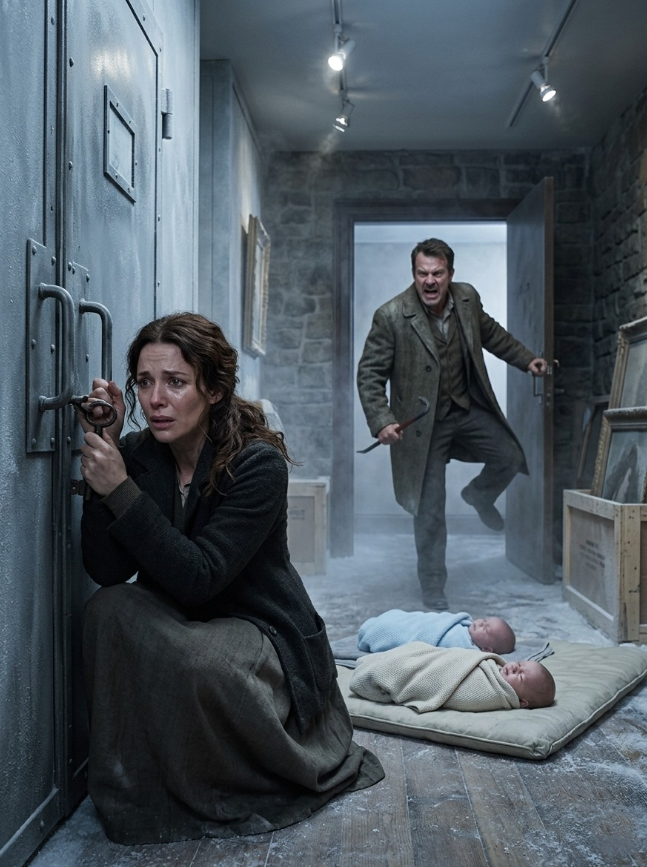
I turned around slowly, my breath already pluming into a thick white cloud in front of my face. High on the sterile, metallic wall, a digital display glowed with a harsh, unforgiving red light that read negative fifty degrees Fahrenheit.
I stood frozen in place, my hands resting instinctively on the massive swell of my belly. I was thirty two weeks pregnant with twins. I was wearing nothing but a thin maternity dress and a light, cream colored cardigan. The cold did not simply surround me; it attacked me. It sliced through the flimsy fabric, biting into my skin, sinking its teeth directly into my bones.
“Quentin?” I called out, my voice sounding thin and small in the cavernous space of the storage facility. I pressed both of my bare hands against the frosted steel of the door. “Quentin, this is not funny at all. Open the door right now.”
A burst of static crackled from the small, grated intercom mounted near the frame. Then, my husband’s voice filtered through the speaker. It was not panicked. It was not frantic. It was perfectly, terrifyingly calm. It sounded almost bored.
“I am sorry, Isabella. I really am,” he said.
My stomach dropped into a dark abyss as I pressed my face against the freezing metal. “Let me out of here,” I whispered. “Please, Quentin. Think about the babies.”
“The life insurance policy pays triple for an accidental workplace death,” he interrupted, his tone as casual as if he were discussing the weather. “And no one knows you are here. You left your phone in the glove compartment of the car. Remember?”
I felt my knees buckle slightly as I recalled the late night call asking me to bring him a file for an emergency inventory check at Oakhaven Logistics. His suggestion that I wear something comfortable had been a trap. His casual reminder not to bring my phone into the storage bay because the extreme temperatures would kill the battery had been the final piece of the plan.
It had all been meticulously planned.
“You did this on purpose,” I said, my voice shaking so violently my teeth chattered.
Quentin sighed, and he almost sounded proud of himself. “The narrative is perfect, Isabella. You came to help me. You got disoriented. You wandered into the wrong high capacity storage unit. By morning, no one will question it.”
I pressed my hands harder over my belly as the twins kicked frantically inside me. “Quentin,” I sobbed, tears instantly freezing on my cheeks. “Please. Think about your children.”
“I am thinking about them,” he replied coldly. “Two million dollars thinks very, very well.”
The intercom clicked. Then, it went dead.
I was alone.
At first, the sheer adrenaline of panic took over. I fought the door. I threw my weight against it. I pounded my fists until my knuckles split and bled, smearing bright red arcs across the frosted steel. I kicked it with my bare feet until my toes went numb.
Nothing moved. It was a vault built to keep the world out, and now, it was my tomb.
I forced myself to stop, gasping for air that felt like swallowing shattered glass. Think, Isabella. Think. The industrial freezer was about twelve feet square. Towering metal shelves lined the walls, stacked high with sealed boxes. There were no blankets. No tools. No way out.
Suddenly, the lights flickered and went dark.
I screamed as the darkness threatened to swallow me whole. The lights were motion activated, so if I stopped moving, if I surrendered to the exhaustion, absolute darkness would win.
So, I began to pace. I walked in small, stiff circles. I swung my arms and stomped my feet, trying desperately to keep my blood circulating.
Another violent kick from inside my belly stopped me in my tracks.
“Mama is here,” I whispered, wrapping my arms tightly around myself. “Mama is fighting for you.”
But as I took another step, a wave of agony ripped through my lower abdomen. It was sharp. It was sudden. It was entirely wrong.
I bent forward, gripping my knees as I gasped into the freezing air. “No, please, not now,” I pleaded.
I was only thirty two weeks along. But my body was in a state of absolute crisis. The extreme cold and blinding terror had overridden my biology, pushing my body into premature labor to save itself.
A warm rush of fluid spilled down my legs, splashing onto the metal grating of the freezer floor. Before my eyes, the fluid began to crystallize, freezing solid into the steel almost instantly.
I was about to give birth alone in a freezer cold enough to kill a grown man.
But as the next contraction ripped through me, a terrifying, mechanical grinding sound echoed from the ventilation shafts above, and the fans kicked into overdrive. A fresh blast of arctic air plummeted from the ceiling, plunging the temperature even lower.
I waved my arms frantically in the dark, screaming until the motion sensors caught my movement and the harsh fluorescent lights flickered back to life.
There was no help coming. There was only steel, ice, blinding pain, and two babies who were coming into this frozen hell whether I was ready for them or not.
I peeled off my light cardigan, my fingers clumsy and unresponsive, and wrapped it securely around the bottom of my belly, tying the sleeves in a tight knot.
“Stay warm,” I whispered to my unborn children, my lips blue and cracking. “Let Mama do the work.”
I dragged a heavy cardboard box off the bottom shelf, using it to brace my back as I sank to the freezing floor. I squatted in the middle of the room, surrounded by frost, and prepared to do the impossible.
The first baby came after what felt like an eternity of torture. The pain was a blinding fire that contrasted brutally with the freezing air. I narrowed my entire universe down to a single point of focus: survival.
Push. Breathe. Hold on.
I screamed, the sound echoing endlessly off the metal walls, until finally, a tiny, fragile girl slid into my shaking, frostbitten hands.
She was blue. She was utterly silent.
“No, no, no,” I sobbed, pulling her instantly to my bare chest, rubbing her fragile back with my numb fingers. “Breathe, baby. Please breathe. Do not let him win.”
For one agonizing second that stretched into a lifetime, nothing happened. Then, her tiny chest hitched, and she let out a weak, thin cry that cut through the hum of the freezer.
I sobbed with profound relief. “Good girl,” I wept. I desperately tried to tuck her under my dress, pressing her directly against my skin.
But there was absolutely no time to rest. Another massive contraction tore through me. The second twin was coming.
Still clutching my newborn daughter to my chest with one hand, I braced my legs against the icy floor and pushed with every ounce of strength I had left.
Minutes later, a boy was born into the cold. He, too, was a terrifying shade of blue. He, too, was entirely silent.
And again, I wept, begging him back to life, rubbing his small limbs, blowing my warm breath over his tiny face. “Please, baby boy. Breathe for Mama.”
At last, he gasped, a sputtering intake of freezing air, and then he cried. Both of my babies were alive. It was impossible. They were tiny, premature, and freezing, but they were alive.
I had no scissors to cut the cords. I had no blankets. I could only bundle them both against my bare skin, wrapping the thin cardigan tightly around us all, and pray that my own fading body heat would be enough.
I checked the digital face of my watch through a thick haze of blurry vision. It was seven fifteen in the morning. I had been trapped inside for ten hours. Ten hours in a sub zero death box.
But I could feel myself fading now. The violent shivering had finally stopped. I knew enough about hypothermia to know that was significantly worse than the shaking. It meant my body had given up.
I looked down at my babies. “I am sorry,” I whispered, my voice barely a rustle of air. “Mama tried so hard.”
My eyes drifted closed. The darkness felt warm, inviting, and peaceful. But then, the heavy, metallic clack of the deadbolt echoed through the room.
The door was opening. I forced my heavy eyelids open, staring at the sliver of light expanding into the room. A tall, broad silhouette stood in the doorway. Quentin had come back to check his work.
I pulled my babies tighter to my chest, baring my teeth in the dark. “Do not touch them,” I rasped.
The figure stepped into the light, dropping to his knees. The man looking down at me was not my husband. It was a stranger with terrified eyes.
“I have got you,” the stranger said, stripping off his thick wool suit jacket and wrapping it around me and my children.
Before I could ask his name, the darkness finally pulled me under.
I woke up in the Intensive Care Unit forty eight hours later. Pain was no longer an abstract concept; it was my only reality. My fingers were heavily bandaged in thick white gauze. My left foot felt like it was encased in concrete. My throat burned.
A doctor with kind eyes sat beside my bed. “I am Dr. Penelope Miller,” she said gently. “You are safe, Isabella. You are at Riverview Hospital.”
I tried to sit up, panic surging. “My babies?”
Dr. Miller placed a warm hand on my shoulder. “They are in the NICU. Critical condition, but stable. Your daughter is three pounds, two ounces. Your son is two pounds, fourteen ounces. They are fighters.”
Hot tears slipped from my eyes. “Quentin? My husband…”
The doctor’s face hardened. “He has been arrested. Attempted murder, three counts.”
I closed my eyes. I had survived. My babies had survived.
A soft knock at the door pulled me from my thoughts. The man from the freezer stepped inside. He looked exhausted.
“My name is Tobias Vane,” he said quietly, pulling up a chair.
I recognized the name. Tobias Vane was a tech CEO whose company occupied the building three doors down from Oakhaven Logistics.
He explained how he had been working late. He saw my car in the parking lot at midnight. When he left at dawn, the car was still there. Seeing the maternity items, his instincts flared. He demanded building security check the keycard logs. When they saw Quentin had accessed Freezer Bay C and never logged out, Tobias forced them to open the door.
“I just opened the door, Isabella,” Tobias said softly. “You are the one who kept them alive.”
“But why did you push the guards?” I asked.
Tobias’s jaw tightened. “Seven years ago, Quentin and I were partners. He stole my entire proprietary platform. He forged my signature, bankrupted me, nearly destroyed my future, and walked away clean. I spent seven years rebuilding. When I saw his name on those logs, I knew someone was in trouble.”
He looked at me with a fierce intensity. “I could not stop him seven years ago. But I promise you, with my resources, I will help you bury him now.”
Before I could process his offer, a sharp looking woman in a trench coat walked in.
“Mrs. Bennett? I am Detective Sarah Jenkins,” she said, her face grim. “We have a problem.”
My heart rate monitor spiked. “What is it?”
“Quentin’s defense attorney just went before a judge,” she sighed. “Quentin posted the two million dollar bail. He is out. And his lawyer just filed an emergency petition to take custody of the twins, claiming you suffered a severe psychotic break and locked yourself in the freezer.”
A cold dread coiled in my gut. He was not just trying to escape prison; he was coming for my children.
Within forty eight hours, the story became a national media circus. The public was horrified: a pregnant wife locked in an industrial freezer, a miraculous billionaire rescue.
But Quentin immediately began to twist the narrative. He hired the most ruthless PR firm in the city. He appeared on morning talk shows looking devastated, crying real, calculated tears. His lawyers issued statements calling the event a tragic misunderstanding born of pregnancy induced psychosis.
His mother went on television and called me deeply unstable, claiming I had wandered into the freezer in a delusional state.
I knew this pattern intimately. The gaslighting. The smearing. The complete rewriting of reality. It was how Quentin had controlled me for years.
But this time, I was not fighting alone.
My best friend, Hannah, moved into a rented safehouse with me. Detective Jenkins worked relentlessly. And Tobias Vane quietly funded the best legal team money could buy.
Sitting in the safehouse living room, Tobias laid out a thick stack of folders.
“We found it,” Tobias said, his eyes dark with triumph. “His financial records reveal four hundred thousand dollars in hidden gambling debts. He recently expanded your life insurance policy to a massive two million dollar payout for accidental death on company premises.”
Detective Jenkins added to the pile. “We recovered his deleted search history. He researched freezer death timelines and the failure rates of carbon monoxide detectors. Killing you was cheaper than divorcing you.”
I looked at Tobias and Hannah. “I want to change the babies’ names. Now. I will not have them carry the name of the man who tried to murder them.”
A judge approved the petition. My children became Emma and Noah Weston, taking my maiden name.
The criminal trial began three months later. The courtroom was a suffocating sea of reporters.
I took the stand on the third day. I sat in the witness box, looking directly at Quentin. He looked confident, expecting me to break down in hysterics and prove his mother right.
I did not.
I described the trap. The cold click of the deadbolt. The chilling conversation over the intercom. The excruciating pain of premature labor.
I never raised my voice. I never broke a single tear. When his defense attorney cross examined me, trying to paint me as a hysterical woman, I met his condescension with absolute, terrifying calm.
The prosecution rested. The defense began their case, parading character witnesses.
Then, they called their star witness, Miranda Hayes, Quentin’s former fiancée from a decade ago. She was brought in to testify to his impeccable character and gentle soul.
Miranda took the stand, looking pale and fragile. As the defense attorney began his questioning, I watched Tobias lean forward.
If Miranda convinced the jury Quentin was a saint, reasonable doubt would set in. He would walk free.
The defense attorney smiled warmly at her. “Ms. Hayes, in the four years you dated Mr. Bennett, did he ever once show a propensity for violence?”
Miranda opened her mouth to speak, but her eyes suddenly darted to me. She saw the missing toes on my foot. She saw the scars on my hands.
And suddenly, the star witness began to hyperventilate on the stand.
The courtroom fell into a dead, electric silence as Miranda gripped the edges of the witness stand, her knuckles turning stark white.
“Ms. Hayes?” the defense attorney prompted, his confident smile faltering.
Miranda kept her eyes locked on Quentin. The meticulously rehearsed script seemed to dissolve on her tongue.
“He…” Miranda started, her voice a trembling whisper. Tears spilled over her lashes. “He told me she was crazy. He told me it was just an accident.”
Quentin’s smug facade cracked. He shot a lethal, warning glare at the witness stand. The defense attorney stepped forward. “Your Honor, my witness is distressed.”
“Let her speak!” the prosecutor objected sharply.
The judge banged his gavel. “Ms. Hayes, did Mr. Bennett ever show a propensity for violence?”
Miranda broke. A ragged sob tore from her throat. “Yes! Yes, he did!” she cried out, pointing a trembling finger directly at Quentin. “He paid me fifty thousand dollars to come here today and lie! He is a monster!”
The gallery erupted into chaos. Quentin half stood from his chair, his face a mask of pure fury before his lawyers yanked him down.
“Order!” the judge roared. “Explain your statement immediately.”
Miranda wiped her face. “Seven years ago,” she said, her voice echoing in the breathless quiet. “I tried to leave him. I packed my bags. He lured me down to the basement of his family’s estate. He locked the heavy oak door from the outside.”
She looked directly at me. I saw the horrifying recognition of a survivor in her eyes.
“He left me in pitch darkness for three days,” Miranda wept. “No food. No water. He stood on the other side of the door and told me if I ever tried to leave again, I would never see the sun. When he finally let me out, I was so broken I stayed for two more years. He does not make mistakes. He builds traps!”
The courtroom exploded again. The star witness they had bought to destroy me had just handed the prosecution the ultimate weapon: a documented pattern of psychological torture.
The defense’s case shattered like glass.
Two days later, the jury was sent to deliberate. I sat in the sterile hallway, holding Hannah’s hand. Tobias stood near the window, a quiet mountain of support.
Six agonizing hours passed. Finally, the bailiff opened the heavy doors. “The jury has reached a verdict.”
My heart hammered against my ribs. The jury foreperson handed a folded slip of paper to the judge.
“Will the defendant please rise,” the judge commanded.
“On the first count of attempted murder in the first degree, regarding the victim Isabella Bennett,” the foreperson read. “We find the defendant… Guilty.”
I let out a breath I had been holding for months.
“On the second count… regarding the infant Emma Weston… Guilty.”
Hannah began to cry openly.
“On the third count… regarding the infant Noah Weston… Guilty.”
Three guilty verdicts. Three life sentences without the possibility of parole.
As the bailiffs slapped cold steel handcuffs onto Quentin’s wrists, he twisted his head, looking back at me. There was no remorse. Only the cold stare of a predator caught in his own trap. I stared right back until the heavy wooden doors closed behind him.
I had won.
But as I walked out of the courthouse, Tobias’s phone buzzed. He looked at the screen, and his jaw locked.
“Isabella,” Tobias said softly. “Quentin’s mother just filed a civil suit against you for grandparent visitation rights. And she is demanding full custody.”
The custody battle with Quentin’s wealthy, vindictive mother was a brutal epilogue, but it was a war she was destined to lose. Armed with the convictions and Tobias’s relentless legal team, the family court judge dismissed her petition with extreme prejudice within a month.
Finally, the legal battles were truly over. But the physical and emotional recovery had only just begun.
The toll of the freezer was permanent. I had lost three toes on my left foot to severe frostbite. I had lingering nerve damage in my hands that made them ache fiercely whenever the weather turned cold. I spent months in intensive physical therapy.
Emma and Noah spent eight terrifying weeks in the NICU before coming home.
Through all of it, Tobias Vane was simply there. He helped quietly. He never forced closeness or demanded my time. He paid the exorbitant legal fees. He arrived with hot dinners. He brought groceries. He brought infinite patience.
One quiet evening, six months after the trial, I sat on the balcony with him.
“I do not know how to trust a man anymore, Tobias,” I confessed. “I look at people and I just look for the trap.”
Tobias nodded slowly. “Then do not trust me yet, Isabella,” he said steadily. “Just let me stand beside you while you figure it out. I am not going anywhere.”
That was the true beginning of us. It was not a cinematic rescue. It was just presence. Then, slowly, it became more. A shared dinner. A walk through the park. A hand held without pressure. A kiss, given only when I was entirely ready. Tobias never asked me to heal faster than my scars allowed. And precisely because he did not demand it, I began to.
A year later, when Emma and Noah were thriving and I no longer felt the compulsion to check the deadbolts ten times a night, Tobias proposed.
He did not do it because he wanted to be my savior. He did it because he loved the woman I had become.
“I do not need you to be unbroken, Isabella,” he said. “I just want to build something real with you.”
I said yes.
A few months later, Tobias legally adopted Emma and Noah. The children called him Dad. And he earned that title in all the invisible ways that mattered.
Life settled into a beautiful rhythm. But the past has a funny way of demanding attention. Three years after the trial, I walked down the driveway to check the mail. Mixed in with the bills was a plain white envelope. The return address was stamped in black ink: State Penitentiary, Inmate number 84729, Quentin Bennett.
I froze. For a second, the ghost of the freezer rushed back. I could smell the metallic tang of the frozen air. Quentin was reaching out from his concrete cage.
Slowly, deliberately, I turned around and walked back to the backyard where Tobias had built a stone fire pit. Small embers were still glowing.
I did not open the letter. I dropped the envelope directly onto the hot coals. I watched it burn until it was nothing but gray, fragile ash. Then, I crushed the ashes with the heel of my boot.
Years passed. I channeled the darkest night of my life into a beacon for others, becoming a national voice in domestic violence advocacy. I told women the exact truth no one had told me: You are not weak because you stayed. The cage was built around you one invisible bar at a time. But your story does not end with your abuser.
One warm summer evening, I stood on the back porch. Inside, Emma and Noah were asleep on the rug. Tobias stepped out, wrapping a warm arm around my waist.
“Quentin thought that freezer would erase me,” I said quietly.
Tobias took my scarred hand, kissing my knuckles. “Instead,” he murmured, “it revealed you.”
I smiled into the darkness. He was absolutely right. Quentin had tried to turn me into a tragic victim. Instead, the extreme pressure of that sub zero vault had forged a survivor. A mother. A fighter.
Isabella Bennett entered that freezing vault as a terrified wife trapped in a lie. She walked out as Isabella Vane, living proof that even the absolute coldest night cannot kill a woman who refuses to stop fighting.