“If you want to leave this house, Dad, you’ll do exactly what I tell you.”
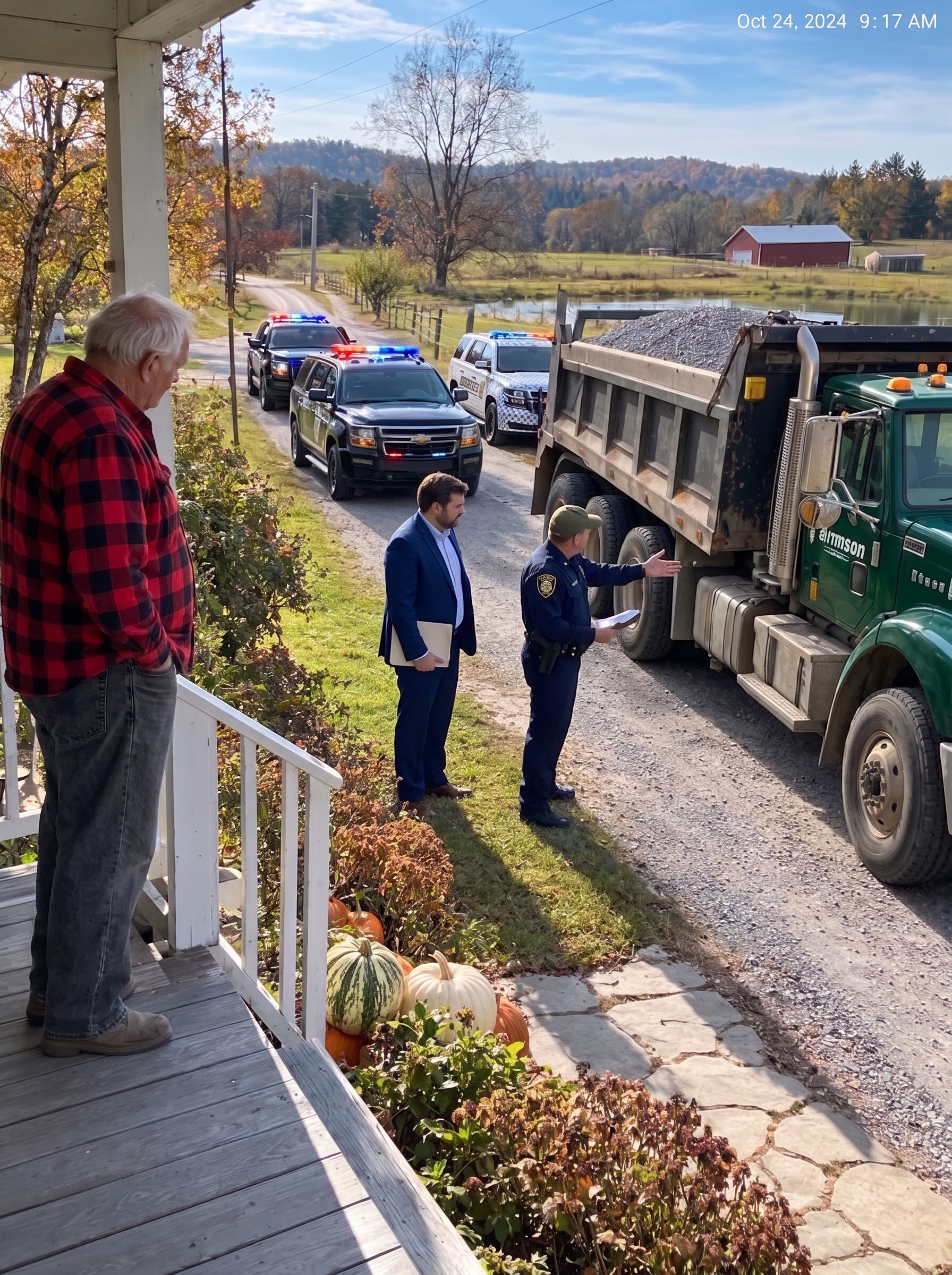
My son stood at the end of my gravel driveway in a navy business suit, one hand resting on the side of a concrete mixer truck. He had parked it sideways across the only road off my property. The front bumper nearly touched the embankment. The back wheels sat inches from the tree line. There was no room for my pickup to get around it, and there was no second way out. There never had been. Margaret used to joke that our driveway was the only road in Tennessee that went nowhere except home.
I was still holding my first cup of coffee. It was a little after seven on a Tuesday morning in late October, and the fog hadn’t lifted off the hills yet.
“What are you doing, Michael?”
“I’m giving you one last chance to be reasonable.”
He reached into his jacket and pulled out a folded stack of papers. He held them up the way a lawyer holds up evidence on television.
“Sign the land over to me, and I’ll move the truck.”
I didn’t say anything. I just looked at him. At the suit. At the shoes that had never been meant for gravel. At the truck with the name of a concrete company painted on the drum, slowly turning, even though there was nothing to pour.
For more than forty years, that property outside Knoxville had been my home. Thirty-eight acres. A creek on the east side, woods on the north, and a white farmhouse that Margaret and I bought in the spring of 1983 for $64,000 we didn’t really have. I still remember the closing. Margaret signed the deed with her fountain pen and got ink on the side of her hand, and the man from the title company laughed and handed her a tissue.
We repaired that roof twice. We planted a garden behind the kitchen. We hung a rope swing from the old oak tree. We raised Michael and his sister, Sarah, in those rooms.
When Margaret got sick, we still owed $31,000 on the mortgage. After she passed, her life insurance policy paid out, and I used part of it to pay the house off completely. I remember sitting at the bank on Kingston Pike while the manager stamped the release. I remember thinking she was still taking care of me, even after she was gone.
That was two years ago now. Since then, the house had become the only place where grief didn’t feel like a stranger knocking on the door. Her gardening gloves were still in the mudroom. Her recipe cards were still in the kitchen drawer, held together with a red rubber band. Some evenings I sat on the porch and watched the hills go dark and remembered how her hand used to rest on the arm of the chair beside mine.
Michael knew all of that. He knew exactly what the land meant to me. And he knew I had no intention of selling it.
It hadn’t started with a truck.
It started at Sunday dinner, about eight months after the funeral. Michael leaned back in his chair and said, almost kindly, “Dad, this is a lot of land for one man.”
“I manage.”
“You’re seventy-one. The fence on the north side is falling down. The gutters need replacing. What happens when you fall off a ladder and nobody finds you for three days?”
I told him I’d be careful. He let it go.
A month later, he brought it up again. This time he mentioned a developer. A company called Ridgeline Land Partners was buying property all over the county, he said. Big money. People were getting rich just by signing their names.
“I’m not selling to a developer,” I said.
“Nobody said you had to.”
Then, in the spring, he made his offer. He came to the house with a printed sheet and a pen already clicked open.
“Sell it to me,” he said. “That way it stays in the family. You keep living here. Nothing changes.”
“How much?”
“Two hundred and fifty thousand.”
I looked at the paper. Then I looked at my son.
The county had just reassessed the property. I had the notice in the kitchen drawer, right under Margaret’s recipe cards, because the property taxes had gone up and I’d been grumbling about it. The appraised value was $612,000.
He was offering me less than half.
“No,” I said.
He didn’t argue. He just folded the paper, put the pen back in his pocket, and left without finishing his coffee.
After that, the visits stopped. Sunday dinners disappeared. Phone calls became short text messages. Busy this week. Kids have a thing. Talk soon. I told myself he was angry and would come around. I told myself he had a job and a wife and two children and a mortgage of his own. People get busy.
Standing in front of that concrete truck, with my coffee going cold in my hand, I finally understood. The silence hadn’t been distance. It had been pressure. He had been waiting for loneliness to soften me up.
“You planned this,” I said.
“I tried talking to you.”
“You tried buying my home for almost nothing.”
“You don’t need this much land.”
“That isn’t your decision to make.”
His jaw tightened. I knew that look. He’d had it since he was six years old.
“You’re getting older, Dad. You can’t keep this place up forever. I have debts. I have kids. I have a future to think about.”
“So do I.”
“Your future is sitting alone in a house full of memories.”
He said it on purpose. I could tell. He’d been saving it. The words landed exactly where he aimed them, somewhere under my ribs, but I didn’t raise my voice.
“This is still my home.”
“Then sign it over and stay here for now. I’ll figure out the rest later.”
For now. I heard those two words very clearly.
I looked at the papers in his hand. There it was. The real reason for the truck. He wanted control, and he wanted it while I was still too shocked to protect myself.
“No,” I said.
Michael laughed. It was a short, ugly sound.
“You don’t have cell service out here. You know that. Sarah’s in Oregon. Your nearest neighbor is a mile away. And you’ve spent two years pushing every single person out of your life.”
He tapped the side of the truck.
“I took two weeks off work. I’ve got food and water in the car. Sooner or later you’re going to figure out that I can wait a lot longer than you can.”
My coffee cup shook a little against my fingers. Just a little.
He noticed. And he smiled.
That smile did something to me. I can’t explain it any better than that. It steadied me more than any kind word could have. Because in that smile I saw that he wasn’t desperate, or confused, or sorry. He was enjoying it.
I set the cup down on the porch railing.
“You’re right about one thing,” I said. “I did shut myself away after your mother died.”
“Then you understand your situation.”
“I understand that you were counting on my grief.”
His face went hard.
“Call it whatever you want. The truck moves when you sign.”
I turned around, walked back into the house, and closed the door behind me.
I’m sure Michael thought I’d gone inside to read his contract. Or to count the cans in my pantry. Or maybe to sit down at the kitchen table and cry, the way I had so many nights since the funeral.
Instead, I locked the door and went upstairs.
Margaret used to tease me about the things I kept. Old tools. Camping maps from trips we took in the eighties. A coffee can full of mismatched screws. And a satellite phone we bought years ago for hiking trips into the Great Smoky Mountains.
“What are we going to do with that?” she asked me once, holding it up like it was a brick.
“You never know when we might need it.”
She smiled at me the way she always did when she thought I was being foolish but loved me anyway. “Then keep it somewhere you’ll remember.”
It was in a cardboard box behind my winter coats, in the upstairs closet. I knelt down on the floor, pushed the coats aside, and pulled the box out. My knees complained. My heart was pounding so hard I could hear it.
The phone was on top of the maps, right where I’d left it. I pressed the power button.
Nothing.
I pressed it again and held it down. The screen stayed black. I thought about the charger and couldn’t remember where it was. I thought about Michael at the bottom of the hill, leaning on that truck, sure of himself.
Then a faint light glowed on the little screen.
I carried the phone to the bedroom window, the one that faced the open sky over the back field, and I waited for a signal.
My first thought was to call Sarah. But Sarah was more than two thousand miles away in Portland. She couldn’t do anything except worry.
I needed someone close. Someone who could see that truck with their own eyes before Michael had a chance to move it and tell a different story about what had happened that morning.
So I called Harry Collins.
Harry lived about a mile down the county road. We’d been neighbors for almost thirty years. Before he retired, he spent three decades with the Knox County Sheriff’s Office. He was the kind of man who still checked his locks twice and still noticed out-of-state license plates.
He picked up on the fourth ring.
“Harry, it’s David. I need you to listen to me carefully.”
I told him everything. The truck. The contract. Two weeks of food and water. When I finished, the line went quiet for so long I thought the call had dropped.
“Your son blocked you in?”
“Yes. He has papers. He says the road stays blocked until I sign the land over to him.”
“Stay inside,” Harry said. His voice had changed. It wasn’t the voice of the man who brought me tomatoes. It was the voice he must have used at work for thirty years. “Lock the doors. Don’t let him know you reached anybody.”
“Harry, there’s something else. The porch camera. Margaret made me put it in after that string of break-ins a few years back. It might have recorded everything he said.”
“Don’t touch the system. Don’t delete anything, don’t move anything. Leave it exactly the way it is.”
“All right.”
“I’m making some calls. Sit tight, David.”
After he hung up, I went down to my small office off the living room. The security monitor sat on the desk next to a stack of unopened mail. A little green light in the corner of the screen said the camera was still recording.
The picture was clear. It showed the driveway, the truck, and my son standing beside it with the contract in his hand. It showed the exact spot where he’d stood when he told me I would eventually run out of food.
Through the window, I could see Michael leaning against the truck. He had his phone out, scrolling, like he was waiting for a table at a restaurant. Like the whole thing had already been decided.
I sat down in my desk chair and watched the clock.
Twenty-eight minutes later, I heard engines beyond the trees.
Harry’s old blue pickup came around the bend first. Two marked county cruisers followed right behind him, lights on but no sirens.
Michael pushed himself off the truck so fast he nearly tripped. The papers in his hand shifted. He stuffed his phone in his pocket.
Harry stepped out onto the gravel. The first deputy got out of his cruiser and walked straight toward my son.
“Sir,” the deputy said. He looked from Michael to the truck to the narrow road behind it. “Is this your vehicle?”
Michael looked past him, up at the house.
“Yes,” he said. “We’re having a family discussion.”
The deputy looked at the gap between the truck’s bumper and the embankment. You couldn’t have fit a bicycle through it.
“Move it.”
“Dad called you?” Michael asked.
“Move the truck, sir.”
Michael’s face changed then. Not a lot. Just enough for me to recognize the little boy who used to dig for excuses whenever he broke something. The lamp in the living room. The window in the barn. Sarah’s bicycle.
He looked up at the porch. I was standing behind the locked glass door. He lifted both his hands, palms out, like he was inviting me to fix a simple misunderstanding.
“Dad!” he called. “Tell them I’m trying to help you!”
I unlocked the door and opened it, but I stayed on the porch.
“You told me I couldn’t leave until I signed.”
“That’s not what I meant.”
Harry walked up the path and stopped at the bottom of the porch steps. Close enough to talk quietly.
“You all right?”
I nodded. It took me a second to realize I wasn’t. My hands had started shaking again. Harry looked at them. He didn’t say a word about it.
Behind him, the deputy repeated the order. Michael climbed into the cab of the truck. The engine turned over with a grinding cough. For one awful second, nothing happened. Then the big tires rolled backward and crushed the edge of Margaret’s flower bed by the road. Bee balm, mostly. She’d planted it for the hummingbirds.
Michael straightened the truck out along the county road. And just like that, there was an empty lane of gravel between my house and the rest of the world.
I never thought a stretch of gravel could make me want to cry.
The second deputy came up to the porch. She was a woman about Sarah’s age with her dark hair pulled tight. Her name tag read Alvarez. She asked if I needed medical attention. I said no. Then she asked me to tell her about the morning from the very beginning.
So I did. I told her about the coffee and the fog and the truck. I told her what Michael said about my food running out.
Michael stood by the truck while I talked. At first he watched me. Later he just stared down at the papers in his hands.
When I got to the part about the food and water in his car, his head snapped up.
“I brought supplies because Dad’s been forgetting things,” he said loudly. “He doesn’t eat. He doesn’t open his mail. I’m worried about him.”
Deputy Alvarez turned and looked at him for a long moment.
“Did he forget how to drive?”
Michael didn’t answer.
“Did your father ask you to block the road?”
“No.”
She wrote that down in her notebook.
The first deputy walked back from the truck. He said he’d called the number on the door. The truck belonged to a concrete company on the other side of Knoxville. Michael had signed it out that morning for what he’d called an approved job site.
“Where was the job supposed to be?” Alvarez asked.
“Out past Farragut.”
That was nowhere near my house.
I looked at my son. He wouldn’t meet my eyes.
Alvarez asked about the camera. I led her inside to the office. Harry stood in the doorway with his arms folded while she pulled up the morning’s footage.
We heard my own voice first, thin and tinny through the porch microphone. Then Michael’s.
“I can wait a lot longer than you can.”
The room felt smaller after that.
Alvarez watched the rest without saying anything. Then she asked me to leave the system running and said someone would come out to make a proper copy of the recording.
She stepped outside to talk to her partner. Through the office window, I watched Michael unfold his contract. He smoothed it flat on the hood of a silver sedan parked farther down the county road.
That’s when I realized he’d brought two vehicles. A truck to keep me in. A car to take him home.
I hadn’t even noticed the car that morning.
The deputy looked over the papers. Michael talked fast, waving his hands, pointing up at the house. The deputy’s face didn’t change at all. After a few minutes, he folded the contract, slid it into a clear plastic evidence sleeve, and carried it to his cruiser.
Michael stopped talking.
When Alvarez came back inside, she asked me something I didn’t expect.
“Mr. Reed, did you ever authorize your son to sign anything on your behalf? A power of attorney? Anything like that?”
“No.”
“Did your wife leave him any ownership interest in this property? Was his name ever on the deed?”
“No. The deed is in my name. It went to me when Margaret died. It’s recorded at the courthouse.”
She glanced toward the window.
“There’s a signature page attached to that contract. We need to examine it. For now, I’d ask you not to discuss the document with him.”
I thought about Margaret’s handwriting. All those nights at the kitchen table, paying the electric bill and the phone bill and the property taxes with that fountain pen that always left ink on her hand.
“What signature?” I asked.
Alvarez hesitated.
“The one that’s supposed to be yours.”
For a moment, I couldn’t hear the voices outside. I heard the old refrigerator kick on in the kitchen. I heard Harry shift his weight on the floorboards in the doorway.
“I never signed anything,” I said.
“I understand.”
Through the window, I watched the first deputy tell Michael to turn around. He brought my son’s hands behind his back.
Michael looked toward the house one last time. He wasn’t smiling anymore.
I took a step toward the front door. Harry put out his arm, gently, without touching me.
“You don’t have to go out there, David.”
“But he’s my son.”
“I know he is.”
The deputy put Michael in the back of the cruiser and shut the door.
An hour later, the concrete company sent a manager to pick up the truck. He was a heavyset man named Gary, red-faced and out of breath, and he apologized to me twice before he even said his name. He said Michael had sworn the truck was needed for a private pour. He kept looking at the flattened flower bed like it was his fault.
“We’ll pay for the damage,” he said. “Whatever it costs.”
“The flowers can wait,” I told him.
I couldn’t think about flowers yet.
By afternoon, the truck was gone. The tire marks were still there. So was my coffee cup on the porch railing. A thin skin had formed over the cold surface. I picked it up and carried it inside.
My house looked exactly the way it had looked that morning. And it felt nothing like it.
Harry stayed until dark. We sat at the kitchen table while I called Sarah on the landline. For years the signal on that phone had been unreliable, crackling and dropping whenever it rained. But that day, the call went through on the first try.
She picked up while walking into a meeting. I could hear heels on a hard floor.
“Dad?”
“Are you somewhere you can sit down, honey?”
She stopped walking. I heard traffic behind her, a car horn, wind.
“Is it you? Are you sick? Is it your heart?”
“No. I’m safe.”
That word almost broke me. I had to stop and hold the edge of the table.
Then I told her. The truck. The contract. Michael in the back of the cruiser. She didn’t say a word until I got to the signature.
“Dad,” she said quietly. “Two months ago, Michael called me. He asked whether you’d given me power of attorney.”
The kitchen went very still.
“What did you tell him?”
“I told him it was none of his business.”
“Why didn’t you tell me he asked?”
“I tried. I called that night. You didn’t answer.”
I remembered. I’d seen her name light up on the kitchen phone. I’d let it ring. I couldn’t stand the idea of explaining why I hadn’t been eating right, or why there were three weeks of unopened mail on my desk, or why I’d started sleeping in the recliner instead of our bed. The next morning, I sent her a text. Everything’s fine.
“I should have tried again,” Sarah said.
“I should have answered.”
We stayed on the line a long time, each of us holding a different piece of the blame, neither one willing to set it down.
Harry, who had known our family since the kids were in diapers, got up from the table and pulled out a chair.
“I’ll make tea,” he said.
Sarah booked the first flight she could get, a red-eye through Denver.
That night, I checked every door twice. I knew Michael couldn’t come back. Harry had made a call and told me he wouldn’t be released before morning. But I still stood at the window and watched every set of headlights that passed on the county road.
Just after midnight, I went upstairs to get a clean blanket. The cardboard box was still on the closet floor. The satellite phone sat on top of the old maps, its battery almost dead.
Margaret had insisted we practice using it before our first big mountain trip. I complained the whole time. We were hiking marked trails, I said. We weren’t climbing Everest.
“A marked trail,” she told me, “can still take you somewhere you didn’t expect to go.”
I sat down on the edge of the bed with the phone in my hands.
For two years, I’d wanted her back for the smallest reasons. To tell her the tomatoes had split after the rain. To ask where she kept the spare button jar. To hear her laugh when I burned the toast, which was every single morning.
That night, I wanted her back so I could tell her what our son had become. And so she could tell me whether he’d always been heading there, and I’d just never seen it.
I slept in the chair by the bedroom window. Or I tried to.
Sarah got there late the next morning. I heard her rental car on the gravel before I saw it. She came through the front door with one suitcase and a paper bag full of airport sandwiches. She dropped both on the floor and held me so tight that my back started to ache.
Neither of us let go for a long time.
When she finally stepped back, she looked older than she did on our video calls. Or maybe I did. It was hard to tell anymore.
She walked through the house slowly, touching things. In the mudroom, she stopped and picked up Margaret’s gloves.
“You kept these.”
“I never found a reason to move them.”
She opened her mouth to say something, then closed it. She put the gloves back exactly where they’d been.
We ate the sandwiches at the kitchen table. They tasted like cardboard and I ate two anyway, because I realized I hadn’t eaten since the morning before.
Afterward, I took her outside to see the tire tracks. The truck had pressed one of Margaret’s little metal garden markers deep into the mud. Sarah knelt down, pulled it free, and wiped it on her jeans. It said bee balm in Margaret’s neat handwriting.
“She would have given him a piece of her mind for driving over this,” Sarah said.
I smiled for the first time since the truck showed up.
Then Sarah’s face turned serious.
“Jenna called me while I was at the airport.”
Jenna was Michael’s wife. They’d been married fourteen years. Their children, Noah and Lucy, used to run through this house looking for their grandmother’s hidden jars of candy. After Margaret died, their visits got fewer and further between. I’d blamed school and sports and the busy shape of family life.
“What did she say?”
“Michael told her you’d agreed to sell.”
My hand tightened around my glass.
“He told her the money would clear their debts. He told her the papers were almost done.”
I looked out the window at the strip of torn-up dirt where the flowers used to be.
“How much do they owe?”
“She doesn’t know the full amount.”
“How can she not know?”
“That’s what she’s trying to find out.” Sarah reached across the table and took my hand. “She sounded scared, Dad. And angry. But she believed you. The minute I told her what happened, she believed you.”
I thought of Jenna helping Margaret carry dishes to the sink at Thanksgiving. I thought of Noah falling asleep against my shoulder after a long Christmas dinner, his mouth sticky with pie. Whatever Michael had done, they were going to wake up inside it too.
“Are the kids all right?”
“They’re at Jenna’s sister’s in Maryville.” Sarah hesitated. “Jenna asked if she could call you.”
“Yes. Of course.”
The call came that evening, just after dark. Jenna didn’t start with an apology. She started with the truth.
“I didn’t know he was taking the truck, David.”
“I believe you.”
“He said you’d signed a preliminary agreement. He showed me a page. It had your name on it.”
“I never signed it.”
“I know that now.”
I heard a child’s voice in the background, then a door closing. When she spoke again, her voice was lower.
“I found papers today. In his desk. He took out a home equity loan against our house last year. Ninety-two thousand dollars. With First Horizon.”
I closed my eyes.
“Did you sign it?”
“No.” Her breath shook. “But my name is on it, David. My signature. On every page.”
The silence that followed had a different weight to it. She had her own signature to answer for now. Her own house to protect. Her own children asleep in someone else’s guest room.
“Get somebody to look at those papers,” I said. “A lawyer. Tomorrow, if you can.”
“I’m going to.” She was quiet for a moment. “David, I don’t know what to tell the kids.”
“Tell them I’m safe.”
“They think you stopped wanting to see them.”
I gripped the edge of the counter so hard my knuckles turned white.
“Who told them that?”
“Michael did. He said you needed space. After Margaret. He said Grandpa didn’t want noise in the house anymore.”
I saw Noah at eight years old, running across the yard toward the rope swing with his shoelaces untied. I saw Lucy in her purple rain boots, holding out a fistful of worms for the chickens we didn’t keep anymore. I had let the quiet in my house get so deep that I never noticed what it was swallowing.
“I did need some space,” I said. “But I never stopped wanting them. Not for one day.”
Jenna didn’t say anything for a long moment.
“I’ll tell them,” she said.
Over the next week, the shape of Michael’s plan came slowly into view, like a photograph developing in a tray.
Harry recommended a lawyer, a woman he’d known from his years at the sheriff’s office. Her name was Denise Whitaker, and she had a small practice on Gay Street in downtown Knoxville. She drove all the way out to my house because I told her I didn’t feel like going anywhere yet. She sat at my kitchen table with Sarah and me, spread out her yellow legal pads, and spoke plainly. She never rushed me when I needed to stop.
The deputies had made her a copy of Michael’s contract. It was eleven pages long. The title on the first page said Family Transfer and Occupancy Agreement.
“The first part sounds generous,” Denise said, running her finger down the page. “It says you would keep the right to live in the house. That’s the phrase your son kept repeating. Stay here for now.”
“I remember.”
“But look here.” She turned to page six. “That right depends on you meeting upkeep requirements. Requirements set by the new owner. He could decide the gutters weren’t cleaned to his standard, or the fence wasn’t fixed, and you’d be in violation.”
“And then?”
“And then he could ask you to leave. Legally, it would be his house.”
Sarah swore under her breath.
“There’s more,” Denise said. She turned to page nine. “This clause allows the new owner to immediately assign the property to another buyer. Immediately. No waiting period. No notice to you.”
“So he could sell it the same day I signed.”
“He could sell it before the ink dried.”
Then she turned to the last page. The signature page. She slid it across the table toward me.
My name was there. David R. Reed. Dated September 14th.
I stared at it until the ink seemed to float up off the paper.
The signature leaned right. Mine leans left. Always has. But the first letter, the capital D, curled at the top the same way Margaret used to make it when she signed our Christmas cards. Love, David and Margaret. Every year for forty-one years.
He had copied my name from his mother’s handwriting.
It was close enough to hurt.
“Investigators will compare it to your real signature,” Denise said gently. “Document examiners. That’s their job. You don’t have to solve this from your kitchen chair, David.”
“There’s a notary stamp,” Sarah said, pointing.
Denise nodded. “That’s being looked at too.”
Before she left, Denise asked me to do a few things. She asked me to call the three credit bureaus and put a fraud alert on my name, just as a precaution. She asked me to pull my credit report and my bank statements going back a year. She asked me to call the Knox County Register of Deeds and ask whether anything had been filed against my property recently.
“I’m not saying you’ll find something,” she said. “I’m saying you’ll sleep better once you know you won’t.”
Sarah made the calls the next morning while I sat beside her. The deed was clean. Recorded in my name, nothing new filed. My credit report showed no new accounts. My checking account at Home Federal showed my Social Security deposit on the third of every month and my TVA pension on the first, same as always. My savings account still had $47,300 in it.
I let out a breath I didn’t know I’d been holding.
Still, that night, I couldn’t sleep. I went upstairs and started bringing down boxes from the closet. Tax returns. Old survey maps. A folder of receipts Margaret had kept for every repair we ever made to the house. Sarah heard me on the stairs and came down in her pajamas to help.
We spread everything across the dining room table.
We found nothing about Michael.
We found ourselves instead.
A receipt from 1991 for the lumber we used to build the platform for the rope swing. $112.40 from a hardware store that closed years ago. A sketch Margaret drew of the garden beds, with little arrows pointing to where the tomatoes would go. A photograph of Sarah and Michael standing in a half-built treehouse, both wearing crooked paper crowns from somebody’s birthday party.
Sarah picked up the photograph and looked at it for a long time.
“He wasn’t always like this.”
“No.”
“I keep thinking about him at Mom’s funeral. Remember? He carried all those folding chairs back inside after everybody left. By himself. He wouldn’t let anyone help.”
I remembered. Michael stayed at the church hall until it was completely empty. Then he asked me whether I wanted company that night.
I told him I was tired.
The next week, he asked again. I told him I was managing.
Somewhere between those nights and that truck, he’d made choices I couldn’t explain away. My distance was real. So was his.
“Whatever I did wrong after your mother died,” I said slowly, “I didn’t make him forge my name.”
Sarah set the photograph down.
“I know, Dad.”
I said it again, quieter, because I needed to hear myself say it out loud.
“I didn’t make him do that.”
A few days later, Denise called with news about the developer.
“Ridgeline Land Partners has been buying parcels behind your property,” she said. “Four of them so far. About two hundred acres total. They want to build a subdivision. Maybe three hundred homes.”
“What does that have to do with me?”
“Their access road. The cheapest way in is through a strip of your land. About two acres, running along the creek and up past your oak tree. Without it, they’d have to build a much longer road from the other side. That would cost them close to two million dollars more.”
I sat down hard in the kitchen chair.
“Michael offered to get them that strip,” Denise went on. “He set up a company. Reed Property Solutions, LLC. Registered with the state in June. Ridgeline paid that company an advance of eighty-five thousand dollars by wire transfer in August.”
“For land he didn’t own.”
“For land he promised he’d deliver. The company had a deadline. They wanted proof by the end of October that he could close.”
The end of October. The truck had come on October 21st.
That’s why it had been now. That’s why it had been so sudden.
I went out to the porch after I hung up. Beyond the driveway, the hills rolled away under a pale sky. I’d always thought Michael wanted the whole place because of what it was worth. But the house, the garden, the oak tree, all of it had just been sitting in the way of a road on somebody’s map.
A week later, a man from Ridgeline called Denise. He was polite. He said the company had suspended all dealings with my son and would cooperate fully with investigators. He said the company was embarrassed. Then, very carefully, he asked whether I might consider selling the access strip directly to them.
They offered $340,000 for the two acres.
“The decision is yours alone,” Denise told me. “You don’t owe anybody an answer this week. Or this year.”
I asked for time.
I knew what Margaret would say about making a big decision while I was angry. She’d take me outside first. She’d point at something living, a bird or a bloom or a fat tomato, and she’d wait until my breathing slowed down.
So I walked the property with Sarah.
We followed the creek out past the far fence. Winter had stripped the banks nearly bare, and the water ran clear and cold over the stones. The strip on the developer’s map cut right across it, then climbed the hill toward the oak tree.
Sarah stopped walking.
“That’s where Mom taught me to ride my bike.”
“You went straight into the ditch.”
“Michael tried to catch me.”
“He went in right after you.”
We stood there remembering the two of them climbing out, covered head to toe in red Tennessee mud, Margaret laughing so hard she had to sit down in the grass.
“I don’t want the road,” I said.
Sarah nodded. “Then there won’t be one.”
“Are you sure? That’s a lot of money. Someday this place will be partly yours.”
“I’m sure you should decide what happens to it while you’re here to decide.”
I looked at her. “When did you get so sensible?”
“Somebody in this family had to.”
She smiled. Then her eyes filled up.
“I hate what he’s done to every single memory, Dad.”
“He doesn’t get to have every memory.”
She wiped her face on her sleeve, and we walked home slowly.
I called Denise that evening and told her I wouldn’t sell. She passed it on.
For the first time since the concrete truck appeared, I felt like I’d made a choice about my own land for its own sake. Not to punish Michael. Not to prove anything to anybody. Just because I wanted to keep walking beside that creek for as long as my knees would let me.
Sarah had to fly home after two weeks. Her company had been patient, but she had a project due. She made me promise to answer the phone every time it rang. I promised. I kept it.
Jenna brought the children on a Saturday afternoon in November. She called from the road first, to make sure I was ready.
I was standing in the kitchen with a plate of store-bought cookies. Margaret would have baked them from scratch. I almost put them back in the cabinet out of embarrassment.
Then a car door slammed, and Lucy’s voice carried up the driveway.
“Grandpa?”
I opened the front door.
She stopped at the bottom of the porch steps like she wasn’t sure she was allowed to come up. Noah stood behind her. He was taller than I expected. Much taller. Jenna kept one hand on each child’s shoulder.
“Hello,” I said.
Lucy looked past me, into the house.
“Mom said you wanted to see us.”
“Very much.”
“You didn’t call.”
“No,” I said. “I didn’t.”
I went down one step so we were closer to the same height.
“I should have called. I’m sorry, Lucy.”
Her bottom lip trembled.
“Dad said you were sad and didn’t want any noise.”
“I was sad. Your grandmother died, and I didn’t know how to be around people anymore. But I always wanted you. Always.”
Lucy thought about that for a long moment, the way she thinks about everything. Then she climbed the steps and wrapped her arms around my waist.
Noah waited until she let go. Then he held out his hand. I shook it. His grip had changed. The softness of a little boy was giving way to the shape of the man he’d become.
“Hi, Grandpa.”
“Hi, Noah.”
He looked down at our hands and didn’t let go right away.
Inside, the kids ate the cookies anyway. Lucy went straight to the pantry and found Margaret’s candy jar hidden behind the flour tin. It was empty.
“Grandma always kept peppermints in here.”
“I remember.”
I got my car keys off the hook.
Jenna laughed softly. “David, you don’t have to go anywhere.”
“I’ve got an errand worth making.”
I drove into town with Noah in the passenger seat. The county road was wide open. That should have felt ordinary. Instead, I watched every curve of it like I was learning it for the first time.
Noah waited until we passed Harry’s place.
“Did Dad really block you in?”
“Yes.”
“Was he going to hurt you?”
I kept both hands on the wheel.
“I don’t know what he thought was going to happen.”
Noah stared out the windshield.
“Mom says he’s responsible for what he did.”
“She’s right.”
“He’s still my dad, though.”
“Yes, he is. You can love him and be angry with him at the same time.”
He turned and looked at me.
“Can you?”
The tires hummed on the road.
“I’m trying to learn how,” I said.
At the grocery store, we bought peppermints, a bag of flour, and a bag of oranges that Lucy had asked for over the phone. When we got home, Noah filled the candy jar to the top. Lucy made us both promise to leave some for her next visit.
Jenna watched from the kitchen doorway. Later, while the kids were upstairs digging through the closet for their old board games, she sat down across from me at the table.
“I hired a lawyer,” she said. “A woman Denise recommended. I gave her the loan papers. All of them.”
“Good.”
“The bank is investigating. They’re saying it could take months.” She turned her coffee cup in a slow circle. “I’m separating our finances. I opened my own checking account on Monday. First one in my own name since I was twenty-four.”
“What about the house?”
“We’re working on it. There’s ninety-two thousand dollars against it that I never agreed to. If the bank decides I’m responsible, I don’t know what happens. My sister has room for us if we need it.”
I wanted to offer money. I wanted to write her a check right there at the table. But I also knew how easily help could turn into one more thing someone used to make decisions for her. I’d just learned that lesson the hard way.
“If the kids need anything, you ask me,” I said. “And if you need anything for yourself, you ask me too.”
Her eyes shone.
“Thank you, David.”
She didn’t ask that day. But a month later, she called and asked whether I could pick Lucy up from school while she took Noah to a doctor’s appointment.
I was sitting in the pickup line twenty minutes early.
Lucy climbed into the truck and showed me a drawing she’d made of a fox. It had orange legs and a very long tail. When we got home, I pinned it to the refrigerator with one of Margaret’s old magnets.
It stayed there through everything that followed.
The case moved slowly. Slower than I thought anything could move. The truck had been witnessed by two deputies and a retired sheriff’s investigator. The camera had recorded Michael’s demand, word for word. The bank records traced the $85,000 wire from Ridgeline straight into his company’s account, and from there into his personal checking, and from there to a stack of overdue debts. Credit cards. A personal loan. Back payments on a failed investment in a storage-unit development in Sevier County that had gone bankrupt the year before.
The document examiners compared the signature on the contract to my real one, the one on my driver’s license and my bank signature card and forty years of tax returns.
It didn’t match.
The notary whose stamp appeared on the page told investigators she had never met me. Her stamp had gone missing from her office months earlier. Michael had been a client.
None of that made it easier to sit through the hearings.
The first time I saw Michael in court, he was wearing a different suit. Gray this time. His hair was shorter. He looked at me once from across the room. Then he looked away and didn’t look back.
Afterward, in the hallway, he walked toward me with his attorney beside him. Denise stepped up next to me.
Michael stopped a few feet away.
“I never meant for it to go this far, Dad.”
I heard the gravel crunching under the concrete truck’s tires.
“You drove it there,” I said.
He swallowed hard.
“I thought if we could just talk, without Sarah interfering—”
“Sarah wasn’t there.”
“I know. That’s what I mean.”
His attorney put a hand near his elbow. Michael kept going anyway.
“I was desperate. You don’t understand how bad it was.”
“You told me you could wait until I ran out of food.”
His face turned red.
“I said something stupid.”
“You took two weeks off work. You packed a car. You signed out a truck. That’s not saying something stupid, Michael. That’s a plan.”
People moved around us in the courthouse hallway. A door opened somewhere. A clerk called out a name. For a moment, Michael seemed to shrink inside his gray suit.
“I didn’t want to lose everything,” he said.
I looked at him.
“Neither did I.”
Denise touched my arm and suggested we leave. I turned to go.
“Dad,” Michael said. “Did you tell Noah I was going to hurt you?”
I stopped walking.
“I told him I didn’t know.”
“He thinks I’m a monster. He won’t talk to me on the phone.”
“He’s frightened. Talk to him honestly when you’re able.”
Something hardened in Michael’s eyes then. Something I recognized.
“You could have helped me before any of this happened. You had six hundred thousand dollars sitting in dirt and you let me drown.”
I felt the old pull. The one every parent knows. The urge to explain myself, to soften his anger, to make it all right because he was my son and he was hurting.
Then I remembered how carefully he’d parked that truck. Front bumper to the embankment. Back wheels to the trees. Not an inch to spare.
“I would have listened if you’d told me you were in trouble,” I said. “You never gave me that chance. You went to a developer instead of your own father.”
I walked away before he could answer.
The outcome came the following spring. Michael stood up in court and admitted that he’d used the truck to pressure me and that he’d tried to pass off a signature that wasn’t mine. There were consequences in the criminal case. His employer, an insurance brokerage where he’d worked for nine years, let him go. The $85,000 he’d taken from Ridgeline became a debt he was ordered to repay, every dollar of it, in monthly payments that would take him years.
The loan papers with Jenna’s name on them were handled in her own case. The bank eventually agreed she had never signed them.
I won’t pretend I felt satisfied when it was over. Relief came first. Then a sadness so heavy I had to sit down on the courthouse steps while Sarah, who had flown in again, went to bring the car around.
Michael was alive. I was alive. There was no simple version of this story where both of those things could stop hurting.
Harry found me sitting there. He’d come to hear the decision. He lowered himself onto the step below mine with a grunt.
“Road’s clear,” he said.
I let out a breath that was almost a laugh.
“Has been for months.”
“I know.”
We watched people cross the courthouse square. A woman with a stroller. Two lawyers arguing over coffee.
“I keep thinking about all the times I could have asked him what was wrong,” I said.
Harry rested his forearms on his knees.
“You can wonder about that. Just don’t confuse wondering with responsibility.”
“What if I’d noticed sooner?”
“Maybe you’d have found out sooner that he needed help. Maybe he’d have just lied to you sooner. You can’t know, David. Nobody can.”
I looked at him.
“When did you get so wise?”
“Retirement. Lots of time to think about all the things I should have said twenty years ago.”
He stood up, slowly, and held out his hand. I took it, and he pulled me to my feet.
That summer, Sarah stayed for six weeks. Her office let her work remotely, which meant my kitchen table filled up with her laptop, her coffee cups, and little yellow sticky notes she left for herself everywhere. On the fridge. On the bathroom mirror. One on the coffee maker that just said Call Dad’s doctor.
I’d thought the house was quiet because Margaret was gone. Now I learned how much noise could come back into it.
Sarah took work calls on the porch. Noah helped me rebuild the rope swing, replacing the old frayed ropes with new ones from the hardware store. Lucy planted bee balm in the strip where the truck had ruined Margaret’s flower bed. The concrete company had sent a check for $400 to cover it. Lucy insisted on picking out every plant herself.
Jenna came some weekends. Harry came every Sunday, always carrying something he claimed he’d made too much of. One time it was cornbread so hard we had to soak it in soup to eat it. He ate two pieces anyway and accused the rest of us of having weak teeth.
We laughed until our sides hurt.
Then I went into the mudroom and cried where nobody could see me. Margaret should have been there. The happiness of that afternoon had made her absence sharp all over again.
Sarah found me. She didn’t ask if I was all right. She just stood beside me and looked at the gloves.
“I used to think you kept things because you couldn’t let her go,” she said.
“Maybe I did.”
“I kept one of her scarves. The blue one with the birds. I wore it to every job interview I had after she died.”
I turned to her. “You never told me that.”
“I thought it would upset you.”
“It would have.”
We both smiled, sadly.
“I wish you’d told me anyway,” I said.
Sarah leaned against the doorframe.
“There were a lot of things I didn’t know how to talk about either.”
So we talked. Really talked, for the first time in two years.
We talked about Margaret’s last weeks, when Sarah had been across the country and Michael had handled most of the hospital visits. Sarah told me she’d carried guilt for missing one particular evening, a Thursday, when Margaret had asked for her and she couldn’t get a flight.
I told her Margaret had known exactly why she couldn’t come. That night, Margaret asked me to tell Sarah she was proud of her.
“I told you at the funeral,” I said.
Sarah shook her head slowly. “I don’t remember that.”
Grief had swallowed the words before they ever reached her.
So I said them again. Right there in the mudroom.
“Your mother was proud of you, Sarah. She said so. Those were her words.”
Sarah covered her face with both hands. I held her until we heard Lucy hollering from the kitchen for more lemonade.
In August, Denise helped me put my affairs in order. We sat in her office on Gay Street with the air conditioner rattling in the window, and we went through everything. The deed. My will, which I hadn’t touched since Margaret and I made it together in 2009. My savings and my pension. The question of who would make decisions for me if I someday couldn’t make them myself.
Sarah came with me. She didn’t ask to be in charge of anything. She only asked one thing, over and over.
“Does this say what you want, Dad?”
By the time we finished, it did. I named Sarah as executor and gave her durable power of attorney, signed in front of a notary I’d actually met, in a room I was actually sitting in. I set up a healthcare directive. I left the house to both my children in equal shares, with the land held in a way that couldn’t be sold off in pieces without both of them agreeing.
Michael’s name stayed in my will. Denise asked me twice if I was sure. I was.
“He’s still my son,” I told her. “What he did is his to carry. What I leave him is mine to decide.”
I also met with a local land trust about protecting the creek and the woods. A young man named Peter Holloway from the Smoky Foothills Land Conservancy came out twice to walk the property with me. He explained what a conservation agreement would mean, what it would protect, and what it would limit for whoever owned the land after me. He was honest about all of it. He didn’t push.
I took the papers home and read them on the porch.
Noah found me there one afternoon.
“Are you selling?”
“No.”
He sat down next to me.
“Then what’s all that?”
“I’m deciding how to take care of this place after I’m gone.”
He looked out at the hills for a while.
“Grandma said the creek was older than all of us.”
“She did.”
“Is that true?”
“Older than your grandfather, at least. And that’s saying something.”
He grinned. Then he got quiet.
“Can I still fish there? After?”
“That’s one of the things I’m checking on.”
I didn’t want to protect the land so tightly that the kids couldn’t walk through it anymore. What good was a creek nobody was allowed to stand beside?
When I finally signed, in September, the agreement protected the creek corridor and the north woods forever. No road. No subdivision. No pavement. But it left room for the house, the garden, the oak tree, the swing, and the ordinary life Margaret and I had built there. It left room for fishing.
The agreement was recorded at the Knox County Register of Deeds on September 19th.
The developer’s road would never cross that land. Not in my lifetime, and not in Noah’s, and not in his children’s.
I stood beside the creek that afternoon holding a copy of the recorded papers. The wind moved through the leaves overhead. For the first time, I felt certain that someday I could leave this place without it being taken from me.
Michael’s first letter came in September. An ordinary white envelope with his handwriting on the front.
I left it on the dining room table for two days. On the third day, I opened it with Sarah sitting beside me. She’d flown in for the weekend, maybe on purpose.
He wrote about the debts first. The storage-unit investment that went bankrupt. Then another loan to cover it. Then the home equity loan he’d taken out against his own house, with Jenna’s name forged on it. Then the advance from Ridgeline, which he’d told himself he could cover once he persuaded me, before anybody started asking questions.
He said he’d convinced himself I would still get to live in the house for years. He said he knew now that wasn’t the same as asking me.
Near the end, he wrote about the truck.
I watched you go back inside, he wrote. I thought you were afraid. For a minute, that felt like winning.
I had to put the page down.
Sarah waited. She didn’t say anything. When I could read again, I picked it back up and finished it.
He apologized. He didn’t ask me to drop anything or keep anything secret or speak to anyone on his behalf. He just apologized.
That mattered. It didn’t erase the morning. But it mattered.
I folded the letter and put it in the drawer with Margaret’s recipe cards.
Weeks later, I wrote back. I told him I’d read every word. I told him Noah was working hard in school and had made the junior varsity soccer team. I told him Lucy had learned to whistle, badly enough to scare the birds off the feeder. I told him he could write again, but I wasn’t ready to see him.
I spent a full hour on that last sentence. Then I drove to the post office and mailed it before I could change my mind.
He didn’t answer right away. I was glad. It meant there was room for both of us to live with what I’d said.
Winter came back. The bee balm Lucy planted died back and left its roots sleeping under the soil. I visited Sarah in Oregon in January, like I’d promised. I stayed ten days. I saw her apartment and met the friends whose names I’d only heard on the phone. I learned that she loved a bakery two streets from her building because its front windows faced the morning sun.
When I came home, the house welcomed me without asking me to stay inside it forever.
Jenna and Michael began living apart. She told the children what she could, in words they could understand. Michael kept writing to them. I never asked what they wrote back. That belonged to them.
I saw him once, at Lucy’s school concert in April. She was singing near the back of the second row in a white blouse, standing on her tiptoes so she could see the music teacher. Michael sat across the aisle from Jenna and Noah. I sat beside Harry.
For the first few songs, I only watched Lucy. During the applause, I glanced over.
Michael was watching her too. His eyes were wet.
When it was over, we passed each other near the exit doors. He stopped. I stopped.
“She sounded good,” he said.
“She did.”
His hands stayed at his sides.
“I got your letter.”
“I know.”
“I’ve been writing another one.”
“Take your time.”
We stood there under the bright fluorescent lights of the school hallway. Parents called to their kids. A teacher hurried past us carrying a box of leftover programs.
Michael looked at me.
“Do you think we could talk someday? Really talk?”
I thought about the truck. And I thought about the little boy who jumped into a muddy ditch to save his sister. Both of them belonged to the man standing in front of me.
“Someday,” I said. “I don’t know when.”
He nodded slowly.
I walked outside with Harry. He didn’t ask what Michael had said. He just walked beside me to the truck.
That evening, Lucy came home with me because Jenna had volunteered to stay and help clean up after the concert. We ate leftover soup at the kitchen table. Then Lucy asked if we could find one of Grandma’s recipes.
We opened the kitchen drawer. Margaret’s cards were there, bound with that same red rubber band. Michael’s letter sat underneath them.
The first card was for peach cobbler. The second was for buttermilk biscuits. And tucked in the middle of the stack, we found something that wasn’t a recipe at all.
It was a small photograph. I’d never seen it before.
Margaret stood under the oak tree with one hand resting on the rope swing. Michael and Sarah stood on either side of her, young enough to still have scabbed knees. I must have been behind the camera.
On the back, in Margaret’s handwriting, were four words.
There’s room for everyone.
Lucy sounded them out carefully.
“Was Grandma talking about the swing?”
“Maybe.”
There had always been fights over that swing. Whose turn it was. How high to go. Who got pushed first. Finally Margaret made me nail a wider board to the seat so the kids could ride it together and stop arguing.
I turned the photograph over in my hands.
“Your grandmother usually meant more than one thing at a time.”
Lucy slid the photograph back between the recipe cards, very carefully.
“Can we make the cobbler tomorrow?”
“Yes.”
“Can Noah come?”
“Of course.”
She thought about it.
“And Mom?”
“Yes.”
Then she looked at the photograph again.
“Dad too?”
I didn’t answer fast enough.
Lucy looked down at the table. “You can say no, Grandpa.”
I pulled out the chair next to her and sat down.
“Your dad and I have some things to work through. That takes time.”
“Will he come someday?”
“I hope so.”
It was the truth. Hope didn’t require me to pretend we were ready.
Lucy leaned against my arm. We sat like that until the refrigerator started humming and the porch light clicked on by itself.
The next summer, Michael and I met at a café in town. A little place on Market Square with metal chairs and too many ferns. We chose somewhere public because it felt easier for both of us.
He got there early. I got there exactly on time.
He stood up when he saw me. We shook hands. I hated how much distance there was in that small gesture. And I needed every inch of it.
We ordered coffee. For a while, we talked about safe things. Noah learning to drive and nearly taking out Jenna’s mailbox. Lucy’s determination to grow the tallest sunflowers in Knox County.
Then Michael set his cup down.
“I’ve wanted to tell you why I thought I could do it.”
I waited.
“When Mom got sick, you handled everything. The appointments. The insurance company. The medical bills. Paying off the house. You never fell apart. Not once that I saw.” He looked at his hands. “I thought you were strong enough that I couldn’t really take anything from you.”
I looked at my son for a long moment.
“You watched me bury her, Michael.”
“I know.”
“Nobody is so strong that you can safely take their home.”
His face crumpled, just for a second.
“I know that now.”
“Why didn’t you ask me for help with the debts?”
“Because you’d ask what I’d done. And I’d have to tell you.”
“What had you done?”
He stared down at the table.
“Spent money I didn’t have. Lied to Jenna. Signed her name. Kept thinking one more deal would fix everything.” He swallowed. “And then I saw what Ridgeline would pay for that access strip. After that, every time you said no, all I heard was you saying my family could lose their house.”
“You were the one putting their house at risk.”
“Yes,” he said.
Just yes. Quietly. I thought about all the other explanations he could have given to avoid that one word. He didn’t use any of them.
“What are you doing now?”
“Working at a warehouse in Alcoa. Paying back what I owe. Four hundred and twelve dollars a month to Ridgeline. Seeing a counselor every Thursday. Trying to answer Noah when he asks me things I don’t want to answer.”
I nodded.
He looked at me.
“Can I come by the house?”
“Not yet.”
His shoulders dropped.
“I want to see whether we can talk without you needing something from me first,” I said.
He sat with that for a while. Then he said, “All right.”
When we left, he didn’t ask to walk me to my truck. We just stood there on the sidewalk in the summer heat.
“I miss Mom,” he said.
“I do too.”
That was as far as we got. It was further than the courthouse hallway.
On the drive home, I passed the bend where the concrete truck had first appeared through the trees. I didn’t slow down. I drove up the open road and parked beside the house.
The bee balm had come back thick along the driveway. Bees moved through the purple flowers like the ground had never been touched.
That evening, I took Margaret’s gloves out of the mudroom. The leather had gone stiff. One fingertip was worn almost all the way through. I carried them outside and laid them on the porch beside me.
The hills went dark. A car passed on the county road, its headlights flickering through the trees. The rope swing moved a little in the wind.
I thought about the years I’d spent believing that keeping her things exactly where she left them was the only way to keep her close. Then I thought about Lucy at the kitchen table, sounding out the words on the back of that photograph.
There’s room for everyone.
I couldn’t bring Margaret back. I couldn’t make Michael the man he was before that morning, or make myself the father I might have been in the years after she died.
But the porch had room for another chair. The kitchen drawer had room for Lucy’s drawings next to the recipe cards. And the house had room for people who came without trying to own it.
A week later, Sarah came for a visit. She brought a small suitcase and, for once, no work laptop. Harry showed up with a basket of tomatoes from his garden. Noah drove up with Jenna and Lucy, gripping the steering wheel so seriously that all of us stood back on the porch while he parked.
We spent the whole afternoon making cobbler. The kitchen got hot. Flour dusted the counter and Jenna’s sleeve and the tip of Lucy’s nose. Lucy read Margaret’s recipe out loud, stopping at a stain that had blurred one of the measurements. Sarah knew what it said. Margaret taught her to make it the summer she turned sixteen.
Outside, Noah and Harry fixed a loose porch step. I watched them through the window. Noah handed Harry the wrong screwdriver twice. Harry just kept talking like neither mistake mattered.
When the cobbler cooled, we carried our plates outside. There weren’t enough chairs. Noah sat on the steps. Lucy claimed the swing. Sarah leaned against the porch post and ate straight out of her bowl.
For a moment, I could see Margaret among them so clearly that I turned toward the empty chair.
The ache came. It stayed. So did the warmth of the sun on my arm.
I set my plate on the railing and went inside for another chair.
When I came back out, Lucy had stopped swinging.
“Grandpa,” she called. “There’s room here.”
She scooted over to one side of the wide wooden seat. The seat Margaret made me build so nobody would have to wait their turn.
I set the chair down by the porch. Then I walked out to the oak tree and sat down beside my granddaughter.
The new ropes creaked. Lucy pushed against the ground with her heels. We moved a little, then a little more.
From the porch, Sarah yelled for us to save her some cobbler. Lucy yelled back that it was too late, even though half a pan was still sitting in the kitchen.
I laughed.
The road below us lay open, all the way down to the bend.
And for the first time in a long while, I wasn’t watching to see who might leave.
I was listening to the people who were here.
The August heat settled heavy over the valley, thick with the smell of sweet grass and curing hay from the lower pasture. For two weeks after Sarah and Jenna left, the silence around the house felt different than it used to. It wasn’t the heavy, suffocating silence of the months following Margaret’s death, when every empty corner seemed to demand an explanation I couldn’t give. It was just quiet. The kind of quiet that lets you hear the water moving over the limestone rocks down in the creek bed, or the cicadas rising and falling in the canopy of the big oaks as the sun drops behind the ridge.
On a Tuesday afternoon, a blue pickup I didn’t recognize turned off the county road and came slow up the gravel drive. It stopped near the barn, kicking up a small cloud of white dust that hung motionless in the humid air.
A man got out. He wore a faded chambray shirt with the sleeves rolled to his elbows and work boots that had seen better days. He stood by the driver’s door for a moment, looking at the house, then at the garden patch where the tomatoes were turning red on the vine.
It was David Miller. He lived three miles down the creek on the old Henderson place. I hadn’t spoken to him in four years—not since the funeral, when he’d stood in the back of the chapel in a dark suit that didn’t quite fit his shoulders, squeezed my hand, and walked out without saying a word.
I came down off the porch and met him by the well-house.
“Eldridge,” he said, taking off his hat and wiping his forehead with the back of his arm.
“David.”
“Warm one.”
“It is.”
He looked toward the woods at the back of the property, where the property line ran along the ridge. “I heard about the business with Ridgeline. Word gets around the county.”
“It usually does.”
“I heard they backed off.”
“They did.”
David nodded, running his thumb along the brim of his hat. “Good. That access strip… my grandfather always said that ridge was meant to hold the wind off the valley, not haul gravel out of it.” He paused, looking down at his boots. “I brought something.”
He reached into the cab of his truck and pulled out a heavy iron hinge, rusted dark brown, attached to a piece of split white oak.
“Found this down in the lower bottom where our lines meet,” David said. “It’s from the old gate your father built back in sixty-two. The post rotted out maybe twenty years ago, but the iron’s still solid. Thought you might want it back.”
I took the iron in my hand. It was cold despite the heat, rough and heavy. I remembered my father hammering those iron straps on the anvil behind the blacksmith shop, his shirt soaked through with sweat, telling me that anything worth building was worth building so it stayed put.
“Thanks, David,” I said.
He didn’t leave right away. We stood there in the shade of the walnut tree.
“Michael doing alright?” David asked carefully.
“He’s in Alcoa,” I said. “Working. Taking it a day at a time.”
David looked at me for a long beat, his blue eyes squinted against the glare of the driveway. “My youngest boy, Marcus… he had a rough stretch five years back. Gambling. Took money from his sister’s savings account to cover a bad week in Council Bluffs. We didn’t talk for two years.”
I held the old gate hinge, feeling the weight of the iron. “How is he now?”
“He’s back,” David said simply. “He lives in Maryville now. Runs a small engine repair shop. We don’t talk about Council Bluffs much. But he comes down on Sundays. He helps me mow the upper churchyard.” David put his hat back on. “It takes a while for the grass to grow back over a ditch you dug yourself, Eldridge. But it grows.”
He got back into his truck, started the engine, and backed down the drive, leaving me standing there with my father’s iron in my hand.
By September, the light began to change. It lost that sharp summer glare and turned soft and golden in the late afternoons. Noah came up on a Saturday morning by himself. He was sixteen now, tall and lanky, with hands that seemed a little too big for his wrists, just like Michael’s had been at that age.
He brought a tackle box and two old spinning rods he’d found in Jenna’s garage.
“Mom said it was okay if I came up,” Noah said, standing on the bottom step of the porch, looking at his sneakers. “I thought maybe we could fish the deep hole by the bend.”
“Water’s low,” I told him. “But the bass usually lie under the willow bank this time of year.”
We walked down to the creek together. Noah walked fast, his long legs taking the slope effortlessly, while I took a more measured pace, watching where I put my boots. The creek path was clear—I’d spent an hour two days prior cutting back the greenbriers that always tried to claim the bank.
We sat on the flat limestone ledge where the water pooled before dropping over a ledge of roots. Noah tied on a rubber worm with hands that trembled just a bit.
“Dad called me Thursday,” Noah said quietly, keeping his eyes on the knot he was tying.
“Did he?”
“Yeah. He asked about the soccer team. I told him I scored against Heritage.”
“What did he say?”
“He sounded… I don’t know. Happy. But like he was trying not to talk too loud or say too much.” Noah cast his line out into the dark water under the willow. The line zipped through the guides with a sharp whir. “He asked if I was coming up here today.”
“What did you tell him?”
“I told him I was.” Noah looked at the water where his float bobbed gently in the eddy. “He said to tell you he got the second installment paid on the Ridgeline note.”
I didn’t answer right away. I watched a blue dragonfly land on the tip of my rod.
“Your father’s working hard, Noah,” I said.
“Is he ever coming back here, Grandpa?”
The question sat between us, simple and heavy, like the limestone rock we were sitting on.
“I don’t know if he’ll ever live in this house again,” I said softly. “That’s not really how things work when something breaks that bad. But he’s your father. This land… he grew up on it. He knows where every spring is. He knows where the wild plums grow on the north ridge.”
“He told me he used to build forts down here,” Noah said.
“He did. Him and Sarah. They built one out of cedar logs right over there behind that sycamore. Margaret made them tear it down because they used her good kitchen twine to lash the roof together.”
A faint smile touched the corner of Noah’s mouth, then disappeared. “He missed my game on Tuesday.”
“He’s working shifts at the warehouse, son.”
“I know,” Noah said. “It’s just… everybody else’s dad was sitting in the bleachers.”
He pulled his line in, the plastic worm splashing out of the water, and cast again. We sat there for two hours until the sun shifted behind the ridge and the shadows stretched across the pool. We didn’t catch anything except two small sunfish that Noah threw back, but when we walked back up the hill, he was walking beside me instead of ten yards ahead.
October brought the cold nights. The leaves on the maples along the creek turned a bright, furious red that looked like fire against the gray limestone cliffs.
Michael’s second letter arrived on a Friday.
It was thicker than the first. I didn’t leave it on the dining room table this time. I took it out to the porch, sat in the rocker Margaret used to sit in when she was shelling peas, and slit the top with my pocketknife.
He didn’t write about money this time.
Dear Dad,
The counselor says I need to write down the things I remember before I started thinking I could fix everything by lying. I don’t know if that’s right or not, but I’m doing what she says.
I remembered the winter of ninety-three, when the heavy snow collapsed the roof of the old tractor shed. You and I spent three days out there in the freezing cold, pulling the tin off so the timber wouldn’t crush the old Massey Ferguson. My hands were so cold I couldn’t feel my fingers by noon.
You took your own gloves off and gave them to me. You said a man can always get warm again, but he can’t replace a finger once it’s gone.
I kept thinking about that last week. I thought about how many times you gave me what you had, and how I took it like it was just something I was owed. I thought if I got rich on that Ridgeline deal, I’d buy you a new tractor. I told myself I was doing it for you and the kids. But that was a lie I told myself so I wouldn’t have to look at what I was really doing.
I’m working forty-eight hours a week now. They put me on the night shift loading pallets. It’s good work. It makes me sleep at night because my back hurts too much to lie awake thinking.
Jenna let me take Noah and Lucy to the diner in town last Sunday. Lucy showed me how she can whistle now. She’s right, it’s terrible. She scared the waitress.
I’m not asking for anything, Dad. I just wanted you to know I’m still trying.
Michael.
I read it twice. Then I folded it carefully, went inside, and put it in the drawer with the recipe cards. But I didn’t put it underneath Margaret’s stack this time. I laid it right beside them, where the red rubber band didn’t cover it.
November brought the first hard frost. The garden went black overnight, the corn stalks rattling like dry paper in the north wind.
Harry came up on a Wednesday with a quarter of a deer he’d taken on his back property. We spent the afternoon in the smokehouse, hanging the meat and salting the hides.
“Saw Michael down at the hardware store in town last week,” Harry said, wiping his greasy hands on an old burlap sack.
I stopped knotting the baling twine. “He was in town?”
“Yeah. Buying some weatherstripping and a tube of caulk. Looks like he lost about fifteen pounds. His face looks thinner.”
“He’s working night shift.”
“Yeah,” Harry said. He took a plug of tobacco from his pocket, thought better of it, and put it back. “He looked at me when I came in the door. Looked like he was fixin’ to turn around and walk out the back.”
“Did he?”
“No,” Harry said, looking me straight in the eye. “I walked right up to him and asked if he knew where they kept the heavy-duty gate latches. He walked me over to aisle four and showed me. We stood there for five minutes talking about latches.”
Harry spat into the sawdust on the floor.
“He’s your son, Eldridge. He made a mess of things, no two ways about it. But he didn’t run. A lot of men would have taken off for Texas or Florida once the sheriff started asking questions. He stayed right here in the county where everybody knows what he did.”
“Staying isn’t the same as fixing,” I said.
“No,” Harry agreed. “It ain’t. But you can’t fix nothing if you ain’t there to hold the wrench.”
That night, after Harry left, I sat in the kitchen with a cup of black coffee. The house was cold—the woodstove in the living room needed another log, but I didn’t get up to stoke it. I sat there looking at the kitchen drawer.
I got out a sheet of paper and an envelope.
Michael,
The frost hit the garden yesterday. I got the winter squash in before it turned, but the tomatoes are done.
Noah came up in September and we fished the deep hole. He’s throwing a line pretty straight now. Reminds me of you when you were about his age, always trying to reach that dark spot under the willow bank.
Harry said he saw you at the hardware store.
If you’re not working next Saturday morning, you can come up and help me clear the fallen pine off the fence line on the north pasture. Bring your chainsaw. Mine needs a new sprocket.
Dad.
I didn’t wait an hour this time. I drove down to the end of the driveway, put the letter in the tin mailbox, and raised the red flag.
Saturday morning came cold and clear. The grass was white with frost that crunched under my boots as I walked out to the woodpile.
At eight o’clock, a beat-up red sedan pulled up the driveway. The muffler had a rust hole in it, making a low, wet rumble that died as soon as Michael turned the key off.
He got out slowly. He wore an old canvas coat with duct tape over a tear in the left sleeve. He looked tired—there were dark circles under his eyes that hadn’t been there a year ago—but his posture was straight.
He stood by his car, his hands buried deep in his pockets.
“Morning,” he said.
“Morning,” I said.
I pointed toward the barn. “I got the oil checked in the tractor. The pine’s down about two hundred yards past the old springhouse. Took out three spans of barbed wire when it went.”
Michael nodded. “I brought two extra chains for the saw.”
“Good.”
We didn’t talk much on the way up the hill. I drove the old tractor, the engine popping in the crisp morning air, while Michael walked behind with the saw and the gas can.
The pine was a big one—a yellow pine that had been struck by lightning two summers back and finally given up during the October gales. It lay heavy across the three-strand wire, its top branches crushed into the blackberry brambles on the other side.
Michael didn’t ask where to start. He set his saw on a flat rock, primed the carburetor, and pulled the cord. The motor roared to life, high-pitched and sharp in the quiet woods.
He worked methodical, starting from the top branches and working his way back toward the trunk. I worked behind him with the double-bitted axe, limbing the wood he’d cut and stacking the brush in a pile out of the way.
We worked for two hours without stopping. The cold air burned in my lungs, but my shoulders warmed up as the pile of cut firewood grew.
Around ten, Michael shut the saw off to refuel. The sudden silence in the woods was startling. You could hear the crows calling from the top of the ridge and the soft trickle of the springhouse overflow fifty yards down the slope.
Michael wiped his face with his sleeve. He looked at the stack of wood we’d made.
“That’ll fill the wood-bin twice over,” he said.
“It will.”
He sat down on a fresh-cut pine log, his elbows resting on his knees. He looked at the sawdust covering his boots.
“Jenna and I signed the separation papers last Tuesday,” he said quietly.
I set the axe down against a stump. “I know. She told me.”
“She’s keeping the house in town. I wanted her to have it. The kids need to stay in that school district.”
“Where are you living?”
“Renting an apartment over the laundromat on 3rd Street,” Michael said. “It’s small. One bedroom. Noah sleeps on the pull-out couch when he stays on weekends.” He looked up at me, his eyes squinting into the morning light. “It’s not much, Dad. But it’s paid for with my own money. Every cent.”
“That’s something,” I said.
He picked up a pine chip and broke it between his fingers. “I thought about what you said at the café. About taking things from people because you thought they were strong enough.”
I didn’t say anything. I just listened.
“I spent my whole life thinking I had to be the guy who had it all figured out,” Michael said, his voice dropping low. “When I was in college… when I started that first business… I thought if I wasn’t making more money than the guys I went to school with, I was failing. And then when the storage units went under…” He shook his head. “I was so scared of everybody finding out I’d messed up that I just kept digging.”
He looked at the fallen tree trunk, its yellow heartwood exposed to the sky.
“I ruined everything, didn’t I?”
I walked over and sat down on the other end of the log. The smell of fresh pine resin was strong and sharp.
“You ruined a lot of things, Michael,” I said honestly. “You broke Jenna’s trust. You took money that wasn’t yours. You made your kids wonder who their father was for a while.”
He winced, but he didn’t look away.
“But you didn’t ruin everything,” I continued. “Noah’s playing soccer. Lucy’s learning to whistle. Your mother’s trees are still standing on that ridge.” I looked at him—really looked at him—for the first time in over a year. “And you’re sitting here cutting wood on a Saturday morning instead of hiding in an apartment in Knoxville.”
Michael swallowed hard. He looked down at his rough, oil-stained hands.
“Can I… can I come for Thanksgiving?” he asked, his voice barely audible over the wind in the treetops. “Jenna said she’s taking the kids to her mother’s in Virginia. I don’t want to be alone in that apartment.”
I thought about the kitchen table. I thought about Margaret’s four words on the back of that small, faded photograph.
There’s room for everyone.
“Sarah’s flying in on Wednesday,” I said. “She said she’s bringing some kind of pie recipe she found in Oregon. We’ll need somebody who knows how to run the woodstove so the kitchen doesn’t freeze while the turkey’s in.”
Michael looked up. A tear caught in the stubble on his cheek, but he didn’t wipe it away.
“I can do that,” he said.
“All right then.” I stood up and picked up the axe. “Let’s get this trunk bucked up before the rain starts. Weather report said we’ve got a system coming in from the west.”
Michael pulled the cord on the chainsaw. It caught on the first pull, its engine screaming as it bit into the thick yellow pine, throwing a shower of bright, sweet-smelling woodchips across the cold brown earth.
Thanksgiving Day was overcast and cold, with a gray sky that promised rain before dark.
Sarah arrived first, her rental car loaded with bags of groceries and a wreath of dried lavender she hung on the front door. By noon, the kitchen was warm and smelled of roasted sage, onions, and the sweet, buttery crust of three different pies.
Michael arrived at one. He didn’t come in through the front door like a visitor. He came through the mudroom, took off his muddy boots, and set them neatly beside mine on the mat.
Sarah met him in the hallway. For a long moment, neither of them said anything. Sarah looked at him—at his thinner face, his worn coat, the dark circles under his eyes—and then she stepped forward and put her arms around his neck.
Michael held her tight, his head buried in her shoulder. I saw his back shake once, then he straightened up, wiped his eyes, and looked at me.
“Stove needs another log, Dad,” he said, his voice thick.
“Wood’s in the box,” I told him. “Don’t use the cedar. Use the oak we split last week.”
We spent the afternoon in that kitchen. It was cramped and hot. Sarah burned the first batch of rolls because she was busy arguing with Michael about how much garlic went into the mashed potatoes. I sat in the corner chair, out of the way, watching them move around each other. They didn’t talk about Ridgeline. They didn’t talk about the loans or the forged signature. They talked about the time Sarah fell out of the mulberry tree and broke her wrist, and how Michael had lied to Margaret and said a rogue cow had knocked her over so she wouldn’t get in trouble for climbing too high.
We ate at three o’clock.
There were three of us at a table meant for six, but it didn’t feel empty. We passed the turkey and the mashed potatoes, and when Sarah made a toast, she didn’t talk about the past year. She held up her glass of apple cider and looked around the small room.
“To the house,” she said softly.
“To the house,” Michael repeated, his glass touching hers.
I looked down at my plate, then out the window toward the oak tree. The rope swing was still, hanging straight down in the cold afternoon air.
“To the people in it,” I said.
After dinner, while Sarah was washing dishes and Michael was carrying the leftover turkey out to the cold pantry, I went into the living room and pulled out the bottom drawer of the old oak secretary desk.
In the back, behind the old deeds and the tax receipts from forty years ago, was a small, flat wooden box my father had carved out of walnut. I took it out, carried it to the kitchen table, and opened the lid.
Inside were three things: the original land grant signed in 1888, the small photograph of Margaret and the kids under the oak tree, and the rusted gate hinge David Miller had brought me back in August.
I took the photograph out and set it on the table.
When Michael came back into the room, wiping his hands on a dish towel, he saw it. He stopped by the stove and looked down at the small square of paper.
“I haven’t seen that in thirty years,” he said softly.
“Lucy found it,” I told him. “Tucked in with your mother’s recipe cards.”
Michael came closer and picked it up by the edges, careful not to touch the front with his thumb. He stared at his own young face, at Sarah’s scabbed knees, at Margaret’s hand resting on the rope swing.
He turned it over.
He read the four words written in Margaret’s neat, slanted hand.
He didn’t say anything for a long time. He just stood there under the yellow light of the kitchen fixture, holding that piece of paper like it was the only solid thing left in the world.
“She always knew,” Michael whispered.
“She knew us better than we knew ourselves,” I said.
I reached out and took the photograph back, setting it carefully in the walnut box next to the old deed and the rusted iron hinge.
“I’m going down to the creek to check the lower fence before it gets dark,” I said, standing up and reaching for my coat. “You want to walk down?”
Michael looked at the box, then at me.
“Yeah,” he said, reaching for his canvas coat hanging on the peg by the door. “I’ll get my boots.”
We walked out into the November twilight together. The air was sharp and smelled of incoming rain. The woods were quiet around us, the trees dark and bare against the gray sky, but down in the valley, the creek was running high and clear, making its way through the limestone, cutting its channel deep and sure into the earth.
We walked side by side down the gravel drive, our boots hitting the ground in the same slow, steady rhythm, neither of us looking back to see who was following.
THE END…!