PART 2
The envelope looked ordinary.
White paper. Federal seal. My parents’ names typed in clean black ink across the front.
But the moment the senior agent held it out, my mother reacted as if it were burning.
“I’m not accepting anything,” she snapped.
The agent did not blink.
“You don’t have to accept it for it to be served.”
My father’s mouth opened, then closed. For once, he had no speech prepared. No disappointed sigh. No lecture about family. No way to make the room bend around his version of reality.
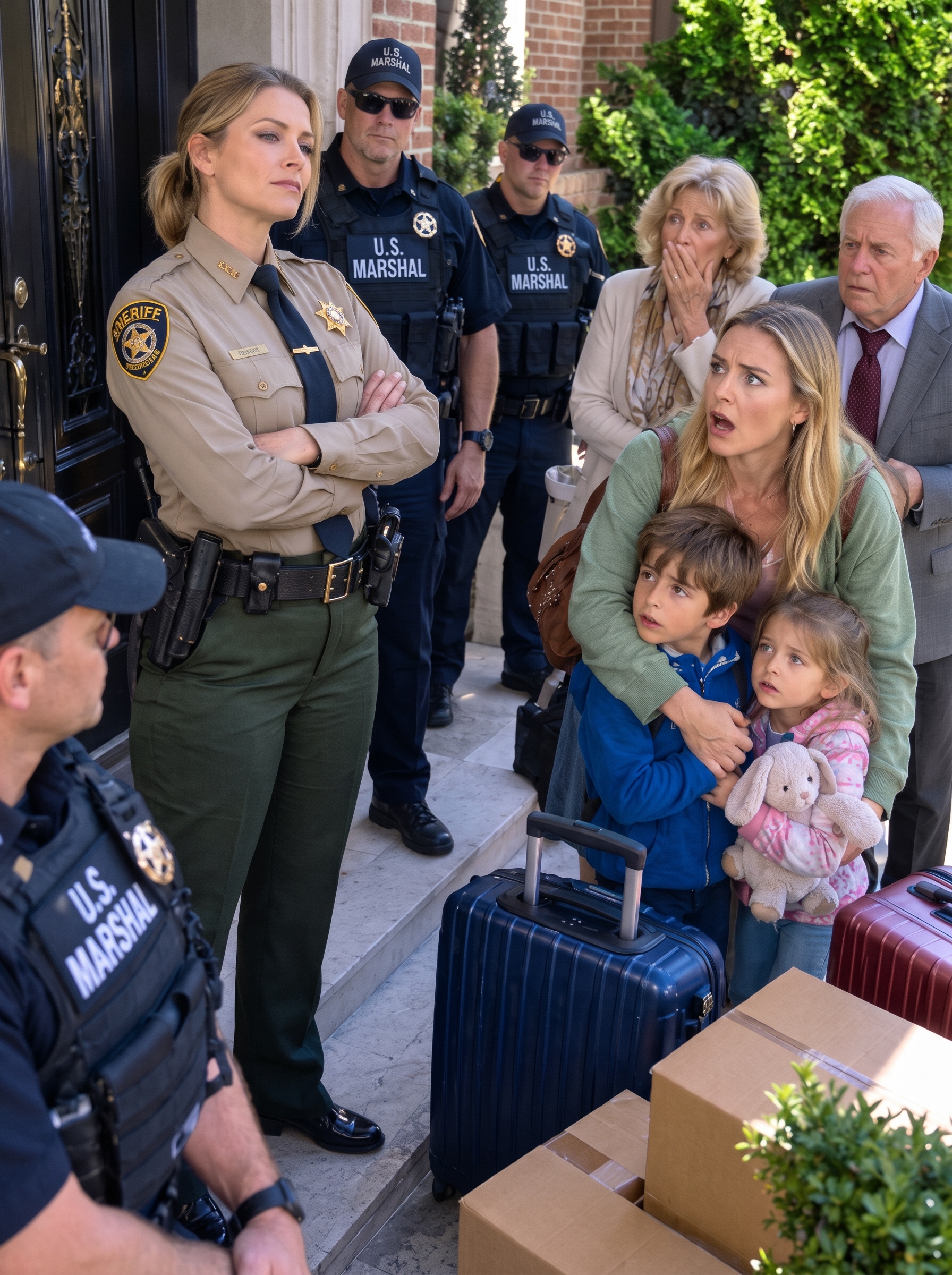
Paige stood beside the destroyed office door, still wearing the expression of someone waiting to wake from a nightmare. Her two children huddled behind her, clutching their backpacks, confused by words like federal and compromised and evidence.
I watched it all from the secure conference room twenty-eight floors above the city, my face reflected faintly in the dark glass wall in front of me. I was not in the penthouse. I had not been there since the first alert hit my phone and showed Paige standing in my private entryway, grinning like she had won something.
That had been her first mistake.
Thinking I needed to be present to defend what was mine.
The agent placed the envelope on the marble coffee table.
“My client has instructed us to proceed with all protective measures,” he said. “This includes removal from the premises, preservation of evidence, and immediate notification to every agency connected to the secured workspace.”
My mother gave a sharp laugh.
“Client? She’s your client now? She’s my daughter.”
The agent turned slightly toward the ceiling camera, as if speaking through it to me.
“Ms. Marissa Vale is the legal owner of this property, the protected leaseholder of the restricted workspace, and the complainant in this matter.”
Complainant.
That word finally cracked something in my mother’s face.
For years, she had treated me like a resource with inconvenient emotions. Paige was the fragile one, the struggling one, the one who always needed help. I was the dependable one. The successful one. The one who could afford it.
So when Paige’s marriage collapsed, my parents expected me to hand over my guest suite.
When Paige lost her rental, they expected me to “temporarily” move her into my penthouse.
When I refused, they called me selfish.
And when I changed the entry codes, they apparently decided to test whether a lock could love them more than I did.
My father picked up the envelope with stiff fingers.
“Open it,” my mother whispered.
“I know how envelopes work, Elaine.”
His voice was low and dangerous, but not directed at the agents. It was directed at the room itself, at the cameras, at me.
He tore the seal.
Inside were three documents.
The first was a formal notice barring them and Paige from all properties under my name.
The second was a civil complaint for attempted unlawful occupancy, property damage, and interference with federally protected materials.
The third was thinner. Only two pages.
My father stopped reading halfway down the first page.
My mother snatched it from him.
“What?” Paige demanded. “What is it?”
No one answered her.
My mother’s hands began to tremble.
Then she looked up at the nearest camera.
“Marissa,” she said, and there it was — not anger, not outrage, but fear. “Where did you get this?”
For the first time that afternoon, I leaned toward my microphone.
The penthouse speakers clicked softly.
“From Grandma’s attorney.”
Paige frowned.
“What does Grandma have to do with this?”
My father shut his eyes.
My mother whispered, “No.”
I let the silence stretch just long enough for all three of them to feel the shape of it.
“Four years ago,” I said, “Grandma left me a private letter with instructions to open it only if I ever believed my family was trying to take my home.”
Paige scoffed, but it came out thin.
“That’s insane.”
“Grandma knew all of you better than I did.”
My father finally spoke.
“That old woman was confused at the end.”
“No,” I said. “She was very clear.”
The agent nodded to one of the officers, who began photographing the documents in my father’s hands.
My mother clutched the paper tighter.
“Marissa, listen to me. Whatever you think this means, we can discuss it privately.”
“You had privacy,” I replied. “You used it to plan how to trap me in court.”
The room went still again.
On one of the television screens, paused footage showed my father’s mouth open mid-sentence, caught forever saying the words he never thought I would hear.
Once Paige gets mail delivered here, we’ll claim she’s established residency.
He looked smaller beneath the image of himself.
My father had always been a large man in my memory. Not physically, but in presence. He filled rooms with opinions. He decided when conversations were over. He measured love in obedience and called it respect.
Now he looked like a man standing underneath a falling ceiling, pretending it was only rain.
Paige stepped forward.
“Okay, fine,” she said quickly. “Maybe Dad said something stupid. But I didn’t know about any federal stuff. I thought this was just your office. I didn’t know breaking the door was a big deal.”
“You told your son to find a screwdriver,” I said.
Her face twisted.
“I was upset.”
“You told him there might be cash inside.”
“That was a joke.”
“You said you were going to sell my equipment.”
“I didn’t mean it!”
The senior agent looked at her without expression.
“Intent is something the court can consider.”
“The court?” Paige repeated, her voice rising. “Why does everyone keep saying court? She’s my sister!”
“No,” I said quietly. “I was your sister before you tried to steal my home.”
My mother flinched as if I had slapped her.
“Don’t speak to her like that.”
There it was.
Even now.
Even with police in the room and evidence on every screen, my mother’s first instinct was still to protect Paige from the consequences of Paige.
Something inside me, something old and tired and patient, finally went cold.
“I want them out,” I said.
The senior agent gave a short nod.
The officers moved gently but firmly. They told Paige she needed to gather essential belongings and leave the property. She argued. Then pleaded. Then cried. Her children began crying too, and for a moment my chest tightened.
Not because I regretted it.
Because they were children, and none of this was their fault.
I muted my microphone and looked away.
Beside me, my attorney, Daniel Cross, stood with his arms folded, watching the live feed.
“You’re doing the right thing,” he said.
“I know.”
But knowing did not make it painless.
On the screen, Paige wiped her face and shoved clothes into a designer duffel she had taken from my closet. An officer stopped her.
“That isn’t yours.”
She froze, then threw the bag onto the sofa.
“Fine! She can keep her precious bag.”
My mother helped gather the children’s things while glaring at every camera as if hatred could blur the footage. My father remained by the coffee table, still holding Grandma’s document.
That document was not just a warning.
It was a copy of a trust amendment.
For years, my parents had told me Grandma left “a few sentimental things” and nothing more. They said her estate had been simple. They said there was no money. They said the house had been sold to cover medical expenses.
They lied.
Grandma had left behind a trust for me.
A significant one.
And according to the amendment, my parents had been removed as successor trustees six months before her death because Grandma suspected them of pressuring her to change beneficiaries.
The attorney’s letter attached to it was worse.
It said that after Grandma died, my parents never disclosed the amendment. They transferred assets through an older trust document and represented themselves as valid trustees.
I had not known any of this until three weeks ago.
Three weeks ago, Grandma’s former attorney called me after receiving an anonymous package containing copies of bank statements, old emails, and a note written in shaky blue ink.
They lied to her too.
At first, I thought it was a mistake.
Then I saw the signatures.
Then I saw my father’s email to my mother.
Marissa doesn’t need it. Paige does.
I had spent three weeks feeling like the floor beneath my childhood had been quietly removed.
The penthouse incident had only given me the final piece.
Proof that they had not changed.
Proof that they would keep taking until there was nothing left to take.
My father looked up suddenly.
“Who sent you this?”
I unmuted.
“What?”
“The letter. The evidence. Who sent it?”
“I don’t know.”
He stared into the camera, his face pale but alert now.
“That’s not true.”
“It is.”
“Marissa,” he said, and his voice changed. It softened into the tone he used when he wanted obedience to feel like concern. “You don’t understand what you’ve opened.”
Daniel glanced at me.
I leaned closer.
“Are you threatening me?”
“No,” my father said. “I’m warning you.”
The senior agent stepped forward.
“Mr. Vale, I’d be careful.”
My father ignored him.
“That trust was complicated. Your grandmother was involved with people you don’t know. People who don’t like having old records dragged into daylight.”
My mother hissed, “Stop talking.”
But my father’s eyes stayed locked on the camera.
“She had secrets, Marissa. So did your grandfather. You think this is about money? You think this is about Paige sleeping in your guest room?”
He laughed once, bitterly.
“You have no idea what she left you.”
A chill moved through me.
Daniel’s posture changed.
“What does that mean?” I asked.
My mother grabbed my father’s arm.
“Enough.”
He shook her off.
“For once, she should hear it.”
While I was nearly 3,000 miles away on assignment in London
PART 3 Paige appeared in the hallway, clutching her daughter’s coat.
“Hear what?”
Nobody answered.
The agent repeated, “Mr. Vale.”
My father dropped the trust amendment back onto the coffee table.
Then he smiled.
It was not a pleasant smile.
It was the smile of a man who had lost control of the room but found a match in his pocket.
“You want to be independent?” he said to me. “Fine. Be independent. But when they come looking for what’s hidden in that building, don’t call us.”
The lights flickered.
Just once.
Every screen in the penthouse blinked black.
Then came back.
Daniel’s phone buzzed. So did mine. So did the agent’s.
A new security alert appeared.
ARCHIVE ACCESS REQUEST DETECTED.
Location: Vale Family Storage Facility.
Authorization used: MARISSA VALE.
I stared at it.
“That’s impossible,” I whispered.
Daniel was already typing.
“Your credentials?”
“No. I didn’t authorize anything.”
The senior agent snapped orders to his team. One of the federal techs opened a case kit and connected a device to the penthouse control panel.
My father’s smile faded.
For the first time, he looked genuinely surprised.
My mother noticed.
“What is that?” she asked.
The agent did not answer.
Another alert appeared.
BIOMETRIC OVERRIDE ACCEPTED.
My blood turned cold.
Accepted.
Not attempted. Accepted.
Daniel looked at me.
“Marissa, where are you?”
“Secure conference room.”
“Stay there.”
On screen, Paige stepped back.
“Wait. What’s happening?”
My father grabbed his coat.
“We’re leaving.”
The officer nearest him raised a hand.
“No one has been cleared to leave yet.”
My father exploded.
“You don’t understand! If someone accessed that storage unit, then this is already bigger than your paperwork.”
My mother was crying now, but silently. Tears slid down her face while she stared at the screen.
“Richard,” she whispered, “who has her biometric?”
My father did not answer.
That silence was the loudest confession of the day.
I stood.
Daniel moved in front of me.
“Marissa.”
“Who has my biometric?” I demanded.
My voice came through every speaker in the penthouse, sharp enough to stop everyone.
My father looked toward the camera.
For one second, I saw regret.
Not love.
Not guilt.
Regret that the wrong secret had surfaced at the wrong time.
Then a new video feed opened on the center television.
It showed a storage facility I recognized immediately. Low concrete ceiling. Blue metal doors. Fluorescent lights.
Unit 718.
My grandmother’s old unit.
The one my parents claimed had been emptied years ago.
The camera angle shook slightly as if the feed came from a body camera. Someone stood in front of the storage door, entering a code.
Then the person turned just enough for the camera to catch their reflection in the metal latch.
I stopped breathing.
It was me.
Not exactly me.
A woman with my height, my dark hair, my face, my posture.
She wore black gloves and a gray coat.
She lifted her hand to the scanner.
The lock flashed green.
Paige screamed.
My mother covered her mouth.
My father said one word.
“Impossible.”
The storage door rolled upward.
Inside was not furniture.
Not boxes.
Not old photographs.
Inside was a room.
A hidden, climate-controlled archive lined with shelves, safes, sealed cases, and a steel table in the center. On the table sat a black folder with my grandmother’s name embossed in silver.
The woman who looked like me walked straight to it.
She opened the folder.
The feed crackled.
A voice spoke, calm and female.
“Marissa should have stayed out of this.”
Then the screen went black.
For several seconds, nobody moved.
Even Daniel looked stunned.
I heard my own heartbeat, slow and heavy, as if it belonged to someone else.
The senior agent recovered first.
“Lock down all connected locations. Now.”
His team moved quickly, but my eyes remained fixed on the blank screen.
A woman with my face had just opened a door with my biometric signature.
A woman with my voice had spoken my name like a warning.
Behind me, Daniel said something into his phone, but I barely heard him.
Because suddenly, one memory rose from the deepest part of my mind.
I was seven years old, hiding under Grandma’s dining table during a thunderstorm. My parents were arguing in the kitchen. Grandma’s hand rested gently on my back.
“Listen to me, Marissa,” she had whispered. “One day, people may tell you that you are the only one. Don’t believe them.”
I had thought she meant I was not alone.
Now I wondered if she meant something else entirely.
On the penthouse screen, my father sank slowly onto the sofa.
My mother whispered, “She’s back.”
Paige turned to her.
“Who’s back?”
My mother stared at the dead screen, her face emptied of every lie she had carried for years.
Then she said the name that changed everything.
“Celeste.”
Daniel turned to me.
“Who is Celeste?”
I looked at my parents on the screen.
Neither of them would meet my eyes.
And somewhere across the city, a woman wearing my face had just stolen whatever my grandmother had spent her life hiding.
While I was nearly 3,000 miles away on assignment in London
PART 4 — THE ENVELOPE THAT BURNED THE FAMILY TREE
My father did not take the envelope at first.
He stared at it as though the senior agent had extended a snake toward him instead of a sealed packet with his name printed across the front in black federal lettering.
My mother, however, had never been afraid of paper.
She stepped forward, chin high, one hand pressed to the pearls at her throat. Even through the speaker system, even from thousands of miles away in a silent London hotel room, I could hear her breathing—the tight, offended breaths of a woman who had spent her entire life mistaking control for love.
“Give it here,” she snapped.
The agent did not move.
“This envelope is addressed to both of you,” he said. “Before you open it, I need you to understand that everything you say and do in this residence is still being recorded.”
My father let out a bitter laugh.
“This is insane. This is our daughter’s home.”
“No,” the agent replied. “It is Deputy Marshal Keane’s private residence. And the room your daughter attempted to force open is a protected workspace containing federally secured materials.”
Paige flinched at the word “force.”
Her son, Tyler, stood frozen near the staircase, still holding the fireplace poker she had handed him. He was only ten, all elbows and wide eyes, with one suitcase beside his sneaker. His little sister, Emma, was curled on the couch in her pink coat, hugging a stuffed rabbit like she could disappear behind it.
I wanted to be angry at Paige. I was angry at Paige.
But looking at those children made something inside me ache.
They had not planned this. They had been packed into a car in the middle of the night and told they were moving into Aunt Marissa’s beautiful apartment because grown-ups had decided the truth was optional.
The agent noticed Tyler’s hand trembling.
“Buddy,” he said gently, “you can put that down.”
Tyler looked at Paige first.
That hurt worse than the door.
He waited for permission from the person who had handed him a tool and made him part of something he did not understand.
“Put it down,” Paige whispered.
The poker clattered against the marble floor.
My mother finally snatched the envelope from the agent. She tore it open with sharp, angry fingers, pulling out a stack of documents, a letter, and a flash drive sealed inside a clear evidence sleeve.
At the top of the first page, in bold letters, were the words:
While I was nearly 3,000 miles away on assignment in London
PART 5 NOTICE OF REVOCATION OF ACCESS AND FAMILY FINANCIAL BOUNDARY STATEMENT.
My mother’s face tightened.
“What kind of dramatic nonsense is this?”
My father leaned over her shoulder. Paige took one step closer, then stopped, as though the papers gave off heat.
I knew exactly what they were reading, because I had written the first letter myself.
Not as a deputy marshal.
As the daughter they had trained to feel guilty for having a locked door.
Mom. Dad.
If you are reading this inside my home, it means you crossed a line I clearly told you not to cross.
It means you chose to believe that family gives you ownership over my labor, my privacy, and my peace.
It means you used Paige’s children as shields.
It means I was right to prepare.
My mother stopped reading aloud.
But the screens in my penthouse did not.
At my instruction, the system opened the digital copy and began displaying it line by line across every television, every wall panel, every smart monitor in the apartment.
My father staggered back as my words filled the room.
For fifteen years, I have paid debts I did not create.
I have covered rent, medical bills, car repairs, legal fees, school supplies, emergency loans, “temporary” expenses, and family obligations that somehow never ended.
I did it because I loved you.
I stopped because loving you was destroying me.
Paige covered her mouth.
My mother whispered, “Turn that off.”
No one did.
The next page appeared.
A ledger.
Every transfer. Every check. Every so-called emergency. Every holiday where I was told not to bring gifts because “money would be more useful.” Every loan that became a donation the moment I asked about repayment.
My father’s voice came out low.
“You kept records?”
I sat in my hotel room with the London rain streaking the windows and whispered back, though they could not hear me yet.
“Yes, Dad. I learned from you.”
He had always told me that paperwork won wars.
He had never imagined I would be the one to build the archive.
The agent turned a page.
“This packet includes a formal no-entry notice, revocation of all prior access codes, documentation of attempted unlawful entry, evidence of property damage, and instructions from Deputy Marshal Keane regarding temporary care arrangements for the minors present.”
Paige’s head jerked up.
“What care arrangements?”
The agent’s expression softened, but only slightly.
“Your sister arranged a hotel suite nearby for the children tonight. Food, transportation, and a licensed child welfare liaison have already been contacted. You may accompany them if you agree to leave the residence peacefully and provide a statement.”
My mother gave a short, ugly laugh.
“Oh, now she wants to play hero.”
My voice cut through the apartment speakers.
“No, Mom.”
Everyone froze.
I had connected through the secure channel, my laptop open on the desk of a hotel room nearly three thousand miles away. My hair was still loose from sleep, my face pale in the blue glow of the screen, but my voice was steady.
“I want the kids warm, fed, and out of the middle of this.”
Paige turned toward the nearest camera.
“Marissa?”
“Hi, Paige.”
She looked smaller than she had two minutes earlier.
Not innocent. Not yet.
But smaller.
My father pointed at the camera. “You have no right to humiliate your family like this.”
“You broke into my home.”
“We are your family.”
“And you thought that made it easier.”
Silence rolled across the room.
My mother stepped forward, her eyes glittering. “You would really do this to your own sister? To your niece and nephew?”
“I did not bring Tyler and Emma there,” I said. “Paige did. You helped her. Dad helped her. You planned it for weeks.”
“That is not—”
The screens changed again.
This time the footage showed my mother at her kitchen table three nights earlier, captured from Paige’s own phone during a video call she had unknowingly backed up to a shared family cloud I had been invited to years before and never removed from.
My mother’s voice filled the apartment.
“Bring the children. She won’t dare make herself look cruel. Once you’re in, cry. Make it about stability.”
Paige shut her eyes.
My father said, “Enough.”
But the system played the next clip.
His voice.
“Do not leave once you’re inside. Possession matters. Keep mail there. Take pictures. Make her negotiate.”
The senior agent looked at him.
My father said nothing.
On screen, my mother smiled in the old video and added, “Marissa has had too much for too long. It is time she remembered where she came from.”
That sentence struck harder than I expected.
Because I did remember.
I remembered wearing thrift-store coats while my parents bought Paige new dresses because she “needed confidence.” I remembered being told I was strong, which in our house meant I could be ignored. I remembered bringing home scholarship letters and watching my mother ask if there was any cash award attached. I remembered my father smiling proudly at neighbors while whispering later that success was only respectable if it benefited the family.
I remembered all of it.
That was the problem.
Paige’s voice broke.
“Mom told me you said yes.”
I looked at her through the camera.
“No, she didn’t.”
Paige turned slowly toward our mother.
My mother’s expression did not change.
“She would have said yes eventually.”
It was such a perfect sentence that even my father closed his eyes.
There it was.
The family philosophy in six words.
Consent was just delay.
Boundaries were just obstacles.
My home had not been stolen tonight by mistake. It had been claimed according to the rules they had lived by for years.
One of the officers spoke quietly to Paige.
“Ma’am, you need to gather essential items for yourself and the children. The rest will be documented and removed later.”
“I’m not leaving,” my mother said.
The agent looked at her. “You are not a resident here.”
“I am her mother.”
“That is not a legal address.”
My father stepped between them. “We will call our attorney.”
The agent nodded. “You may.”
“He’ll straighten this out.”
“Before or after he explains the locksmith waiting in the lobby?”
My father’s face changed.
Just barely.
But I saw it.
So did the agent.
He tapped his earpiece. “Send him up.”
A minute later, the elevator opened again.
A nervous man in a brown jacket stepped out, carrying a locksmith bag and a clipboard. His eyes went from the officers to the agents to Paige’s suitcases, and the confidence drained out of him so fast he nearly dropped his tools.
“I was told this was a lockout,” he said.
My father did not look at him.
The agent held out a hand. “Invoice and work order.”
The locksmith handed them over immediately.
The work order listed my address.
The requested service: permanent lock replacement.
The client name: Richard Keane.
My father.
Not Paige.
Not a confused mother of two.
My father had planned to replace the locks on my home while I was overseas.
I leaned closer to my laptop camera.
“Dad.”
He would not look up.
“Ask him about Unit 14B,” I told the agent.
For the first time all night, my father looked truly afraid.
My mother turned toward him.
“Richard?”
The agent repeated calmly, “Unit 14B?”
My father swallowed.
The screens went black for one breath.
Then a new file opened.
KEANE FAMILY TIMELINE — PHASE TWO.
Paige whispered, “What is Unit 14B?”
My father said nothing.
And that was how I knew the night had only begun.
PART 4 — UNIT 14B AND THE LIES IN STORAGE
Unit 14B was a storage locker in a climate-controlled facility ten minutes from my parents’ house.
I knew about it because my father was careful, but not imaginative.
For years, every password he created was some variation of his high school football number, my mother’s initials, and the word “family.” He had used the same storage company since I was in college. Back then, he kept Christmas decorations there, boxes of old tax records, and my grandmother’s cedar chest, which my mother insisted smelled “too old” to keep in the house.
Three weeks before Paige broke into my penthouse, a notification had appeared in my email.
A storage facility receipt.
Forwarded accidentally.
My father had meant to send it to himself. Instead, autocomplete chose me.
The subject line read: 14B ACCESS CONFIRMED.
I might have ignored it if the amount had been normal.
It was not.
He had paid for after-hours access, document scanning services, and private shredding.
My father never paid extra unless he was hiding something.
So I did what I had learned to do on fugitive cases.
I followed the paper.
While I was nearly 3,000 miles away on assignment in London
PART 6
Not as a marshal. Not with government authority. I used public records, my own accounts, my own family documents, and one private attorney I trusted more than blood.
What I found did not surprise me.
That almost made it worse.
Inside Unit 14B, my father had been building a fake history.
Printed emails made to look like I had invited Paige to stay.
Unsent letters addressed to her at my penthouse.
Draft affidavits claiming she had “longstanding family permission.”
A copy of the old one-time service code.
Screenshots from real estate forums.
Notes from calls with an attorney who, judging from the messages, had not been told the whole truth.
And on top of it all, in a blue folder labeled MARISSA — LEVERAGE, he had placed copies of old checks I had written to him and Mom, with handwritten notes in the margins.
Proof she supports family.
Proof she accepts obligation.
Proof pattern of shared assets.
When my attorney sent me photographs of the folder, I stared at that phrase for a long time.
Shared assets.
Not daughter.
Not sister.
Not person.
Asset.
In the penthouse, my father finally found his voice.
“This is illegal,” he said. “You cannot search my storage unit.”
“I didn’t,” I replied through the speakers. “Your storage company contacted me after you listed my name and address as an authorized emergency contact. My attorney requested preservation of documents after your own emails suggested you were using my address in a false claim.”
His jaw tightened.
“You think you’re very smart.”
“No,” I said. “I think I was very tired.”
That landed differently.
Not dramatically. Not loudly.
But I saw Paige look at the floor.
The senior agent spoke to my father. “The contents of that unit are being reviewed by appropriate authorities now. Tonight’s attempted entry into a protected workspace makes the context relevant.”
My mother gripped the envelope so tightly the pages bent.
“Richard,” she said, “tell me you didn’t put my name on anything.”
My father looked at her.
There are marriages built on love, and there are marriages built on shared enemies. My parents had spent thirty-seven years turning outward whenever they needed someone to blame. Teachers. Bosses. Neighbors. Me.
For the first time, there was no one outside the circle.
Only them.
My father’s silence answered her.
She struck him with the papers. Not hard enough to hurt, but hard enough to reveal the crack.
“You said this would be simple,” she hissed.
Paige stared at them. “You both told me Marissa agreed.”
“You needed a place,” my mother snapped.
“So you lied?”
“I protected you.”
“You used me.”
“You would have been living in your car.”
“I was not living in my car!”
The lie burst out of Paige before she could stop it.
Everyone turned.
Even I sat back in my chair.
Paige pressed a hand over her mouth, then slowly lowered it.
“I wasn’t living in my car,” she said again, quieter. “I told Mom the landlord gave me thirty days. She said Marissa had room. She said Marissa had always been selfish but could be pushed. I said no at first.”
My mother scoffed.
Paige’s voice sharpened. “I said no.”
Tyler looked up.
It was the first time all night he had heard his mother sound like someone waking from a dream.
Paige went on, words tumbling faster now. “Then Dad said he talked to a lawyer. He said if Marissa really loved us, she wouldn’t fight. He said the worst that could happen was she’d yell and then calm down. Mom said to bring the kids because Marissa would never make a scene in front of them.”
My mother’s mouth flattened.
“You agreed.”
“I was desperate!”
“You were weak.”
Paige recoiled.
For a moment, I saw us as children again.
Me, twelve years old, holding a permission slip for a gifted summer program my parents refused to pay for.
Paige, seven years old, sobbing because she had spilled juice on Mom’s white rug.
Our mother had used different words then.
Careless. Dramatic. Ungrateful.
But the tone was identical.
The agent interrupted before the argument could spiral.
“Ms. Paige Keane, you have two choices right now. Leave peacefully with your children and cooperate, or be removed from the residence while arrangements are made for the minors.”
Paige looked at Tyler and Emma.
That was the moment I learned whether my sister was only selfish or something more complicated.
She bent, picked up Emma’s stuffed rabbit from the couch, and tucked it into her daughter’s arms.
“We’re leaving,” she whispered.
Emma began to cry.
“I know, baby,” Paige said, voice trembling. “I know. We’re going somewhere safe tonight.”
My mother lunged toward her.
“Paige, don’t you dare let Marissa scare you out of what you deserve.”
Paige turned on her.
“What do I deserve, Mom? Her house? Her bed? Her life?”
“You deserve help.”
“Then why didn’t you offer me your guest room?”
The silence after that was enormous.
My parents had a four-bedroom house.
A finished basement.
A sunroom my mother used for antique chairs no one was allowed to sit in.
They had never intended to take Paige in.
They intended to place her in my home like a flag in conquered land.
My father cleared his throat. “Your mother’s health—”
“Her health is fine,” Paige said. “She plays doubles tennis every Thursday.”
My mother’s eyes flashed.
I almost smiled.
Not because it was funny.
Because for once, Paige had noticed the furniture of our childhood—the excuses, the locked cabinets, the rooms reserved for appearances while the living daughters made themselves smaller.
The agents began escorting everyone toward the elevator. Paige carried Emma. Tyler pulled two suitcases and refused to look at the damaged office door.
As my parents passed the camera, my father finally looked directly at me.
“You think this ends with tonight?”
“No,” I said. “Tonight is just the part you can’t deny.”
My mother leaned close to the wall panel.
“You will regret making enemies of your own blood.”
I wanted to say something devastating.
Something sharp enough to cut through all the years she had made me apologize for succeeding.
Instead, I said the truest thing.
“I didn’t make enemies, Mom. I stopped pretending they were safe.”
The elevator doors opened.
For a second, my penthouse was full of people, noise, luggage, shame, and flashing red security notices.
Then the doors closed.
The apartment fell silent.
Across the ocean, dawn began to pale behind London’s rain.
I looked at the empty entryway on my screen.
My sister’s purse was still on the table.
One of Emma’s tiny gloves lay on the floor near the couch.
And the door to my protected office stood dented but closed.
The system generated its final alert of the night.
RESIDENCE SECURED.
I should have felt relief.
Instead, I felt something far more dangerous.
Clarity.
PART 5 — THE SISTER WHO FINALLY TOLD THE TRUTH
Paige called me at 6:43 a.m. London time from the hotel suite I had arranged.
I nearly did not answer.
Not because I wanted to punish her.
Because there are moments when hearing someone’s voice too soon can undo the strength it took to survive them.
The phone buzzed across my desk.
Paige Keane.
For years, that name had meant emergencies.
Can you send money?
Can you talk to Mom?
Can you cover this just once?
Can you please not make a big deal out of it?
I let it ring four times.
Then I answered.
For a moment, neither of us spoke.
In the background, I heard cartoons playing softly, the rustle of hotel sheets, and Emma asking if breakfast had pancakes.
Paige’s voice came small.
“They’re okay.”
I closed my eyes.
“Good.”
“Emma thinks we’re on vacation.”
“Let her.”
“Tyler knows we’re not.”
“He’s old enough to know when adults are lying.”
That hurt her. I heard it.
“I’m sorry,” she said.
I stared at the London skyline, the city washed silver by morning rain.
I had imagined those words before.
Not in a grand way. Not in a fantasy where everyone wept and changed overnight.
Just once, I wanted someone in my family to say they were sorry without adding a reason I was still somehow responsible.
Paige did not add one.
So I waited.
She inhaled unevenly.
“I thought you’d fold.”
There it was.
Ugly. Honest.
Better than pretty lies.
“Why?”
“Because you always did.”
I turned away from the window.
“I know.”
“I told myself that meant you didn’t mind.”
“No, Paige. You told yourself that because it helped you take things.”
She was quiet for so long I thought the call had dropped.
Then she said, “Mom said you had everything.”
“She said that a lot.”
“She said the penthouse was proof you abandoned us.”
“The penthouse was proof I worked.”
“I know.”
“No. You didn’t.”
She accepted that.
Another small silence.
Then she said, “Dad told me you used family money to buy it.”
I laughed once, without humor.
“What family money?”
“I know. I know that now.” Her voice shook. “He said there had been an inheritance from Grandma Hazel. He said you took your share early and never told me.”
My hand tightened around the phone.
Grandma Hazel.
The only adult in our family who had ever looked at me like I was not selfish for wanting a door that closed.
She had died when I was twenty-three. She left me a wooden recipe box, a watch that did not work, and a letter telling me to run toward the life my parents called “too much.”
There had been no money.
At least, none that reached me.
“What inheritance?” I asked.
Paige went silent.
Cold moved through me.
“Paige.”
“I don’t know,” she whispered. “Dad said Grandma left something for both of us. He said you got yours when you finished school. He said mine went toward family expenses because I had kids and needed more help.”
The rain tapped the glass like fingernails.
I sat down slowly.
“Did you ever see documents?”
“No.”
“Did he?”
“I don’t know.”
That was when the story shifted.
Until then, the night had been about my home.
Suddenly, it was about a dead grandmother, missing money, and another door my father had kept locked.
I pulled up my encrypted notes and opened a new file.
HAZEL KEANE ESTATE.
“Tell me everything he said.”
Paige let out a broken breath.
“Marissa, I called to apologize.”
“You can do both.”
So she did.
She told me how Dad had started mentioning Grandma Hazel’s “help” years ago, always vaguely, always when Paige asked why I had managed to graduate without drowning in debt. He implied I had received advantages. He implied I owed the family because I had already benefited from it.