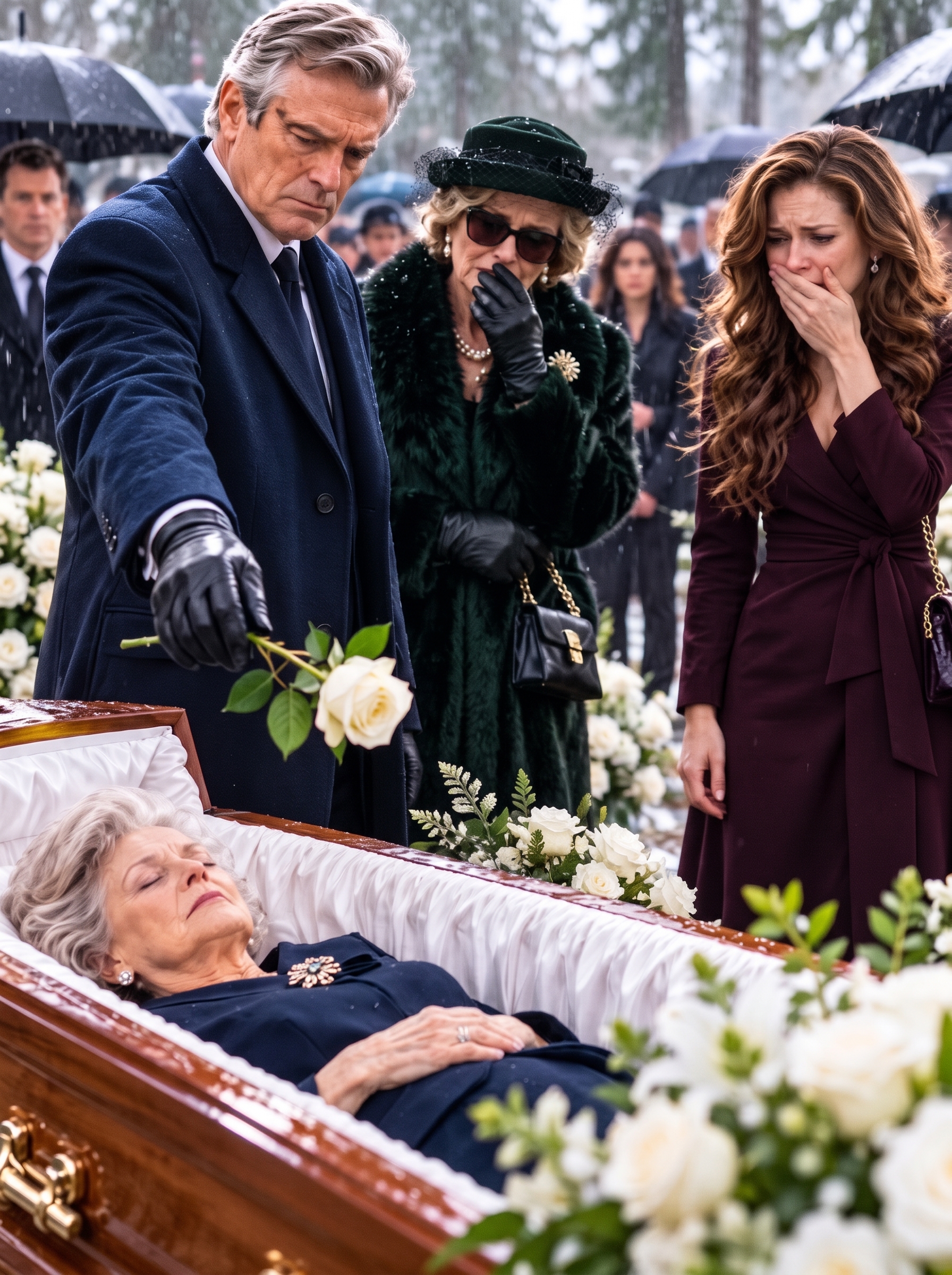
“Throw it in with her. That worthless thing belongs underground.”
My father’s voice cut through the silence at Cedar Ridge Cemetery as he tossed a small blue savings passbook onto my grandmother’s open casket.
The book struck the white satin lining, bounced against a cluster of roses, and came to rest near her folded hands.
For several seconds, nobody moved.
The cemetery workers stood beside their equipment. My uncles stared at the ground. The pastor stopped gathering his papers.
I stood so still that rainwater collected inside my shoes.
Then my father laughed.
“Maybe now Samantha will stop asking about money that doesn’t exist.”
His name was Gregory Vance.
He was fifty-four years old, dressed in an expensive black suit, and standing beside the grave of the woman who had raised him.
He looked more annoyed than heartbroken.
I looked at the little blue book resting against Grandma Beatrice’s chest.
Two nights earlier, she had squeezed my hand with surprising strength.
“Don’t let Gregory find it,” she had whispered.
Now he had found it.
And he wanted it buried with her.
“Dad,” I said quietly, “why would you do that?”
He turned toward me.
The expression on his face was painfully familiar.
It was the same look he gave me whenever I questioned his decisions.
The same look he wore when I was sixteen and asked where my college savings had gone.
The same look he gave Grandma whenever she tried to defend me.
“Do what?” he asked.
“Throw her things into the grave.”
He gestured toward the casket.
“That old notebook? It’s garbage, Samantha.”
“It belonged to Grandma.”
“Everything belonged to your grandmother. Now she’s dead.”
Behind him, my stepmother, Pamela, adjusted her sunglasses.
She wore a fitted black coat that probably cost more than my monthly rent.
Her lipstick looked freshly applied.
“Gregory,” she said, “don’t argue with her today.”
For one foolish moment, I thought she was defending me.
Then she added, “She’s emotional enough without being encouraged.”
My half-brother Dustin made a small coughing sound.
I knew he was hiding a laugh.
He was twenty-two, broad-shouldered, and dressed in the kind of designer jacket my father always claimed he couldn’t afford.
Dustin leaned toward me.
“If Grandma left fifty bucks in there, you can buy us burgers.”
A few cousins laughed.
I stared at him.
He shrugged.
“Come on. It’s a joke.”
I wanted to tell him there was nothing funny about humiliating someone beside a freshly opened grave.
Instead, I looked at Grandma.
Her face was peaceful beneath the soft lighting from the funeral home.
She wore her favorite lavender blouse.
The collar had been carefully pressed, just as she would have wanted.
Someone had arranged white carnations around her shoulders.
I knew she disliked carnations.
She always said their smell reminded her of hospital corridors.
She would have preferred the little yellow roses she grew beside her porch.
But nobody had asked me.
Nobody had asked what Beatrice actually loved.
My father had organized the funeral, selected the flowers, and made himself the center of every conversation.
Now he was smiling beside her coffin.
“There’s your inheritance,” he said.
He pointed toward the passbook.
“No house. No property. No secret fortune. Just a useless little notebook.”
His gaze moved down my borrowed black dress.
“And if you’re smart, you’ll finally stop expecting other people to rescue you.”
I felt the familiar pressure building behind my eyes.
For years, I had practiced swallowing my anger before he could turn it against me.
At twenty-seven, I could still become that frightened little girl in seconds.
I hated that about myself.
Grandma never did.
She used to say fear was something the body remembered, even when the mind understood it was safe.
I looked back toward the casket.
The blue passbook was still visible between the flowers.
Something about its position disturbed me.
Grandma had protected that book for as long as I could remember.
She wrapped it in an embroidered cloth.
She kept it inside a rusted butter-cookie tin beneath her bed.
She never left it lying around when my father visited.
Yet he had handled it like a worthless scrap of paper.
I looked at his gloved hands.
He had never cared enough about Grandma’s belongings to recognize her favorite teacup.
Why had he gone looking for that particular book?
And why was he so determined to bury it?
The pastor cleared his throat.
“Perhaps we should continue.”
My father nodded as though he had done everyone a favor.
The cemetery workers stepped forward.
I wanted to reach into the casket and retrieve the book.
My hands actually moved.
Then my father turned his head.
“Don’t make a scene, Samantha.”
The words stopped me.
They had stopped me hundreds of times before.
I lowered my hands.
The workers adjusted the casket.
Metal fittings clicked beneath the drizzle.
Then Grandma began descending into the ground.
I watched until the white lining disappeared.
My father stepped beside Pamela and checked his watch.
I remembered Grandma’s fingers around mine.
I remembered the desperation in her whisper.
And for the first time, I wondered whether the woman who had spent her life protecting me had died afraid.
Not of pain.
Not of being alone.
Of her own son.
My Father Threw My Grandmother’s888
Cedar Ridge was a quiet cemetery outside a small Pennsylvania river town, less than an hour from Pittsburgh.
Grandma had chosen her burial plot fifteen years earlier.
She said she liked the oak tree overlooking the eastern fence.
In spring, wildflowers grew between the older stones.
In autumn, the hillside turned gold.
She wanted somewhere peaceful.
My father complained about the price.
He complained again when the cemetery requested payment for maintaining the plot.
Then he told everyone at the funeral reception that he had personally handled every detail.
That was Gregory Vance.
He liked the appearance of generosity.
He disliked the actual expense.
I had learned the difference before I learned how to drive.
When I was eight, he bought me a beautiful bicycle for my birthday.
He made sure the entire neighborhood watched me unwrap it.
He took photographs beside the handlebars.
The following week, he sold the bicycle because I had forgotten to clean my bedroom.
Grandma found me sitting on the porch, staring at the empty space beside the steps.
She said nothing about my father.
She took my hand and walked me into her kitchen.
Then she placed a plate of warm biscuits in front of me.
“Sometimes,” she said, “people give things because they want everyone watching.”
I remember looking up at her.
“Why?”
“Because being seen giving is more important to them than the gift.”
I thought about that at the cemetery.
Dad had spent the funeral greeting relatives and accepting sympathy.
He accepted praise for caring for his elderly mother.
He thanked people for their kindness.
He even told a distant cousin that Beatrice had been difficult during her final months.
That was a lie.
Grandma had become quieter, not difficult.
She stopped answering the telephone when my father called.
She startled whenever someone knocked after dark.
She began hiding ordinary things.
Receipts.
Letters.
An envelope containing her pension statement.
Once, I found her standing beside the kitchen window with the curtains barely parted.
A car had slowed outside.
She held her breath until it passed.
“Grandma?”
She smiled too quickly.
“Just watching the weather, sweetheart.”
But her hands were shaking.
I noticed things like that.
I simply didn’t understand them.
Or perhaps I was afraid to understand.
For most of my life, I had believed my father’s anger was something our family had to endure.
Grandma endured it.
I endured it.
Even my mother had endured it, according to the few memories I had of their marriage.
My parents separated when I was young.
My mother eventually moved out of state and struggled to rebuild her own life.
Contact became irregular.
Grandma became the person who remembered everything.
She remembered when school started.
She remembered whether I needed new shoes.
She remembered the exact way I liked my eggs.
And when my father said I was too sensitive, Grandma always listened before answering.
“You’re allowed to feel things,” she told me.
That sentence seemed simple.
In our house, it was revolutionary.
By the time the cemetery workers began filling the grave, the rain had become heavier.
Mud clung to the sides of my shoes.
Pamela opened a large black umbrella and held it over herself.
Dustin stood beneath its edge.
Nobody offered me shelter.
An uncle approached my father and murmured something about the reception.
Dad nodded.
“We should get moving. The caterer charges by the hour.”
I looked at the mound of dark earth beside Grandma’s grave.
“I’m staying a little longer.”
My father turned.
“Why?”
“I want a moment alone.”
He gave a theatrical sigh.
“Samantha, your grandmother isn’t going anywhere.”
The cruelty was casual.
That almost made it worse.
I looked toward the oak tree.
“I know.”
Pamela stepped closer.
“Your father has had a difficult week. Try not to make today about yourself.”
I nearly laughed.
Grandma had been the one dying.
Dad had visited twice during her final month.
Both visits ended with arguments.
Yet Pamela spoke as though he had endured the greater suffering.
“I’m not asking anyone to stay,” I said.
Dustin moved past me.
“Suit yourself.”
Then my father placed his hand on my shoulder.
His fingers pressed harder than necessary.
“Don’t go digging around in things that don’t concern you.”
I looked up.
Something moved behind his eyes.
It vanished almost immediately.
“I’m talking about the house,” he added.
“I didn’t ask about the house.”
“Good. Because there’s nothing there for you.”
He released my shoulder.
Then he walked away.
I stood beneath the rain, feeling the place where his fingers had been.
He had never mentioned a house before that morning.
He had never needed to.
Grandma rented her little cottage.
She owned an aging television, a sewing machine, and furniture that had survived several decades.
There was no property to inherit.
Nobody believed otherwise.
So why did he keep reminding me?
The answer seemed connected to the passbook.
I could feel it.
I simply couldn’t see how.
Eventually, the relatives disappeared down the gravel path.
Car doors closed.
Engines started.
The sounds faded behind the trees.
The cemetery workers finished placing the first layers of loose soil.
One of them approached me.
“Ma’am, we’re nearly done here.”
I nodded.
He glanced at my soaked dress.
“You need a minute?”
“Yes, please.”
He looked toward his coworker.
Then both men stepped away toward their truck.
The grave had not yet been fully leveled.
Loose earth covered the lowering equipment, and a shallow ridge remained near one side.
A corner of blue caught my eye.
I stepped closer.
At first, I thought it was part of the floral wrapping.
Then I saw the narrow white edge beneath the mud.
My heart began hammering.
It was the passbook.
Somehow, it had slipped from the casket lining as the coffin descended.
Now it lay partly buried near the side of the grave.
I looked over my shoulder.
Nobody was watching.
I dropped to my knees.
Cold mud soaked through my stockings.
I dug carefully with my fingers, pushing away wet clumps of soil.
A small stone cut my knuckle.
I barely noticed.
Then my fingertips caught the softened cover.
I pulled the book free.
For several seconds, I simply held it.
The blue cloth cover was wet.
Brown water streaked the faded gold lettering.
Grandma had wrapped this little book in a clean cloth every month.
My father had thrown it into the ground.
And somehow, it had found its way back to me.
I wiped the cover against my dress.
Then I opened it.
The first page showed her full name.
Beatrice Vance.
Beneath it, in blue ink, was a sentence written in the unmistakable uneven script of her final months.
If Gregory tells you this book has no value, remember that he already tried to take what it leads to.
I read it twice.
Then a third time.
The words seemed to move across the paper.
Grandma had anticipated this.
She had known my father might call the book worthless.
She had known I might find it.
My throat tightened.
For a moment, I could almost hear her voice.
Not her frightened whisper from the hospital.
Her ordinary kitchen voice.
The one she used when teaching me to sew a straight seam.
“Slow down, sweetheart. Look closely.”
I closed the passbook.
Then I stood.
Mud covered my hands.
Rain ran down my face.
I pressed the book against my chest and walked toward the cemetery gate.
I did not go to the reception.
I did not call my father.
I went home.
My Father Threw My Grandmother’s888
My apartment occupied the second floor of an old brick building near the Riverfront Market.
The windows rattled when freight trucks crossed the bridge.
The radiator clanged every morning.
My kitchen was barely large enough for one person to turn around.
But the apartment belonged to me.
That mattered.
I had signed the lease after saving for almost two years.
Before that, I rented a bedroom in a shared house.
Before that, I lived with Grandma whenever my father decided I was unwelcome.
I worked as an administrative assistant for a regional medical supply company.
The salary was modest.
The health insurance was decent.
Most months, I managed to pay my bills without asking anyone for help.
I was proud of that.
My father considered it proof that I lacked ambition.
“You’re almost thirty,” he told me once. “Still answering phones?”
I reminded him that I handled purchasing records and vendor contracts.
He waved the explanation away.
“Whatever makes you feel important.”
Grandma asked different questions.
“Are they treating you well?”
“Are you saving anything?”
“Do you get enough time to eat lunch?”
When I received my first promotion, she baked a lemon cake.
She wrote my name on it using crooked yellow icing.
Dad never asked about the promotion.
He asked how much money I made.
I stopped telling him.
That was one of the first boundaries I ever learned to keep.
The others took longer.
That night, I locked my apartment door.
Then I pushed the kitchen chair beneath the doorknob.
The chair would not have stopped someone determined to enter.
I knew that.
But seeing it there helped me breathe.
I placed the passbook on my table.
Mud had dried along its binding.
A thin film of water remained between several pages.
I found a clean towel and gently pressed the moisture away.
Then I switched on the yellow kitchen light.
The book looked older than I remembered.
Its edges were frayed.
The gold letters on the cover had nearly disappeared.
One corner had been reinforced with transparent tape.
Grandma had repaired things instead of replacing them.
Her winter coat had the same buttons for twenty years.
Her favorite saucepan had a handle wrapped in wire.
She kept envelopes from birthday cards because the paper was still usable.
But she never seemed ashamed of having little.
She took pride in making things last.
I opened the first page again.
There was the warning.
There was her name.
And beneath the printed account information, there were decades of handwritten figures.
I began reading.
At first, nothing seemed unusual.
Thirty dollars.
Seventy-five dollars.
A hundred and twenty.
Two hundred.
Occasionally, a deposit reached five hundred.
A few entries showed a thousand dollars.
Grandma had earned money wherever she could.
She hemmed pants for neighbors.
She baked pies for church events.
She washed linens for a small bed-and-breakfast.
For years, she repaired uniforms for a local cleaning company.
I remembered her sitting beneath the kitchen window, guiding fabric through her old sewing machine.
Sometimes she worked so late that I fell asleep to the rhythm of the needle.
When I asked why she never bought herself something nice, she smiled.
“I’m putting a little away.”
“For what?”
“For something that matters.”
I assumed she meant emergencies.
Or her funeral.
Or perhaps a newer television.
I never imagined she meant anything else.
As I turned the pages, the handwriting changed.
Earlier deposits were recorded neatly.
Later entries had corrections in the margins.
Some figures were underlined.
Others had small question marks beside them.
Then the withdrawals began.
One thousand eight hundred dollars.
Three thousand.
Four thousand six hundred.
An amount just below ten thousand.
I stared at the numbers.
Grandma had lived on a fixed income.
She complained about the rising price of milk.
She saved grocery coupons in a plastic envelope.
Why had thousands of dollars been leaving her account?
I turned another page.
There was a transfer.
Then another.
Each had a date and a reference number.
Beside several entries, Grandma had written two letters.
G.V.
My father’s initials.
I felt cold.
It was not the cold from my wet clothes.
It settled somewhere deeper.
I remembered an afternoon three months earlier.
Grandma had asked me to help straighten her kitchen cupboards.
We were folding dish towels when her phone rang.
She saw the caller’s name and set the phone facedown.
“Don’t you want to answer?” I asked.
“No, sweetheart.”
“It might be important.”
“It usually is to him.”
She had said it lightly.
But she kept checking the phone until it stopped ringing.
Later, I heard her talking in the hallway.
“No, Gregory. I told you the answer.”
A pause.
Then her voice changed.
“You already took more than I agreed to.”
When I appeared, she ended the call.
I asked if everything was all right.
She reached for a dish towel.
“Your father has his worries.”
“What kind of worries?”
She folded the towel twice.
“His own.”
I accepted that answer.
Now I wished I had asked again.
I wished I had stayed.
I wished I had understood that Grandma’s silence might have been protecting me from something dangerous.
My Father Threw My Grandmother’s888
At the center of the passbook, two pages clung together.
I separated them carefully.
A folded sheet of paper slipped onto the table.
My breath caught.
The paper had been folded into quarters.
Its edges were worn.
A small brown stain marked the upper corner.
I knew Grandma’s stationery.
She bought inexpensive lined paper in packs from the discount store.
She kept it in the kitchen drawer beside her stamps.
I opened the note.
My name appeared at the top.
Samantha.
I touched the first letter.
Grandma had always written my name with an unusually large S.
The remaining lines were crowded together.
Her handwriting sloped downward.
Some words looked as though they had been added later.
I began reading.
My sweet girl,
If you have found this, I need you to forgive me for being frightened.
I should have told you sooner.
Your father did not only take money from me.
He tried to take something that has belonged to you since the day you were born.
I stopped.
My mouth had gone dry.
I read the sentence again.
Something belonging to me since birth?
I had never owned anything significant.
Not as a child.
Not as a teenager.
Not as an adult.
My father had made certain I understood that.
When I turned eighteen, he announced that I could begin paying rent.
I was still in high school.
He said adulthood came with responsibilities.
Grandma quietly gave me the money.
Later, when I earned a small scholarship for community college, Dad insisted the payment should go through him.
He claimed he understood financial matters better than I did.
I trusted him.
By the second semester, the money was gone.
He told me there had been unexpected family expenses.
When I cried, he accused me of selfishness.
“Do you think raising a child is free?”
Grandma learned about it months later.
I remembered the look on her face.
She didn’t cry.
She didn’t shout.
She sat very straight at the kitchen table and asked how much had disappeared.
When I told her, she closed her eyes.
Then she wrote me a check for my next semester.
Her hand shook so badly that she had to begin again.
“Why are you paying for it?” I asked.
“Because you should never have lost it.”
At the time, I thought she meant the scholarship.
Now I wondered what else she had been trying to replace.
I forced myself to continue reading.
Please don’t ask Gregory about this.
Don’t ask Pamela either.
There are things they have said and done that I cannot explain safely while he still has access to my papers.
You must go to the bank yourself.
Take this book.
Ask for the account marked by the red stamp.
They have records there.
You deserve to see them.
The final lines were darker, as though she had pressed harder against the paper.
I never wanted you to spend your life believing you were a burden.
You have always been loved.
Grandma.
I sat motionless.
Outside, a truck crossed the bridge.
The windows trembled.
A neighbor laughed somewhere downstairs.
Life continued around me while everything I understood about my family began shifting.
The note did not mention an amount.
It did not explain what my father had attempted to steal.
It did not tell me whether Grandma had succeeded in stopping him.
Instead, it gave me a direction.
The bank.
The red stamp.
I turned through the remaining pages.
My fingers were clumsy.
I checked the front cover.
The back cover.
The narrow margins.
Then I found it.
Near the final page, a faded red circle enclosed a short handwritten reference code.
The ink had soaked slightly into the paper.
Beneath it was a series of numbers.
Not the account number printed at the front.
Something different.
I copied the code onto a notepad.
Then I checked it twice.
Grandma had drawn another small mark beside it.
A single arrow.
Pointing toward the inside of the back cover.
There, almost hidden beneath the binding, were three words.
Ask for records.
I leaned back in my chair.
The kitchen suddenly felt too small.
Grandma had spent years hiding this book.
She had carried it to the bank every month.
My father had tried to destroy it in the most final place imaginable.
And somehow, the answer was still inside its pages.
My Father Threw My Grandmother’s888
I looked at my phone.
There were seven missed calls.
Three from Pamela.
Two from Dustin.
Two from Dad.
A message appeared while I was staring at the screen.
Dad: You embarrassed the family by skipping the reception.
I did not answer.
Another message followed.
Your grandmother would have wanted us together.
I almost threw the phone.
Grandma had spent her final weeks asking whether I could visit when Gregory was away.
He knew that.
He knew she feared his temper.
He knew how much she dreaded the sound of his car in the driveway.
Yet he was using her memory to demand obedience.
My phone vibrated again.
Pamela: Please don’t start another family problem.
Then Dustin sent a photograph.
It showed several relatives sitting around a restaurant table.
There were drinks, appetizers, and smiling faces.
My father sat at the center.
Dustin had added a caption.
Guess we know who inherited the funeral expenses.
I placed the phone facedown.
Then I cried.
Not the graceful kind of crying people describe in condolence cards.
I cried until my throat hurt.
I cried for Grandma.
I cried for the years she had spent defending me.
I cried because I had allowed my father to convince me that my needs were excessive.
Most of all, I cried because I remembered the last time I saw her fully awake.
Two nights before the funeral, the hospice nurse had called.
Grandma had been restless.
She kept asking for me.
I hurried to her house.
The bedroom smelled faintly of lavender soap and medication.
A small lamp glowed beside her bed.
Her knitted cardigan hung over a chair.
Grandma looked impossibly small against the pillows.
I sat beside her and took her hand.
She opened her eyes.
“Samantha.”
“I’m here.”
She tried to smile.
“You came.”
“Of course I came.”
Her fingers tightened.
Then she glanced toward the hallway.
“Is Gregory here?”
“No.”
She relaxed slightly.
I noticed.
But I told myself she was simply tired.
She watched me for a long moment.
“You have to promise me something.”
“Anything.”
“Don’t let him find it.”
I thought she meant her will.
Or her jewelry.
Or perhaps some personal letters.
“Find what?”
“The book.”
“What book?”
She struggled to breathe.
“The blue one.”
I leaned closer.
“Grandma, I don’t understand.”
Her eyes filled with tears.
“Don’t let him tell you who you are.”
I brushed damp hair from her forehead.
“He can’t.”
She looked at me with such sadness that I felt suddenly young.
“He already has, sweetheart.”
I wanted to ask what she meant.
Before I could speak, footsteps sounded in the hallway.
Grandma’s hand tightened painfully.
Then my father’s voice came from the doorway.
“What’s going on in here?”
She released me.
I turned.
Gregory stood with his coat still on.
Pamela was behind him.
Neither looked surprised to see me.
My father glanced toward Grandma’s bedside table.
Then he looked at us.
“Having a secret meeting?”
“No,” I said.
He stepped into the room.
“Good. Because the nurse says Mother needs rest.”
Grandma turned her face toward the wall.
I stayed another hour.
She never mentioned the blue book again.
The following morning, she was barely conscious.
She died shortly before dawn.
At the time, I believed her final words were simply the confused worries of a dying woman.
Now the passbook lay open before me.
Her warning was written in ink.
And I could no longer pretend she had been confused.
My Father Threw My Grandmother’s888
Around midnight, I made myself tea.
I forgot to drink it.
The cup cooled beside the passbook while I examined each page.
The transactions seemed to tell two stories.
One belonged to the woman I knew.
A woman who saved small amounts with stubborn patience.
A woman who could turn scraps of fabric into children’s quilts.
A woman who believed a few dollars put aside mattered.
The other story was harder to understand.
It involved large transfers, unfamiliar references, and my father’s initials.
Several withdrawals appeared close together.
Others followed long gaps.
I could not tell which entries represented ordinary transactions.
I could not tell whether Grandma had authorized any of them.
I only knew she had written Gregory’s initials beside certain amounts.
The final pages contained more handwritten marks.
Some entries had been circled.
Others carried tiny crosses.
A date six months earlier was underlined twice.
I remembered that month.
Grandma had stopped attending church.
She told everyone she was tired.
I visited one Sunday and found her sitting at the kitchen table.
A stack of envelopes lay in front of her.
When she saw me, she covered them with a newspaper.
“What’s all that?”
“Just paperwork.”
“Need help?”
She hesitated.
Then she shook her head.
“No, sweetheart.”
I poured us coffee.
While I was searching for sugar, someone knocked at the door.
Grandma flinched.
It was my father.
He came inside without waiting for an invitation.
Pamela remained in the car.
Dad kissed Grandma’s cheek.
Then he noticed the envelopes.
“Still sorting that stuff?”
Grandma put her hand over them.
“I told you I would take care of it.”
His smile tightened.
“We discussed this.”
“And I told you my answer.”
I was standing near the sink.
I remember how quietly she spoke.
I remember feeling embarrassed.
Family arguments always made me search for something useful to do.
I washed a clean spoon.
Then washed it again.
My father noticed me.
“Samantha, give us a minute.”
I looked toward Grandma.
She nodded, but she wouldn’t meet my eyes.
I stepped onto the porch.
Through the kitchen window, I saw my father lean across the table.
I could not hear his words.
Grandma pulled the envelopes closer.
He pointed at them.
She shook her head.
Then he stood abruptly.
When I came back inside, he was gone.
Grandma was sitting alone.
One hand rested against her chest.
“Are you all right?” I asked.
She looked at the doorway.
“I’m tired of being told that what belongs to me belongs to someone else.”
I thought she was talking about her pension.
Perhaps she was.
But now, with the passbook in front of me, I understood something else.
Grandma had been trying to tell me.
Not through one dramatic confession.
Through little pieces.
A frightened look.
An unfinished sentence.
A stack of hidden envelopes.
A book wrapped in cloth.
I had seen each piece separately.
Only now were they beginning to fit together.
At one in the morning, I searched the name of the bank printed inside the passbook.
The institution had changed names over the years.
Two older local banks had merged with a regional company.
The Grand Avenue branch still existed.
It opened at eight the following morning.
I found a page explaining how to obtain records for deceased account holders.
The instructions mentioned identification, death certificates, and legal authority.
I had none of the paperwork except my driver’s license.
Dad had kept Grandma’s death certificate.
He had told me the documents were his responsibility.
I wondered whether the bank would turn me away.
Then I remembered her letter.
Go directly.
Ask for records.
She must have believed the bank would recognize something.
Perhaps the red code mattered.
Perhaps someone there knew her.
I closed the website.
My phone rang.
Dad.
The screen glowed in the dark kitchen.
I watched until the call ended.
A voicemail notification appeared.
Against my better judgment, I played it.
“Samantha, it’s your father.”
His voice was controlled.
That was never reassuring.
“I don’t know what game you’re playing, but I’m tired of it.”
There was a pause.
Then he continued.
“Your grandmother had nothing. Stop letting your imagination get carried away.”
He had not asked me about the book.
He had not mentioned seeing me retrieve it.
Yet the message felt strangely specific.
I listened again.
Your grandmother had nothing.
Why did he need me to believe that?
I checked the time.
One seventeen.
The chair remained beneath the doorknob.
I looked toward my dark windows.
A set of headlights moved across the ceiling as a car passed outside.
I told myself I was being ridiculous.
Then I remembered Grandma watching the street through her curtains.
I moved away from the window.
For the first time, I understood why she had been so careful with ordinary pieces of paper.
Paper could prove things.
Paper could contradict people.
Paper could survive after someone stopped speaking.
That thought frightened me.
It also gave me something I had not felt in years.
A little courage.
My Father Threw My Grandmother’s888
I spent the rest of the night sorting through the passbook.
At three, I found myself studying one familiar deposit.
It was for eighty dollars.
The date was the morning after my sixteenth birthday.
I remembered that birthday clearly.
Dad had forgotten it.
Pamela had bought Dustin a new gaming console the same week.
I received a card containing twenty dollars.
My father wrote that I should be grateful.
Grandma came over with a small cake.
She gave me a yellow scarf she had knitted.
Inside the card, she wrote that I was worth more than other people’s opinions.
I had kept that card for years.
Seeing the eighty-dollar deposit made me wonder whether she had gone to the bank after leaving our house.
Perhaps she had put money away because she could not give me more openly.
There was another deposit near my high school graduation.
And another when I started college.
I traced them with my finger.
I had always measured Grandma’s love through things I could see.
Cakes.
Scarves.
School lunches.
A warm bedroom when my father told me to leave.
Now I was looking at years of deposits I had never known about.
Maybe the amounts meant nothing more than careful saving.
Maybe they represented something much larger.
Either way, the pattern made my chest ache.
Grandma had been thinking about my future while I was struggling to survive my present.
At four thirty, I opened the letter again.
I noticed a sentence near the bottom.
The ink was faint.
I had missed it earlier.
If he asks whether I gave you anything, don’t answer until you have spoken to the bank.
I read it slowly.
That was not the advice of a woman worried about an ordinary inheritance dispute.
It was a warning.
My father had already asked questions about Grandma’s possessions.
He had already tried to convince me nothing existed.
And he had thrown away the one object she specifically wanted me to protect.
I folded the letter and placed it back inside the book.
Then I wrapped everything in a clean hand towel.
I put the bundle into a brown paper grocery bag.
It looked absurdly ordinary.
A bag that might contain bread.
Or milk.
Or a few apples.
Instead, it held the last message my grandmother had written to me.
I placed it beside the door.
Then I sat on the floor with my back against the couch.
I did not sleep.
At six thirty, the city began waking.
The bakery downstairs switched on its ovens.
Delivery vans rattled along the street.
Someone dragged a trash container across the sidewalk.
I showered quickly.
Then I stood in front of my closet.
Every blouse I owned looked wrong.
Eventually, I put the black funeral dress back on.
The hem was stained with cemetery mud.
I brushed away the dried dirt.
Some marks remained.
I decided I didn’t care.
Grandma had seen me in worse.
She had seen me after arguments.
After failed exams.
After nights when I believed I was too stupid to build a life away from my father.
She never demanded that I look composed before asking for help.
I would not pretend to be composed now.
I checked the grocery bag.
The passbook was wrapped securely.
The letter was still inside.
My driver’s license was in my wallet.
I had enough money for the bus and breakfast, although I doubted I could eat.
At seven fifteen, I left the apartment.
I pulled the door closed and tested the lock twice.
The morning air smelled of wet pavement.
A pale fog hung above the river.
Commuters hurried toward bus stops carrying coffee and umbrellas.
A man outside the market was arranging crates of apples.
He smiled as I passed.
I smiled back automatically.
The normality unsettled me.
Grandma was dead.
My father might have stolen from her.
Something belonging to me might exist in a bank I had never visited.
Yet the world looked exactly the same.
People still complained about traffic.
A bus driver still argued with someone over a fare.
A child dropped a mitten and burst into tears.
Nobody knew what was happening inside my paper bag.
I took the bus downtown.
During the ride, I sat near the rear window and held the bag against my knees.
Every time the bus jolted, I tightened my grip.
I remembered going to the bank with Grandma when I was little.
She dressed carefully for those trips.
She wore her knitted cardigan.
She carried her clasp purse.
She sometimes dabbed perfume behind her ears.
“Why do you dress up to put money in the bank?” I asked once.
She laughed.
“Because some things deserve to be taken seriously.”
I used to think she meant the tellers.
Now I wondered whether she meant the promise she had made herself.
The Grand Avenue branch stood at the corner of a busy intersection.
Its front windows reflected the gray morning sky.
Inside, fluorescent lights shone across polished floors.
A security guard stood near the entrance.
A row of customers waited beneath a display advertising retirement accounts.
I stopped just inside the doors.
For a moment, I wanted to leave.
I imagined the teller laughing at the muddy passbook.
I imagined being told it was obsolete.
I imagined my father’s voice.
You always make something out of nothing.
Then I remembered the warning beneath Grandma’s name.
I walked forward.
The line moved slowly.
An elderly man argued about a missing check.
A young mother tried to calm a restless toddler.
A woman complained about an ATM fee.
Nobody paid attention to me.
That helped.
When my turn came, a teller with dark hair and a pale blue blouse smiled.
“Good morning. How can I help you?”
Her name tag read Natalie.
My hands felt suddenly clumsy.
“I need some help with an old account.”
“Of course.”
“It belonged to my grandmother.”
Natalie’s expression softened.
“I’m sorry for your loss.”
“Thank you.”
I placed the grocery bag on the counter.
Then I unwrapped the hand towel.
The blue passbook appeared between us.
Natalie looked at it with mild curiosity.
“We haven’t seen many of those in a while.”
“My grandmother kept it for years.”
“Do you have the account number?”
“I think it’s inside.”
I turned to the first page.
Natalie leaned forward and entered the printed number.
She waited.
Then she typed again.
Her eyebrows drew together.
“That’s unusual.”
My stomach tightened.
“What’s wrong?”
“Let me verify something.”
She entered another sequence.
Then she glanced at the passbook.
Her professional smile disappeared.
“May I see the back page?”
I hesitated.
Grandma had told me to ask about the red stamp.
I had not mentioned it yet.
“Why?”
Natalie looked at me.
“There’s a note attached to this account.”
“What kind of note?”
“I need to confirm the reference information first.”
I opened the back page.
The faded red circle was visible.
Natalie leaned closer.
She did not touch the book.
Instead, she looked toward her screen.
Then she looked at the code.
Her face changed.
It happened gradually.
First, her mouth tightened.
Then her eyes widened slightly.
Finally, the color drained from her cheeks.
She sat perfectly still.
“Ma’am,” she said, “who gave you this passbook?”
“My grandmother.”
“When?”
“She kept it all her life. I found it after her funeral.”
Natalie swallowed.
“Are you a direct relative?”
“Her granddaughter.”
“Your full name?”
“Samantha Vance.”
Her fingers stopped above the keyboard.
For a moment, she seemed to forget what she had been doing.
Then she spoke very quietly.
“Could I see your identification?”
I opened my wallet.
My driver’s license slipped against the counter.
Natalie picked it up.
She compared the information with the screen.
Then she compared it again.
Her hands had begun trembling.
“Is there a problem?” I asked.
She did not answer immediately.
Instead, she reached for the telephone.
“Mr. Mercer? This is Natalie at window four.”
She listened.
“I need you here.”
Another pause.
“Yes. It’s the restricted reference.”
I watched her shoulders stiffen.
Then she said something that made my stomach drop.
“The named person is standing in front of me.”
She listened again.
“Yes. Her identification matches.”
Natalie replaced the receiver.
She looked at me with an expression I couldn’t understand.
It was not suspicion.
It was not ordinary surprise.
She looked frightened.
“What is happening?” I asked.
“Please remain at the counter for a moment.”
“Why?”
“I need my manager.”
“Am I in trouble?”
“No,” she said quickly.
Then she stopped.
“I don’t believe so.”
Those last three words frightened me more than anything else.
The security guard near the entrance looked in our direction.
Natalie made another telephone call.
This time, she spoke almost in a whisper.
I caught only a few words.
“Compliance.”
“Verified identity.”
“Immediate notification.”
Then she mentioned the police.
My throat closed.
I gripped the edge of the counter.
“Why are you calling the police?”
Natalie looked miserable.
“I’m sorry, Ms. Vance. I can’t discuss the account details from this station.”
“Did my grandmother do something wrong?”
“No.”
The answer came so firmly that I stared at her.
She lowered her voice.
“Please don’t think that.”
A man in a gray suit approached from the offices behind the counters.
He was perhaps forty-five, with neatly combed hair and a crooked name tag.
Daniel Mercer.
Branch Manager.
Natalie moved aside.
He studied her monitor.
Then he looked toward the blue book.
“Ms. Vance?”
“Yes.”
“I’m Daniel Mercer.”
He extended his hand.
I shook it.
His palm was cold.
“I’m sorry about your grandmother.”
“Thank you.”
He turned toward Natalie.
“Has anyone else accessed this record today?”
“No.”
“Have you changed anything?”
“No, sir.”
“Good.”
He turned the sign at her station to Window Closed.
Customers nearby began looking over.
I wished the floor would open beneath me.
“Mr. Mercer, please tell me what’s happening.”
He looked at my driver’s license.
Then he opened the passbook to the final page.
His eyes settled on the faded red circle.
He studied the handwritten code for several seconds.
When he finally spoke, his voice had changed.
It was quieter.
More careful.
“Where did you get this specific reference?”
“My grandmother wrote it.”
“Did she explain what it meant?”
“No.”
“Did she tell you to bring it here?”
“Yes.”
He glanced toward the teller.
Something passed between them.
Neither said a word.
I reached for the passbook.
He did not stop me.
“Is the account empty?” I asked.
He looked back at me.
“Why would you think that?”
“My father said it was worthless.”
His jaw tightened.
“What is your father’s name?”
“Gregory Vance.”
Daniel became very still.
He placed one hand against the counter.
“Gregory Vance is your father?”
“Yes.”
“Your grandmother was Beatrice Vance?”
“Yes.”
He looked down at the passbook.
Then he examined my identification one final time.
A muscle moved along his jaw.
Behind us, a telephone began ringing.
Natalie stepped away to answer it.
Daniel leaned slightly closer.
“Ms. Vance, I need to ask you something important.”
I nodded.
“Did your father know you were coming here today?”
“No.”
“Are you certain?”
“As far as I know.”
“Has he contacted you since your grandmother passed?”
“Yes.”
Daniel took a slow breath.
“Did he ask about this book?”
“Not directly.”
He glanced toward the entrance.
The security guard was standing straighter now.
I followed his gaze.
“Why are you looking at the door?”
Daniel turned back.
“Because there’s information connected to this account that requires special handling.”
“What information?”
He hesitated.
Then he spoke with deliberate care.
“Ms. Vance, I’d like you to come with me into a private office.”
I felt every person in the bank looking at us.
“I haven’t done anything wrong.”
“I understand.”
“Then why did your teller call the police?”
His expression softened slightly.
“Because someone instructed us to notify them if this particular record appeared.”
“Someone?”
He nodded.
“An investigator.”
My breath caught.
I looked at the muddy passbook.
At Grandma’s name.
At the red circle.
Then I looked back at him.
Daniel stepped away from the counter and gestured toward the hallway.
“Ms. Vance, I need you to remain inside the bank for a little while, if you’re willing.”
He paused.
“The police are coming, and I believe they need to speak with you.”
My Father Threw My Grandmother’s888
I stared at Daniel Mercer.
“Speak with me about what?”
He glanced toward the customers waiting near the counter.
“Not out here.”
“Am I being investigated?”
“No, Ms. Vance.”
“Then why would the police need me?”
He lowered his voice.
“Because your grandmother reported something before she died.”
The words struck harder than I expected.
Grandma had reported something.
She had actually gone to someone for help.
I looked down at the passbook.
“Was it about my father?”
Daniel did not answer.
He didn’t need to.
His silence told me enough.
I suddenly felt the urge to run.
Not because I believed I had done anything wrong.
Because I knew what happened when people challenged Gregory Vance.
He shouted.
He threatened.
He lied.
Then he convinced everyone else that the person confronting him was the problem.
I had spent twenty-seven years learning how to avoid his anger.
Now I was standing in a public bank while someone prepared to involve the police.
My father’s anger would not be avoidable.
Daniel seemed to understand my hesitation.
“You’re free to leave,” he said. “I can’t require you to stay.”
I looked toward the doors.
Rain streaked the glass.
A city bus stopped at the intersection.
For one moment, leaving seemed wonderfully simple.
I could take the passbook home.
I could put it in a drawer.
I could pretend I had never read Grandma’s letter.
Then I remembered her final expression.
The fear in her eyes when she heard Gregory approaching.
I looked at Daniel.
“Where’s the office?”
He stepped aside.
“This way.”
The hallway behind the banking floor was narrow and quiet.
A framed photograph of the original branch hung beside a drinking fountain.
Several employees looked up as Daniel passed.
One woman gave him a questioning glance.
He shook his head almost imperceptibly.
Nobody spoke.
He opened a door at the end of the hallway.
The office contained a conference table, four chairs, and a small window overlooking the parking lot.
A box of tissues sat beside a glass pitcher of water.
Daniel gestured toward a chair.
“Please sit wherever you’re comfortable.”
I remained standing.
“I need you to explain why the police are coming.”
He placed the passbook on the table.
Then he sat opposite me.
“Before I explain what I can, I need to verify a few details.”
I nearly laughed.
“Everyone keeps verifying things.”
“Because the information is sensitive.”
“My grandmother is dead. My father threw this book into her grave. I haven’t slept.”
My voice began shaking.
“I need someone to tell me what is happening.”
Daniel’s expression changed.
“He threw it into her grave?”
“Yes.”
“During the funeral?”
“Yes.”
Daniel glanced at the mud along the cover.
“That’s how you recovered it?”
I nodded.
He looked down for several seconds.
Then he pushed a box of tissues toward me.
“I’m very sorry.”
I didn’t take one.
He leaned back.
“Ms. Vance, there is an active fraud investigation involving transactions connected to your grandmother.”
I felt the words settle over me.
“Fraud?”
“Yes.”
“Someone stole from her?”
“There are allegations of unauthorized withdrawals and attempted access to a separate protected account.”
My pulse quickened.
“A separate account?”
Daniel hesitated.
“I can confirm that your name appears in records associated with this reference.”
“My name?”
“Yes.”
“Why?”
“That is one of the reasons our compliance department requested immediate notification.”
I looked at the blue book.
Grandma’s letter suddenly felt heavier inside it.
Daniel continued.
“Your grandmother visited this branch several months ago. She brought documents that raised serious concerns.”
“What documents?”
“Account statements, copies of correspondence, and records of transactions she disputed.”
I remembered the envelopes on Grandma’s kitchen table.
The way she covered them with a newspaper.
The way my father demanded to see them.
“Did she tell you who took the money?”
Daniel folded his hands.
“She identified someone.”
“Gregory Vance?”
He held my gaze.
“I think it’s best that the investigator answer that question.”
I pressed my fingers against my forehead.
“Why didn’t anyone tell me?”
“Your grandmother requested confidentiality while the matter was being reviewed.”
“Why?”
Daniel looked genuinely troubled.
“I can’t speak for her.”
I knew the answer.
She was afraid.
But knowing did not make it easier.
“She was alone,” I whispered.
Daniel said nothing.
“She was frightened, and she went through all of this alone.”
His gaze moved toward the passbook.
“From what I’ve seen, your grandmother was trying very hard to protect someone.”
I looked up.
“Me?”
He didn’t answer directly.
But his expression made my chest tighten.
A knock sounded at the door.
Natalie appeared carrying a sealed plastic document sleeve.
She handed it to Daniel.
“The records department sent the preliminary packet.”
“Thank you.”
She looked at me.
For a moment, the professional distance disappeared from her face.
“I’m sorry I frightened you earlier.”
I managed a nod.
She hesitated.
“Your grandmother came here often.”
I looked at her.
“You knew her?”
“Not well. I started working here two years ago.”
Natalie glanced toward Daniel.
He nodded slightly.
“She always brought exact change for the parking meter,” Natalie continued.
A small, unexpected memory pierced my grief.
Grandma used to keep quarters in a pill bottle.
She insisted the parking meters were designed to steal money.
Natalie gave a faint smile.
“She used to ask whether we had updated our security cameras.”
I stared at her.
“Why would she ask that?”
Natalie’s smile vanished.
“She said she wanted to know whether people could prove they’d been here.”
Daniel touched the document sleeve.
“Natalie, thank you.”
She understood.
She left quietly.
I looked toward the closed door.
Grandma had not been confused.
She had been gathering evidence.
She had known she might need proof of where she went and what she said.
The realization hurt.
For months, my family had treated her growing anxiety as a symptom of old age.
My father called her forgetful.
Pamela said she was becoming suspicious.
Dustin joked that Grandma thought everyone wanted her fortune.
I had sometimes wondered whether stress was affecting her memory.
Now I wondered how often she had been telling the truth while everyone dismissed her.
Daniel slid a sheet of paper toward me.
It was a simple acknowledgment form.
“This confirms that you’ve brought the original passbook voluntarily.”
“Are you keeping it?”
“Only with your permission. Our investigator may need to examine it.”
I looked at the blue cover.
For a moment, I couldn’t bear the idea of giving it away.
It was one of the last things Grandma had touched.
It smelled faintly of damp paper and the soap she used.
I wanted to take it home and place it in her cookie tin.
But I also remembered what she had written.
Ask for records.
“What happens if I agree?”
“We’ll document its condition and provide a receipt.”
“And I can get it back?”
“Once it is no longer required as evidence, subject to the investigator’s instructions.”
I took the pen.
My hand shook.
Then I signed.
It felt like a small act of betrayal.
As though I were handing Grandma’s private life to strangers.
But the alternative was worse.
I had spent years protecting family secrets.
I was beginning to understand who benefited from that protection.
A few minutes later, a woman entered the office.
She wore a navy blazer, dark trousers, and a badge clipped to her belt.
Her hair was pulled into a low ponytail.
“Ms. Vance?”
I stood.
“I’m Detective Celia Moran.”
She shook my hand.
Her grip was steady.
“This is a difficult morning. I’m sorry about your grandmother.”
“Thank you.”
Celia looked at Daniel.
“Has she been advised?”
“Only that there’s an investigation.”
The detective pulled out a chair.
“Before anything else, you’re not under arrest.”
I let out a breath.
“You wouldn’t believe how many times I’ve wondered about that.”
“I understand.”
She placed a notebook on the table.
“I would like to ask questions, but you can stop this conversation whenever you need.”
I nodded.
“Did your grandmother ever tell you she was concerned about unauthorized transactions?”
I looked at the passbook.
“Not directly.”
“Did she mention pressure from another family member?”
“Yes.”
“Who?”
“My father.”
Celia waited.
I swallowed.
“Gregory Vance.”
Her pen moved.
“What did she say?”
I described the telephone call.
The envelopes.
Grandma’s fear when he arrived unexpectedly.
I explained how she hid the passbook.
Then I told Celia about the funeral.
I described my father throwing the book onto the casket.
The laughter.
The shallow soil.
The warning inside the cover.
Celia didn’t interrupt.
Only once did she look up sharply.
That was when I repeated Dad’s words.
“Let it rot with the old lady.”
The detective’s expression hardened.
“Do you have the note your grandmother left?”
“Yes.”
I opened the passbook.
Then I removed the folded sheet.
Celia accepted it carefully.
She read it.
Her face remained controlled, but something changed in her eyes.
“Did you know this existed before yesterday?”
“No.”
“Did anyone else?”
“I don’t think so.”
“Did you show your father?”
“Absolutely not.”
“Good.”
She stopped writing.
I looked at her.
“Why is that good?”
“Because we need to understand who knew about these records and when.”
I leaned forward.
“Detective, my grandmother wrote that my father tried to take something belonging to me since birth.”
Celia looked toward Daniel.
He looked back.
The silence between them frightened me.
“What does that mean?” I asked.
Celia folded her hands.
“It means we have reason to believe you may be an affected party in this investigation.”
“Affected how?”
“We’re still confirming the full financial record.”
“Did he steal my money?”
She paused.
“We have evidence of attempted unauthorized access.”
“That’s not an answer.”
“It’s the most accurate answer I can give right now.”
I looked at the passbook.
For twenty-seven years, my father had told me I was irresponsible with money.
He had used that accusation to justify controlling whatever I earned.
Now a detective was telling me he might have tried to access funds I had never known existed.
My stomach turned.
Celia asked me about my childhood.
Not everything.
Only the parts involving money, documents, and my father’s authority.
I told her about the scholarship.
I told her about the summer wages he took when I was seventeen.
I told her how he insisted on holding important paperwork.
“Did he ever ask you to sign blank forms?” she asked.
I thought carefully.
“Yes.”
“When?”
“Several times.”
“Do you remember what they were?”
“Sometimes insurance paperwork. Sometimes tax forms.”
“Did he explain them?”
“Not really.”
“Did you keep copies?”
“No.”
I felt ashamed.
Celia noticed.
“Ms. Vance, many people sign documents presented by someone they trust.”
“I didn’t trust him.”
She waited.
I looked down.
“I was afraid of him.”
The admission seemed to change the air.
I had never said it so plainly to a stranger.
Not even to myself.
Celia closed her notebook for a moment.
“Thank you for telling me.”
My eyes filled.
“I should have stopped him.”
“Which part?”
“All of it.”
She shook her head.
“You were a child when much of this happened.”
“I was an adult later.”
“Being an adult doesn’t erase years of pressure.”
I looked away.
Outside the window, a gray sedan moved through the parking lot.
Its tires hissed against the wet pavement.
Celia waited until I looked back.
“Your grandmother may have understood more than you realized.”
I swallowed.
“What do you mean?”
“She told us she was concerned about your ability to challenge your father’s version of events.”
“Because he always made me feel crazy.”
Celia didn’t answer.
She didn’t need to.
I wiped my face with a tissue.
Then I told her about the note in Grandma’s handwriting.
The one hidden beneath her name.
Celia read it again.
“Your grandmother was very specific,” she said.
“She knew he would say the book was worthless.”
“Yes.”
“Did he know the bank was investigating him?”
Celia paused.
“We have communicated with him regarding disputed transactions.”
My heart began beating faster.
“So he knew?”
“He knew questions had been raised.”
I remembered his performance beside the grave.
The exaggerated laugh.
The announcement that I would inherit nothing.
The way he watched the soil cover Grandma’s coffin.
Perhaps he had not merely been humiliating me.
Perhaps he had been trying to convince everyone that the book meant nothing.
Because he knew it meant something.
A sharp ringing sound interrupted us.
Daniel glanced at his phone.
His expression changed as he read the screen.
“Excuse me.”
He stepped into the hallway.
Celia continued asking questions.
But I could hear low voices outside.
Then Daniel returned.
“Detective, could I speak with you?”
Celia stood.
They moved near the door.
Their conversation was quiet.
I caught only a name.
Gregory.
I stopped breathing.
Celia turned toward me.
“Ms. Vance, when you arrived this morning, did anyone follow you?”
“I don’t think so.”
“Did your father know you planned to visit the bank?”
“No.”
“Has he contacted you today?”
I checked my phone.
There was a new message.
Dad: Call me immediately.
I showed it to her.
Celia read it.
“When did this arrive?”
“Ten minutes ago.”
She glanced toward Daniel.
He rubbed the bridge of his nose.
Then he spoke.
“Your father has an appointment at this branch this morning.”
I stared at him.
“What?”
“He scheduled it before today.”
“Why?”
Daniel hesitated.
“To discuss records connected to your grandmother’s estate.”
I felt a wave of nausea.
“He said there was nothing.”
Celia looked toward the door.
“Apparently, he has questions of his own.”
I remembered the cemetery.
Dad checking his watch.
Dad reminding me there was no inheritance.
Dad warning me not to look through Grandma’s belongings.
He had thrown the book away on purpose.
He had expected it to disappear.
And now he was coming to the very bank Grandma told me to visit.
I gripped the edge of the chair.
“Does he know I’m here?”
“Not from us,” Daniel said.
“Will you tell him?”
“No.”
Celia spoke gently.
“Ms. Vance, you don’t have to meet with your father.”
I nodded.
But my body was already reacting.
My shoulders tightened.
My breathing became shallow.
Somewhere inside me, the frightened girl who had hidden school reports under her mattress was preparing for punishment.
I hated how automatic it was.
Celia seemed to notice.
“Look at me.”
I did.
“You have a right to ask questions about records involving you.”
I swallowed.
“And he has no right to stop that.”
The words sounded impossible.
I wanted to believe them.
Then voices rose outside.
One belonged to my father.