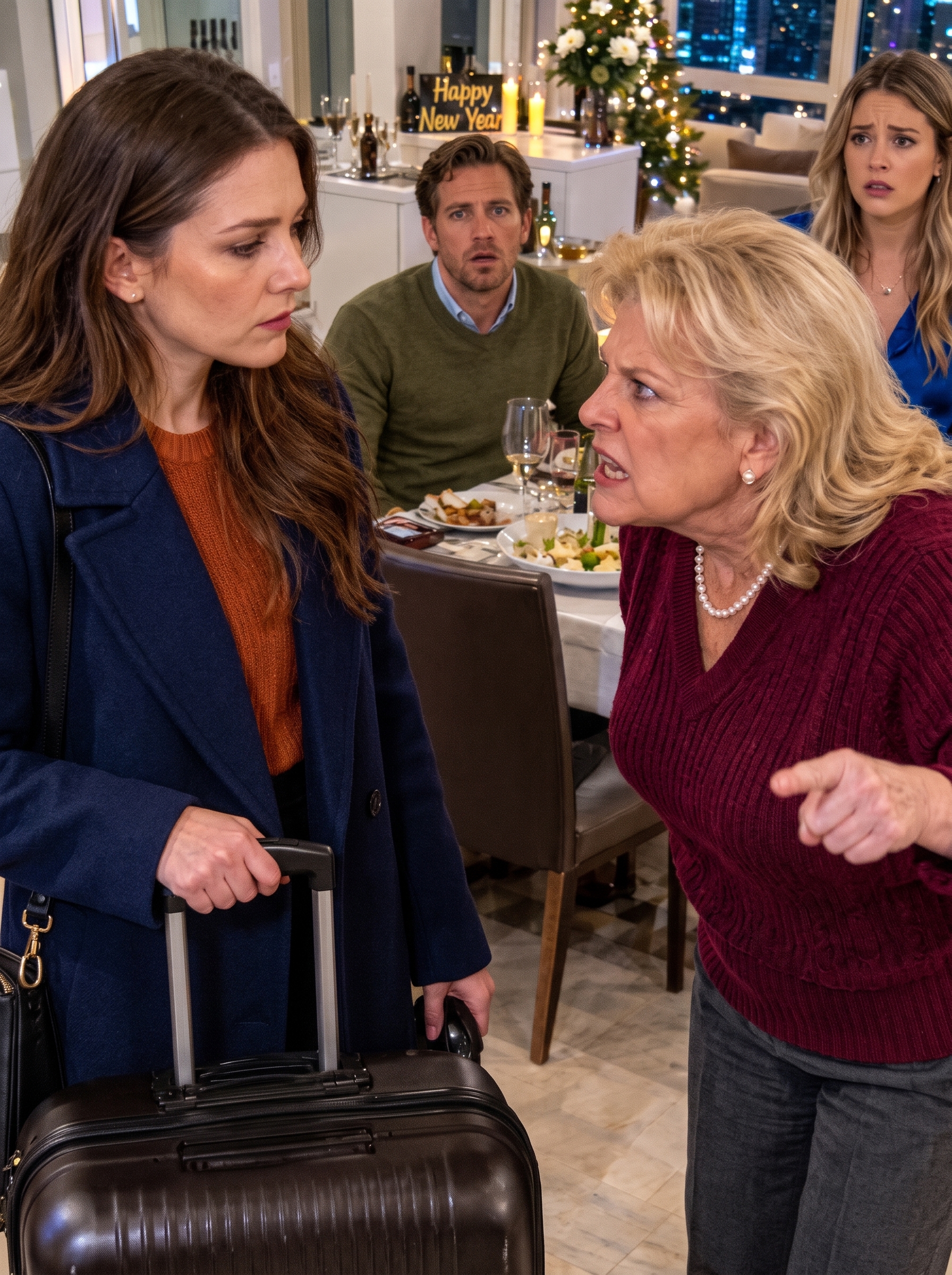
Everyone’s freezing,” and I calmly replied, “Why is that suddenly my responsibility?”
Chloe was twenty-six and had not held a full-time job since graduating from college. She had been staying with us “for a few weeks” for almost two years. Her belongings had slowly taken over the guest room, half the hallway closet, and an entire cabinet in my bathroom.
But somehow, she had become the authority on homemaking.
I carried another serving dish from the kitchen and placed it on the table.
Deborah tasted the roasted pork and frowned.
“Too salty.”
Arthur kept eating.
“Arthur,” Deborah said, “you really ought to say something.”
He glanced up.
“About what?”
“About your wife.”
That phrase bothered me more than it should have.
Your wife.
Not Eleanor.
Not our daughter-in-law.
Not family.
A problem attached to him.
Deborah leaned back in her chair.
“Three years of marriage, and she still acts like she’s living by herself.”
I stared at her.
The irony was so enormous that for a second I wondered if she was making a joke.
I was the one who woke before six to prepare coffee.
I was the one who ordered groceries.
I was the one who remembered Deborah’s prescriptions, Chloe’s favorite yogurt, Arthur’s dry cleaning, the HOA notices, the maintenance appointments, the utility renewals, the insurance paperwork, and every birthday that mattered to his family.
I had spent three years making sure everyone else could move through their days without noticing the machinery beneath their comfort.
And apparently that was the problem.
I had made it look too easy.
Deborah continued.
“A wife should bring people together. She should make a family feel cared for.”
I placed my fork down.
Arthur finally looked at me.
His expression wasn’t angry.
That would almost have been easier.
He simply looked tired of the conversation.
As though my humiliation were an inconvenience happening near him.
“Mom,” he murmured, “it’s New Year’s Eve.”
“I’m trying to help you.”
“You’ve made your point.”
“No, I don’t think I have.”
She turned toward me.
“You barely speak to us unless we speak to you first. You come home from work and act exhausted. You disappear into the bedroom with your laptop. Half the time, I don’t even know what you do at that company.”
I almost answered.
Then I stopped.
That was another thing nobody in Arthur’s family had ever really asked.
They knew I worked in finance.
They assumed that meant something vague involving spreadsheets.
Deborah once introduced me to a neighbor by saying, “Eleanor does office work downtown.”
I had never corrected her.
I was the director of finance for the North American division of an international manufacturing company.
The previous year, my total compensation had crossed four hundred thousand dollars.
I didn’t talk about it because money had never been something I used to measure people.
Maybe that had been my mistake.
Arthur knew approximately what I earned.
But even he had never seemed interested in the actual number. We kept separate personal accounts, and because I already owned the condo, I had simply continued paying the household expenses.
At first, it felt practical.
Then his mother moved in temporarily after selling her house.
Then Chloe needed somewhere to stay while she “figured things out.”
Then temporary became normal.
My groceries doubled.
My utilities climbed.
My peaceful two-bedroom condo became a four-person household.
Arthur kept transferring money to his mother every month.
I kept paying for everything else.
And because I never complained loudly enough, everyone concluded there was nothing to complain about.
Deborah was still talking.
“Look at the Hendersons downstairs. Susan works, keeps a beautiful house, always looks cheerful, and they already have a little boy.”
The room went still.
There it was.
The subject that always arrived eventually.
I looked at Arthur.
He moved a piece of rice around his plate.
“Mom.”
“What? I’m saying what everyone is thinking.”
“No,” I said.
It was the first thing I had said in several minutes.
Deborah blinked.
“No?”
“You’re saying what you’re thinking.”
At New Year’s Eve dinner, my mother-in-law ordered me out of the house, so I quietly went home without arguing, but at midnight my husband called demanding, “Why did you turn off the heat?
Everyone’s freezing,” and I calmly replied, “Why is that suddenly my responsibility?”
PART 2
She stared at me as though the distinction offended her.
“Eleanor, I don’t like your tone.”
“My tone is fine.”
Chloe stopped scrolling.
Arthur looked at me now.
Really looked.
Maybe he finally heard something different in my voice.
Deborah certainly did.
She straightened.
“Excuse me?”
I pushed my chair back and stood.
“I’m done with dinner.”
“You’ve barely eaten.”
“I’m not hungry anymore.”
“You don’t get to walk away every time someone tells you something you don’t want to hear.”
I turned toward the bedroom.
“Eleanor.”
I kept walking.
“Eleanor, I’m speaking to you.”
I stopped at the hallway entrance.
When I turned around, Deborah was standing.
Arthur had not moved.
Chloe watched us with open curiosity.
Deborah pointed toward the front door.
“If you’re going to behave this way, maybe you should spend the holiday with your own family.”
Nobody spoke.
I looked at Arthur.
He looked back at me.
This was his moment.
Not mine.
His.
One sentence would have changed the evening.
Mom, this is Eleanor’s home.
Mom, enough.
Mom, apologize.
Anything.
Instead, he said, “Can everybody just calm down?”
Deborah folded her arms.
“I am perfectly calm.”
Then she looked directly at me.
“Go on. Go back to your mother. Maybe a few days away will help you remember how people are supposed to behave in a family.”
Something changed in me.
Three years of arguments suddenly became irrelevant.
I didn’t need Deborah to understand me.
I didn’t need Chloe to respect me.
And, most painfully, I no longer needed Arthur to choose me.
I nodded.
“Okay.”
Deborah’s expression shifted.
“What?”
“I said okay.”
I walked into the bedroom.
Arthur followed thirty seconds later.
I opened the closet and pulled out a suitcase.
He stood in the doorway.
“Ellie.”
I didn’t answer.
“Come on.”
I placed folded clothes inside.
“You know how Mom gets.”
I zipped one side compartment.
“She doesn’t mean everything she says.”
I put my laptop charger into the front pocket.
“Ellie.”
“What?”
“Don’t do this.”
I finally looked at him.
“Do what?”
“Turn this into something bigger.”
For a moment, I simply stared at him.
It was almost impressive.
His mother had told me to leave my own home, and somehow I was the one turning it into something bigger.
“She told me to go.”
“She was upset.”
“And you?”
“What about me?”
“You were sitting three feet away.”
Arthur rubbed the back of his neck.
“What exactly did you want me to do? Start another argument?”
“No.”
I closed the suitcase.
“I wanted you to be my husband.”
His face changed.
That landed.
But not enough.
He lowered his voice.
“Can we talk about this tomorrow?”
“No.”
“Eleanor.”
“I’m going to my parents.”
“On New Year’s Eve?”
“Yes.”
“What are people going to think?”
That sentence ended whatever small hesitation remained in me.
Not how do we fix this.
Not are you okay.
Not please stay.
What will people think?
I picked up my suitcase.
Arthur remained in the doorway.
When I approached, he stepped aside.
I walked past him.
Deborah and Chloe were still near the dining table.
Deborah lifted her eyebrows when she saw the suitcase.
“You’re actually leaving?”
“You told me to.”
“Oh, please. A grown woman should know the difference between someone speaking emotionally and an actual invitation to leave.”
“Then maybe a grown woman should know not to say things she doesn’t mean.”
Her mouth tightened.
Chloe gave a little laugh.
I put on my coat.
Then I took out my phone.
There were four automatic payment schedules connected to the household accounts.
Gas.
Electricity.
Water.
Building services.
I had been meaning to reorganize them for months.
That night, I finally did.
I didn’t request immediate shutoffs. I didn’t interfere with anything already paid.
I simply canceled my automatic renewals.
If the people living there wanted services, they could put the accounts under their own names and pay for them like adults.
It took less than a minute.
Chloe noticed me tapping the screen.
“What are you doing?”
“Taking care of something.”
I slipped the phone into my coat pocket.
Then I opened the door.
“Happy New Year.”
Arthur had followed me into the foyer.
“Ellie—”
I looked at him once.
He stopped.
I walked out.
The hallway was cooler than the condo, and the quiet felt almost luxurious.
Inside the elevator, I saw my reflection in the mirrored wall.
No tears.
No trembling hands.
No dramatic breakdown.
I looked tired.
That was all.
Tired beyond anger.
Tired beyond hope.
The elevator reached the lobby.
My phone buzzed before I even reached the street.
Arthur.
I ignored it.
My father arrived twenty minutes later.
He had offered to pick me up the moment I texted.
He didn’t ask for an explanation when I got into the car.
He simply turned up the heat and said, “Your mother made soup.”
That nearly undid me.
Not because soup mattered.
Because care did.
At my parents’ apartment, my mother opened the door before we reached it.
She wrapped her arms around me.
I stood there in the hallway, still holding my suitcase.
“You don’t have to tell me anything tonight,” she whispered.
And for the first time in three years, I felt no obligation to immediately solve somebody else’s problem.
My old bedroom had become part storage room and part sewing room, but my mother had already changed the sheets.
I showered.
I put on an old college sweatshirt.
I climbed into bed.
Around midnight, fireworks began glowing beyond the windows.
My phone lit up several times.
Arthur.
Arthur again.
Chloe.
Arthur.
Then Deborah.
I turned the phone face down.
At 12:14 a.m., Arthur called again.
This time I answered.
“Hello?”
His voice came fast.
“Ellie, something’s wrong with the heat.”
I stared at the ceiling.
“Okay.”
“The furnace isn’t running.”
“Then call the service company.”
“I tried checking the account. It says the automatic payment isn’t active.”
“That’s correct.”
Silence.
“What do you mean, that’s correct?”
At New Year’s Eve dinner, my mother-in-law ordered me out of the house, so I quietly went home without arguing, but at midnight my husband called demanding, “Why did you turn off the heat?
Everyone’s freezing,” and I calmly replied, “Why is that suddenly my responsibility?”
PART 3
“I canceled automatic payments connected to my account.”
“Why would you do that?”
“Because I no longer live there.”
“Eleanor, you left two hours ago.”
“Your mother told me there was no place for me in that home.”
“She was angry.”
“And now I’m elsewhere.”
“Ellie, please don’t play games.”
My voice remained level.
“I’m not playing anything. The condo is mine. The household accounts are mine. I paid them because I lived there. I no longer live there.”
“Can’t you just reactivate the payment? We’ll sort everything out tomorrow.”
“No.”
He seemed genuinely stunned.
“Mom’s here. Chloe’s here.”
“I know.”
“It’s cold.”
“Then open accounts in your names.”
“It’s a holiday.”
“That sounds inconvenient.”
“Eleanor.”
I closed my eyes.
For three years, inconvenience had been mine.
I had rearranged meetings because Deborah needed rides.
I had left work early for building appointments because Arthur was busy.
I had spent Saturday mornings grocery shopping because Chloe forgot the list.
I had prepared family dinners after twelve-hour days because everyone expected dinner to appear.
Now, for once, inconvenience belonged to somebody else.
“Arthur, listen carefully. I bought that condo before our marriage. My name is the only name on the deed. Every regular household bill has come from my account for three years. Your mother told me to leave, and you allowed it. I left.”
His breathing changed.
“I know the condo is yours.”
“Do you?”
“Of course I do.”
“Then start acting like it.”
I ended the call.
He called back.
I turned off my phone.
Outside, fireworks continued across the winter sky.
Inside, my mother’s apartment was warm.
I slept until ten the next morning.
Arthur did not.
By dawn, he had rediscovered several facts he had spent years ignoring.
The first was written on the condo deed.
Eleanor Hayes.
The second appeared in three years of household statements.
Eleanor Hayes.
The third was more difficult to admit because it wasn’t written anywhere.
He had not been providing the life he thought he had been providing.
Eleanor had.
Arthur had always considered himself responsible.
He had a respectable position in procurement operations. He earned a good salary. He helped his mother financially. He had savings.
Those facts had allowed him to think of himself as the dependable center of his family.
But he had savings largely because his housing cost had been zero.
His utility cost had been zero.
Most of his grocery cost had been zero.
Furniture?
Eleanor.
Appliances?
Eleanor.
HOA fees?
Eleanor.
Insurance connected to the property?
Eleanor.
Repairs?
Usually Eleanor.
Cleaning supplies, household basics, replacement linens, holiday dinners, subscriptions his mother enjoyed?
Again and again, Eleanor.
Arthur sat in the cold living room on New Year’s morning and opened his banking app.
For the first time, he tried to calculate what independent life would actually cost.
His stomach tightened.
Deborah emerged from the guest room wearing two sweaters.
“Has Eleanor fixed the heat?”
“No.”
“What do you mean, no?”
“She canceled her automatic payments.”
Deborah stared at him.
“She did what?”
Chloe appeared behind her wrapped in a blanket.
“That’s unbelievably petty.”
Arthur looked at his sister.
Something about the sentence irritated him.
Maybe because twelve hours earlier he would have agreed.
Now he couldn’t.
“She doesn’t live here anymore.”
Deborah waved a hand.
“She’ll come back.”
“No.”
The certainty in his voice made both women pause.
Arthur looked toward the kitchen.
Eleanor’s coffee machine sat beneath the cabinet.
Her labels were on the pantry containers.
Her handwriting was on the calendar.
Her life was everywhere.
And for the first time, it looked less like decoration and more like evidence.
Deborah crossed her arms.
“Call her.”
“I did.”
“And?”
“She said the accounts are our responsibility now.”
“Our responsibility?”
“Yes.”
“What kind of wife does that?”
Arthur looked at his mother.
Then he said something he had never said before.
“Mom, this condo belongs to Eleanor.”
Deborah blinked.
“I know you two are married.”
“No. I mean it legally belongs to Eleanor. She bought it before we married. Her name is the only one on the deed.”
The room went silent.
Chloe lowered her blanket.
“This is Ellie’s condo?”
“Yes.”
Deborah gave an incredulous laugh.
“That doesn’t make sense.”
“It makes perfect sense.”
“How could she afford a place like this?”
Arthur hesitated.
Because that question revealed another thing he had allowed his family to misunderstand.
“She earns more than I do.”
“How much more?”
“A lot.”
Deborah’s expression sharpened.
“How much is a lot?”
Arthur rubbed his forehead.
“Her compensation last year was a little over four hundred thousand.”
Chloe stared at him.
“Four hundred thousand dollars?”
“Yes.”
“Per year?”
“Yes, Chloe.”
Deborah sat down slowly.
For several seconds, nobody spoke.
Then she looked around.
The condo seemed to change before her eyes.
The Italian dining table she had criticized.
Eleanor’s expensive but understated sofa.
The renovated kitchen.
The quiet building in one of the better neighborhoods in Chicago.
For three years, Deborah had proudly told friends that her son had done well for himself.
She had believed this was Arthur’s home.
She had believed Eleanor was fortunate to be living there.
Reality had been exactly the opposite.
“And the HOA?” Deborah asked quietly.
“Ellie pays it.”
“The electricity?”
“Yes.”
“The water?”
“Yes.”
“The groceries?”
“Mostly.”
Deborah looked toward the dining table where the remains of Eleanor’s New Year’s dinner still sat.
“What do you pay?”
Arthur didn’t answer.
“Arthur.”
“My own expenses.”
“And?”
“I give you money every month.”
“That’s not what I asked.”
He looked away.
Deborah understood.
The color left her face.
Chloe sat down beside her.
“So we’ve been living here because Eleanor allowed us?”
Arthur nodded.
Deborah whispered, “For three years?”
“Yes.”
Her eyes moved toward the hallway.
Less than twenty-four hours earlier, she had stood there and told Eleanor to leave.
The woman whose name was on the deed.
The woman paying the household bills.
The woman who had cooked the dinner Deborah criticized.
A strange expression crossed her face.
Not remorse.
Not yet.
Fear came first.
“What do we do now?”
Arthur stood.
“I’m going to Eleanor’s parents.”
“I’m coming with you.”
He stared at her.
“Mom—”
“I said I’m coming.”
Chloe sat upright.
“Me too.”
The three of them arrived at my parents’ building shortly after noon.
I knew because my father looked through the window and said, “Well. The committee has arrived.”
My mother stopped arranging dishes.
“Arthur?”
“And company.”
I was sitting at the kitchen table with coffee.
My body tensed automatically.
Then I reminded myself that I was home.
Really home.
“You don’t have to see them,” Dad said.
“I know.”
“Do you want to?”
“No.”
That was the answer.
Simple.
Powerful.
No.
My father went to the door.
I stayed in the kitchen.
Even from there, I could hear Arthur.
“Dad, I just want to speak with Ellie.”
“You can call me Robert.”
A pause.
“Robert, please.”
“She doesn’t want to speak with you.”
Then Deborah’s voice.
“We came to apologize.”
Dad almost laughed.
“What fortunate timing.”
“I’m serious.”
“So am I.”
“This is a family matter.”
“My daughter is my family.”
“So is she to us.”
That time Dad actually laughed.
“Interesting. Yesterday she apparently wasn’t.”
Deborah’s voice lowered.
“I spoke emotionally.”
“You told her to leave her own home.”
“I didn’t understand—”
My father interrupted.
“That it was hers?”
Silence.
That silence told him everything.
He continued more quietly.
“So that’s why you’re here.”
“No,” Deborah said quickly.
“We genuinely want to repair things.”
“Would you be standing outside this door if the condo belonged to Arthur?”
Nobody answered.
I looked down at my coffee.
My mother reached across the table and squeezed my hand.
In the hallway, Chloe began explaining that everyone had misunderstood one another.
My father was unimpressed.