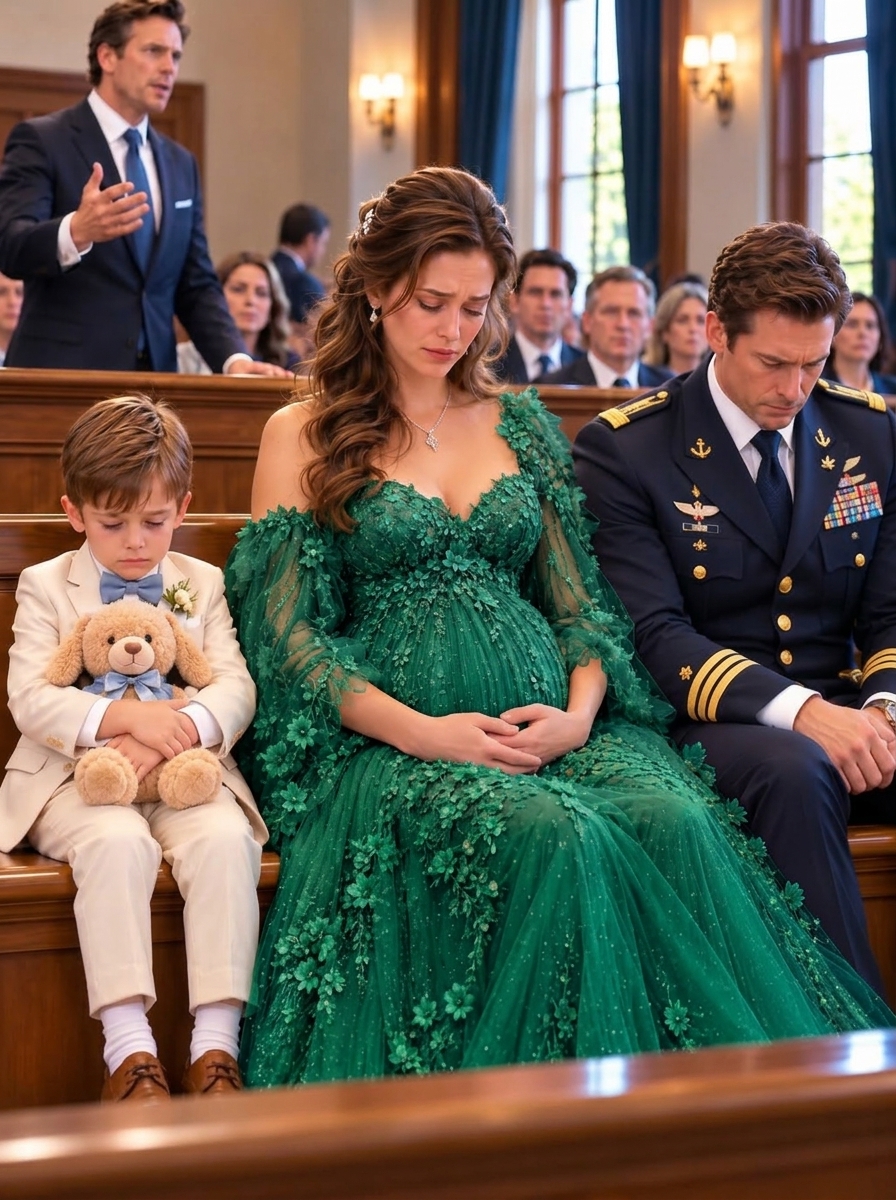
The envelope felt surprisingly heavy in my hand.
Not physically.
It contained only a few folded pages.
But there are moments when paper can weigh more than stone.
Julian stepped toward me.
“Audrey.”
Maria immediately moved between us.
“Not here.”
“I just want to explain.”
“You’ve had months to explain,” I said.
He stopped.
That was the strange thing about Julian.
During our marriage, his apologies had usually arrived wrapped in explanations.
He hadn’t forgotten dinner; a client called.
He hadn’t ignored my messages; his battery died.
He hadn’t meant to hurt me; I misunderstood.
Even the affair had initially arrived disguised as something else.
Clara understands the pressure I’m under.
Clara helps with business decisions.
Clara is just a friend.
By the time he admitted the truth, I had become allergic to explanations.
I slipped the envelope into my purse.
“I’ll read it when I’m ready.”
His face changed.
Not anger.
Resignation.
“All right.”
Leo tugged my sleeve.
“Can we get lunch?”
The ordinary question rescued everyone.
The child advocate smiled.
“That sounds like an excellent idea.”
Julian glanced at Leo.
“I can take you.”
Leo hesitated.
Children notice hesitation in adults long before they understand why it exists.
I refused to make him choose.
“How about all of us eat downstairs?”
Julian looked surprised.
So did Maria.
I added quickly, “In the cafeteria.”
Clara shifted behind him.
I looked at her.
“Not all of us.”
She nodded once.
There was no argument.
No sarcastic laugh.
No theatrical exit.
She simply picked up her handbag.
“I’ll leave.”
Julian turned.
“Clara.”
“No.”
Her voice was quiet.
“You need to be with your son.”
Something passed between them.
Something complicated.
Then she walked away.
I expected satisfaction.
Instead I felt tired.
The courthouse cafeteria served grilled cheese sandwiches that tasted mostly like butter and tomato soup that had probably come from a can.
Leo thought it was wonderful.
He sat between Julian and me, dipping triangular pieces of sandwich into his soup while explaining an elaborate playground disagreement involving two first-graders, a soccer ball, and a rule no adult could understand.
For ten minutes, our divorce disappeared.
We were simply two people listening to a child explain his day.
Then Leo asked, “Where am I sleeping tonight?”
Julian and I looked at each other.
There it was.
The question beneath every other question.
Where do I belong now?
Julian answered first.
“At home.”
Leo frowned.
“Which home?”
I looked down at my soup.
Julian had no answer.
Neither did I.
The child advocate, Ms. Hanley, had joined us at the next table. She didn’t interrupt, but her presence reminded me that we needed to do better.
I looked at Leo.
“You have two places where people love you.”
He considered that.
“But my room is at Daddy’s.”
“Your room can stay there.”
“And Audrey’s?”
I swallowed.
The house was technically still ours.
The settlement I had offered would have given it entirely to Julian.
But the judge had stopped that.
“For now,” I said, “I’m staying there too.”
Julian shifted.
I ignored him.
Leo nodded as if the matter were settled.
Then he returned to his sandwich.
Children sometimes accept a temporary truth more easily than adults.
After lunch, Julian took Leo to his sister’s house.
I went home with Maria.
Our home.
For the first time, I understood why I had avoided calling it that.
The word hurt.
The living room looked exactly as it had that morning.
Leo’s sneakers were beneath the coffee table.
A blanket was folded across the sofa.
A bowl of decorative lemons sat on the kitchen island because six months earlier I had seen a magazine photograph and decided our kitchen needed yellow.
Ridiculous details.
The marriage was ending.
The lemons remained.
Maria made tea.
I sat at the table with Julian’s envelope in front of me.
“You don’t have to read it today,” she said.
“Yes, I do.”
“Audrey—”
“I’ve spent too long refusing to know things because knowing them hurt.”
I opened the envelope.
There were four pages.
The first was dated five months earlier.
Before I discovered the affair.
Before Julian asked for a divorce.
Before I realized our marriage had already begun collapsing.
Audrey,
If you’re reading this, either the business failed or I lost my nerve and finally told you how bad things are.
Neither opening made me feel better.
I continued.
Julian wrote that Vance Custom Millwork had signed a major hotel renovation contract the previous year.
The project was supposed to transform the business.
He hired workers.
Leased additional equipment.
Bought materials on credit.
Then the developer stopped paying invoices.
Three hundred and forty thousand dollars remained unpaid.
The company borrowed against future contracts to cover payroll.
A second client delayed payment.
By January, Julian was moving money between accounts to keep employees paid.
He didn’t tell me.
He wrote that he was ashamed.
I stopped reading.
“Of what?” I whispered.
Maria sat across from me.
“What?”
“He says he was ashamed.”
She waited.
I picked the pages up again.
Julian had spoken to Clara at a commercial real-estate conference.
She worked for Sterling Development Partners and had experience restructuring struggling contractors.
At first, according to the letter, she helped professionally.
She introduced him to an attorney.
An accountant.
Two potential investors.
The proposed Sterling-Vance company would have acquired certain contracts while Vance Custom Millwork settled its debts.
Somewhere during those meetings, their relationship crossed a line.
Julian didn’t describe it.
For that, I was grateful.
He wrote only:
I made one failure into two.
My vision blurred.
I continued.
The family trust had been proposed by the restructuring attorney.
Because our house contained substantial equity and because Julian had personally guaranteed several business obligations, the attorney suggested reviewing what could legally be protected for family purposes before any additional guarantees were made.
The trust was never finalized.
According to Julian, another attorney warned him that transferring assets while creditors were looming could create serious legal problems.
So he stopped.
That explained the reversed bank transfers.
It did not explain why he hid everything from me.
The last page did.
I told myself I was protecting you from stress because of the pregnancy.
The truth is uglier.
I was afraid you would look at me and see a failure.
So I made sure you saw confidence instead.
Then when Clara knew everything and you knew nothing, being around her became easier.
She knew the numbers.
She knew the fear.
You knew the version of me I was trying to pretend still existed.
I used that difference as an excuse for what I did.
It wasn’t one.
I lowered the paper.
The kitchen went silent.
For months, I had imagined Julian’s affair as a simple equation.
He wanted Clara more than he wanted me.
Perhaps that was still partly true.
But human beings rarely destroy their lives for one clean reason.
Julian had built an entire second world because he couldn’t bear for me to see the first one failing.
Then he chose someone who already knew.
Understanding did not forgive him.
But it changed the shape of the wound.
I read the final paragraph.
If the business collapses, I want Audrey protected first.
If our marriage survives this, I’ll tell her everything.
If it doesn’t, these instructions still stand.
The house should go to Audrey.
Enough cash should be reserved for one year of expenses.
Leo’s education account should remain untouched.
Anything left belongs to the creditors before it belongs to me.
I folded the letter.
Maria watched me carefully.
“Are you all right?”
“No.”
Then, after a moment, “But I’m clearer.”
That evening, Leo stayed with Julian’s sister.
Julian didn’t come home.
He texted once.
I booked a hotel. I won’t come to the house unless you ask.
I didn’t reply.
Around nine, another message arrived.
This one from Clara.
I almost deleted it.
Instead I opened it.
I owe you an apology. Not because Julian and I made mistakes. That is too small a word. I knew he was married. I knew you were pregnant. Nothing about the business excuses that.
I stared at the screen.
Another message appeared.
But there’s something you should know about the settlement. I did not tell him to ask for everything.
My pulse quickened.
Then:
I told him the opposite.
I called Maria.
She came over the next morning.
Clara agreed to meet us at a coffee shop near Maria’s office.
I hated the idea.
But I went.
Clara was already seated in the back corner when we arrived.
Without courtroom makeup and the sharp blue dress she’d worn the previous day, she looked less formidable.
Still elegant.
Still unmistakably the woman whose messages I had found on my husband’s phone.
But tired.
She stood.
“Thank you for coming.”
I didn’t answer.
Maria sat beside me.
Clara pushed a folder across the table.
Not blue.
Gray.
“What is this?” Maria asked.
“Emails between Julian and me.”
My stomach twisted.
“I don’t want to read your personal messages.”
“They aren’t personal.”
“Then why should I care?”
“Because he’s lying to you about something else.”
I almost stood.
Maria placed a hand on the table.
“Let her finish.”
Clara looked directly at me.
“When Julian told me you had agreed to give him the house and your share of the savings, I told him not to accept.”
I laughed.
“You laughed in court.”
Her face tightened.
“Yes.”
“Why?”
She looked embarrassed.
“Because I was nervous and defensive and behaving badly.”
The simple answer surprised me more than an excuse would have.
“I thought the settlement was theatrical,” she continued. “I thought you were making an offer you knew the judge would reject.”
“I wasn’t.”
“I understand that now.”
She opened the folder.
“Julian told me you wanted nothing associated with him.”
“That part is true.”
“He also said you refused to discuss finances.”
“That part is true too.”
Clara’s eyes softened slightly.
“He interpreted that as permission.”
“Permission for what?”
“To give you as little information as possible.”
I looked at Maria.
She was already reading.
Clara continued.
“I told him disclosure wasn’t optional just because you didn’t want a fight.”
“Why would you care?”
The question came out sharper than I intended.
Clara accepted it.
“Because I made enough selfish decisions already.”
She looked down at her coffee.
“And because I watched my parents destroy each other financially when I was twelve.”
That was not what I expected.
“My mother signed everything my father put in front of her because she wanted the divorce finished. Two years later she discovered debts she hadn’t known existed.”
She looked back at me.
“I wasn’t going to participate in that.”
I wanted to dislike her answer.
Instead it sounded painfully believable.
Maria turned one of the printed emails toward me.
Julian,
Audrey needs independent counsel and complete disclosure before signing anything. If she wants to waive assets after that, it’s her decision. But do not confuse exhaustion with informed consent.
The email was dated eleven days earlier.
I read it twice.
“Julian never told me.”
Clara shook her head.
“No.”
“Why?”
“I think he was scared.”
“Of losing money?”
“No.”
She paused.
“Of you discovering how close the business came to failing.”
I leaned back.
“That still makes no sense.”
“To him, I think it does.”
Clara folded her hands.
“He built his identity around providing for people.”
“He cheated on the people he was supposedly providing for.”
“Yes.”
No defense.
No excuse.
Just yes.
Maria continued reading.
Then she stopped.
“What is this?”
Clara’s expression changed.
“What?”
Maria pointed to a line near the bottom of one page.
“This payment.”
I looked over.
$48,000.
Recipient: EV Family Holdings.
Maria asked, “Who is EV?”
Clara shook her head.
“I don’t know.”
“You were helping restructure the company.”
“That account isn’t part of the restructuring.”
Maria flipped pages.
Another payment.
$12,000.
Then $9,500.
Then $21,000.
All to the same recipient.
My skin went cold.
“EV.”
I knew those initials.
Evelyn Vance.
Julian’s mother.
I hadn’t seen her in almost four years.
Julian barely spoke to her.
Their relationship had fractured after his father died.
According to Julian, Evelyn had wanted to sell the family’s old woodworking property in southern Missouri.
Julian believed it should remain in the family.
They stopped speaking after a terrible argument.
At least that was the story I knew.
Maria looked at me.
“You recognize the name?”
“Maybe.”
Clara seemed genuinely puzzled.
“These transfers started almost eighteen months ago.”
“Before the business trouble?”
“Yes.”
My heart began pounding.
“Before you?”
Her face tightened.
“Yes.”
Maria closed the folder.
“We need to ask Julian.”
I shook my head.
“No.”
Both women looked at me.
“I’ve spent seven years learning things only after Julian decided which version I could handle.”
I stood.
“This time I want the records first.”
Over the next three days, Maria’s financial analyst traced the payments.
They weren’t secret gifts.
They weren’t hidden affair expenses.
They weren’t money Julian had stolen from the business.
They were loan repayments.
Eighteen months earlier, Evelyn Vance had loaned Julian nearly one hundred thousand dollars.
Privately.
No bank.
No public filing beyond a promissory note Julian kept in his office.
Why?
The answer arrived Friday afternoon.
Maria called while I was folding tiny newborn clothes in the nursery.
“We found the original deposit.”
“And?”
“The money Evelyn loaned Julian didn’t go into the company.”
I sat down slowly in the rocking chair.
“Where did it go?”
“A title company.”
“For what?”
There was a pause.
“Your house.”
I stared through the nursery doorway toward the hallway.
The house Julian was willing to accept from me.
The house I had offered to surrender.
“What are you saying?”
“When you refinanced eighteen months ago, there was a lien problem from the original construction loan. Julian needed funds to clear it.”
“He told me the refinance was routine.”
“It wasn’t.”
My mouth went dry.
“Why would his mother loan him money for the house?”
“We don’t know.”
I looked around the nursery.
The pale green walls.
The wooden crib Julian and Leo had assembled together.
The little mobile with clouds above it.
Then I remembered something.
A conversation from years earlier.
Evelyn standing on our back porch during Leo’s fourth birthday party.
She had watched me cut cake while Julian took photographs.
She said something I barely remembered until that moment.
You gave that boy a mother when nobody asked you to.
I had laughed.
“He already has a mother.”
Leo’s biological mother lived in Oregon and called regularly, but because of work and distance, Leo spent most of his time with Julian and me.
Evelyn had squeezed my hand.
I know. I’m saying there’s more than one way to mother a child.
I stood abruptly.
“Maria.”
“Yes?”
“I need Evelyn’s address.”
“What are you planning?”
“I want to talk to her.”
We found Evelyn the following afternoon.
Not hidden.
Not gone.
Living two hours away in a small brick house outside Rolla.
When she opened the door, she looked older than I remembered.
Gray had overtaken her dark hair.
Her expression changed when she saw me.
“Audrey?”
I held my coat closed over my stomach.
“Can we talk?”
She stared at me for several seconds.
Then she stepped aside.
Her living room smelled like cinnamon tea.
Photographs covered one wall.
Julian as a child.
Julian with his father.
Leo as a baby.
And, near the center, a photograph of me holding Leo at his preschool graduation.
I looked at it.
Evelyn noticed.
“He sends pictures.”
I turned.
“Julian?”
She nodded.
“I thought you weren’t speaking.”
“We aren’t.”
“That makes no sense.”
A sad smile appeared.
“Families often don’t.”
We sat.
I asked about the loan.
Evelyn was silent for a long time.
Then she said, “Julian didn’t ask me.”
“What?”
“I offered.”
“How did you know he needed money?”
“Because the title company called me.”
“Why would they call you?”
Evelyn looked toward the photographs.
“Because I still owned part of the land beneath your house.”
The room became very quiet.
“Our house?”
“The lot.”
I stared at her.
“Julian told me his father gave him that property.”
“He did.”
“Then why did you own it?”
“Because Daniel didn’t give it only to Julian.”
She rose slowly and walked to a wooden cabinet.
From inside she removed an old envelope.
She handed it to me.
Inside was a copy of a deed.
Three names were listed.
Daniel Vance.
Evelyn Vance.
Julian Vance.
I frowned.
“I don’t understand.”
“After Daniel died, his share transferred according to his estate.”
“To Julian?”
Evelyn shook her head.
“No.”
She looked at me.
“To Leo.”
My breath caught.
The land beneath our house was partially owned by a six-year-old child.
Evelyn leaned back.
“Julian has spent years trying to straighten out what Daniel did.”
“Why wouldn’t he tell me?”
“Because he was furious with his father.”
“Why?”
She looked toward the window.
“Daniel didn’t trust Julian with everything.”
The statement hurt despite having nothing to do with me.
Evelyn continued.
“He loved his son. But he knew Julian’s greatest strength and greatest weakness were the same.”
“What was that?”
“He believed he had to solve every problem alone.”
I thought about the business.
The debt.
Clara.
The hidden letter.
Our marriage.
Evelyn sighed.
“Daniel wanted part of the property preserved for Leo so Julian could never mortgage all of it for a business venture.”
My eyes closed.
“That is exactly what Julian tried to do.”
“Yes.”
“And you loaned him money instead.”
“To clear the lien without touching Leo’s interest.”
“Why?”
She looked surprised by the question.
“Because you lived there.”
I didn’t understand.
Then she added quietly, “And because Leo lived there.”
My throat tightened.
Evelyn reached for my hand.
I let her take it.
“I didn’t loan Julian that money so he could own the house.”
“Then why?”
“So the children would always have somewhere to come home to.”
Children.
Plural.
I looked down at my stomach.
Evelyn smiled faintly.
“He told me about the baby.”
Despite everything, I smiled too.
“It’s a girl.”
Her eyes filled.
“Oh.”
For several moments, neither of us spoke.
Then Evelyn said something that changed the question I had been asking since the courthouse.
“You think Julian wants the house.”
“He accepted it.”
“He may have accepted your offer.”
“That sounds like the same thing.”
“It isn’t.”
I studied her face.
“What do you mean?”
Evelyn squeezed my hand.
“Ask him who he intended to put on the deed after the divorce.”
My heart began beating faster.
“Who?”
She shook her head.
“That answer should come from him.”
That evening, I drove home with the deed beside me on the passenger seat.
Julian was standing on the front porch.
He had come to pick up Leo’s school tablet.
When he saw my car, he stepped back as if he expected me to tell him to leave.
I got out.
He noticed the envelope.
His face changed.
“You went to see my mother.”
“Yes.”
“Audrey—”
“Who were you going to put on the deed?”
He went completely still.
I walked closer.
“You accepted the house in our settlement. Who were you going to give it to?”
He looked down.
For once, I didn’t let silence rescue him.
“Julian.”
His voice was barely above a whisper.
“You.”
I stared at him.
“And Leo.”
He swallowed.
“And the baby.”
Everything I thought I understood shifted again.
Not enough to repair our marriage.
Not enough to erase betrayal.
But enough to reveal something I had not expected.
Julian had been lying to me.
Again.
Only this time, the lie had hidden something he never intended to keep for himself.