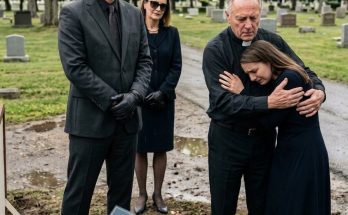
My family had a tradition. Every grandchild received ten thousand dollars at eighteen from a trust my grandfather set up in 1985. Twelve grandchildren. Twelve checks. Twelve little ceremonies around the dining room table where Grandpa would say the same thing every time.
“This isn’t free money. This is a door. Use it to step into something better.” My oldest cousin used hers for nursing school. My brother used his toward a truck. My sister put hers into a college fund.
One cousin used his for welding certification.
Another used it for rent after leaving a bad marriage.
Nobody got rich from ten thousand dollars.
But every one of us remembered the feeling.
Being seen.
Being trusted.
Being told that someone who came before us had thought about our future.
So when my son, Caleb, turned eighteen, I called the executor.
My uncle Martin.
He had handled the trust since my grandfather died.
I expected a familiar process.
A form.
A signature.
Maybe a week of waiting.
Instead, Uncle Martin cleared his throat and said, “The trust is empty.”
At first, I thought I had misheard him.
“What do you mean empty?”
“I mean there’s nothing left, Julia.”
“That’s impossible.”
“It’s been a hard few years for the market.”
“The market didn’t erase four hundred thousand dollars.”
He became quiet.
Too quiet.
My grandfather had funded that trust carefully.
He had placed money into it in 1985 when the first grandchild was born.
He added to it every year until his death.
He told all of us, proudly, that even after the first few payouts, the remaining balance should grow enough to cover every grandchild.
By the time Caleb turned eighteen, there should have been well over four hundred thousand dollars.
Enough not only for my son, but for the younger grandchildren too.
Uncle Martin sighed.
“Julia, I don’t know what you want me to say. The money is gone.”
“Then send me the records.”
“I don’t think that’s necessary.”
That was the moment my stomach turned cold.
Because honest people do not fear records.
I asked again.
He refused again.
So I got a lawyer.
Then I got a court order.
Records showed withdrawals starting in 2002.
One person.
Every month.
For twenty-two years.
My uncle had been draining the trust for his Florida vacation home.
A home the whole family visited every Thanksgiving.
The same home where we took group photos on the beach.
The same home where Uncle Martin gave speeches about family unity while the grandchildren slept on couches and air mattresses.
The same home he called “Grandpa’s blessing.”
It had been bought with Grandpa’s betrayal.
For three weeks, I barely slept.
My lawyer printed transaction histories thick enough to bruise a table.
Five thousand here.
Three thousand there.
Seven thousand.
Twelve thousand.
Emergency repairs.
Maintenance.
Consulting fee.
Executor reimbursement.
Property improvement.
The labels changed.
The destination did not.
Martin Hale.
Hale Coastal Holdings.
A contractor connected to Martin’s Florida house.
A property tax account in Martin’s name.
A line of credit secured by the vacation home.
Every document pointed to the same truth.
My uncle had not made one mistake.
He had made twenty-two years of choices.
And for twenty-two years, every holiday, he smiled at us.
He watched grandchildren turn eighteen.
He watched us hug Grandpa’s photo.
He watched us believe the tradition was safe.
And all that time, he was stealing the future one withdrawal at a time.
I could have gone quietly to court.
Part of me wanted to.
But another part of me could not stop thinking about my grandmother.
Evelyn Hale.
Ninety-two years old.
Confined to a wheelchair after a stroke.
She had not spoken more than a few words in months.
Most of the family treated her like furniture now.
They kissed her forehead.
Adjusted her blanket.
Talked around her.
Never to her.
But my grandmother had helped build that trust.
Everyone credited Grandpa because his name was on it.
But Grandma had balanced the books.
She clipped coupons, managed farm income, tracked deposits, and made sure every grandchild’s name was written correctly in the old ledger.
She deserved to know.
So I chose Christmas.
Thirty-five family members gathered at Uncle Martin’s house in Ohio.
The dining room smelled of ham, cinnamon, pine, and expensive wine.
Children ran between rooms.
Cousins hugged.
My brother joked near the fireplace.
A football game played low in the den.
My grandmother sat near the tree in her wheelchair, a red blanket over her knees, her eyes drifting from face to face.
Uncle Martin stood at the head of the table, carving knife in hand, smiling like a man with nothing to hide.
That almost made me sick.
Caleb stood beside me, tall and quiet, wearing the navy sweater I had bought him for his birthday.
He had not said much since learning the trust was gone.
At first, he shrugged and said, “It’s okay, Mom. I didn’t really need it.”
But I knew that was pride speaking.
He had planned to use that money for community college and tools for the automotive program.
He had already budgeted every dollar.
He had already imagined Grandpa helping him take that first step.
And my uncle had stolen even the dream of that.
After dinner, when coffee was served and everyone settled in the living room, I stood.
My lawyer, Denise Carter, stood quietly near the hallway.
Nobody noticed her at first.
I held a folder in both hands.
“Before dessert,” I said, “we need to talk about Grandpa’s trust.”
The room shifted.
A few cousins looked up.
Uncle Martin’s face tightened.
“Julia, this is not the time.”
“That’s funny,” I said. “You had twenty-two years to pick a better one.”
The room went silent.
My aunt Carol frowned.
“What does that mean?”
I opened the folder.
“When Caleb turned eighteen, I called Uncle Martin about his distribution. I was told the trust was empty.”
Whispers moved through the room.
My cousin Melissa sat forward.
“Empty?”
“That’s what he said.”
Uncle Martin set down his coffee cup.
“Julia is upset. This is a misunderstanding involving market losses and administrative expenses.”
“Then you won’t mind if I show the records.”
His face changed.
Not much.
But enough.
I placed the first page on the coffee table.
Then the second.
Then the third.
“Withdrawals began in March 2002. They continued monthly for twenty-two years. The money went to Uncle Martin, his holding company, contractors tied to his Florida vacation home, and property expenses connected to that house.”
Nobody spoke.
I looked around at my cousins.
“The house we all visited every Thanksgiving.”
A gasp came from my aunt.
Uncle Martin stood.
“That is enough.”
“No,” I said. “It is finally enough.”
He pointed at me.
“You have no idea what I sacrificed for this family.”
“You were executor. You had a fiduciary duty.”
He laughed bitterly.
“I was the one handling everything after Dad died. I was the one everyone called. I was the one paying taxes, hiring accountants, managing investments. Did anyone thank me?”
My cousin David said, “So you paid yourself with the grandchildren’s money?”
Uncle Martin’s face reddened.
“I took reasonable compensation.”
I lifted another document.
“Reasonable compensation does not include a Florida vacation home.”
He slammed his hand on the table.
“Your grandfather would have wanted me to enjoy life!”
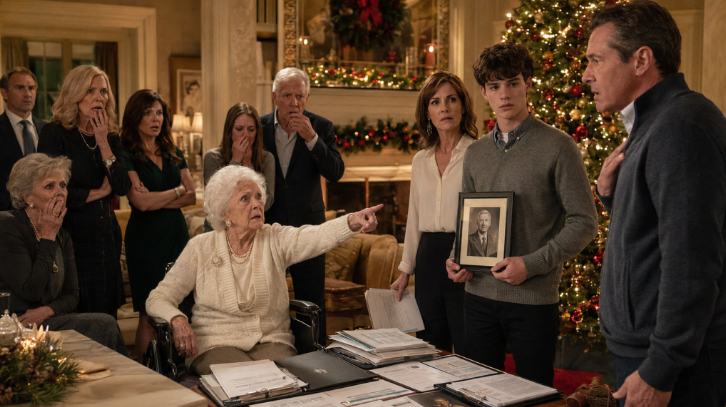
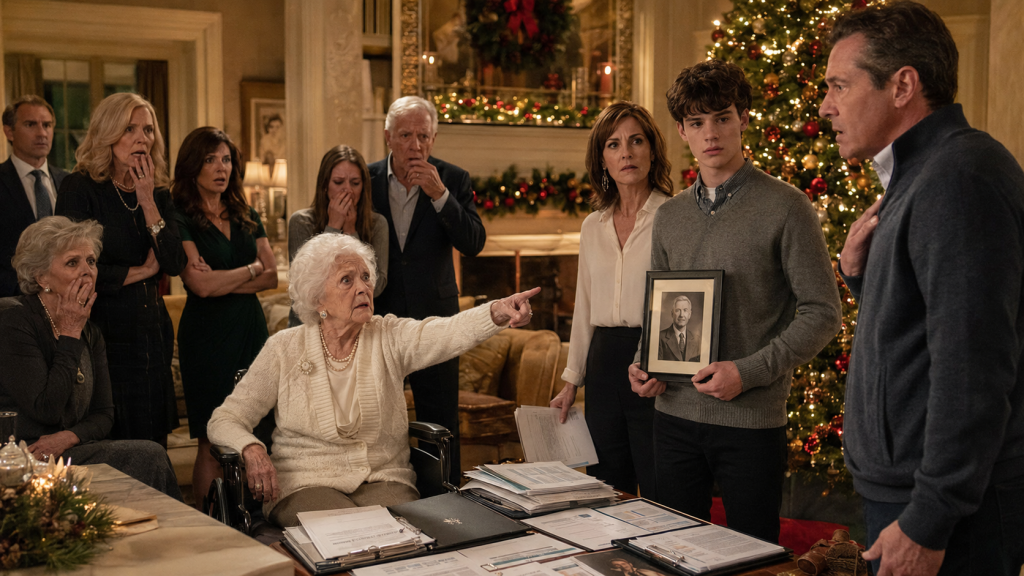
That was when my grandmother moved.
At first, I thought she was only shifting in her chair.
Then her hand tightened around the armrest.
Her eyes, cloudy for months, sharpened.
The entire room seemed to hold its breath as she pushed herself straighter.
My aunt whispered, “Mom?”
Grandma Evelyn lifted one trembling hand.
Her voice, when it came, was thin.
But it cut through the room sharper than any lawyer ever could.
“Your father would have called you a thief.”
Thirty-five people froze.
Uncle Martin’s face drained of color.
“Mom, you don’t understand.”
She pointed at the folders spread across the Christmas table.
“I understand numbers. I balanced your father’s books for forty years.”
My chest tightened.
For months, people had spoken around her as if she were already gone.
But the woman who had counted every dollar was still there.
Trapped in a body that had slowed down.
Not a mind that had surrendered.
Then she looked at me.
“Read the first withdrawal.”
My hands shook as I opened the court records.
“March 2002. Five thousand dollars. Check written to Martin Hale.”
Grandma closed her eyes.
“That was the month he told me he needed help with medical bills.”
I read the next.
“April 2002. Three thousand. June 2002. Seven thousand. Every month after that.”
My cousins stared at their father like they had never seen him before.
Uncle Martin’s children looked destroyed.
His youngest daughter, Rachel, whispered, “Dad?”
He did not look at her.
Then my son Caleb stood.
He walked to the fireplace mantel and picked up the framed photo of my grandfather.
Grandpa was smiling in the picture, wearing his old brown jacket, standing beside a tractor with one hand raised against the sun.
Caleb placed the frame beside the evidence.
“Great-Grandpa worked thirty years for this family,” he said. “You spent it on a beach house.”
Uncle Martin’s jaw tightened.
“I was executor. I had discretion.”
My lawyer stepped forward.
“No, sir. You had fiduciary duty. And as of this morning, the court has frozen your Florida property.”
My aunt Carol gasped.
“What?”
Denise continued calmly.
“The court is reviewing restitution, breach of fiduciary duty, misappropriation of trust assets, and potential fraud. The property may be subject to recovery.”
Uncle Martin stared at her.
“You can’t do that.”
“The court already did.”
Grandma began to cry.
Not loudly.
Just enough to break everyone’s heart.
“I trusted you with his legacy,” she whispered. “Now you will return it before I die.”
For the first time in my life, I saw my uncle truly speechless.
Not because he was sorry.
Because the room had turned against him.
That is different.
He looked around, searching for someone to defend him.
His wife would not meet his eyes.
His children looked devastated.
My cousins looked furious.
Even the younger grandchildren, the ones who did not fully understand trusts or court orders, understood that something sacred had been stolen.
Then Grandma spoke again.
“Martin.”
He looked at her slowly.
“You will not host Thanksgiving again.”
That sentence landed harder than the court order.
Because Thanksgiving at the Florida house had been his kingdom.
His stage.
His proof that he was generous.
His favorite lie.
My uncle’s face crumpled with rage.
“You’re all ungrateful. Every one of you enjoyed that house.”
“We thought it was yours,” my cousin Melissa said.
“It was mine.”
“No,” I said. “It was bought with stolen trust money.”
He pointed at me.
“You did this.”
I shook my head.
“No. I found it.”
That night ended with no dessert.
No Christmas songs.
No gift exchange.
People left in silence, clutching coats and children, whispering in driveways.
My grandmother asked to go home with me.
That shocked everyone.
Especially Uncle Martin.
“She lives with Carol,” he snapped.
Grandma looked at my aunt Carol, who had cared for her for years with exhausted devotion.
Then she looked at me.
“I want to see the ledger.”
So she came home with me for three days.
I placed Grandpa’s old ledger on my dining table.
She ran her fingers over the pages like they were a prayer book.
Each grandchild’s name.
Each planned distribution.
Each note in her small handwriting.
For Caleb: 10,000 at eighteen. Tools or tuition.
She tapped that line.
“He wrote that after Caleb was born,” she said softly.
I began crying.
“I’m sorry I didn’t check sooner.”
Grandma looked at me.
“You trusted family.”
“That feels stupid now.”
“No,” she said. “It feels expensive.”
That was Grandma.
Even half-broken by age and illness, she could still tell the truth cleanly.
The court case took months.
Uncle Martin hired an aggressive attorney.
He claimed he was entitled to executor fees.
Then he claimed Grandpa had verbally given him permission.
Then he claimed the withdrawals were loans.
Then gifts.
Then reimbursements.
Every version contradicted the last.
The judge did not seem impressed.
Denise presented twenty-two years of records.
The trust documents.
The distribution schedule.
The withdrawal history.
The property records showing the Florida home was purchased after the withdrawals began.
Bank statements showing trust funds used for renovations, hurricane repairs, new furniture, pool maintenance, and even a boat dock.
A boat dock.
From money meant for eighteen-year-olds starting their adult lives.
My cousins testified.
Not against each other.
Against the lie.
Melissa testified that her daughter was only twelve and would have been next in line after Caleb’s younger cousin.
David testified that he had been told the trust was “healthy” only two years earlier.
My aunt Carol testified that Uncle Martin had often told the family the Florida house was funded through “smart investing.”
Then Grandma testified by recorded deposition because travel was too hard on her.
She wore a blue sweater, her hair brushed carefully, her hands folded in her lap.
The lawyer asked, “Mrs. Hale, did your husband intend the trustee or executor to use the grandchildren’s trust for personal property?”
Grandma looked directly into the camera.
“My husband would have rather burned that house down than steal from his grandchildren.”
The room went silent.
Even Denise cried.
In the end, Uncle Martin was removed as executor.
A court-appointed trustee took over what remained of the trust records.
The Florida home stayed frozen pending sale.
Uncle Martin was ordered to pay restitution, though nobody expected full recovery.
Too much had been spent.
Too much had vanished into years.
But the house was listed.
The proceeds were ordered back into the trust as much as possible.
The boat was sold.
The furniture was sold.
The vacation home that had hosted our family Thanksgivings became evidence with palm trees.
When the first recovered funds arrived, Caleb finally received his ten thousand dollars.
He did not smile when the check came.
He held it quietly, then looked at Grandpa’s photo on our mantel.
“I wish it didn’t come like this,” he said.
“So do I.”
He used part of it for tuition.
Part for automotive tools.
And he put one thousand dollars into a small savings account labeled Door Money.
When I asked why, he said, “Great-Grandpa said it was a door. I want to keep part of it open.”
That nearly broke me.
Grandma lived long enough to see the Florida house sold.
The day Denise called with the news, I drove to Carol’s house with Caleb.
Grandma was in her chair by the window.
I told her, “It’s done.”
Her eyes filled.
“How much came back?”
“Enough for the younger grandchildren to get something. Not what Grandpa planned. But something.”
She closed her eyes.
“Good.”
Then she whispered, “He would be so mad.”
I laughed through tears.
“Yes. He would.”
“And proud of you.”
I had to look away.
For most of my life, I had been the family member who avoided conflict.
I paid my share.
Showed up.
Cooked.
Helped clean.
Kept quiet when older relatives said cruel things because peace seemed easier.
But sometimes peace is just a pretty word for silence around wrongdoing.
That Christmas taught me the difference.
Uncle Martin never apologized.
Not really.
He sent a letter through his attorney saying he regretted “the distress caused by confusion around trust administration.”
Grandma read it once and said, “Coward.”
Then she threw it into the trash.
After the court ruling, the family changed.
Of course it did.
Some people blamed me for exposing it at Christmas.
They said I should have handled it privately.
I asked them whether twenty-two years of theft had been private enough.
That usually ended the conversation.
Thanksgiving moved back to Ohio the next year.
Not in a beach house.
Not in a place bought with stolen money.
We held it in a rented community hall with folding tables, crockpots, mismatched chairs, and no ocean view.
It was the best Thanksgiving we had ever had.
Grandma sat at the head of the table.
Caleb sat beside her.
Before we ate, she asked him to stand.
He looked embarrassed but obeyed.
Grandma lifted her glass of apple cider.
“To the grandchildren,” she said. “All of them. Living, grown, young, and not yet born. Your grandfather loved you before some of you existed. Don’t let anyone tell you legacy belongs to the loudest man in the room.”
Nobody spoke for a moment.
Then everyone raised their glasses.
Even the children.
Uncle Martin was not invited.
Some wounds need distance before they can even begin to heal.
Maybe one day his children will forgive him.
Maybe they will not.
That is their road.
Mine was simply to protect what was left.
The trust my grandfather created in 1985 will never be what he intended.
Twenty-two years cannot be undone.
But the lie ended.
The house sold.
The records came into the light.
And my grandmother, silent for months, found her voice when it mattered most.
People remember the moment she stood from her wheelchair, though technically she did not stand fully.
Her body could not.
But her spirit did.
Her truth did.
Her love for Grandpa did.
And when she said, “Your father would have called you a thief,” she did more than accuse her son.
She restored the family’s memory.
Grandpa had not failed us.
The trust had not simply disappeared.
The market had not swallowed our inheritance.
A man had stolen it.
And finally, in front of thirty-five family members at Christmas, we stopped protecting him with polite silence.
My son got his ten thousand dollars.
The younger grandchildren got something too.
But what we recovered that Christmas was worth more than money.
We recovered the truth.
And in families like mine, truth is often the one inheritance nobody expects to survive.
THE END! THANKS FOR READING!