My mother died at eighty-nine. Three weeks later, while renovating her bedroom, I found a letter behind the wallpaper. Sealed. Addressed to me. Dated forty-one years ago. At first, I thought it was an old bill or some forgotten note from a contractor. The wallpaper had been peeling near the corner behind her dresser, and I was scraping it away slowly, trying not to think about the fact that the room still smelled like her lavender lotion.
My mother, Ruth, had lived in that room for thirty-six years. She had folded laundry on that bed. Prayed beside that window. Hidden Christmas gifts in the closet. Held my hand there when my first marriage ended. I thought I knew every inch of that room.
Then the putty knife caught on something flat.
I peeled back a brittle strip of wallpaper and found a cream envelope taped directly to the wall.
My name was written across the front.
Eleanor.
Not Ellie.
Not sweetheart.
Eleanor.
The name my mother only used when something mattered.
My hands began to tremble before I even opened it.
The paper inside was thin and yellowed.
The ink had faded, but her handwriting was unmistakable.
If you’re reading this, I’m gone.
I sat down hard on the floor.
The room seemed to tilt around me.
I kept reading.
When you were six weeks old, a woman came to our door. It was raining. She was crying so hard she could barely speak. She begged me to take you. Your father was dangerous. She said if he found you, he would use you to punish her forever.
My breath caught in my chest.
No.
That was the first thought.
Just no.
My mother was my mother.
Ruth Collins was the woman who packed my lunches, braided my hair, and sat in the front row at every school concert even when I only played triangle.
She was the woman who taught me how to make biscuits and how to stand up straight when life tried to bend me.
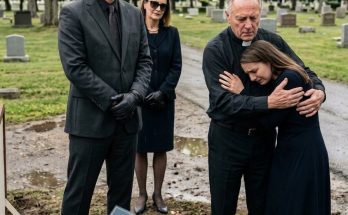
She was the woman I had buried under a maple tree three weeks earlier.
The letter shook in my hands.
I wanted to stop reading.
I could not.
I did what she asked. I took you in. Your papers were arranged through people who owed me favors from my nursing years. I told the world you were a late blessing. I told you the same because I believed safety mattered more than truth.
Tears blurred the words.
Then came the line that made my heart stop.
She visits every birthday. Sits in a car across the street. She never misses one.
My birthday had been three days ago.
I stood so quickly my knees almost buckled.
I ran to the hallway, grabbed my phone, and opened the Ring camera app with shaking fingers.
The footage from my birthday loaded slowly.
Too slowly.
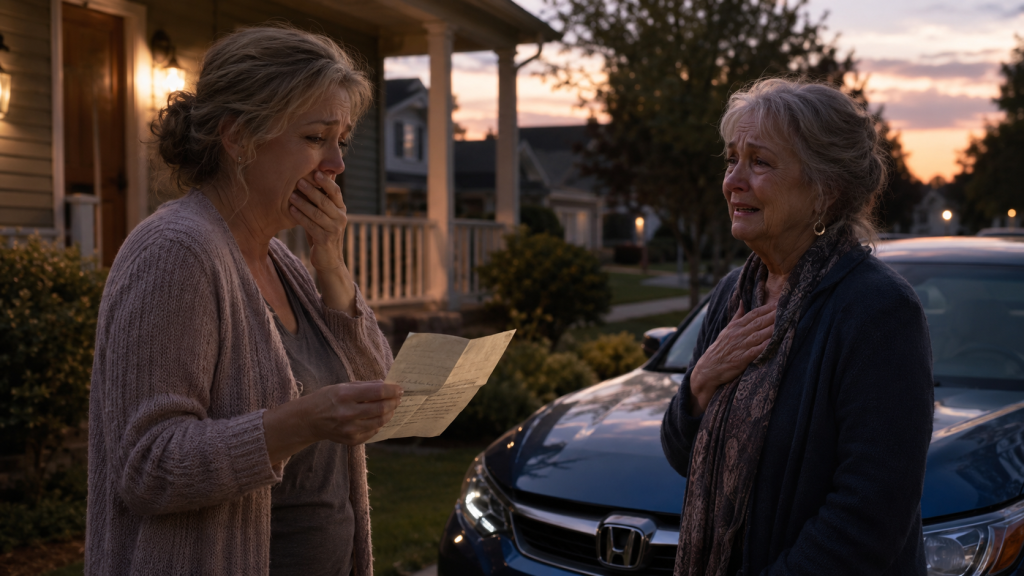
There it was.
A blue Honda.
Parked across the street.
Two hours.
The driver never got out.
I zoomed in until the image blurred.
A woman sat behind the wheel.
Gray hair.
Both hands on the steering wheel.
Face turned toward my house.
I checked the year before.
Same car.
Same date.
Same place.
Two years before.
Same car.
Five years before.
Same car.
Every birthday the app still stored.
Every year.
Always watching.
Always leaving before dark.
My stomach turned as I remembered last year’s strange gift.
A small box left on the porch.
Inside was a gold bracelet worth far more than something a neighbor would leave.
No card.
No note.
Just a bracelet with a tiny engraved heart.
I had thought it was a mistake.
Now I knew it was not.
I went back to the letter.
Ruth had written more.
Her name is Clara Whitmore. She is your birth mother. I made her promise not to come close while your father was alive. I made her promise because I was afraid. Maybe I was right. Maybe I was cruel. Maybe both. Forgive me for the lie, if you can. But know this: I loved you as mine from the first night I held you.
I pressed the letter to my chest and sobbed.
Not because I suddenly loved Ruth less.
Because I loved her the same, and that made the truth more complicated.
She had saved me.
She had lied to me.
She had protected me.
She had stolen my right to know.
All of it lived together in one sealed envelope behind wallpaper.
Then I heard a car outside.
A low engine.
I froze.
Slowly, I walked to the front window and pulled back the curtain.
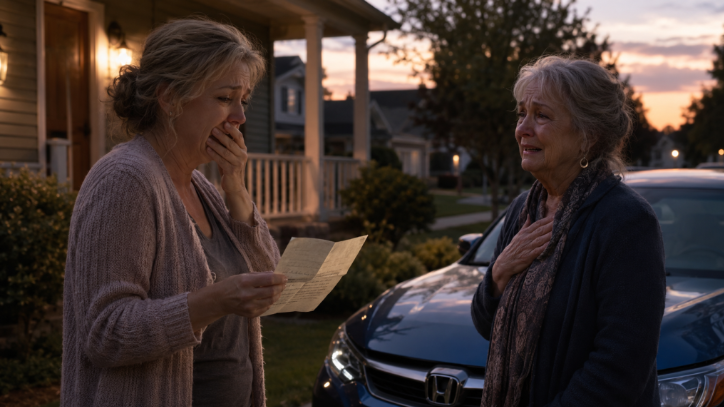
The blue Honda was there.
Parked across the street.
The same car.
My hands went cold.
I opened the front door and stepped outside.
The air smelled like rain.
The woman in the Honda looked up.
For a long moment, neither of us moved.
Then she opened her door.
She was older than I expected, maybe in her early seventies, thin and elegant, wearing a pale blue coat and holding a small velvet box in both hands.
She stared at me like I was something sacred.
I walked down the path, my legs unsteady.
“Are you Clara?” I asked.
Her eyes filled instantly.
She pressed one trembling hand to her chest.
“I’m your mother,” she whispered.
My knees nearly gave out on the sidewalk.
For fifty-one years, I had believed my mother was the woman I buried three weeks ago.
Now this stranger with my eyes stood before me, looking at me like a miracle she had been punished for loving.
“No,” I said, though my voice broke. “My mother just died.”
Tears slid down Clara’s face.
“I know. Ruth saved you. I have thanked her every year from this car.”
The words landed softly and violently at the same time.
I looked at her face.
The shape of her mouth.
The curve of her cheek.
The eyes.
My eyes.
“Why didn’t you come back?” I asked.
Clara looked toward my house.
“Because your father spent thirty years searching for both of us.”
My breath stopped.
“Who was he?”
“Victor Hale,” she said.
The name meant nothing to me.
But it had clearly haunted her.
“I was twenty-two when I had you. Victor was charming at first. Then controlling. Then dangerous. By the time you were born, I knew if I stayed, he would destroy both of us.”
She opened the velvet box.
Inside was a tiny hospital bracelet.
The plastic was yellow with age.
A name was printed across it.
Eleanor Grace Whitmore.
My birth name.
I touched the bracelet with one finger.
I felt as if I were touching a ghost version of myself.
“Ruth was your nurse?” I whispered.
Clara nodded.
“She saw the bruises. She saw how afraid I was. She hid me for one night in her cousin’s basement. Then she told me she could keep you safe.”
Her voice broke.
“I handed you to her at the back door while it rained. You were wrapped in a white blanket. You had hiccups.”
I covered my mouth.
“I don’t remember anything.”
“I do,” she said. “Every second.”
“Why birthdays?”
“Because Ruth allowed that much. She said if I came near you, Victor might find out. But she let me sit across the street once a year. She would leave the porch light on. That was our signal that you were safe.”
My heart twisted.
The porch light.
Every birthday of my childhood, my mother always insisted on turning on the porch light before cake.
Even when it was still daylight.
I had thought it was one of her habits.
It had been a message.
To Clara.
To my first mother.
“You never missed one?” I asked.
“Never.”
“Even when I was grown?”
“Especially then.”
I looked back at the house.
The house Ruth left me.
The house Clara had watched from a distance.
The house that held both love and lies.
“She told me your father died,” I said. “Is he dead?”
Clara nodded slowly.
“Last month.”
“Last month?”
“He had been in prison for years, then in a care facility. I hired someone to watch the records. When I learned he died, I planned to come to you before your birthday.”
“Why didn’t you?”
Her face crumpled.
“I saw the funeral flowers. I knew Ruth was gone. I lost my courage.”
For a moment, I could not speak.
Then my phone buzzed in my pocket.
A Ring alert.
Motion detected at the front door.
I turned toward the house.
A man I had never seen stood on my porch.
He was around sixty, tall, gray-haired, wearing a dark coat.
In one hand, he held another sealed letter.
My body went cold.
Clara grabbed my arm.
“Do you know him?”
“No.”
The man lifted the envelope toward the camera as if he knew I was watching.
Then he looked directly across the street at us.
Clara whispered, “Oh God.”
“What?”
“That’s Daniel Hale.”
“Who is Daniel Hale?”
Her voice shook.
“Your father’s son.”
My breath vanished.
The man on my porch was my half-brother.
And he had found me.
For one terrifying second, I thought the danger Ruth had spent my whole life hiding me from had not died with Victor after all.
Then Daniel slowly placed the letter on the porch floor, stepped back, and raised both hands where I could see them.
Not threatening.
Careful.
Almost pleading.
Clara and I crossed the street together.
Every step felt like walking through two lives at once.
At the foot of the porch, Daniel spoke first.
“I’m not here to hurt you.”
I said nothing.
He looked at Clara.
“I found Dad’s files after he died.”
Clara flinched at the word Dad.
Daniel noticed and lowered his eyes.
“I know what he was. I’m not here to defend him.”
He looked at me then.
“You’re Eleanor.”
The name sounded strange from his mouth.
“I go by Ellie.”
He nodded.
“I’m Daniel. I’m sorry to come like this. I didn’t want to scare you, but I saw the obituary for Ruth Collins and realized you might finally learn the truth.”
I stared at the envelope.
“What is that?”
“A letter from Ruth to my mother.”
My heart stuttered.
“Your mother?”
“Victor was married when Clara had you,” he said quietly.
Clara closed her eyes.
I looked at her.
“You knew?”
“I found out too late,” she whispered.
Daniel continued.
“My mother, Helen, knew about you. She knew about Clara. She tried to help once, but Victor controlled everything. After he was arrested, Ruth wrote to her. She told her you were safe, but asked her never to contact you unless Victor’s people came looking.”
He held out the letter.
“My mother kept this until she died.”
I did not take it at first.
Then I did.
The envelope was addressed in Ruth’s handwriting.
Helen,
If anything happens to me before Eleanor knows the truth, please make sure she understands she was loved by two mothers, not abandoned by one.
I read that line three times.
Loved by two mothers.
Not abandoned by one.
My throat closed.
Daniel stepped back.
“I also found something else. Records. Victor kept private investigators on Clara for years. Ruth was right to hide you.”
Clara began crying silently.
I looked at her.
For fifty-one years, she had been the villain in the empty space of my life.
The woman who gave me away.
Now I saw the truth.
She had been a terrified young mother who loved me enough to survive losing me.
I turned to Daniel.
“Why bring this to me?”
He swallowed.
“Because I grew up in his house. I know what he did to people. When I saw your name in those files, I realized you were the one person who got out before he could ruin you.”
He looked toward Clara.
“And she paid for that escape every year.”
The three of us stood on the porch in the cold air, surrounded by dead leaves and old secrets.
Inside the house, Ruth’s bedroom was half-stripped of wallpaper.
Her letter lay on the floor where I had dropped it.
The past was no longer hidden behind walls.
I invited them both inside.
Not because I trusted them completely.
Because truth had already entered my house.
We sat at the kitchen table.
The same table where Ruth taught me to roll pie crust.
Clara held the velvet box in both hands.
Daniel placed a folder between us.
There were records.
Photos.
Copies of old investigation reports.
A younger Clara holding me as a newborn.
Ruth in a nurse’s uniform.
Victor Hale in a suit, handsome in a way that made my skin crawl after hearing his name.
And one photo that broke me.
Ruth standing on my porch on my first birthday, holding me on her hip.
Across the street, barely visible inside a parked car, was Clara.
Watching.
Always watching.
I began to cry.
Clara reached for my hand, then stopped herself.
That broke me more.
She still thought she needed permission to love me.
So I placed my hand over hers.
She sobbed once.
Then covered her mouth.
“I don’t want to replace Ruth,” she said quickly. “I never could. She raised you. She was your mother.”
“Yes,” I whispered.
“I only wanted you to know I didn’t leave because I didn’t want you.”
I looked at her through tears.
“I know that now.”
She bent over our joined hands and cried like the twenty-two-year-old girl she had once been.
The one standing in the rain with a baby she could not keep.
Daniel stayed for an hour.
Before he left, he gave me his number.
“You don’t have to call,” he said. “But if you ever want the full file, I’ll bring it.”
I nodded.
At the door, he paused.
“Victor died angry,” he said. “But he died without finding you. I thought you should know that.”
After he left, Clara and I remained in the kitchen.
The light outside faded.
For the first time in fifty-one years, my birth mother and I sat across from each other without a windshield between us.
“What happens now?” she asked.
I looked toward Ruth’s room.
“I don’t know.”
She nodded.
“I can wait.”
I almost laughed through tears.
“You already have.”
The next weeks were not simple.
People like to imagine reunions as one embrace and a happy ending.
Real reunions are messier.
They are grief, questions, anger, guilt, tenderness, and paperwork.
They are realizing your birthday meant something different to everyone involved.
To me, it had been cake.
To Ruth, proof I was safe.
To Clara, permission to see the child she could not hold.
I finished renovating Ruth’s bedroom slowly.
I did not remove the wall where the letter had been hidden.
Instead, I framed that small torn piece of wallpaper with the tape mark still visible.
Beneath it, I placed Ruth’s letter and Clara’s hospital bracelet.
One month later, Clara came for dinner.
She brought a pie.
It was terrible.
The crust was burned and the filling too sour.
We laughed until we cried.
Ruth had been a wonderful baker.
Clara was not.
That helped, somehow.
It reminded me they were different women.
Both real.
Both mine.
On my next birthday, I did not let Clara sit in the car.
I opened the front door before she could park.
She stood beside the blue Honda, holding a small wrapped gift.
I walked down the path and said, “Come inside.”
She froze.
“Are you sure?”
I nodded.
“The porch light is on.”
Her face crumpled.
Then she came up the walkway.
Inside, I had set three places at the table.
One for me.
One for Clara.
And one empty place with Ruth’s photograph beside a candle.
Clara touched the chair gently.
“She saved us both,” she whispered.
“Yes,” I said. “But she lied too.”
Clara nodded.
“Yes. She did.”
That honesty mattered.
I did not need Ruth to be perfect.
I needed her to be whole.
A woman who loved me.
A woman who hid the truth.
A woman who made a choice in fear and carried it to her grave.
A woman who left me the key when she was gone.
The bracelet from Clara’s velvet box sits in my jewelry drawer now.
Last year’s gold bracelet sits beside it.
Sometimes I wear them together.
One from the mother who gave me life.
One from the mother who watched it from across the street.
I still miss Ruth every day.
Some mornings, I reach for the phone to call her before remembering she will not answer.
Some nights, I wonder what my life would have been if Clara had raised me.
Then I stop.
Because that question has no mercy.
The life I had was the life Ruth protected.
The life I lost was the life Clara mourned.
Both are true.
Daniel and I speak occasionally.
He sent me the full file.
I read it once, then locked it away.
I did not need to live inside Victor Hale’s shadow any longer.
He had taken enough from all of us.
Clara still drives the blue Honda.
I told her she should get something newer.
She smiled and said, “This one knows the way.”
Now, once a week, it parks in my driveway instead of across the street.
And every time I see it there, I feel something inside me shift.
Not healed completely.
Not erased.
But softer.
My mother died at eighty-nine.
Behind her wallpaper, she left me a letter that shattered the story of my life.
But it also gave me back another piece of myself.
I was not abandoned.
I was hidden.
I was not unwanted.
I was protected.
I was not the child of one mother’s love.
I was the child of two women’s impossible choices.
One carried me to a door in the rain.
One opened it.
One watched from across the street every birthday.
One turned on the porch light.
And after fifty-one years, when the blue Honda finally stopped being a secret, I learned that love does not always look like staying.
Sometimes love looks like leaving your baby with someone who can save her.
Sometimes love looks like raising a child born from another woman’s terror.
Sometimes love looks like a sealed letter behind wallpaper, waiting until the danger is gone.
And sometimes, love looks like opening the front door, turning on the porch light, and finally saying:
Come inside.